How to Find Off Market Businesses for Sale: A Playbook
How to Find Off Market Businesses for Sale: A Playbook

McKinsey estimated that approximately six million U.S. small and medium-sized businesses could exit ownership by 2035 as owners retire, compared with about 4.5 million during the preceding decade. In 2022 alone, that analysis estimated 510,000 SMBs exited. 92% closed, only 5% were completed as sales, and 3% transferred to new owners, often within families.
Most viable companies never hit a marketplace. Owners don't have a plan, don't know how to sell, or want privacy and continuity. If you're working out how to find off market businesses for sale, run it as a measured outbound funnel, not a pile of coffee chats. A list of names isn't the edge. A credible closing path is what gets an owner to answer.
Table of Contents
- Where Off-Market Owners Actually Hide
- Build an Owner List You Can Actually Work
- Closing the Financing Gap Without Looking Unserious
- Outreach Messages That Earn a Reply
- Building Adviser and Broker Relationships Around Succession
- Qualifying Owners Before You Spend on Diligence
- Your First 30 Days of Off-Market Sourcing
Where Off-Market Owners Actually Hide
The owners worth meeting aren't in a secret file. They're still running the company, and the people closest to their decisions already know the timeline. Spend the first month where those people sit.
| Channel | Best For | Effort | Lead Quality |
|---|---|---|---|
| Intermediary and broker referrals | Owners already preparing to sell | Medium | High |
| Accountant and attorney networks | Owners planning succession | High | High |
| Supplier and customer referrals | Owners with operational ties to the buyer | Medium | High |
| Trade associations and member directories | Owners in a defined niche | Low | Medium |
| State registry and licensing records | Long-tail local owners | Low | Low until verified |
| Direct mail and cold email | Broad reach and volume | Medium | Low to medium |
| Peer and mastermind networks | Shared deal flow among buyers | Low | Medium among members who close |
Broker referrals are high quality and often late, because the owner is already preparing to sell. Accountant and attorney networks take more effort and reach succession earlier, so that's where I'd put the first month. Supplier referrals work when you already sit in the trade. Directories and licence files are cheap volume. Mail and email buy reach. Peer groups only pay off when members close.
Say you want regional commercial HVAC firms. Pull state contractor licences, cross-check them against the association roster, then ask two local CPAs which owners are in their sixties and starting to talk about stepping back. Two or three channels become one list.
A 2025 U.S. Bank survey of 1,000 small-business owners, companies with annual revenue up to $25 million and two to 99 employees, found that more than half of owners were over age 55, while only 54% had created a succession plan. The same survey reported that 62% found succession overwhelming. Many of those owners may sell later. They haven't called a broker.
Tag every lead with its source. After 30 days, the tag shows which channel produced conversations, not just names.
Test two channels for 30 days, not all seven.
Build an Owner List You Can Actually Work
A list you can't work is a hobby. Build one you can finish.
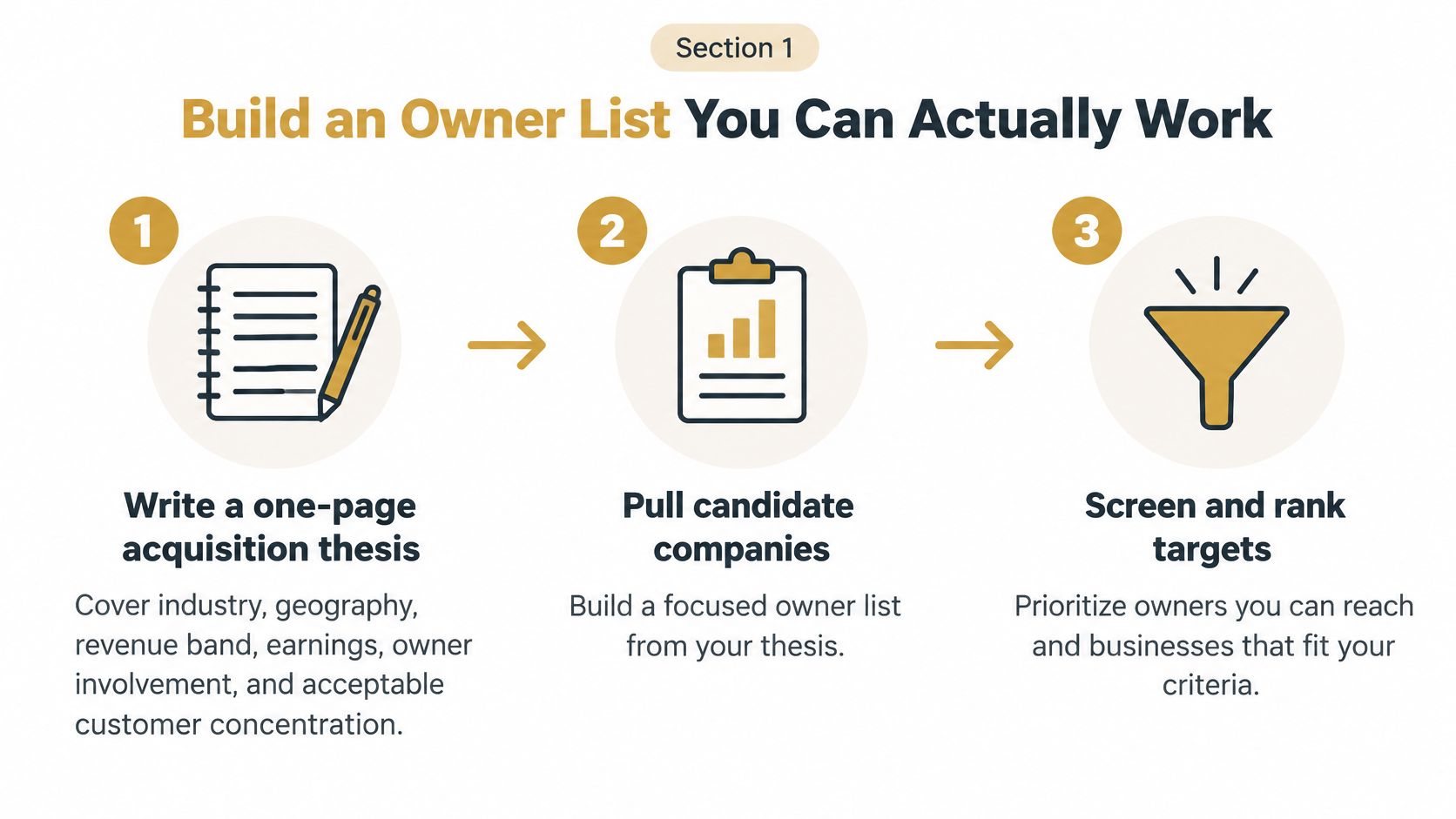
- Write a one-page acquisition thesis covering industry, geography, revenue band, earnings, owner involvement, and the customer concentration you'll accept. Without that page, every registry download looks equally interesting.
- Pull candidates from state business registries, licensing boards, and association directories. Buying a contact file with stale ownership is the usual waste. You mail the person who sold three years ago.
- Record a source and a verified owner name on every row. If you can't name the owner, you don't have a lead yet.
- Remove firms that fail hard filters, such as active litigation, shrinking revenue, or one customer above your limit. A broad list means nobody gets a real follow-up.
- Tag each remaining owner by likely motivation: retirement, partner conflict, capital constraints, or limited growth capacity. The tag decides the tone of the first note.
- Rank the list and set a weekly contact quota. Review it monthly and move firms in or out as ownership signals change.
These starter filters are examples. A first-time buyer with a small equity cheque screens differently from a roll-up operator.
| Criterion | Starter Filter | Why It Matters |
|---|---|---|
| Annual revenue | $1M to $10M | Large enough to support a salary, small enough to acquire with a modest equity cheque |
| Years operating | 7 or more | Shows the business has survived early volatility and has repeatable demand |
| Owner hours per week | 30 or fewer | Signals the company can run without the owner in every decision |
| Largest customer share | 25% or less | Limits the damage if one account leaves after the sale |
| Seller discretionary earnings | $200,000 or more | Sets a floor for debt service and a buyer salary |
| Distance from buyer | Within 2 hours | Makes hands-on handover and site visits practical |
Treat the sheet as a working document. Ownership signals change, and a firm that failed a filter in March can belong on the list in June.
Closing the Financing Gap Without Looking Unserious
Financing decides whether an owner replies, not just whether you close. Small Business Trends reported a sharp mismatch: 90% of surveyed buyers expected seller financing to play some role, while only 29% of owners planned to provide it. A 2025 market update in that same piece put seller financing at roughly 10–15% of typical small-business deal structures, and advisers increasingly treated it as important to closing.
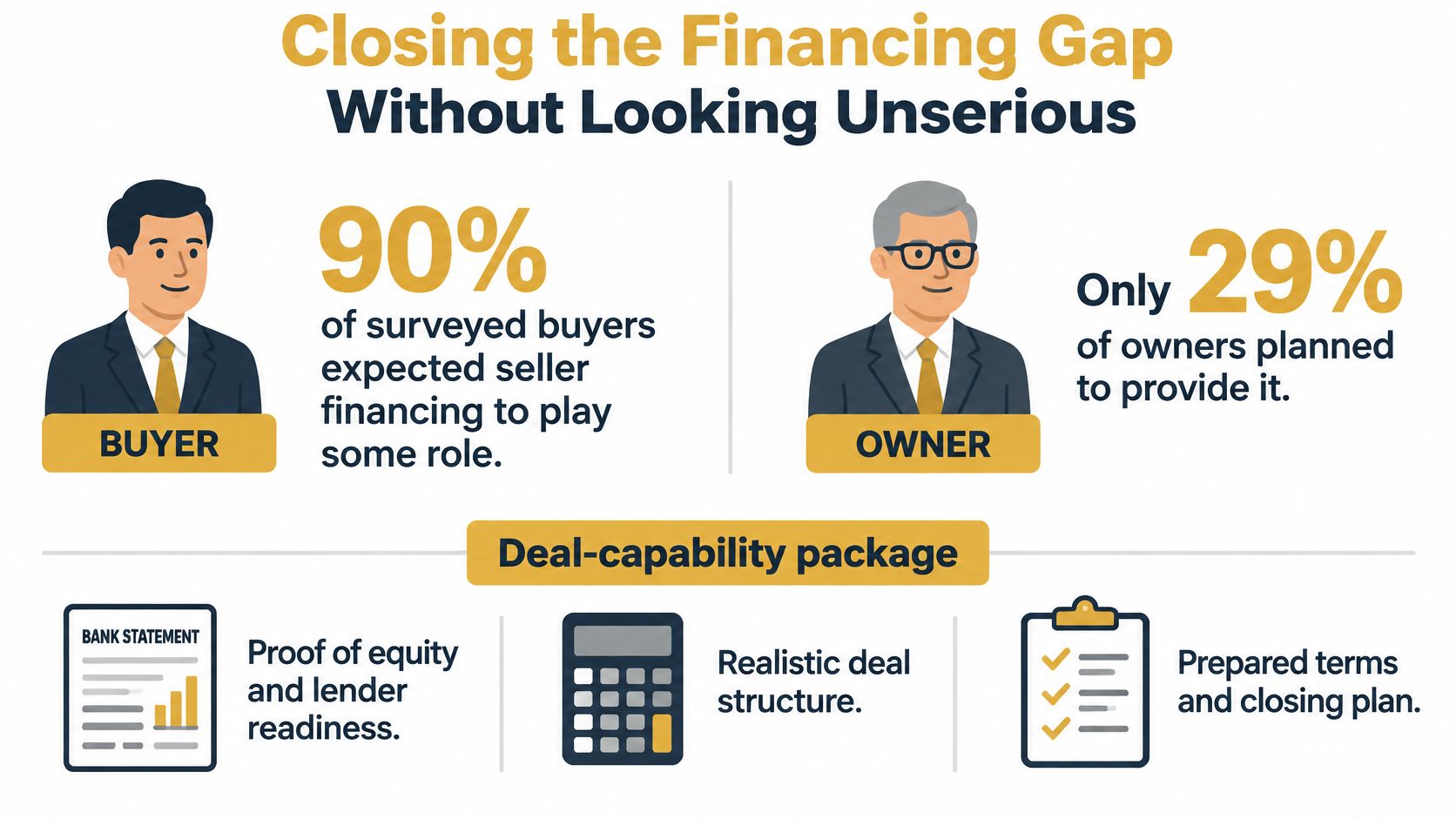
Build a deal-capability package before you write anyone. Include proof of liquidity, a lender or capital-partner conversation, a written transition plan, and two or three structures. Partial notes, earnouts, staged purchases, and minority-to-majority buyouts belong in that folder. Don't ask the seller to finance the deal by default.
The short video below walks through how buyers frame that package without sounding like they're shopping for a loan from the owner.
| Structure | Helps When | Risk When |
|---|---|---|
| Partial seller note | Cash flow comfortably covers payments and the seller stays involved | The business cannot service the debt |
| Earnout | The owner's forecast is credible and the seller wants upside | Earnout targets are vague or control is unclear |
| Staged purchase | The buyer proves performance before taking full control | Milestones are not written down or secured |
| Minority-to-majority buyout | The owner wants a gradual exit and continuity | Valuation and governance rights are left undefined |
Creative terms reduce risk when cash flow covers the payments, milestones are written, and security is real. They conceal weak economics when the business can't service the debt. Seller paper also changes valuation, taxes, control, and the seller's reason to help after close. Read understanding seller financing options before you promise a note you can't document. Sounding serious means showing a closing path, not apologizing for a thin cheque.
Outreach Messages That Earn a Reply
Keep the first note under a short read. Name the company, say why it caught your attention, ask whether succession or liquidity planning is relevant, offer confidentiality, and leave price and broker language out.
Owner letter. I came across [Company] while mapping established [trade] firms in [city]. The tenure and the local customer base are what stood out. If retirement or continuity is on your mind in the next few years, I'd welcome a confidential conversation with no obligation and no brochure. If the timing is wrong, a one-line reply is enough, and I won't follow up past that.
Follow-up email. I'm writing once more about [Company], still with no ask beyond a private conversation. I can share a short buyer profile and keep anything you send confidential. There's no obligation to sell, and I won't discuss price until you want to. If succession or liquidity isn't relevant, tell me and I'll close the file.
Phone opener. This is [Name]. I'm a buyer looking at established [trade] companies in [region], and [Company] fits that focus. I'm not a broker and I'm not quoting a price. Is succession or a future liquidity plan something you're thinking about, or should I leave it there?
A sequence with a stop rule
Use at least two channels across two to three weeks. Stop after three unanswered attempts. Before a cold email wave, warm up new inboxes so the first thousand sends don't land in spam. Follow privacy and commercial-messaging laws in every market you contact.
One outreach dataset covering 288,294 owner emails, published by Deal Source Systems, reported approximately 6 human replies and 1.2 owners open to an acquisition conversation per 1,000 emails. A buyer seeking 10 genuine conversations may need roughly 8,300 targeted contacts before list quality, channel mix, and follow-up. Treat that as a planning benchmark, not a promise. Track deliverability, replies, qualified conversations, NDAs, indications, and signed LOIs separately. Chasing replies from poorly matched owners produces noise.
A lender guide on SBA loans to buy a business states that many SBA-funded acquisitions require the buyer to contribute at least 10% of total project cost in cash or a combination of cash and qualifying seller financing. Don't contact owners without that proof in hand.
Say a buyer cuts a 4,000-firm pull to 1,200 that match the thesis. Fewer emails, more conversations. That's the funnel working.
Building Adviser and Broker Relationships Around Succession
Accountants, estate attorneys, and wealth managers often hear the retirement conversation before anyone calls a broker. That's the warmest channel if you show up as a prepared buyer with a continuity plan, not a price.
- Introduce yourself with range and focus. Give a proof-of-funds range and the sectors you'll buy.
- Offer clear referral terms. Confidentiality and a response window make it easy to send a name.
- Send a one-page summary. State what you buy, what you won't, and how you handle staff.
- Report back every time. A short note after each referral, even when it goes nowhere, keeps you on the list.
Brokers still matter when the owner wants a managed process or you lack a direct path. A listing, though, invites competing bids and gives away the quiet advantage. Read eight rules for dealing with brokers before you treat every introduction as exclusive. Younger buyers are also lining up for retiring owners, so adviser relationships get more crowded, not less.
Ask advisers for introductions, not deals. You earn the next name by how you handle the last one.
Qualifying Owners Before You Spend on Diligence
Headline earnings are a story until the documents agree. Don't price a business off the number in the first email.
| Stage | What You Verify | Go Signal | Stop Signal |
|---|---|---|---|
| Fit call | Seller motivation and timing | Clear timeline and openness to discuss terms | Price-only focus with no flexibility |
| Profile under NDA | Ownership, revenue mix and key staff | Figures stay consistent across documents | Figures change between conversations |
| Earnings normalization | Owner add-backs and one-time costs | Adjusted figures reconcile to bank statements | Add-backs cannot be documented |
| Non-binding indication | Cash flow, transferability and financing path | Lender or capital partner confirms feasibility | Change-of-control clause blocks the deal |
Start with a fit call. The three questions you must ask every seller keep that call on motivation, timing, and what a good exit looks like. Then take a high-level financial and ownership profile under confidentiality, normalize earnings, and test the timetable. Issue a non-binding indication only after cash flow, transferability, and financing feasibility check out.
What to reconcile before you spend
Before significant diligence cost, reconcile tax returns, bank statements, accounting records, payroll, customer concentration, working capital, litigation, licences, and key-person dependency. A valuation guide for owners planning a sale is a useful shared reference when you and the seller are talking past each other on what the earnings are.
Say the owner claims a large set of add-backs. Payroll shows a family salary that won't leave with the seller, and the bank statements don't support the one-time costs. The adjusted figure shrinks below what debt service needs. That's a stop, not a negotiation tactic.
- No proof of funds. You look unserious before the first meeting.
- Sensitive data too early. Trust drops and the owner goes quiet.
- Headline EBITDA. Undocumented add-backs aren't cash.
- Change-of-control clauses. A landlord or franchisor can block the transfer.
- An aggressive offer first. You haven't learned the structure the seller wants.
Attrition, financing conditions, diligence findings, and seller withdrawal mean you need several qualified conversations for each completed acquisition. Keep a pipeline reserve. One friendly owner is not a deal.
Your First 30 Days of Off-Market Sourcing
Use the two channels you picked, not all seven.
- Week one. Write the acquisition thesis and pull the first 150 candidate firms from registries, licences, or directories.
- Week two. Verify owner names, apply the screening filters, and tag likely motivations.
- Week three. Send the first outreach wave and ask two accountants or attorneys for introductions.
- Week four. Review replies, qualified conversations, and adviser referrals, then drop the weakest channel.
Keep, cut, or double down based on qualified conversations, not reply counts. A polite "not now" from the wrong owner doesn't earn that channel another month. Buyers who want structured sourcing playbooks, outreach templates, and mentor feedback on screening and offers can use Dealmaker Wealth Society training modules and its peer community to review active deals alongside other buyers.
The decision in front of you is simple. Start outreach this month, or finish the financing package first so the first owner who answers meets someone who can close.
Dealmaker Wealth Society teaches acquisition entrepreneurs how to source private companies, structure offers, and raise capital through on-demand modules, live coaching, and a peer community. If you want playbooks for direct owner outreach, adviser referrals, and creative financing on your first search, start with the resources at Dealmaker Wealth Society. Bring your thesis and your first 150 names, and use the community to pressure-test the list before you spend a month on the wrong channel.

From the Dealmaker Blog












A Creative Business Buying Fable