
Small Business M&A Guide to Buying and Scaling
Small Business M&A Guide to Buying and Scaling
You've found a business that looks profitable, the seller seems ready, and the broker is asking whether you can send an offer. Then the practical questions arrive. How do you know the cash flow is real? How much money must you bring to closing? What happens to the employees, customers, and systems after ownership changes?
That uncertainty is normal. Small business M&A isn't Wall Street theater reserved for large corporations. It's the disciplined process of buying an operating company, verifying what you're buying, financing the purchase, and improving the business without damaging the engine that already works.
The biggest mindset shift is simple. Starting a restaurant means finding a location, hiring a team, building a reputation, and hoping customers arrive. Buying a running restaurant means evaluating its recipes, staff, supplier relationships, customer demand, and financial records before deciding whether the price makes sense. Acquisition reduces the need to create every business system from nothing, but it replaces startup uncertainty with diligence and integration risk.
The lifecycle is repeatable: define your target, source opportunities, screen the economics, submit a Letter of Intent, complete diligence, arrange financing, close, stabilize operations, and then decide whether to grow organically or acquire complementary companies. Many first-time buyers focus almost entirely on finding a deal. In practice, post-LOI friction often becomes the main bottleneck. Slow document delivery, unclear financing, owner dependency, and weak transition planning can derail an attractive opportunity after both sides have invested substantial effort.
This guide follows the full journey, from the basic components of a transaction to roll-ups and bolt-ons. You don't need to master every term before you begin. You need a clear sequence, realistic assumptions, and enough operating discipline to protect the business after the purchase.
Table of Contents
- Introduction to Small Business M&A Without the Overwhelm
- How Small Business M&A Really Works
- Finding Deals and Valuing Them Correctly
- Financing Your Acquisition and Structuring Creative Deals
- Navigating LOIs Due Diligence and Closing
- Integration and Scaling Through Roll Ups and Bolt Ons
- Your First Acquisition Pathway and Next Steps
Introduction to Small Business M&A Without the Overwhelm
You have savings, corporate experience, or a smaller company of your own. You want to buy something with customers and cash flow already in place. Then the listings introduce SDE, EBITDA, seller financing, earnouts, and working capital adjustments. A practical question, “Can this business support my ownership?” starts to sound like a legal and financial exam.
Begin with the exchange itself. The seller transfers an operating business with assets, customers, employees, processes, and financial history. You provide an agreed mix of cash, financing, and contractual commitments. Ownership is only the starting point. Your responsibility is to protect the parts of the system that work while fixing weaknesses that restrict growth.
Buying a company is like buying a rented house with tenants, maintenance records, and rental history instead of purchasing an empty lot. The existing income can support the purchase, but the structure still needs inspection. A profitable past does not automatically make the business easy to own.
The lifecycle in plain language
A practical acquisition follows a repeatable sequence:
- Define the target: Select a sector, geography, size, profitability profile, and ownership role that match your skills and resources.
- Find opportunities: Review broker listings, build intermediary relationships, and contact owners directly.
- Screen quickly: Set aside companies with weak cash-flow quality, heavy owner dependency, or risks you cannot finance.
- Make an offer: Use an LOI to state the price, structure, exclusivity, contingencies, and timing.
- Verify the story: Examine financial, legal, customer, employee, operational, and technology information.
- Close and transition: Transfer ownership, fund the purchase, retain key people, and reassure customers.
- Scale deliberately: Improve the original company before adding bolt-ons or building a broader roll-up.
A key early distinction is buying a job versus buying a business. If the seller personally controls every customer relationship, approval, and operating decision, the purchase may transfer a workload rather than an independent system. A stronger target has transferable relationships, understandable processes, and enough cash flow to support debt service and your compensation.
Practical rule: Judge an acquisition by whether the business keeps working after the seller leaves, not by how exciting ownership feels.
The market supports repeatable strategies while remaining accessible to individual buyers and small investment groups. In the United States, BizBuySell reported 9,546 closed small-business transactions in 2024, up 5% year over year, with total enterprise value of $7.59 billion, up 15% from 2023. The same reporting showed a $345,000 median sale price, a 3% increase, and an average cash-flow multiple rising from 2.49 to 2.57. The figures appear in the Office for National Statistics M&A bulletin, which reproduces the relevant market reporting.
Those figures make the opportunity concrete. Individual transactions are generally modest beside public-company acquisitions, yet the market includes thousands of owners, buyers, lenders, and advisors. Finding a deal matters, but sourcing is only one stage. After an LOI, missing documents, uncertain financing, seller dependence, and weak transition planning can create more friction than the search itself. Creative financing may keep a viable deal alive, while disciplined integration determines whether the acquired business remains healthy. Approach the process like an operator, with clear assumptions and a plan for the period after closing.
How Small Business M&A Really Works
A buyer can take control of a small company and still discover that much of its value belongs to the seller, a key employee, or an undocumented routine. The transaction changes control over several connected parts at once: equipment, intellectual property, website, inventory, contracts, customer relationships, employees, operating procedures, and future cash flow. The purchase agreement specifies which assets and liabilities transfer. “Buying the business” is therefore a useful shortcut, not a complete legal description.
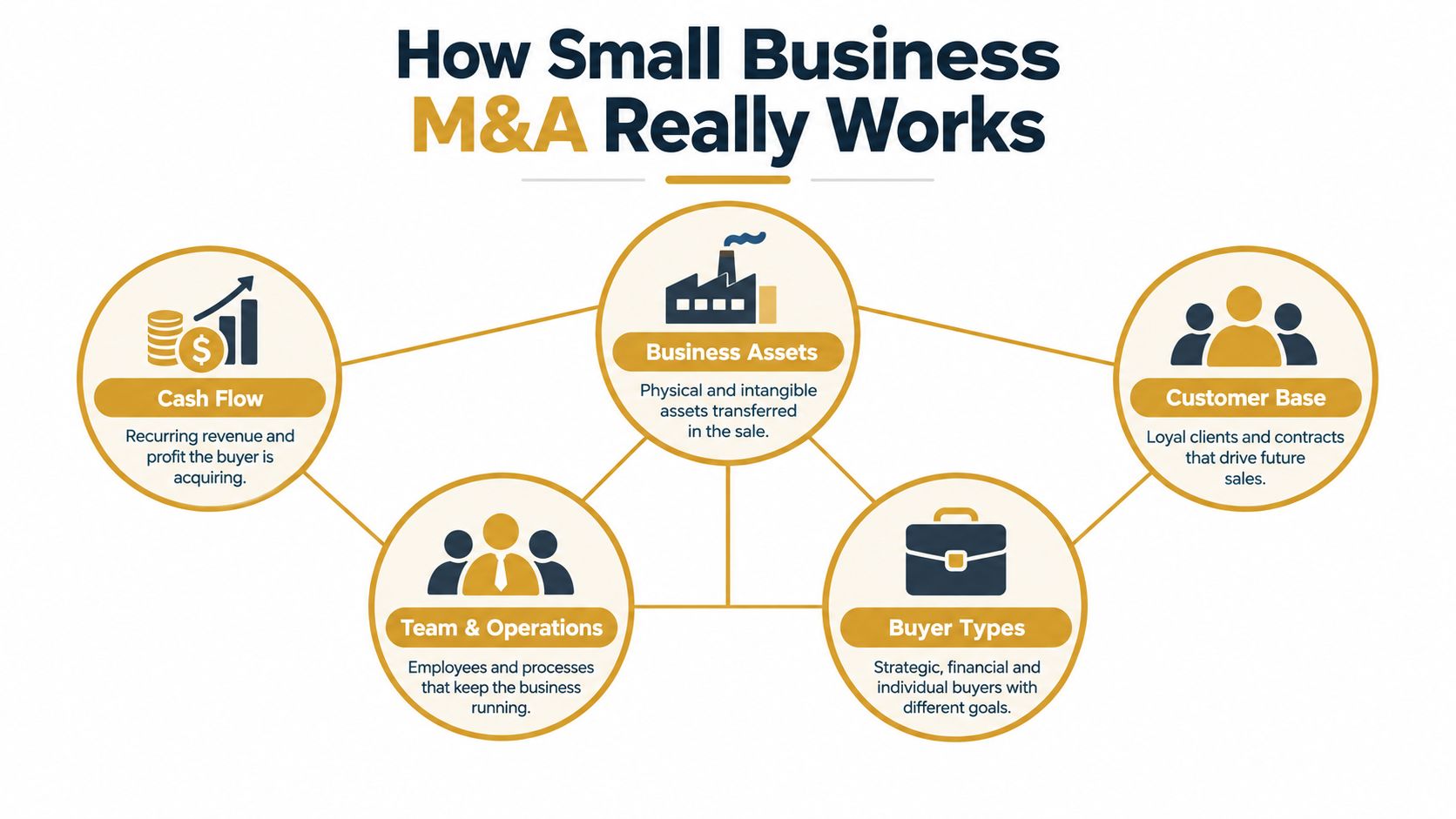
A company works like a functioning machine. Assets are its equipment and tools. Cash flow supplies the fuel. Customers create demand, while the team and operating processes keep delivery consistent. The buyer's role determines how that machine will be maintained, changed, or connected to another company.
Three common acquisition paths
An owner-operator buyout is the most direct path. You purchase the company and take responsibility for leading it. The model can fit a buyer whose experience matches the operation and whose financing plan leaves enough cash flow for debt service and ongoing needs.
A bolt-on adds a complementary company to an existing one. For example, a commercial cleaning business might acquire another local operator and gain customers, staff, routes, or specialized services. The buyer starts with a platform that already has accounting, management, sales, and administrative resources.
A roll-up brings multiple companies in the same or related sector under shared ownership and operating practices. The group may gain purchasing power, centralized administration, broader service coverage, or more consistent reporting. Those benefits depend on execution. Poor integration can drive away customers, confuse employees, and weaken the cash flow that supported the acquisition.
Small-cap M&A also includes transactions beyond local owner transitions. LSEG-based reporting placed worldwide small-cap transactions valued at up to US$50 million at US$170.0 billion in full-year 2024, down 11% from the prior year, with deal count down 14% to a four-year low. Cross-border activity reached a record US$40.8 billion, while private-equity-backed small-cap M&A totaled US$53.0 billion. These figures appear in the ONS quarterly M&A PDF.
That broader market does not mean a first-time buyer needs an international strategy. It shows that individuals, strategic buyers, private-equity-backed platforms, and other capital sources pursue different goals. A strategic buyer may seek customers or capabilities. An individual buyer may want a dependable operating role. A roll-up sponsor may seek a repeatable acquisition process.
Every path eventually faces the same test: Will the acquired business continue producing useful cash flow after ownership changes? Sourcing starts the lifecycle, but post-LOI work often creates the friction. Missing records, seller dependence, financing changes, and weak transition plans can threaten a deal after the buyer has already invested significant effort. Creative financing can preserve a viable transaction, while disciplined integration protects the machine after closing.
Watch the video below for a visual explanation of the transaction components and buyer perspectives.
Finding Deals and Valuing Them Correctly
A first-time buyer can spend weeks chasing an exciting listing, then discover that the seller's records are incomplete or the owner is the only person who can keep customers. A better process treats sourcing as a filter. Brokers may introduce businesses with organized financial packages and a defined sale process. Off-market outreach can reach owners who have not publicly decided to sell. Accountants, attorneys, lenders, suppliers, and other operators may identify opportunities before they reach a broad buyer pool.
Set your criteria before reviewing specific companies. Define the highest purchase price your cash flow and financing can support, the level of personal involvement you want, the geography you can manage, and the sectors where you understand customers and operations. Screen each target for cash-flow quality, customer concentration, recurring revenue, employee stability, equipment needs, and owner dependency. These tests reduce the chance that enthusiasm will replace analysis.

Use cash flow as the starting point
Small businesses are commonly valued by applying a multiple to an earnings measure. For an owner-operated company, that measure may be Seller's Discretionary Earnings, which estimates the financial benefit available to one owner after adjusting for certain owner-specific expenses. A larger business with independent management may instead be assessed using EBITDA or another normalized cash-flow measure.
The multiple only works when the earnings base is reliable. Reported profit can look attractive while the company requires major equipment replacement, depends on one customer, or relies on the owner's personal relationships. Each issue can reduce the amount a buyer should pay. It can also create post-LOI friction if the buyer discovers that the cash flow cannot support the proposed structure.
BizBuySell's 2024 data reported the average cash-flow multiple rising from 2.49 to 2.57, alongside a $345,000 median sale price, as documented in the market bulletin. The movement suggests pricing pressure, not a universal rule for every sector. A stable recurring-revenue company and a highly owner-dependent company require different analysis.
Build a defensible valuation
Begin with financial statements, tax returns, bank statements, payroll records, and a reconciliation of add-backs. An add-back should be a legitimate expense that will not continue under your ownership. It should not be a convenient adjustment that makes weak earnings appear stronger.
Test the downside before making an offer. What happens if a major customer leaves, the seller's relationships do not transfer, a key employee resigns, or the business needs an unexpected equipment purchase? Model the base case and the risks you can identify. This work connects valuation to financing, diligence, and integration rather than treating price as a standalone negotiation.
In Q1 2025, technology and online businesses reportedly saw deal volume rise 74% while median sale price declined 24%, according to BizVal Global's valuation and exit-readiness analysis. The practical lesson is sector-specific: more buyer activity doesn't automatically justify a higher price. The same analysis reported healthcare deal volumes up 75%, business services up 30%, and nearly 60% of SMB transactions using some form of non-traditional financing. Use these figures as market context, not as a substitute for target-level diligence.
A fast screen should answer three questions:
- Can the cash flow support the capital structure?
- Can the customers and team remain after the transition?
- Can you explain exactly how the price follows from normalized earnings?
If the answers are unclear, keep sourcing. A repeatable lifecycle rewards disciplined selection before the LOI, because creative structuring cannot repair earnings that were never dependable.
Financing Your Acquisition and Structuring Creative Deals
Financing is a design problem. The buyer wants to preserve cash and maintain control. The lender wants reliable repayment. The seller wants confidence that the purchase price will be received. An effective structure gives each party enough protection without leaving the operating company starved of cash.
The SBA 7(a) program is a common tool for eligible acquisitions. SBA-backed deals are typically structured with at least 10% buyer equity injected at closing, and lenders underwrite cash-flow coverage rather than purchase price alone. The business coverage test is 1.15x above $350,000, while the global coverage test is 1.0x, with many lenders preferring approximately 1.25x globally. The maximum 7(a) loan size is $5,000,000, and the upfront guaranty fee ranges from 2% to 3.75% of the guaranteed portion, depending on loan size, according to SBA acquisition financing benchmarks.
Compare the available structures
| Financing Structure | Equity Required | Key Requirement | Best For |
|---|---|---|---|
| SBA 7(a) loan | At least 10% buyer equity at closing | Cash-flow coverage, lender approval, eligible use of proceeds | Qualified acquisitions with reliable historical earnings |
| Seller financing | Negotiated buyer contribution | Seller accepts deferred payment and repayment terms | Bridging a valuation gap or reducing cash at closing |
| Earnout | Depends on negotiated structure | Clear performance metrics, reporting rights, and dispute terms | Businesses where future performance is uncertain |
| Equity partner | Negotiated investment | Defined ownership, governance, distributions, and exit rights | Buyers who need capital or complementary expertise |
| Leveraged buyout | Equity plus debt and other instruments | Debt service must remain supportable after closing | Cash-flowing companies with disciplined operating plans |
The table shows why “creative financing” doesn't mean avoiding financial discipline. It means combining instruments to match the risks. A seller note can help bridge a gap between the buyer's financing capacity and the seller's price expectation. An earnout can defer payment tied to customer retention or revenue delivery, but it must define measurement, control, timing, and remedies precisely.
Equity can reduce debt pressure, but it also dilutes ownership and creates governance obligations. A buyout can preserve buyer capital, but excessive debt leaves fewer resources for payroll, inventory, maintenance, and growth.
For a practical overview of how these tools fit together, review business acquisition funding strategies. Use the concepts to build a structure around the company's cash generation, not around a preferred financing product.
Financing principle: The best structure is the one that leaves the operating company able to absorb ordinary surprises after closing.
A simple owner-operator purchase may need one senior loan and a seller note. A roll-up may require equity partners, acquisition facilities, and standardized reporting across targets. Don't use a roll-up capital structure for a single business unless the broader strategy requires it. Complexity creates more parties who can delay approval or challenge assumptions.
Navigating LOIs Due Diligence and Closing
The Letter of Intent is where interest becomes a process. It usually outlines the proposed price, transaction form, financing assumptions, exclusivity period, diligence conditions, transition expectations, and target closing date. Most provisions are non-binding, but the document establishes the commercial framework that attorneys later turn into a definitive purchase agreement.
A good LOI reduces ambiguity without pretending that diligence is finished. It should explain what happens if working capital is below the agreed level, financing approval changes, material customer information differs from the seller's representations, or the buyer discovers a liability that wasn't disclosed.

Treat diligence as a verification process
Create a shared data-room index before requests begin. The buyer should assign responsibility for reviewing each category, and the seller should know which items are urgent. A useful checklist covers:
- Financial records: Tax returns, financial statements, bank activity, accounts receivable, inventory, payroll, debt, and add-back support.
- Customers and revenue: Customer concentration, contracts, renewals, pricing, churn indicators, backlog, refunds, and disputed receivables.
- Legal exposure: Entity records, leases, licenses, intellectual property, litigation, insurance, employment matters, and supplier agreements.
- Operations: Key processes, equipment condition, vendor dependence, health and safety obligations, and capacity constraints.
- Technology and data: Accounting systems, customer databases, cybersecurity practices, software ownership, access controls, and data-transfer requirements.
Buyers often focus on finding a hidden problem. Sellers often experience the process as a test of their credibility. Both perspectives can produce delays. Clear requests, scheduled update calls, and prompt explanations keep ordinary questions from becoming signs of distrust.
A Q2 2025 market analysis reported 2,368 businesses changing hands, with the median sale price rising to $349,000, while median time to close lengthened from 172 to 198 days. The data and interpretation are available in Eric I. Mendelsohn's Q2 2025 M&A analysis. The operational takeaway is important: an active market can still move slowly when buyers need education, lenders need updated materials, and sellers respond inconsistently.
Keep the process moving
Set a weekly transaction calendar with named owners for every open item. Ask the lender early which documents may trigger re-underwriting. Confirm the seller's availability for management interviews, customer transition planning, and operational walkthroughs.
Buyers should also distinguish a genuine discrepancy from a reason to retrade. If the target's verified earnings differ materially from the initial presentation, the price or structure may need to change. If a document arrives late but confirms the original story, solve the process issue without reopening every commercial term.
Legal counsel matters because asset purchases, stock purchases, representations, indemnities, employment arrangements, and tax outcomes can differ substantially. Buyers and sellers who need a broader legal framework for buying or selling a business can use that resource when selecting counsel and defining responsibilities. For operational questions that sit beyond financial verification, consult this operational due diligence factors checklist.
The closing date is not the finish line. It's the moment when every untested assumption becomes an operating responsibility.
Integration and Scaling Through Roll Ups and Bolt Ons
A buyer can close a deal and still weaken the business. The usual causes are changing too much too soon or losing the seller's practical knowledge. The first job is stabilization. Employees need clear decision rights, customers need continuity, and vendors need confidence that orders and invoices will be handled. The buyer also needs dependable visibility into cash, sales, staffing, and service delivery.

Use the first 90 days to protect the engine
During the first month, record responsibilities, meet key employees, contact important customers where appropriate, secure system access, and confirm collections and upcoming obligations. An old process is not automatically a bad process. Learn what it does, why it exists, and what risk a rushed change could create before replacing it.
The next phase establishes a regular operating rhythm. Review revenue, gross margin, cash balance, accounts receivable, customer retention, staffing, and service quality. The right KPIs depend on the sector, but each measure should answer a management question: Are customers staying? Is cash arriving? Are employees delivering the service? Are systems producing information the team can trust?
An NBER working paper found that only 16.28% of acquirers disclosed post-integration progress after one year, and 18.88% after two years, as summarized by Acquisition Ace's M&A statistics page. Limited public reporting does not prove that integrations failed. It does show why buyers need milestones and regular measurement. Without them, synergy capture becomes an assumption rather than a managed process.
Integration discipline: Assign an owner, deadline, baseline, and success measure to every major integration task.
Decide whether the next deal is a bolt-on or a roll-up
A bolt-on should strengthen the platform in a defined way. It may add a service line, extend territory, bring specialized talent, or deepen customer relationships. Before pursuing it, explain how the platform will support the target and how the target will improve the platform.
A roll-up requires greater standardization across companies. Centralized accounting, reporting, procurement, recruiting, marketing, and technology can improve consistency, provided leaders first understand each business's differences. Applying one process on day one can erase local knowledge and weaken employee trust.
Integration risk changes by sector. Business services, healthcare, technology, and online businesses may support acquisition-led growth, yet customer data, regulatory duties, software ownership, clinical processes, fulfillment, and brand identity require different transition plans. Q1 2025 reporting showed healthcare deal volume up 75% year on year, business services up 30%, and technology and online deal volume up 74%. Technology and online median sale price declined 24% during the same period. Those figures reinforce the need to test sector-specific pricing assumptions rather than apply one valuation rule to every target.
Use buy then build strategies only after the first company has stable reporting and clear operating ownership. The second acquisition magnifies weak systems. It does not repair them.
Your First Acquisition Pathway and Next Steps
Your first decision is not which listing to buy. It's whether you should pursue a single owner-operator acquisition or design toward a platform and future roll-up.
Choose the owner-operator path if you want a direct leadership role, have relevant operating experience, and prefer to learn one business thoroughly before adding complexity. Consider a platform strategy if you already understand a fragmented sector, can access management and capital partners, and have a clear reason that multiple businesses will work better together.
A practical 30, 60, and 90-day pathway
During the first 30 days, define your acquisition criteria, learn the core financial terms, prepare a personal financial profile, identify advisors, and create a screening template. Review enough opportunities to recognize recurring patterns in pricing, owner dependency, customer concentration, and financing constraints.
By day 60, build a sourcing routine. Contact brokers, speak with owners and industry participants, organize your documents, and practice normalizing financial statements. You should be able to reject an opportunity quickly and explain why without relying on instinct alone.
By day 90, select only targets that fit your criteria, request the appropriate materials, build a downside case, and prepare an offer structure. Before signing an LOI, confirm how the business will operate if the seller leaves, how debt service will be covered, and which diligence findings would cause you to reduce price or walk away.
A short launch curriculum can help first-time buyers sequence these activities, while mentorship, templates, lender relationships, and peer feedback can help when a live transaction presents an unfamiliar issue. Dealmaker Wealth Society offers training and community support around acquisition basics, sourcing, diligence, creative structuring, capital raising, and post-close scaling. It's one option for buyers who want structured education rather than assembling every resource independently.
Measure readiness by behavior
You're ready to pursue a first acquisition when you can describe your target clearly, evaluate cash flow without depending on a seller's summary, communicate with advisors, and maintain momentum through diligence. You don't need perfect certainty. You need a process that identifies uncertainty early and prices or structures it responsibly.
Avoid three common misconceptions:
- A low price isn't automatically a good deal: Weak cash flow, customer concentration, or owner dependency can make a cheap company expensive to operate.
- Closing isn't the outcome: The acquisition only creates value if customers, employees, systems, and cash flow remain stable afterward.
- Creative financing isn't free financing: Every seller note, earnout, equity arrangement, and covenant creates obligations that must be understood before signing.
Start with one target, one clear operating thesis, and one financing plan that leaves the company breathing room. Then earn the right to scale through disciplined integration.
Dealmaker Wealth Society provides structured education, playbooks, mentorship, and peer support for people learning to buy and scale small businesses through M&A. Visit Dealmaker Wealth Society to explore acquisition training, creative deal structuring resources, and guidance for turning your first transaction into a repeatable operating process.

From the Dealmaker Blog











A Creative Business Buying Fable
