
How to Value a Small Business: A Buyer’s Guide
How to Value a Small Business: A Buyer’s Guide

You've found a small business that looks profitable, the seller has a confident asking price, and the broker's summary suggests an attractive return. Then you open the tax returns and see far less profit than expected. Or you review the seller's projections and wonder whether the growth exists anywhere beyond a spreadsheet.
That tension is normal. How to value a small business isn't about accepting the seller's number or multiplying reported net income by a convenient figure. It's about identifying the cash flow a new owner can receive, testing whether that cash flow will survive the transition, and pricing the risks that remain.
Table of Contents
- Understanding the Core Earnings Metrics
- Normalizing Financials to Find True Cash Flow
- Applying the Right Valuation Method
- Why Industry Averages Mislead Buyers
- Bridging the Valuation Gap with Deal Structure
- Stress-Testing Your Model Before the LOI
Understanding the Core Earnings Metrics
A business can show healthy accounting profit and still produce less cash for a new owner than the seller suggests. Owners often make legitimate tax and lifestyle choices that reduce taxable income. Buyers need a financial picture that reflects the benefit they can receive after closing, including the cost of replacing work the seller currently performs.
A tax return may understate a healthy operation, while a broker's adjusted earnings may overstate a fragile one. Rebuild the earnings picture from the underlying records before applying any multiple.
SDE for owner-operated businesses
Seller's Discretionary Earnings, or SDE, estimates the total financial benefit available to one owner-operator. It generally starts with business profit, then adds back the owner's salary and benefits, depreciation, amortization, interest, and legitimate one-time expenses.
SDE fits a buyer who expects to replace the owner's daily role. A local service company, specialty contractor, or small e-commerce operation may rely on one person for sales, scheduling, purchasing, and management. The reported profit may therefore exclude the full economic benefit of ownership, while the SDE may conceal a replacement cost if the buyer cannot perform those duties personally.
For businesses under about $5 million in annual revenue, a common starting range is roughly 2–4× SDE, according to this business valuation guide. Treat that range as a reference point, not a conclusion. Verify whether the earnings repeat and identify the work, payroll, and transition support required after the seller leaves.
EBITDA as management depth increases
EBITDA, or earnings before interest, taxes, depreciation, and amortization, removes the effects of capital structure and certain non-cash accounting items. It becomes more useful when managers, documented processes, and operating depth allow ownership to change without the buyer taking over every function.
Larger private businesses are often discussed at approximately 3–6× EBITDA, as described in this valuation reference for business owners. A company can report strong EBITDA yet remain owner-dependent. If the seller controls key relationships, approvals, or daily decisions, the buyer may need replacement hiring and extended transition support. Those costs reduce the price the headline multiple can justify.
Practical rule: Match the metric to the role being purchased. SDE measures the benefit of owning and operating the company. EBITDA is more useful when the business can function through a management team.
Document responsibilities before comparing multiples. Use financial metrics for acquisition targets to review the financial picture, then separate owner duties from employee duties. Price the responsibilities that do not transfer cleanly as operating costs, rather than treating the seller's adjusted earnings as fully transferable cash flow.
Normalizing Financials to Find True Cash Flow
Normalization is where valuation becomes either credible or dangerous. You're converting reported results into a defensible estimate of ongoing cash flow, using the trailing 12-month period as the starting point and then checking the adjustments against prior financial statements, bank activity, payroll records, invoices, and tax filings.
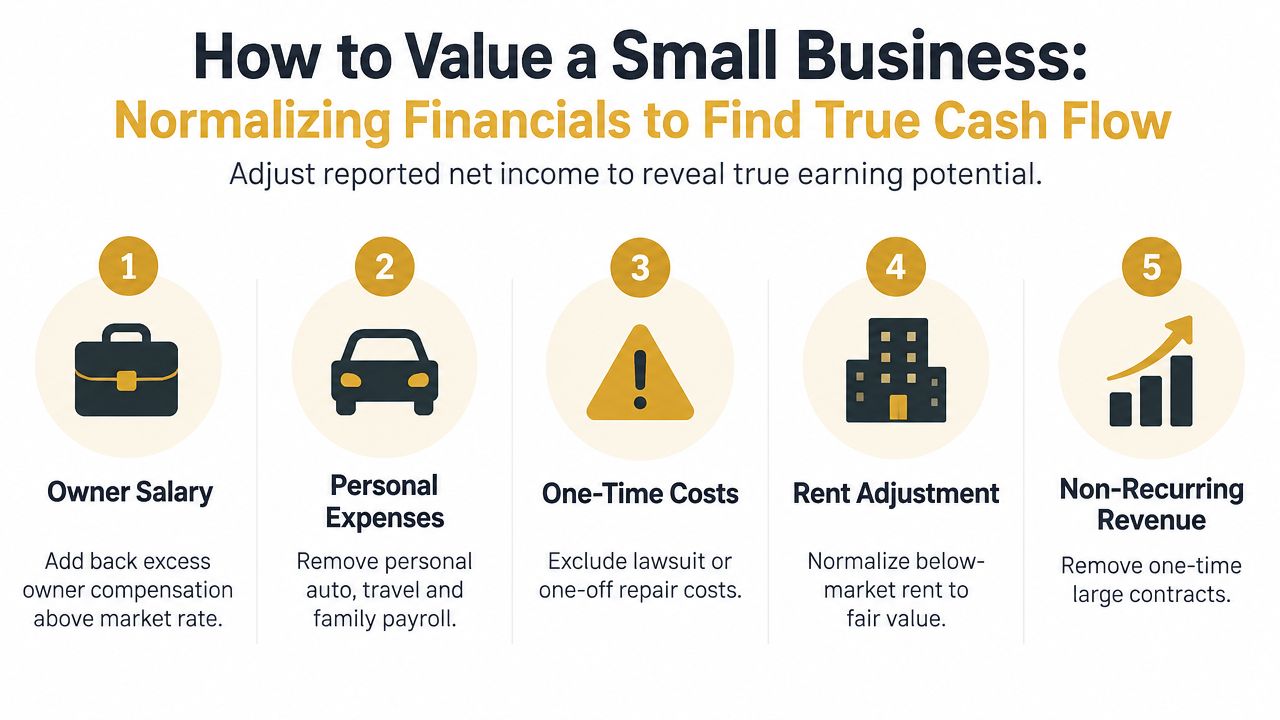
The normalization guidance from Morgan & Westfield emphasizes adding back owner compensation, non-cash expenses, and non-recurring items so cash flow reflects transferable earnings rather than tax or lifestyle choices. That principle is simple. Applying it requires judgment.
Separate genuine add-backs from seller preferences
An add-back belongs in your model only when you can explain why the expense won't continue, or why it will continue at a different, supportable level.
Common candidates include:
- Owner compensation: Add back the owner's compensation only to the extent it exceeds the cost of hiring someone to perform the same work. If the seller is the lead salesperson, replacing that function is a real expense.
- Personal expenses: Auto costs, personal travel, family payroll, and other mixed-use spending may be partly removable. Ask for evidence, not a blanket acceptance of the seller's schedule.
- Non-cash expenses: Depreciation and amortization may be added back, but you still need to account for the capital spending required to maintain equipment and operations.
- One-time costs: A lawsuit, unusual repair, or isolated professional fee may be removable when the event is non-recurring and the underlying issue won't follow you after closing.
- Below-market expenses: Rent paid to a related party may need adjustment to fair market value. A below-market lease can inflate earnings, while an above-market lease can suppress them.
The most common weakness in an add-back schedule is not a false line item. It's an incomplete replacement-cost analysis. A seller may remove their salary, personal vehicle, and travel, but omit the operations manager, sales representative, or administrator required to make the business independent.
Review monthly trends rather than relying on an annual total. A one-time contract can inflate revenue, while an unusually low repair period can make margins look better than they'll be over a normal operating cycle. For cash planning after closing, a buyer may also benefit from a multi-currency cash flow modeling framework when the company sells or pays suppliers across currencies.
Build an audit trail for every adjustment
Create an adjustment schedule with four columns: the reported expense, proposed add-back, supporting evidence, and your confidence level. Then classify each item as accepted, rejected, or subject to verification.
Your normalized figure should survive a skeptical lender, a quality-of-earnings review, and your own first year of ownership. A practical financial health due diligence checklist can help organize that work across revenue, margins, working capital, debt, and customer records.
The result isn't the seller's “best case” earnings. It's the cash flow you can reasonably expect after paying the people, systems, rent, and operating costs needed to keep the business functioning.
Applying the Right Valuation Method
Once normalized SDE or EBITDA is established, compare the business through more than one valuation lens. The earnings multiple usually drives the conversation for a profitable operating company, but comparable transactions and assets provide essential checks against an unrealistic result.
| Method | Best Used For | Key Metric |
|---|---|---|
| Earnings multiple | Profitable owner-operated or management-led businesses | Normalized SDE or EBITDA |
| Comparable sales | Businesses with relevant transaction evidence | Sale price relative to SDE or EBITDA |
| Asset-based floor | Asset-heavy, distressed, or low-profit businesses | Fair value of assets less liabilities |
Earnings multiples
The multiple method is popular because it connects price to the cash flow a buyer is acquiring. Start with normalized earnings, select a range supported by sector and transaction evidence, and then adjust for risk, growth, transferability, and management depth.
A profitable service company with limited equipment may have little asset value beyond working capital, customer relationships, and operating processes. Its earnings power matters more than its book value. By contrast, a business with significant inventory, machinery, vehicles, or property may need a stronger asset analysis even when earnings remain the principal driver.
The key question is not whether a multiple is mathematically easy. It's whether the earnings base and multiple describe the same business.
Comparable transactions
Comparable sales can reveal what buyers have paid, but only when the comparisons are comparable. Match for business model, size, geography, customer mix, margin profile, owner involvement, and transaction structure.
A deal involving a larger management-led company shouldn't automatically set the price for a smaller owner-operated company. Likewise, a distressed sale, an asset-only transaction, or a deal with unusual seller financing may not provide a clean reference point.
Use transaction data to establish a range, then explain why your target belongs above or below that range. Don't use a database average as a substitute for underwriting.
Asset-based valuation
An asset-based approach estimates the value of the company's assets after considering liabilities. It can establish a floor when earnings are weak, provide a recovery estimate in a distressed situation, or expose a seller's price that exceeds the value of the operating business.
It's usually insufficient on its own for a healthy company whose value comes from repeat customers, employees, reputation, contracts, and know-how. Those intangible assets may not appear clearly on the balance sheet, yet they can determine whether the business produces cash after closing.
The broader income approach to valuation is useful when recurring earnings and future cash generation carry more weight than owned assets. In practice, triangulation works best: calculate normalized earnings value, compare it with relevant sales, and test the result against an asset floor.
Why Industry Averages Mislead Buyers
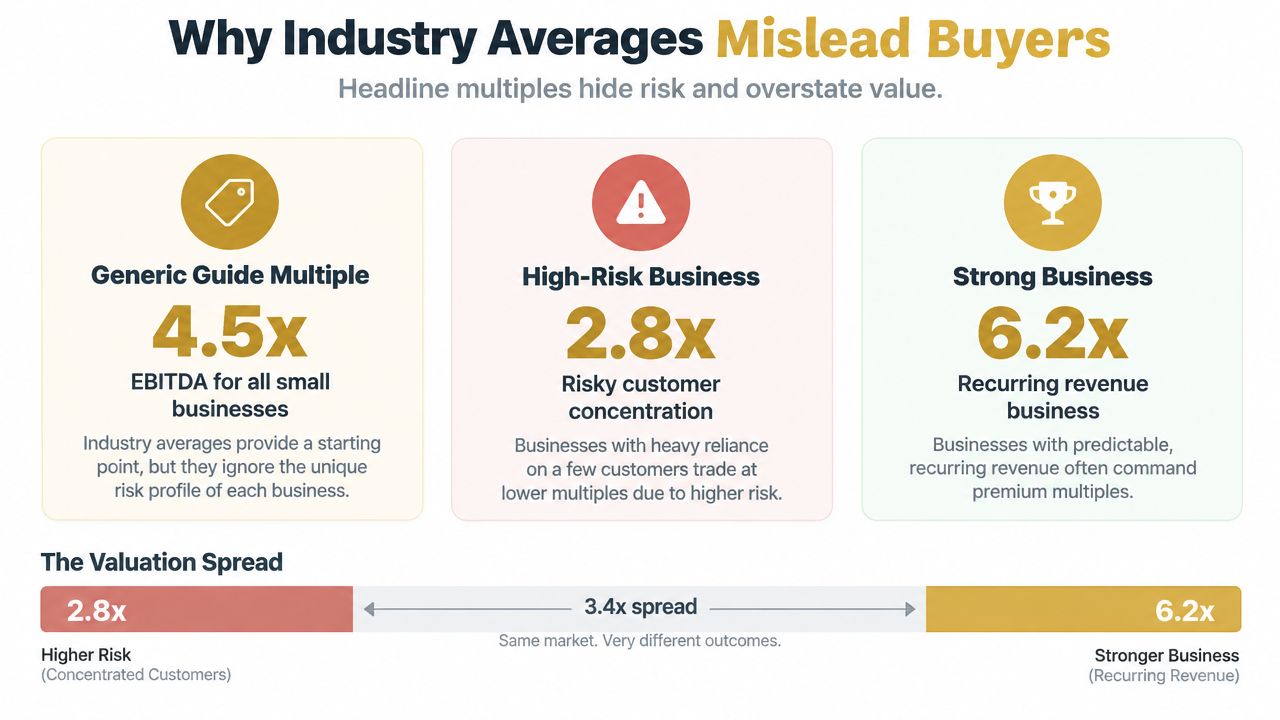
A headline multiple hides the variables that determine whether the buyer can collect the projected earnings. Two companies in the same industry can have similar revenue and reported profit, yet deserve very different prices because one depends on its owner while the other runs through a capable team.
Recent transaction data puts the average small-business sale at about 2.5× SDE across more than 9,500 deals in 2025, while industry ranges extended from under 1.5× to over 6×, according to SDE multiple data by industry. Those figures demonstrate dispersion, not a universal answer.
Owner dependence changes the economics
If the seller personally closes most deals, approves every job, manages key suppliers, and handles the most important customer relationships, you're not buying a fully transferable cash-flow stream. You're buying a business plus a transition problem.
Ask what happens if the seller stops selling immediately after closing. Then ask what happens if the seller's largest customer follows them, if a key employee leaves, or if the seller's informal knowledge isn't documented. Each answer should affect the multiple, the structure, or both.
Autonomous management supports a premium because the buyer can own the company without becoming the only irreplaceable employee. Recurring revenue, documented workflows, diversified customers, and durable contracts can also support stronger pricing, but only when the records confirm that those features produce dependable cash flow.
Quality of earnings beats category labels
A sector average can't tell you whether revenue is recurring or project-based, whether gross margin depends on one supplier, or whether the owner has been underpaying themselves. It also can't tell you whether customer relationships belong to the company or to an individual salesperson.
Use a quality-adjusted scorecard:
- Management depth: Identify the people who can run operations, sales, finance, and customer service without the seller.
- Customer concentration: Review how much revenue comes from major accounts and whether those relationships are contractually protected.
- Revenue durability: Distinguish repeatable subscriptions, reorders, and service agreements from one-off projects.
- Process transferability: Confirm that pricing, fulfillment, lead generation, and reporting are documented and teachable.
- Capital requirements: Check whether growth requires equipment, inventory, hiring, or working capital that the seller's earnings figure understates.
The multiple should explain the risk. If you can't articulate why a business deserves a premium or discount, you're probably anchoring to an average rather than valuing the company in front of you.
Bridging the Valuation Gap with Deal Structure
Sellers often price from what they believe the business should be worth. Buyers price from verified cash flow, replacement costs, financing capacity, and downside risk. Those positions can remain far apart even when both parties are acting in good faith.
Recent buyer sentiment reflects that friction. 76% of buyers describe current valuations as “somewhat high” or “very stretched,” and 61% say seller expectations frequently or sometimes prevent otherwise attractive deals, according to the SMB Insights buyer trends report.
The purchase price is only one part of the negotiation. Terms determine how much risk you take on before the business proves that the earnings are real.
Use seller financing to share confidence
Seller financing can keep the seller economically connected to the outcome. If the seller believes the normalized earnings are durable, carrying part of the price can demonstrate that confidence while reducing the buyer's upfront funding requirement.
The terms matter. Establish repayment priorities, default provisions, security, subordination, and what happens if a material customer or employee leaves. Seller financing shouldn't conceal an unfinanceable price. It should distribute risk in a way that reflects the seller's knowledge of the business.
Tie uncertain value to measurable performance
An earn-out or performance-based holdback can address a specific uncertainty, such as customer retention, revenue transfer, or the seller's continued involvement in business development. Define the measurement carefully. Revenue may be easier to verify than profit, but revenue without margin can reward the wrong behavior.
Write the operating rules before signing. Specify accounting treatment, customer ownership, sales credit, expense allocation, reporting access, and dispute resolution. Vague earn-outs create conflict because the buyer and seller can influence performance differently after closing.
Protect the transition
A transition agreement can require training, introductions, documentation, and availability during a defined period. That support is particularly valuable when the seller controls relationships that haven't been institutionalized.
A lower headline price with weak protections can be worse than a higher price with disciplined contingent consideration. Compare the risk-adjusted economics, not just the number on page one.
A buyer can also bridge a gap with a staged acquisition, a retained equity position, or a rollover arrangement where appropriate. These structures work only when incentives, governance, and exit rights are explicit. Creative terms aren't a substitute for valuation discipline, but they can prevent a fixable disagreement over timing from killing a sound transaction.
Stress-Testing Your Model Before the LOI
A valuation model can calculate perfectly and still produce a bad offer. The failure usually starts with weak inputs, optimistic forecasts, mismatched comparables, or a discount rate that doesn't reflect the company's actual risk.
IESE research groups valuation mistakes into six categories, with discount-rate errors, cash-flow forecasting errors, residual-value errors, and interpretation inconsistencies among the leading problems identified in its analysis of valuation practice (IESE valuation research). The practical lesson is clear: assumptions deserve more scrutiny than formulas.
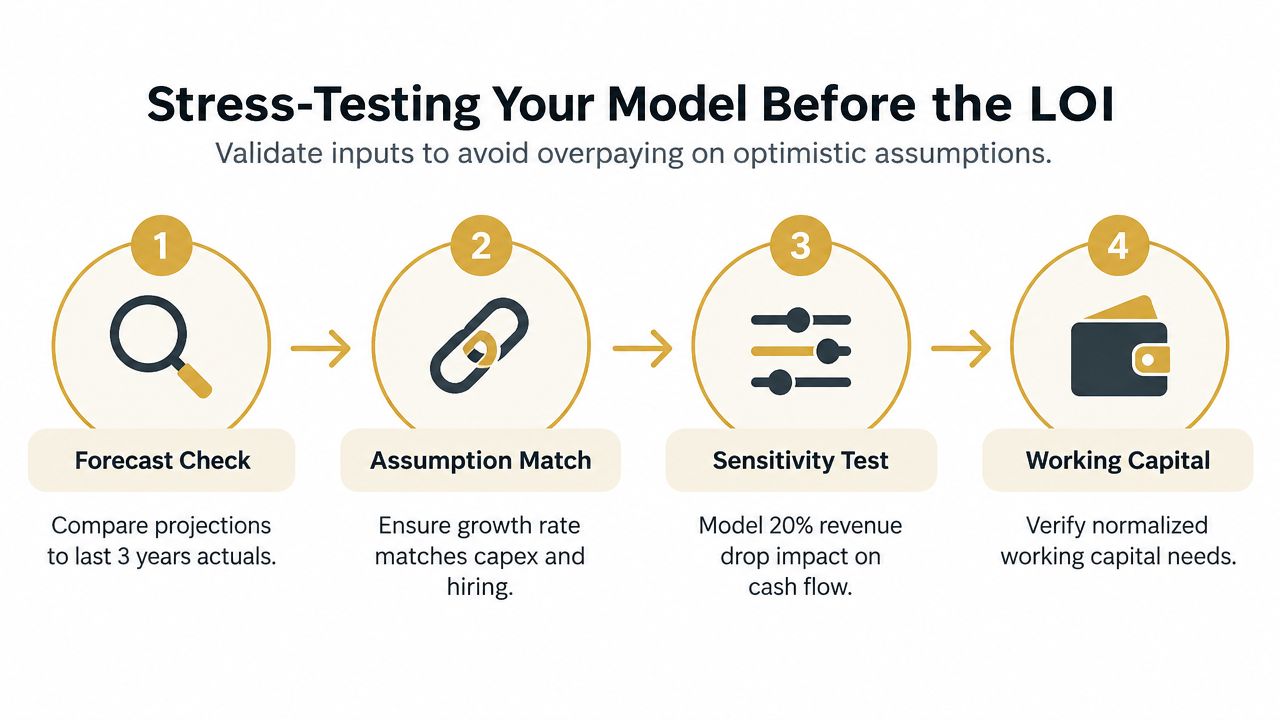
Run the model in a deliberate sequence:
- Reconcile the forecast: Compare the seller's projections with historical monthly revenue, gross margin, payroll, customer activity, and cash conversion. Investigate every material improvement rather than accepting a smooth forecast.
- Match assumptions to resources: A growth plan that requires new staff, equipment, inventory, or marketing spend must include those costs. If the model shows growth without the required investment, it's incomplete.
- Test downside cases: Reduce revenue, compress margins, delay growth, and model the loss of a major customer. The point isn't to predict the worst outcome. It's to learn whether the purchase survives a reasonable setback.
- Calculate replacement costs: Price the people and systems needed to replace the owner's role. Include management, sales, operations, bookkeeping, and transition support where applicable.
- Verify working capital: Determine the cash required to fund receivables, inventory, deposits, seasonal swings, and normal operating needs after closing.
The final offer should reflect the downside case you're willing to own, not the upside case the seller hopes to achieve. If the model works only when every assumption lands correctly, the price is too high or the structure needs more protection.
Dealmaker Wealth Society offers acquisition education, due diligence checklists, deal-structuring playbooks, capital-raising training, and practitioner-led support for people evaluating and buying small businesses. Visit Dealmaker Wealth Society to explore training and community resources that connect valuation analysis with negotiation, financing, and deal execution.

From the Dealmaker Blog













A Creative Business Buying Fable
