Leveraged Buyout Process: A Step-by-Step Playbook
Leveraged Buyout Process: A Step-by-Step Playbook
A leveraged buyout process has three linked phases: pre-investment screening and modeling, ownership value creation and debt paydown, and exit execution. In the classic 1988 example, equity represented only 9.7% of total transaction capitalization, leaving debt and other financing sources to fund roughly 90.3%, which shows both the power of borrowed funds and the narrow margin for error. Bain's Global Private Equity Report
You're probably looking at an acquisition model that works beautifully in the base case. Revenue grows, EBITDA expands, debt amortizes, and the exit multiple creates an attractive equity return. Then someone asks the uncomfortable question: what happens if the margin improvement arrives late, a major customer leaves, rates stay high, or management can't execute the integration plan?
That question defines the buyout process with debt. The transaction doesn't succeed when the purchase agreement is signed. It succeeds when the acquired business produces enough dependable cash to fund operations, meet lender obligations, invest in its future, and still preserve strategic options when conditions change.
Table of Contents
- How the Leveraged Buyout Process Actually Works
- Screening Targets and Normalizing Financials
- Valuation, Modeling, and Stress-Testing Deal Economics
- Choosing Between Bank Debt and Private Credit Financing
- Negotiating Terms and Executing the Close
- Post-Close Operations and Exit Planning
How the Leveraged Buyout Process Actually Works
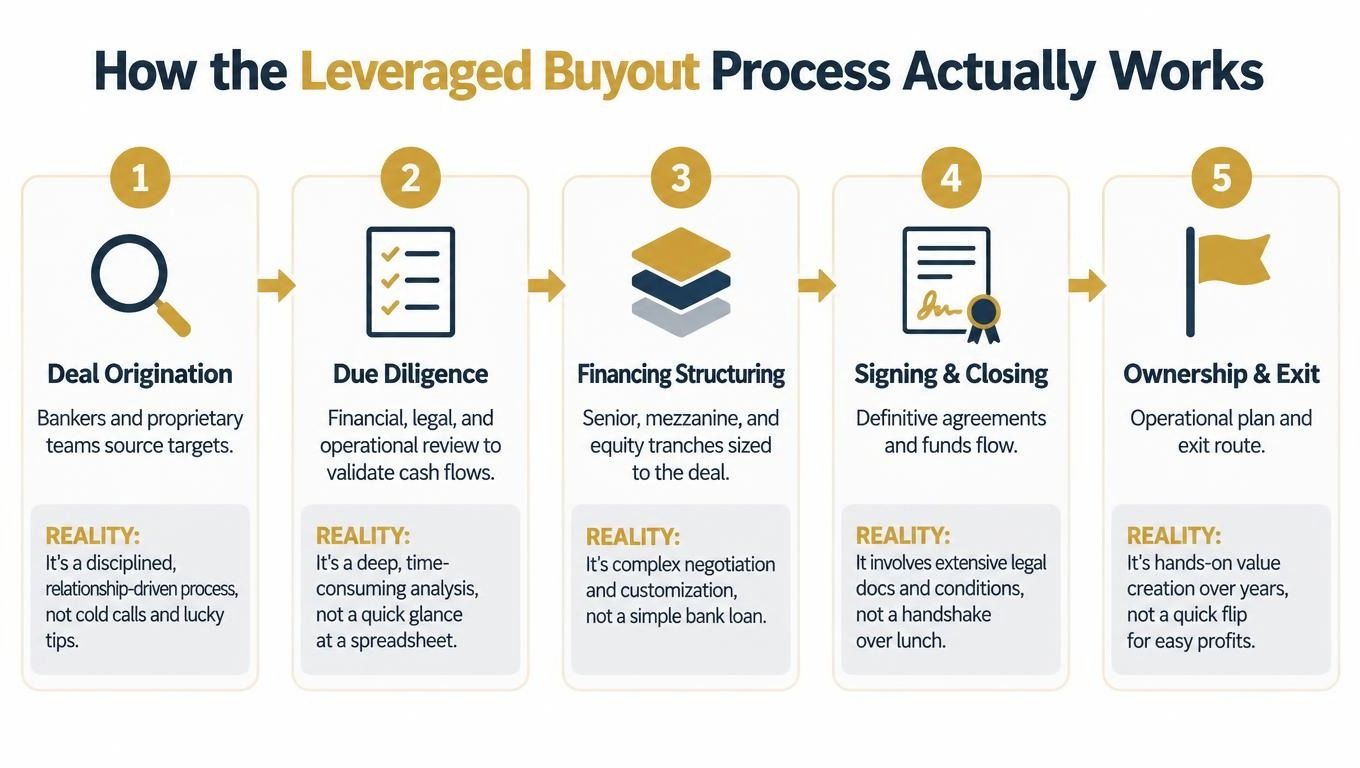
A deal can look attractive at signing and still fail in the first year of ownership. The usual causes are familiar: an integration plan slips, a major customer leaves, margins recover later than expected, or financing costs absorb cash that management expected to reinvest. An LBO works only when the acquired company can produce dependable cash after those pressures appear.
The buyer combines equity with borrowed capital, then places the debt at the acquisition vehicle or operating company. Business cash flow and, where relevant, the asset base support debt service. The ownership team must improve operations and increase the equity value remaining after repayment.
The capital stack may include senior bank debt, private credit, subordinated or mezzanine financing, seller notes, rollover equity, and sponsor capital. Each layer carries its own priority, pricing, repayment expectations, and control rights. A structure that looks efficient in the base case can become restrictive when cash conversion weakens or lenders tighten their requirements.
The three phases that matter
Pre-investment begins with target screening and financial diligence. The buyer tests recurring EBITDA, free cash flow, customer concentration, working-capital requirements, maintenance capital expenditure, tax exposure, and management depth. Those findings set the purchase-price ceiling and determine how much debt the business can carry without starving operations.
Ownership starts at closing, although the operating plan must be detailed before signing. Management executes initiatives, protects service quality, controls cash, and applies excess free cash flow to debt reduction. Lenders judge delivered cash flow and covenant compliance, not the quality of a presentation. Integration work also needs an owner, timetable, and contingency plan, because delayed execution can leave the business paying for debt before the expected benefits arrive.
Exit may involve a strategic sale, secondary buyout, recapitalization, or refinancing. The buyer repays remaining debt and distributes the residual proceeds. Timing depends on company performance, market conditions, available financing, and whether the next owner will accept the existing operational risks.
Practical rule: A plan that requires every initiative to land on schedule is a hope, not an underwriting case.
The 1980s demonstrate the cost of weak downside discipline. United States LBO activity rose from 4 recorded transactions worth approximately $1.7 billion in 1980 to 410 buyouts worth $188 billion in 1988, while high-yield bonds broadened access to acquisition debt. Academic literature reports that more than 30% of management buyouts completed after 1985 later defaulted. A separate review of 47 large LBOs completed from 1987 through 1990 found that approximately 28% filed for Chapter 11 or defaulted by early 1993.
For founders considering a management-led transition, financing is only part of the decision. This guide to how a management buyout helps founders exit connects the transaction with continuity, leadership incentives, and the seller's objectives.
Screening Targets and Normalizing Financials
A target can look profitable until the first seasonal trough, customer loss, or overdue maintenance bill arrives after closing. Buyers protect returns by testing the cash that will remain available for debt service, not by accepting the seller's preferred EBITDA presentation.
Review several years of monthly revenue, gross margin, operating expenses, working capital, maintenance capital expenditure, taxes, and cash conversion. Annual accounts can hide seasonal weakness, renewal risk, or recurring investment requirements. Screening should also identify operational dependencies that may widen after ownership changes, including concentrated customers, key employees, fragile suppliers, or systems that only the seller knows how to operate.
Normalize earnings before sizing the debt load
Build a bridge from reported EBITDA to underwritten EBITDA. Each adjustment needs evidence, a clear accounting treatment, and a realistic assessment of whether the benefit will continue after the transaction.
- Non-recurring costs: Remove exceptional expenses only when the event will not recur and supporting documents establish the case.
- Owner compensation: Replace unusually low or high owner pay with the cost of a capable replacement, including benefits and related employment costs.
- Related-party expenses: Test rent, professional fees, vehicles, and family payroll against market terms. Do not accept them automatically as add-backs.
- Working capital: Determine whether inventory, receivables, or seasonal cash needs exceed the balance-sheet position.
- Maintenance investment: Separate growth spending from the capital expenditure required to keep equipment, software, facilities, and compliance systems operating.
A quality-of-earnings report should reconcile every adjustment to cash conversion. Reported EBITDA can look attractive while free cash flow remains too weak to support the proposed debt. That gap is often caused by recurring working-capital needs or maintenance spending that the seller presents as discretionary.
Turn diligence findings into model inputs
Customer concentration, churn, pricing power, contract renewals, labor requirements, technology dependencies, and tax obligations belong in the financial model. Filing them in a diligence report without changing the forecast leaves the buyer exposed after signing.
Use a risk register with five fields: the issue, financial impact, mitigation, responsible owner, and deadline for the mitigation to work. If a key customer represents a material share of revenue, model a loss or partial reduction. If maintenance has been deferred, include the catch-up work and its timing. If the forecast assumes a price increase, verify the contracts and test the effects on volume and retention.
The fastest way to improve an LBO model is to replace unsupported add-backs with observable cash evidence.
Bain reports that 71% of investments fell short of projected margins, with actual margins averaging 330 basis points below deal-model forecasts. Bain's diligence methodology recommends linking each issue to a quantified EBITDA bridge, implementation cost, owner, milestone, and timing assumption. The practical lesson is direct: operational diligence should shape financing capacity before the buyer signs.
A practical financial due diligence checklist for acquiring a business helps organize evidence before the purchase agreement. The checklist matters less than the discipline behind it. Every important assumption should have a document, a responsible person, or a conservative haircut.
Valuation, Modeling, and Stress-Testing Deal Economics
A deal can close with an attractive entry multiple and still fail when collections slow, integration takes longer than planned, or debt service consumes the cash cushion. The LBO model should expose those risks before the buyer commits, rather than present an appealing internal rate of return.
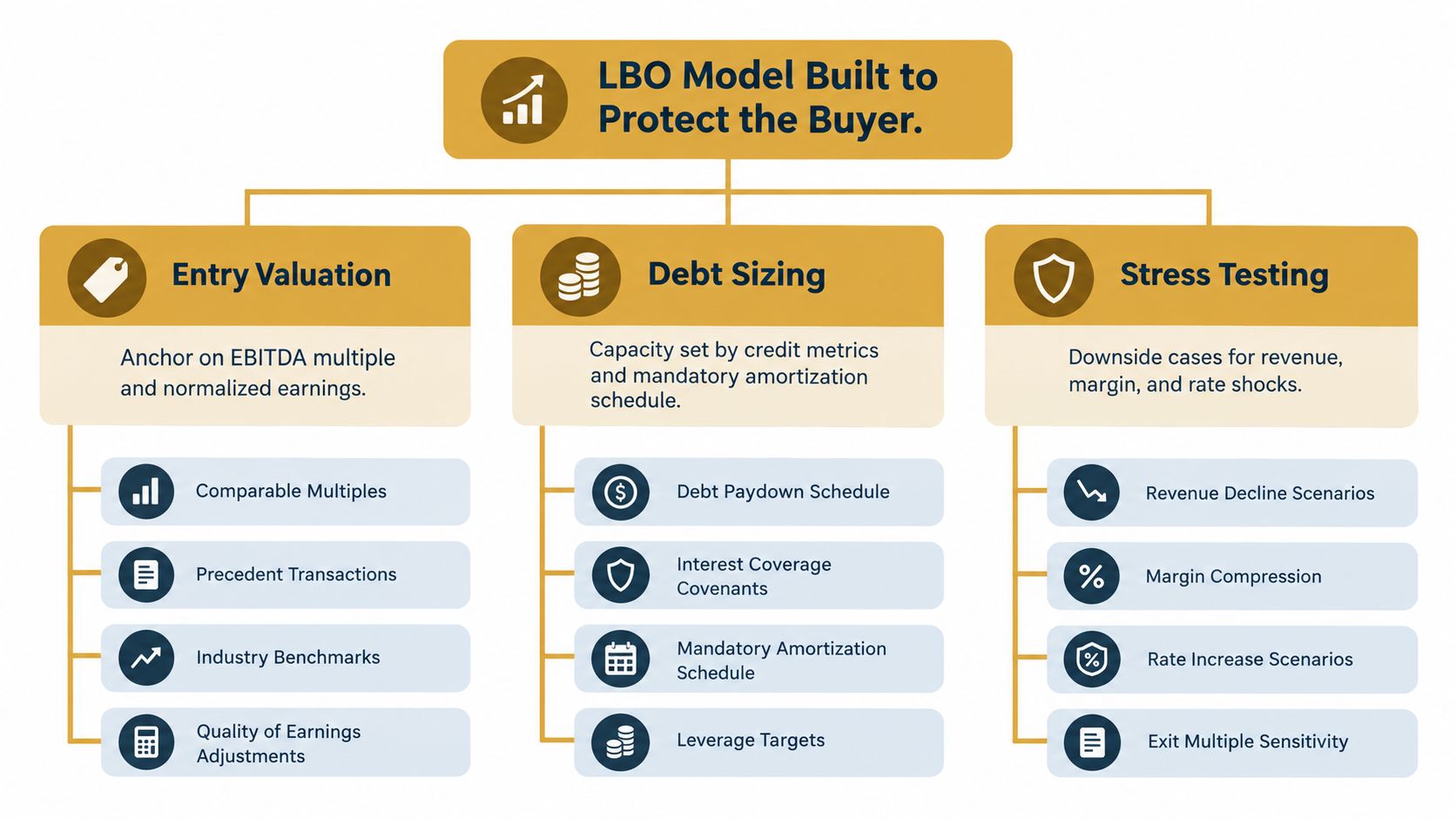
Start with normalized EBITDA and a defensible entry valuation. Build sources and uses, debt tranches, interest expense, mandatory amortization, taxes, working capital, capital expenditure, management incentives, and transaction fees. Where seasonality or volatile collections matter, show cash availability by month. A financial modeling framework for acquisition decisions can help organize the assumptions and outputs.
Build the model around constraints
Debt capacity depends on more than a debt-to-EBITDA ratio. Test interest coverage, minimum liquidity, mandatory amortization, covenant headroom, collateral, cash-flow volatility, floating-rate exposure, and refinancing risk. Oxford research reports that post-financial-crisis LBO debt ratios later returned to a median of approximately 65% in 2013, while debt availability and pricing, rather than theoretical capital-structure optimization alone, largely determined debt levels. how financing conditions determine real-world debt levels.
Separate sponsor returns into their actual drivers:
- EBITDA growth, generated by revenue expansion or volume improvement.
- Margin expansion, produced by pricing, productivity, procurement, or operating redesign.
- Debt paydown, funded by excess cash flow.
- Multiple expansion, created by a higher exit valuation.
- Cash leakage, including dividends, fees, acquisitions, or other uses that reduce debt repayment.
A return case dominated by multiple expansion deserves additional scrutiny. A higher exit multiple may support the target return, but it sits outside the buyer's direct control and can conceal weak post-close execution.
Stress-test the downside before approving the base case
Run a recession case with lower revenue, compressed margins, slower collections, higher interest expense, delayed initiatives, and a more conservative exit valuation. Test the first liquidity shortfall, the covenant breach point, and the management actions available before either event occurs.
Approval should require positive equity value and covenant compliance under the recession case, not merely achievement of the base-case IRR. The exercise should identify which costs can be reduced without damaging revenue, which investments must continue, and which stakeholders require contact if cash deteriorates.
For readers building the valuation layer separately, DCF modeling on Finzer provides context on forecasting cash flows and discounting them. An LBO model layers financing constraints and ownership outcomes on top of valuation analysis.
The completed model should produce three outputs: a price ceiling, a financing ceiling, and a clear list of assumptions that management must deliver after closing. Those outputs connect the purchase decision to the operating work required once the transaction is signed.
Choosing Between Bank Debt and Private Credit Financing
Debt isn't a single product. The financing channel affects certainty of execution, speed, documentation, amortization, pricing, lender control, and the buyer's ability to manage a difficult quarter.
In 2024, private credit accounted for about 31% of new-money originations used for M&A and LBOs, while McKinsey reported that average buyout debt rose to roughly 4.1 times net debt to EBITDA from 4.0 times in 2023 as borrowing conditions improved. The Baker McKenzie market report discusses these financing developments.
When a bank or syndicated loan fits
Bank debt or a broadly syndicated loan may suit a larger, more transparent company with consistent reporting, strong EBITDA quality, established collateral, and enough scale to attract multiple lenders. The structure may offer competitive pricing and a familiar market process, but it can involve extensive syndication work, lender coordination, ratings considerations, and less certainty if market conditions change before closing.
This route is often more attractive when the buyer prioritizes lower headline cost and can tolerate a longer financing process. It may be a poor fit when the target is small, highly specialized, operationally complex, or dependent on a fast close.
When private credit earns its place
Private credit can offer speed, certainty, and a negotiated structure. A direct lender may underwrite the whole transaction, tailor repayment terms, and focus on the borrower's specific cash-flow profile rather than a standardized syndicated package.
The trade-off can include a higher all-in cost, tighter lender control, stronger reporting requirements, or documentation that restricts acquisitions, distributions, additional debt, and other corporate actions. A customized facility isn't automatically more flexible for the borrower. Its flexibility depends on the exact baskets, covenants, cure rights, mandatory prepayments, and lender consent provisions.
| Decision factor | Bank or syndicated debt | Private credit |
|---|---|---|
| Execution | Can depend on syndication and market conditions | Often provides greater certainty through a direct underwriting process |
| Pricing | May offer a lower headline cost for suitable borrowers | May carry a higher all-in cost for customization and certainty |
| Documentation | Standardized structures can be familiar but detailed | Bespoke terms can fit the deal but increase negotiation importance |
| Flexibility | Depends on covenants, baskets, and market format | Depends heavily on negotiated controls and lender rights |
| Best fit | Scaled, transparent, financeable businesses | Urgent, complex, or less public-market-accessible transactions |
Compare two deals with the same debt-to-EBITDA ratio and they may still carry very different risks. Floating-rate exposure, amortization, covenant design, cash-flow volatility, collateral quality, and mandatory prepayment terms can change the survival profile materially.
Use the acquisition financing options guide as a starting point, then ask lenders to show how the facility behaves under the exact downside case used in the investment model. More financing options don't automatically make an acquisition safer. Selection discipline matters more than maximizing borrowed capital.
Negotiating Terms and Executing the Close
Price is only one part of the negotiation. The purchase agreement allocates risk between buyer and seller, while the financing documents determine how much operating freedom remains after closing.
A seller may accept a lower cash payment at close in exchange for rollover equity, a seller note, or an earnout. A buyer may accept a higher headline price if a portion is contingent on measurable performance. These tools can align incentives, but they can also create disputes when the definitions aren't precise.
Design contingent consideration carefully
An earnout should specify the metric, accounting principles, measurement period, decision rights, access to information, and treatment of acquisitions or cost allocations. EBITDA-based earnouts can become contentious when the buyer controls pricing, staffing, investment, and overhead allocation after closing.
Seller rollover equity can preserve continuity and align the former owner with the new ownership group. It also means the seller remains exposed to debt, execution, dilution, and exit timing. The rollover agreement needs clear information rights, transfer provisions, governance terms, and treatment if the seller stops working in the business.
Working-capital adjustments deserve equal attention. Define the target using a normalized historical level, exclude unusual items consistently, and give both parties a process for resolving disputes. A vague working-capital provision can transfer value after signing even when the headline purchase price looks settled.
Protect the business's debt capacity
Legal and commercial diligence should identify change-of-control provisions, licensing requirements, compliance exposure, contract-renewal risk, customer consent requirements, and restrictions on assignment. A contract that terminates after ownership changes can reduce revenue and borrowing capacity immediately.
The closing checklist should connect legal deliverables to the operating plan:
- Financing conditions: Confirm lender approvals, funds flow, security documents, and permitted uses.
- Management continuity: Execute employment, incentive, and authority arrangements before the first operating day.
- Customer and supplier notices: Prepare communications for relationships affected by ownership change.
- Systems access: Transfer banking, payroll, insurance, accounting, and operational permissions.
- KPI baseline: Freeze the agreed starting metrics so post-close performance isn't debated from different data sets.
- First-month cash plan: Schedule collections, payroll, taxes, debt service, and essential suppliers before discretionary spending.
A clean close is not the finish line. It is the first test of whether the buyer can turn a financing structure into an operating rhythm.
Integration should start before the funds flow. Assign owners for each value-creation initiative, document the first reporting cadence, and define what management can approve without board or lender consent. If the buyer waits until after closing to decide who owns the plan, the debt clock starts before the organization does.
Post-Close Operations and Exit Planning
The first weeks after closing expose whether the acquisition thesis works in daily operations. Management needs a current view of available cash, unavoidable payments, overdue customers, supplier demands, and the effect of the next reporting period on covenant headroom. A value-creation plan cannot offset poor visibility into liquidity.
The post-close process also needs to separate temporary pressure from structural failure. An interest-rate shock calls for a different response than lost customers, weak pricing, poor delivery, or an acquisition thesis that no longer fits the business.
Establish operating control early
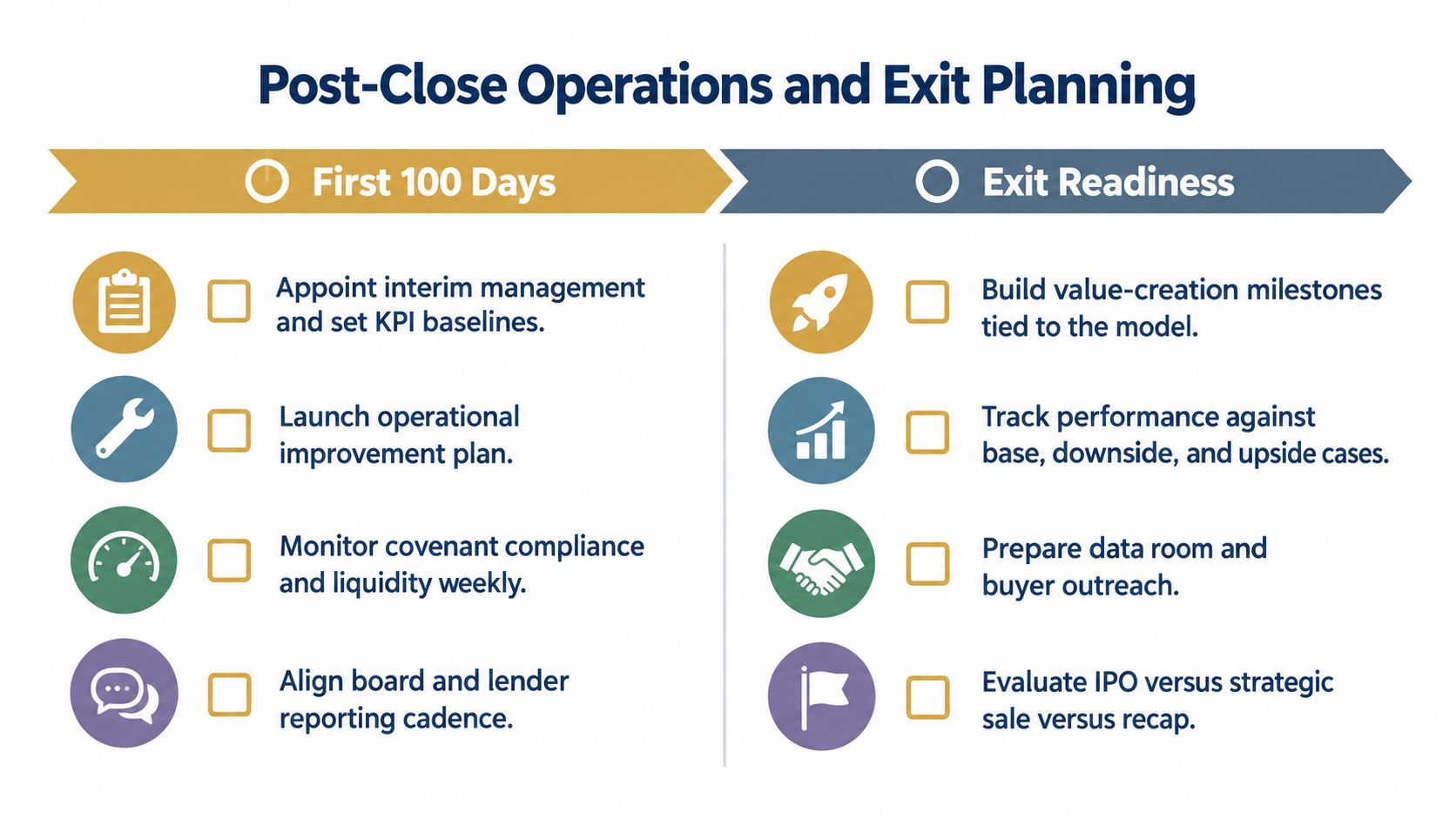
During the first 100 days, appoint an accountable operating leader, establish KPI baselines, launch the improvement plan, and report to the board and lenders on a fixed schedule. Track revenue, gross margin, EBITDA, cash conversion, receivables, inventory, capital expenditure, headcount, customer retention, and covenant metrics.
Maintain a rolling cash forecast and update it when a major customer, supplier, hiring decision, or capital project changes the assumptions. Forecast covenant compliance monthly, even when formal reporting occurs less often. Early visibility gives the buyer time to negotiate before a shortfall becomes a breach.
The financing channel also shapes the post-close playbook. Chambers reports that private-credit activity in 2025 centered heavily on add-ons, refinancings, and dividend recapitalizations, while new sponsor LBO activity remained muted. Direct lenders held about 58% of the sponsor LBO market during 2023 through 2025, compared with 36% during 2020 through 2022, and covenant-lite structures remained common in larger deals. Chambers' private-credit market overview shows why borrowers must understand lender behavior, amendment flexibility, and reporting expectations alongside loan pricing.
Respond before a miss becomes a crisis
When performance weakens, identify the trigger and match the response to the problem:
- Temporary rate pressure: Review hedging, discretionary spending, cash retention, and refinancing timing.
- Operational underperformance: Pause nonessential growth initiatives, replace unclear or weak ownership, and set weekly improvement milestones.
- Liquidity pressure: Seek an equity cure, amend the facility, sell noncore assets, or negotiate a payment profile before cash runs out.
- Structural impairment: Consider a broader restructuring that preserves viable operations and treats stakeholders transparently.
The downside plan must include sellers with notes, rollover investors, employees, minority holders, and lenders. An earnout can fail because of a genuine market shock rather than seller misconduct. Employees may absorb the effects of cost reductions even when the original model assumed investment. Clear communication and fair treatment preserve relationships that may be needed to stabilize the company.
Exit planning starts at entry. Track value-creation milestones that a future buyer will underwrite, maintain a reliable data room, and test strategic sale, secondary buyout, recapitalization, and public-market options. Each route depends on different operating results, market conditions, debt capacity, and buyer appetite, so the plan should preserve alternatives rather than assume one outcome. Buyout results can vary widely, with some investments producing exceptional returns while others return little or no money. As noted earlier, that dispersion makes downside preparation as important as the headline case.
A visual summary of the post-close cadence appears below.
Dealmaker Wealth Society provides acquisition training, deal-structuring playbooks, mentorship, and peer support for buyers working through sourcing, diligence, financing, negotiation, and post-close growth. Visit Dealmaker Wealth Society to explore resources for building and executing a debt-financed acquisition plan with clearer downside controls.
The deals that survive are the ones that preserve operating continuity, protect liquidity, and keep credible exit options alive when the forecast breaks.

From the Dealmaker Blog












A Creative Business Buying Fable