SDE vs EBITDA: How to Pick the Right Metric for a Deal
SDE vs EBITDA: How to Pick the Right Metric for a Deal
You've got a listing open on one screen and a lender's email on the other. The seller quotes a healthy seller's discretionary earnings figure, the broker applies a multiple to it, and the asking price lands well above what your bank will underwrite against EBITDA. Your accountant asks which number is real.
Both are. That's the problem.
The SDE vs EBITDA question isn't a debate about accounting jargon. It decides the price you offer, the debt a lender will extend, and whether you can pay yourself after closing. Most comparisons stop at the definitions. This one carries the arithmetic all the way through to the cash left over once the person running the business has been paid, because that's the account your loan payment comes out of.
Table of Contents
- SDE vs EBITDA at a Glance
- Valuation Multiples by Deal Size
- Calculating SDE and EBITDA Step by Step
- Turning SDE Into Post-Close Cash Flow
- Which Metric Fits Your Deal
- Confirm the Metric Before You Make an Offer
SDE vs EBITDA at a Glance
Read the table first. Six rows carry the distinction, and the last two tell you which side of the line your deal sits on.
| Criterion | SDE | EBITDA |
|---|---|---|
| Question answered | Total benefit available to one full-time owner-operator | Operating earnings after paying a market-rate manager |
| Owner salary and benefits | Added back | Kept as an expense |
| Interest, taxes, depreciation, amortization | Added back | Added back |
| Market-rate manager salary | Not deducted | Deducted |
| Typical company | Owner-operated, usually under about $2 million in deal value | Lower-middle market, roughly $2 million to $50 million |
| Worked example | $400,000 of operating earnings gives about $400,000 of SDE | The same business with a $120,000 manager salary gives about $280,000 of EBITDA |
SDE is the total economic benefit available to one full-time owner-operator. EBITDA is operating earnings after interest, taxes, depreciation and amortization, with a market-rate salary for whoever manages the business left in as a genuine cost.
Two sentences will place your own deal. If you'll be in the building every day, running sales and signing the checks, you're buying an owner's earnings stream. If a manager already runs operations and will still be running them after closing, you're buying a business.
The gap between the two columns isn't a bookkeeping mistake. It's a hiring decision, and it widens whenever the seller's fingerprints are on daily operations. An owner who quotes the phone line, prices the jobs and covers for sick staff is doing a job that somebody has to be paid for after the closing.
The two figures aren't interchangeable. Attach an SDE multiple to an EBITDA base, or the reverse, and enterprise value moves by roughly the replacement salary multiplied by the multiple. Every other term in the negotiation sits on top of that error.
Valuation Multiples by Deal Size
A seller quotes $1 million of SDE and a broker circles 3.1x. The indicated value is about $3.1 million. That figure prices the owner's full cash benefit. It is not the cash left after you pay a replacement operator and still cover debt.
A summary of IBBA and M&A Source Market Pulse data published by CPA Advisor reports median multiples of approximately 2.0x SDE for businesses under $500,000 of earnings, 2.8x SDE at $500,000 to $1 million, and 3.1x SDE at $1 million to $2 million. Above that line the metric changes: 4.0x EBITDA at $2 million to $5 million, and 5.8x EBITDA at $5 million to $50 million.
| Earnings band | Metric usually quoted | Median multiple | Reported range |
|---|---|---|---|
| Under $500,000 | SDE | 2.0x | 1.5x to 2.5x |
| $500,000 to $1 million | SDE | 2.8x | 2.0x to 3.5x |
| $1 million to $2 million | SDE | 3.1x | 2.5x to 3.5x |
| $2 million to $5 million | EBITDA | 4.0x | 4.0x to 5.0x |
| $5 million to $50 million | EBITDA | 5.8x | 4.5x to 6.0x |
Two milestones explain the change of metric. Closely held buyers price the cash one working owner can take, because that owner is the operating system. Once earnings can support independent management, investors move to EBITDA: recurring operating profit left for capital after managers are paid.
The same medians show how far the stakes move. $1 million of SDE at 3.1x implies about $3.1 million of indicated value. $5 million of EBITDA at 5.8x implies about $29 million. Part of that gap is the management layer the larger company already pays.
On the smaller deal, debt service can only be paid from what remains after a replacement operator. Apply the listing multiple to full SDE and the loan is sized on cash the buyer will not keep. I read the band first, then cut the quoted SDE down to cash available for debt before I accept the multiple.
Keep the columns as separate reference points. Medians and reported ranges come from different survey snapshots, so the spread between them is not a negotiating gap you can pocket. Industry, growth, customer concentration and deal structure often move a multiple by more than a full turn.
The screening rule: identify the earnings band first, then apply the multiple that belongs to that band. Price SDE cash only after the replacement operator is paid, or the offer will not service the debt.
Work through how valuation multiples are built and applied in acquisitions so the band, the earnings base and the multiple stay locked together.
Calculating SDE and EBITDA Step by Step
Start with the seller's latest profit and loss and stop at the owner's pay line. That single line decides whether you are looking at cash one operator can take home, or at operating profit after a replacement manager is paid.
Both metrics begin from profit before interest, taxes and owner compensation. BizBuySell's explanation of seller's discretionary earnings puts the split plainly: SDE is the total economic benefit available to one full-time owner-operator, and EBITDA is operating earnings after owner compensation is treated as a real business expense.
SDE generally starts with profit and adds back interest, taxes, depreciation, amortization, one owner's salary and benefits, and personal or discretionary costs the company pays. EBITDA removes interest, taxes, depreciation and amortization, then leaves a market-rate salary in the expenses for whoever manages the business.
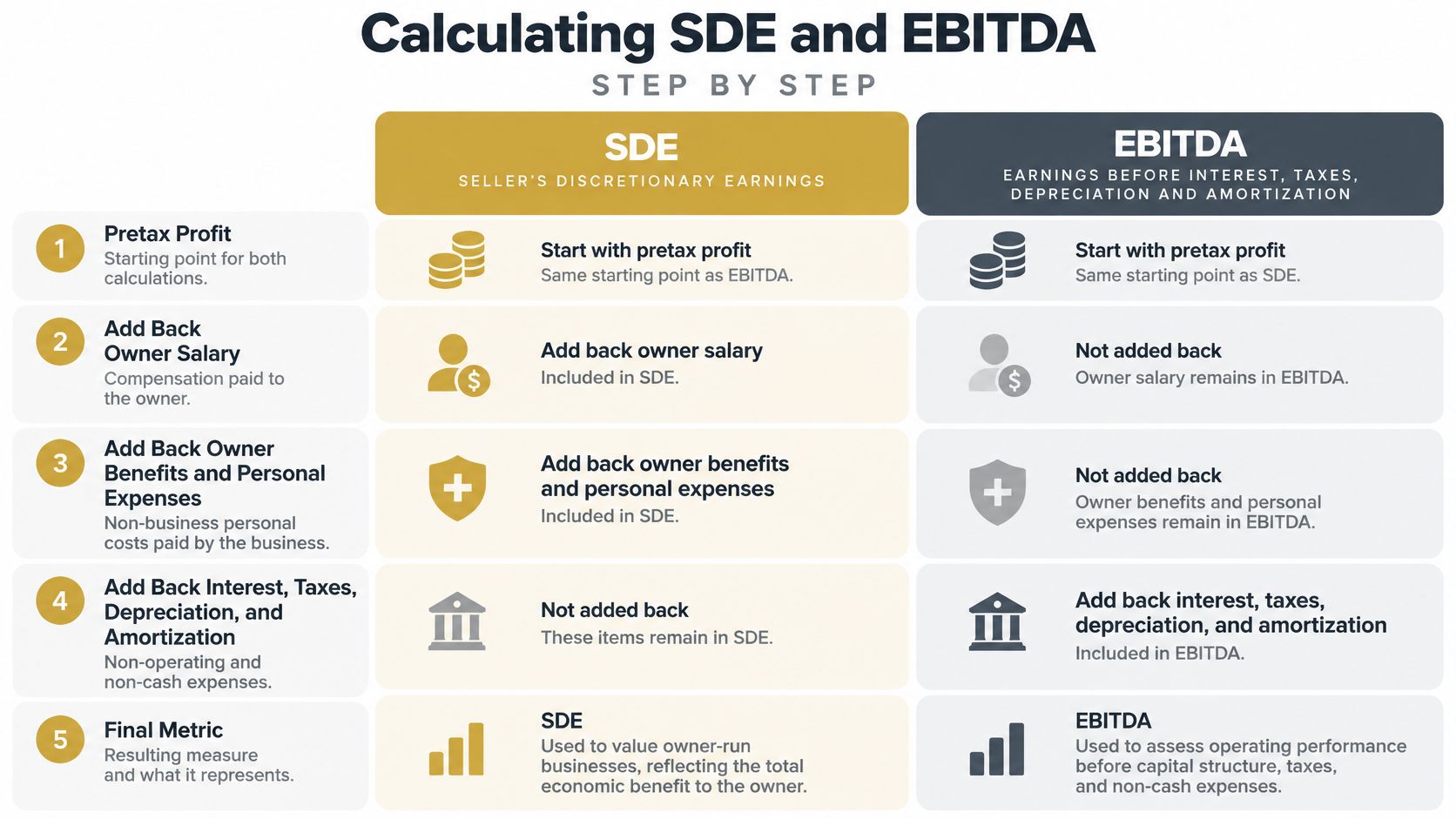
Take normalized operating earnings before owner compensation of $400,000 and a market replacement salary of $120,000. SDE can sit near $400,000. EBITDA can sit near $280,000. Nothing in that gap is an accounting error. It is the cost of the person who runs the company. If you will not do that job yourself, the $120,000, plus the payroll burden on it, is cash you cannot pledge to debt service.
The seven checks, in order
- Confirm the period. Pull the trailing twelve months of profit and loss, or the tax return that matches the period the seller quotes. A common slip is a mismatched period, where the quoted figure comes from a fiscal year that happened to include a large one-off contract.
- Add back interest, taxes, depreciation and amortization to reach pretax operating profit. These four items sit on the same side of the line for both metrics, so they are rarely where the argument starts.
- Add back the owner's salary, benefits and personal expenses, one document per item. A personal vehicle booked as a business cost, or family health cover buried in payroll, is a classic slip. No invoice, payroll register or bank statement means it is not an add-back yet.
- Remove one-time expenses and unrelated income or expenses, with a written reason for each. Watch the "one-time" legal bill that shows up every year. Recurring costs dressed as one-time items are a frequent way earnings get overstated, and add-backs are a common place to look for it.
- The result is SDE. This is what a self-funding owner-operator can reasonably expect to take out in a year, before debt service and taxes.
- Subtract a market-rate replacement salary to reach EBITDA. Use the wage required to hire someone for the seller's actual job in your market, not the seller's historical draw. I would rather overstate that wage than underwrite a loan on the seller's below-market paycheck.
- Compare the multiple only against the matching band from the table above. Metric first, band second, multiple third.
Why the gap exists: SDE is what one working owner can take out. EBITDA is what remains for capital providers after managers are paid. The distance between those numbers is the cost of the operator, and that cost comes out before you size debt.
Run the same math the other way. A company showing $300,000 of EBITDA and $180,000 of owner compensation may show approximately $480,000 of SDE, subject to normalization and verification, as Corporate Finance Institute's guide to seller's discretionary earnings sets out. The add-back is real on paper. It disappears from spendable cash the moment you hire someone to replace what the seller did.
Where listings get inflated
Listings often look strongest in the add-back schedule. That is a common place to look when earnings seem high, and it is where a careful buyer can earn the diligence budget back. Every add-back needs an invoice, a payroll record or a bank statement. Ask for the general ledger, not the summary.
If the target's books run on Sage 50, Snyp's guide to Sage 50 is worth an hour before you request the file, because you'll want to pull owner's draws, personal expenses and one-time items straight from the nominal codes rather than trusting a prepared schedule.
The sharper add-back questions buyers should ask start with who signed the check and which account it cleared from.
Documents to request before you accept any figure:
- Three years of tax returns and profit and loss statements, so you can see whether the earnings are stable or a single good year.
- Twelve months of bank statements, matched against the P&L so deposits and expenses reconcile.
- Payroll registers and benefits schedules, including every family member on the payroll.
- Add-back support, itemized by line, with a receipt or statement attached to each one.
A seller who can't produce that package inside a week is telling you something about the quality of the number.
Turning SDE Into Post-Close Cash Flow
A quoted SDE is not cash in your account on day 30. It's a statement about what the seller took out of the business while doing a job you'll have to either do yourself or pay somebody to do.

Choosing the right measure of cash flow makes the point that SDE adds back one owner's compensation, while the buyer still needs to pay themselves or hire a replacement operator after the acquisition. That replacement salary comes straight out of the cash available for loan payments. It can make an apparently attractive multiple economically misleading.
So build the bridge from stated SDE to debt-service capacity, line by line.
| Line item | Example amount | What it depends on |
|---|---|---|
| Stated SDE | $300,000 | Listing figure after the seller's add-backs |
| Replacement operator salary | minus $120,000 | Whether the buyer pays themselves or hires a manager |
| Payroll taxes and benefits on that salary | Pull from the payroll register, not the listing | Jurisdiction and benefit plan |
| Maintenance capital expenditure | Average the seller's last three years | Equipment or vehicles the seller may have deferred |
| Working capital build | Read receivables and inventory days off the balance sheet | Inventory and receivables needed for growth |
| Cash available for acquisition debt service | Below $180,000 once the lines above are deducted | Result after the lines above |
Fill the unknown lines from due diligence, not from optimism. A business with $300,000 of stated SDE may not support debt as though it generated $300,000 of free cash flow if the buyer requires $120,000 of compensation and the company has material reinvestment needs. The same logic runs through how cash flow is assessed in an acquisition, where the question is always what's left after the business has funded itself.
Here's the contrarian part. A lower SDE multiple does not necessarily mean a cheaper or safer deal. The decisive figure may be the cash left after paying the person who runs the business, and two listings at the same multiple can produce very different post-close remittances once replacement labor, deferred maintenance and working capital are priced in.
Model it before you tour it: if the post-close cash doesn't cover debt service at 1.25x, the multiple on the listing is irrelevant. The deal doesn't work at any price you can finance.
Which Metric Fits Your Deal
A listing quotes SDE, and the broker already has a multiple attached. The number that belongs on your offer is the one that matches who runs the business the morning after close, and what cash remains once that person is paid.
Transactions below approximately $2 million in value are typically priced using SDE. Deals from $2 million to $50 million more commonly use EBITDA. The larger cohort usually has management depth, institutional process and room to scale, so a multiple from one band is not a benchmark for the other.
The owner-operated case. Value under about $2 million, and you plan to work in the business full time. Price on SDE. You are buying a job and a cash flow together. Still put a replacement-salary line in the model. If you step back later, that salary is what the business has to fund before anything is left for debt service.
The managed case. The company already runs without its founder, managers are on payroll, and you intend to keep them. Underwrite on EBITDA. Their compensation is a permanent cost. Leaving it out flatters the earnings you can send to the lender.
The transitional case. The seller is the operator, and you plan to hire a manager within a year. Let the broker market SDE if they want. You underwrite EBITDA after the new salary, not the seller's discretionary number. You are buying the managed case on a twelve-month delay. Price the delay: a year of owner labor, then a permanent manager whose pay comes out of the cash the listing treated as free.
Concentration sits next to the metric, not after you have fallen for the earnings. One customer above 15% of revenue is a weakness. Above 25% is a risk factor priced into the offer. Above 40% changes the deal structure. A business that lives on one contract has SDE borrowed from someone else's purchasing department, and that cash is a poor base for debt no matter which multiple the listing prints.
For the seller-side view of the same choice, when to use seller's discretionary earnings shows how the metric changes what gets marketed and to whom.
The differentiator in one line: SDE asks what one owner can earn from the business, while EBITDA asks what the business earns without that owner.
Three mistakes account for most badly priced offers:
- Applying an SDE multiple to a company that needs a manager. You pay for earnings that leave with the seller, then find the replacement operator consumes the cash the loan was supposed to use.
- Accepting EBITDA from a seller with no add-back documentation. A clean EBITDA claim with no invoices behind it is a wish with a spreadsheet attached.
- Comparing listings across different earnings bands. A 3.1x SDE deal and a 4.0x EBITDA deal are not on the same scale. Stacking them in one spreadsheet ranks nothing.
Confirm the Metric Before You Make an Offer
Before you submit a letter of intent, settle three things in writing.
- Rebuild both figures from tax returns and bank statements. Reject any add-back without a document behind it. You should be able to state the SDE number and the EBITDA number to the nearest thousand, each with a schedule attached.
- Apply the multiple from the matching deal-size band, never crossing SDE and EBITDA. That produces an indicated value you can defend when the lender or your equity partner asks how you got there.
- Run the post-close cash flow bridge and confirm debt service coverage before you name a price. You want the cash left for loan payments written down, not assumed, because that's the number that determines whether you sleep after closing.
Customer verification belongs in the same week, not the week after. The process we teach at Dealmaker Academy has four parts: a customer interview process, a concentration analysis, a contract review and a retention risk assessment. If the earnings depend on three accounts, you need to know how those accounts behave before you sign.
We also keep specialty coaches for capital raising, operations, financial due diligence, M&A legals and contracts, post-acquisition growth, post-acquisition transition and integration, and deal origination, which matters when the metric question turns into a diligence question and you need a practitioner in the specific area rather than general advice.
This guide is education, not personalized financial advice. Confirm the figures with a qualified advisor, and with your lender, before any offer is signed.
Then keep one sentence ready for the broker: which metric is this listing built on, and what does the owner plan to do after closing? A clear answer to both parts tells you whether the listed figure is usable at all.
Dealmaker Wealth Society teaches acquisition entrepreneurs how to read a seller's numbers the way a buyer should, from the first screening call through to post-close integration. If you're working through a live deal and want help rebuilding SDE into a cash flow you can take to a lender, the courses, live coaching and peer community give you practitioners to test the arithmetic against. Visit Dealmaker Wealth Society to see how the training and deal support fit together.

From the Dealmaker Blog












A Creative Business Buying Fable