What Is Capital Raising and How It Powers SMB Deals
What Is Capital Raising and How It Powers SMB Deals
You've found a business that looks solid on paper. The seller has clean books, customers keep coming back, and the asking price feels reasonable. Then you do the math and hit the same wall almost every first-time buyer hits, your savings cover only part of the purchase, and the rest has to come from somewhere else.
That gap is where capital raising enters the deal. In plain English, it's the structured process of getting outside money from lenders, investors, or sellers, in exchange for ownership, a repayment obligation, or some mix of both. For SMB acquisitions, that matters because you're not trying to fund an idea from scratch, you're trying to buy a cash-flowing asset without breaking the business before you own it.
Table of Contents
- The Moment Every Buyer Hits the Funding Wall
- The Core Decision Every Capital Raise Forces
- The Main Types of Capital Available to a Buyer
- How the Capital Raising Process Actually Unfolds
- Why Instrument Choice Changes the Deal You End Up Owning
- What Is Changing in Capital Raising Right Now
- Common Misconceptions That Trip Up First-Time Buyers
- Putting It All Together and Answering the Next Questions
The Moment Every Buyer Hits the Funding Wall
A first-time buyer usually discovers capital raising at the worst possible moment, right after finding a business they want to buy. The purchase price may look reachable at first, then the down payment, fees, working capital, and closing reserves all arrive together on the same page. At that point the question stops being, “Is this a good business?” and becomes, “How do I get this closed?”
What capital raising means in a buyout
For an acquisition buyer, capital raising is the process of sourcing money outside the buyer's own pocket to complete a purchase. That money can come from an investor who wants a piece of the business, a lender who expects repayment with interest, or a seller who agrees to leave some of the price behind on deferred terms. In many real deals, it comes from more than one source at once.
That is why SMB buyouts feel different from launching a startup. A founder can often start small, test the market, and raise money later. A buyer has to line up the capital before closing, because the seller wants certainty and the deal usually only works if the funding is assembled in advance.
Why this matters more for buyers than founders
Acquisition entrepreneurs are not just asking, “Can I raise money?” They are asking, “Can I raise the right kind of money for this exact business?” The answer affects whether they keep control, how much monthly pressure the company carries after close, and how much flexibility they have if growth slows.
A buyer also has to match the money to the machine being bought. A steady, cash-generating service business can often support more debt than a thinner-margin company with uneven collections. A business with strong assets may give lenders more comfort, while a business built on relationships or recurring service contracts may push the buyer toward seller financing, equity, or a mix of structures.
That is the fundamental shift in SMB acquisitions. The financing choice is part of the asset purchase itself, because it shapes who gets to make decisions, who gets paid first, and how much strain lands on the business after closing.
Practical rule: If the purchase can't close without outside money, capital raising is part of the deal, not a separate task.
The Core Decision Every Capital Raise Forces
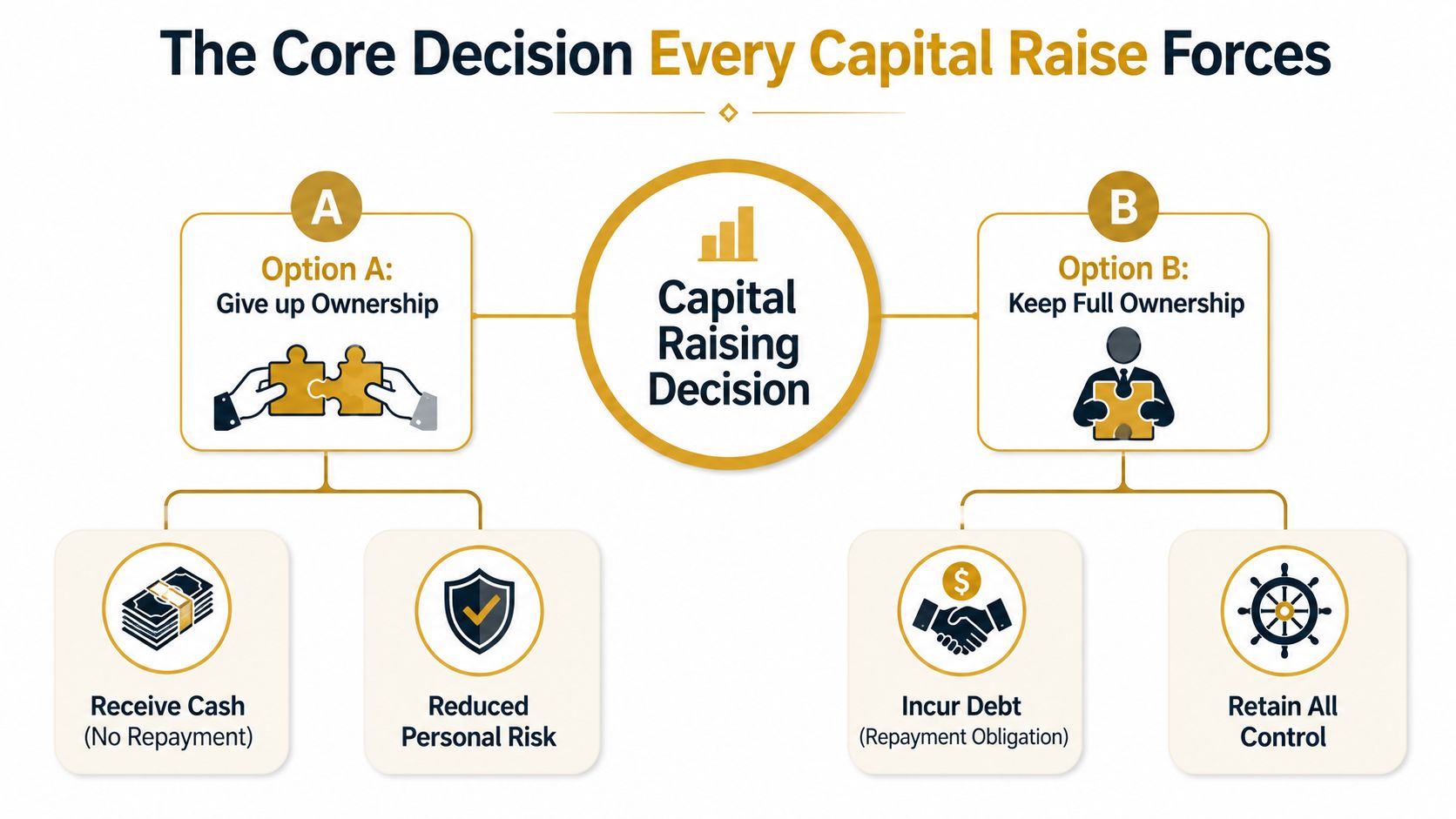
Every capital raise comes down to a trade-off. You either give up some ownership in exchange for cash that doesn't need to be repaid, or you borrow money that must be paid back with interest but leaves ownership more intact. That choice sits underneath almost every acquisition funding conversation, even when the term sheet looks complicated.
Ownership versus repayment
Imagine buying a rental building. Selling part of the building to a partner brings in cash, but the partner now shares the upside and the decision-making. Taking a mortgage keeps the building in your name, but the bank expects monthly payments and can constrain what you do if the numbers get tight.
That same logic applies in SMB acquisitions, except the asset you're buying is usually already producing cash flow. The better that cash flow, the easier it is to support debt. The more uncertain the cash flow, the more tempting equity or hybrid capital becomes.
Why hybrids show up so often
Real buyouts rarely stay cleanly on one side of the line. A buyer might combine personal equity, bank debt, seller financing, and a small investor piece because each source solves a different problem. One fills the funding gap, another reduces repayment pressure, and another makes the seller more comfortable with the closing structure.
The key is to see the trade-off clearly before someone pitches you a “simple” structure that isn't simple at all. Capital raising is never just about cash in. It's about who gets control, who gets paid first, and who carries the risk if the business stumbles.
The Main Types of Capital Available to a Buyer
A buyer's funding menu is usually wider than it first looks. One source may protect control, another may reduce monthly strain, and another may make the closing math work. The label matters because each type of capital sits in a different place in the stack and changes what the buyer owes, who gets influence, and how much room the business has after closing.
A first-time buyer often runs into a simple question disguised as a financing problem. Which source is acting like a partner, which one acts like a lender, and which one is somewhere in between?
Common options in SMB acquisitions
Equity from individual investors or search fund backers means someone puts money into the deal or the holding company in exchange for an ownership stake. In an acquisition, that capital usually takes more risk than senior debt, but it can lower the amount of borrowing the operating company has to support.
SBA and conventional bank debt are the familiar lending options. They tend to fit buyers when the target has steady cash flow and the deal can satisfy underwriting. Bank financing is attractive because it preserves ownership, yet it also puts repayment pressure on the business from day one.
Seller financing is common in SMB deals because part of the purchase price can stay unpaid after closing. That structure can make a deal workable for a first-time buyer, especially when the seller wants a smoother handoff and more confidence that the business will be run well after the sale.
Mezzanine and other hybrid instruments sit between debt and equity. They help when senior debt is not enough to cover the purchase, but the buyer does not want to give away full equity control. In deal terms, they act like a bridge between borrowing and ownership sharing, which is why they often show up when the funding stack needs one more layer.
Private placements and Reg D offerings are another way to raise capital privately, especially when the acquisition is too specific for a public raise. The SEC's Regulation D offerings page shows that this channel remains part of private-market fundraising, which is why many small and mid-sized acquisition plans treat it as part of the toolbox rather than a niche exception (SEC Regulation D offerings).
If you are comparing support programs or financing setups outside the U.S., a practical overview like business support in Ireland can help you see how grants, support structures, and company setup questions interact with financing.
For a buyer who wants a broader map of alternatives, this internal guide on financing options for buying a company is a useful companion once you know which category you are dealing with.
A clean way to read any pitch is to ask, “Is this money asking for equity, repayment, or a hybrid claim on the business?”
How the Capital Raising Process Actually Unfolds
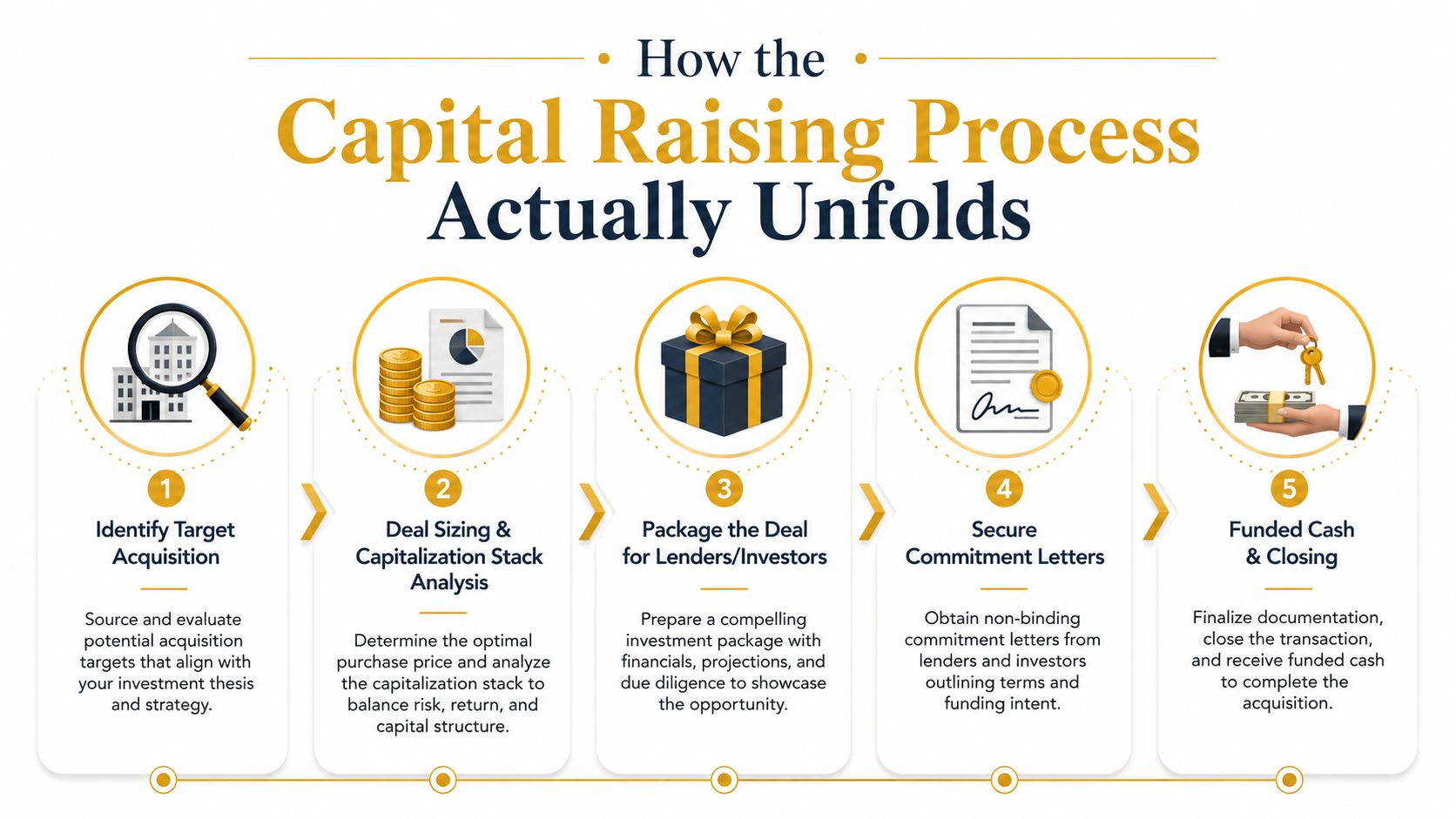
A buyer does not raise acquisition capital by sending a few emails and waiting for money to appear. The process starts with the target itself, because every lender or investor wants to understand what is being bought, how the purchase will be funded, and whether the structure fits the business. If that story is unclear, the raise slows quickly.
From target to transaction package
The first step is deal sizing. That means mapping the purchase price, the needed equity, the debt capacity, and the working capital requirement into one capitalization stack. A first-time buyer can miss how these pieces fit together, so it helps to treat the raise like a funding blueprint, where each source has a job and each job affects the others.
Then the buyer has to turn the opportunity into a package a lender or investor can read quickly. Clean financials, a clear use of funds, and a short explanation of why the business can support the structure usually do more for the conversation than a long generic memo.
A strong pitch deck matters here because different funders care about different details. If you need a practical framework for that work, build a credible pitch deck is a helpful reference for organizing the story before you start outreach.
Where SMB deals slow down
The friction usually shows up during diligence and underwriting. Banks want to review historical performance, customer concentration, debt service capacity, and borrower credibility. In a buyer-led deal, that can take longer than people expect because the buyer does not own the asset yet, so the lender has to underwrite both the business and the person trying to buy it.
A small-business acquisition can feel simple at the letter-of-intent stage and much more demanding once the documents start moving. Every missing tax return, contract, or add-back explanation can send the file back for clarification, which is why organized records often matter as much as the quality of the company itself.
Deal reality: A buyer often loses time not because the business is bad, but because the documents are not ready when the funding conversation starts.
The close itself happens alongside the acquisition documents. Commitment letters, final approvals, and funding instructions need to line up with the purchase agreement, or the deal slips. A buyer also has to keep the funding stack coherent, since one source may depend on another source staying in place until closing. For a closer look at how buyers shape that stack, this guide on business acquisition funding strategies is worth reviewing.
Why Instrument Choice Changes the Deal You End Up Owning
The financing mix doesn't just get you to closing, it shapes the business you wake up owning the day after. A debt-heavy deal and an equity-heavy deal can buy the same company, yet leave the buyer with very different monthly pressure, decision freedom, and exit economics. That's why instrument choice is a strategic decision, not a paperwork detail.
Cash flow, control, and exit math
A mostly debt-financed buyout usually preserves more ownership for the buyer, but it also creates fixed repayment pressure. That means less room for mistakes, less tolerance for a rough quarter, and more attention on cash conversion. A mostly equity-financed deal lowers that repayment burden, but the buyer gives up more of the future upside and usually shares more control.
The hidden issue is often not the size of the raise, it's the terms attached to it. Covenants can restrict behavior, preferences can change who gets paid first, and board or approval rights can narrow what the buyer can do without consent. Those terms matter because they shape operating freedom after close, not just ownership on paper.
For a direct comparison of how these structures behave in buyouts, this internal guide on comparing equity and debt financing for acquisitions is a good next read.
The terms buyers should watch most closely
The first-time buyer should pay especially close attention to a short list of deal terms:
- Covenants: These can limit borrowing, spending, or other actions if performance weakens.
- Liquidation preferences: These affect who gets paid first if the business is sold or wound down.
- Board or approval rights: These can give investors practical control even without majority ownership.
- Repayment timing: This determines how much pressure the company will carry every month.
The cleanest lesson is this. Capital raising is really the art of deciding which obligations you're willing to carry in exchange for the business you want to own.
What Is Changing in Capital Raising Right Now
A first-time buyer can feel the shift in capital raising before the term sheet ever arrives. The market is asking for cleaner books, faster answers, and a clearer plan for how the money will behave after close. For SMB acquisitions, that means the raise is judged less like a simple yes or no and more like a test of whether the buyer can keep the deal and the business steady at the same time.
Public-market strength sends a signal
The SEC reported that in Q1 2026 there were 99 IPOs raising over $22 billion, compared with 84 IPOs raising over $11.8 billion in Q1 2025, which the SEC said represented an approximately 86% increase in proceeds raised. Follow-on registered offerings also rose to 264 deals raising over $44.2 billion, versus 250 deals raising over $40.4 billion a year earlier (SEC market statistics release).
That public-market strength matters even for buyers of private businesses. When larger capital channels show more appetite, the signal often reaches smaller transactions too. Sellers may become more open to negotiations, investors may move with more confidence, and lenders can become more willing to consider structured capital because the broader market feels less cautious.
Execution speed now matters more
Recent industry guidance also places more weight on faster due diligence, digital document exchange, and investor-ready materials as part of modern capital raising (Intralinks guidance on capital raising). For a buyer of a small business, that changes the practical side of the raise. A deal can stall if the financial package looks scattered, even when the target itself is sound.
The easiest way to see it is this. Capital raising now works a lot like arriving at a bank or investor meeting with a partially filled toolbox. If the tools are organized, the other side can assess the transaction quickly. If the records are messy, every answer creates another question, and the financing conversation slows down.
Keep the financials current, build the data room early, and decide which source of capital you want to lead with before the process starts. The buyer who is easier to underwrite often gets a better hearing than the buyer who is still assembling the story while everyone else is waiting.
A useful next read on acquisition funding methods can help you think through the order in which debt, seller support, and equity usually come together in a buyout.
Bottom line: Better market conditions help, but a buyer still wins funding by being easier to underwrite than the next person.
Common Misconceptions That Trip Up First-Time Buyers
First-time buyers usually don't get stuck because they lack a target. They get stuck because they carry the wrong assumptions into the raise. Those assumptions can make a workable deal look impossible, or push a buyer toward a structure that weakens the business after closing.
The myths that cause avoidable mistakes
Myth one, banks only finance deals at prime rates. The issue isn't a single rate, it's whether the business can support the repayment load and whether the structure satisfies underwriting. A buyer who assumes bank money is off the table may walk away too early.
Myth two, equity always means losing control. Equity does mean sharing ownership, but control depends on the actual rights negotiated. Some investors want economics more than day-to-day control, while others may accept a smaller role if the terms are clear.
Myth three, seller financing means the business is weak. In SMB deals, seller financing often reflects alignment, not distress. A seller may use it to show confidence in the handoff and keep some of the upside tied to post-close performance.
Myth four, creative structures scare off serious investors. Serious investors usually care more about whether the logic is coherent than whether the structure is conventional. A thoughtful blend of debt, seller notes, and equity can be more attractive than a rigid all-or-nothing ask.
The process myth is just as damaging
Many buyers also think they need a full investment-bank process to raise a modest amount for a small acquisition. They usually don't. They need a clean story, a usable financial package, and a target list of the right capital providers. That is a very different job from a public offering or a large institutional raise.
A small acquisition often fails to fund because the buyer tries to look bigger than the deal needs, not because the deal is unfinanceable.
If you want a deeper look at funding choices in acquisition settings, the earlier section on the capital mix is the one to revisit before you start talking to money sources.
Putting It All Together and Answering the Next Questions
The simplest way to think about capital raising is this. First, define the trade-off between ownership and repayment. Second, choose the capital mix that fits the deal. Third, run the process with clean documents and a tight story. Fourth, pressure-test the terms that will govern the business after closing.
A few questions usually come up right after that:
How much capital does a first-time SMB buyer need? It depends on the target, the price, and the funding structure, so there's no universal number to memorize. The better question is how much equity, debt, and seller support the specific deal can absorb without choking cash flow.
Is capital raising the same as fundraising? Not exactly. Fundraising is the broad idea of getting money, while capital raising usually refers to a more structured financing process tied to a business transaction or corporate purpose.
How long does a small buyout raise take? It can move quickly when the target is clean, the buyer is prepared, and the funding sources are familiar with the asset. It slows down when diligence is incomplete or the buyer is still figuring out the structure.
Should I mix personal funds, debt, and outside investors? Often, yes, if the mix improves the odds of closing and leaves the company healthy after close. The best structure is the one that lets the acquisition survive its first year with enough cash and enough control to execute.
If you're serious about buying a business, don't treat financing as a side topic. Visit Dealmaker Wealth Society to learn how acquisition buyers structure deals, raise capital, and close with more confidence. The right framework can save you from funding mistakes that show up long after the ink dries.










A Creative Business Buying Fable