Post Merger Integration Plan: Your Step-by-Step Roadmap
Post Merger Integration Plan: Your Step-by-Step Roadmap
The wire has cleared, the seller's founder is still answering emails, and your buyer team is staring at a company that is legally yours but operationally nobody's. That's the moment the post merger integration plan stops being a nice-to-have and becomes the only thing standing between a clean close and a slow leak of customers, employees, and momentum. If you've bought a small business, or you're doing your first search-fund roll-up, you already know the truth. The deal doesn't get won on signing day, it gets won in the messy weeks after.
Table of Contents
- Why Most Acquisitions Fail After the Deal Closes
- Build Your Integration Operating Model and Name the Owners
- Milestones From Day 1 Through Day 180
- Synergy Capture Playbook by Category
- A Bolt-On Integration Scenario You Can Model Against
- Tracking Template and Weekly Cadence
- Avoiding the Traps That Sink Otherwise Good Integrations
Why Most Acquisitions Fail After the Deal Closes
The wire clears, the signatures are dry, and the buyer still has not named the person who will run integration. The founder is still in the building, the bookkeeper is still using the old process, and the first customer call after close lands in a gray zone where nobody knows who should answer. That gap is where value starts to leak out.
A practical post merger integration plan is not a deck. It is a sequence of decisions about people, systems, vendors, and communications, laid out before close so the team can act without guessing. Experienced buyers treat the first months after close as a finite window, because the hard part is not signing the deal, it is getting the new operating rhythm in place before confusion starts to spread.
What the target team reads immediately
Employees do not wait for a strategy memo. They watch whether payroll arrives on time, whether their manager still has authority, and whether the founder still makes every decision. If the first week feels improvised, key people assume the buyer is still figuring things out and start updating their résumé.
Customers and vendors read the same signals. A vague handoff creates duplicate promises, missed service levels, and confusion over who approves pricing or returns. If you are financing the acquisition with debt, that pressure shows up fast, so a resource like SBA lender options for acquisitions can help you think through capital structure and closing support before integration even begins.
Practical rule: the first week should reduce uncertainty, not create more of it.
I have seen small acquisitions go sideways because the buyer treated integration as something to figure out after close. That sounds workable until day 12, when the seller's top employee is half-engaged, the books do not tie to the dashboard, and three vendors are waiting on approvals from people who no longer exist in the old org chart. A written plan keeps that drift from turning into a long, expensive mess.
Build Your Integration Operating Model and Name the Owners
Before you pick dates, build the temporary machine that will run the deal. The integration team is not the combined company's permanent org chart, it's the short-term operating model that keeps the business stable while you change how it works. If nobody is explicitly accountable, every workstream turns into a side job.
Start with one accountable integration lead
Name one person who owns the integration end to end. In a small business deal, that's often the buyer, the buyer's operating partner, or a hands-on COO type who can push decisions through. The seller's founder can stay involved, but only with a defined role, usually as advisor, commercial rainmaker, or transition lead for a limited period.
The Integration Management Office, even if it's just two or three people, should track decisions, deadlines, and open issues. That group needs authority, not just note-taking skills. When deal contract terms matter, especially around transition services, seller support, and obligations that carry past closing, a guide to deal contract management is useful because the operating plan has to match the signed documents.
Give each workstream a real owner
Workstreams should map to the functions that break after close, sales, operations, finance, technology, HR, and customer success. The buyer-side owner needs decision power. The target-side owner needs enough standing to keep the team moving and enough trust that the seller's people won't feel replaced overnight.
| Workstream | Buyer-Side Owner | Target-Side Owner | Primary Deliverable |
|---|---|---|---|
| Sales | Commercial lead | Founder or sales manager | Customer communication and pricing alignment |
| Operations | COO or operator | Operations manager | Process handoff and service continuity |
| Finance | Controller or CFO | Bookkeeper or finance lead | Reporting, cash visibility, and billing control |
| Technology | IT lead or outsourced MSP | Internal admin or vendor contact | System access and migration plan |
| HR | People lead or admin | Founder or office manager | Retention, payroll, and role clarity |
| Customer Success | Account lead | Service manager | Escalation path and client reassurance |
A good RACI for the first 180 days should fit on one page. If you can't explain who decides, who executes, and who gets consulted in five minutes, the integration is already too loose.
The founder shouldn't disappear on day one, but the founder also can't remain the de facto bottleneck.
For a deeper leadership lens on that balance, the internal discussion on leadership alignment in acquisitions is worth reviewing because ownership drift is one of the fastest ways to stall momentum. Dealmaker Wealth Society also teaches acquisition operators how to structure these handoffs in small-team environments, which matters when you don't have a corporate integration staff to lean on.
Milestones From Day 1 Through Day 180
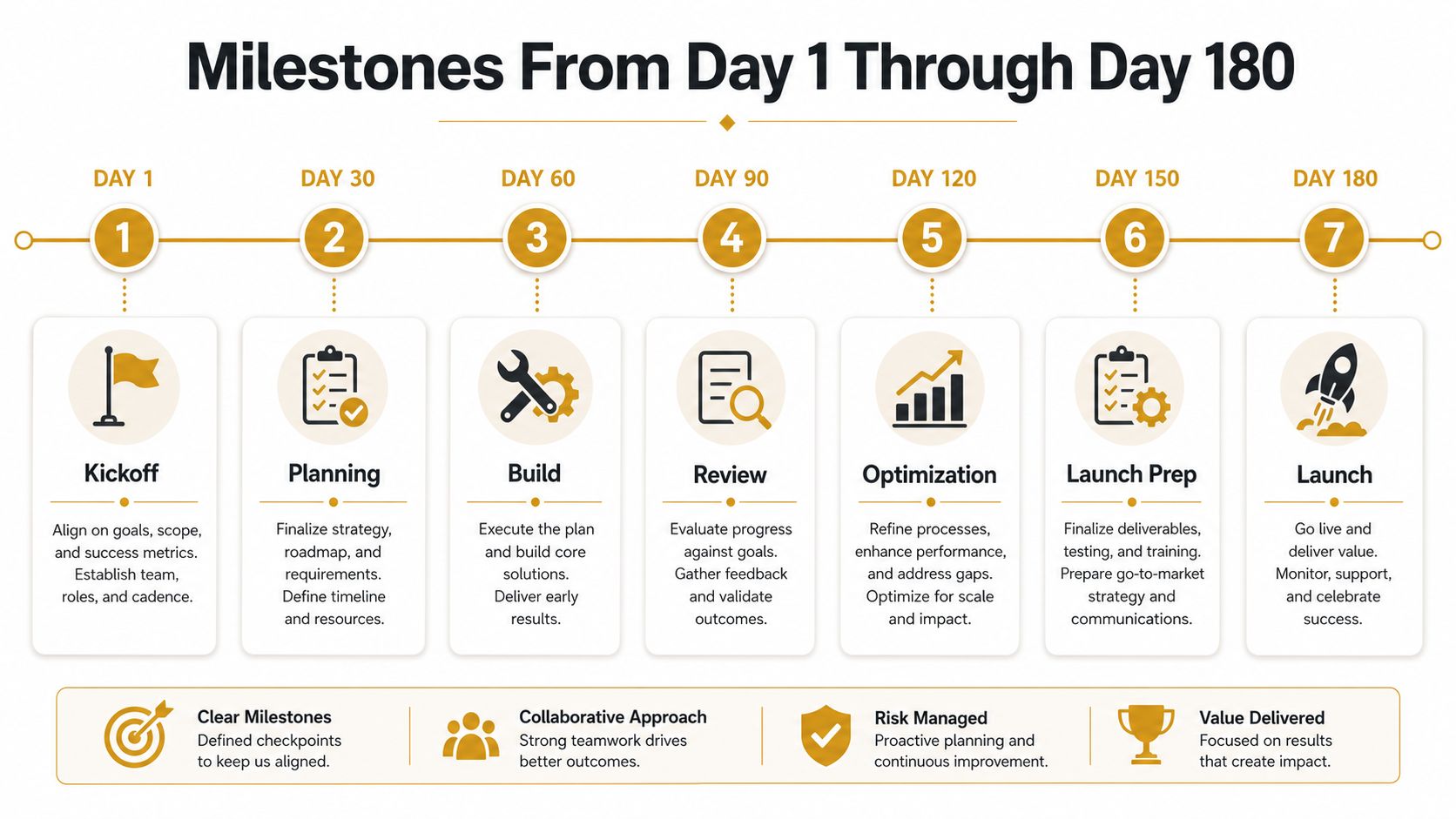
The best post merger integration plan reads like a calendar, not a slogan. Corporate buyers often live by detailed milestone gates because they know that missing one dependency can cascade into missed synergies. Small business buyers need the same discipline, just in a lighter format that a founder, a controller, and an outsourced IT provider can use.
Day 1 through week 2, stabilize and communicate
Day 1 is for access, payroll, customer messaging, and issue triage. Nobody should be wondering where to log in, who signs checks, or whether their job changed overnight. If the seller is still present, set the tone early, the founder is there to reassure, not to rewrite the org chart on the fly.
Weeks 1 and 2 should also lock down the daily operating rhythm. Short check-ins beat long meetings at this stage because the business is still settling, and the most urgent problems are usually practical, not strategic.
Weeks 2 through 6, retain and map dependencies
Once the lights are on, identify which people, vendors, and systems carry the most risk. You line up retention conversations, confirm who owns key accounts, and make sure no critical vendor relationship depends on one personal text thread. A small buyer can't afford to discover that the entire freight arrangement, client billing process, or production schedule sits in someone's memory.
Months 2 through 3, standardize reporting and core systems
By this point, the buyer should be consolidating dashboards, cash reporting, and operating reviews. If the acquired company still runs on a separate reporting rhythm after two months, you're paying for overlap without getting control. Internal workflow planning in the earlier integration planning for business acquisition guide is a useful companion when you're setting those first hard dates.
Months 4 through 6, execute synergy moves
Vendor consolidation, pricing alignment, back-office cleanup, and role redesign should be actively delivering value. The first 100-day review should not be a victory lap, it should be a gap analysis against the remaining work. By day 180, the business should be operating on one reporting system, one set of owners, and one visible list of remaining integration items.
Synergy Capture Playbook by Category
Synergies only matter when each one has an owner and a deadline. I split them into revenue, cost, and people because that is how they surface in a small business after close, and because each category needs a different operator watching it. The common mistake is treating synergy as a finance exercise after the operating team has already moved on. By then, the easy wins are usually gone.

Revenue synergies need commercial ownership
Revenue ideas start to slip when nobody controls the follow-through. Cross-sell only works if someone can name the customer, the offer, the price point, and the rep who will make the call. Pricing alignment needs a decision maker too, because old discount habits can drag the new margin structure back to where it started.
A revenue register can fit in one spreadsheet. I keep it to four fields, the hypothesis, owner, 90-day target, and tracking metric. A row might read, “bundle the acquired product into the buyer's existing customer list,” owned by the commercial lead, with outreach completion and proposal conversion as the check points. That is enough structure to keep the idea alive without pretending a small buyer needs a consulting deck.
Cost synergies need deadlines, not theory
Cost work usually starts with vendors, software, facilities, and duplicate admin roles. The job is to remove overlap after service continuity is protected. In small businesses, the fastest savings often come from stopping two teams from paying for the same tools, payroll services, or outsourced support.
One source on PMI statistics notes that successful acquirers often commit real integration budget up front, and that deals where synergies are explicitly validated and tracked from the start tend to perform better (PMI statistics). That point matters because underfunded integration usually creates more waste than it removes. If you do not have budget for a clean handoff, you usually end up paying for rework, churn, and extra management time.
People synergies are usually the hardest
People work is less about cuts and more about clarity. Retention bonuses can make sense for the two or three people who know how the business runs, but money alone will not fix a messy transition if their role is fuzzy. Leadership succession also has to be explicit, because a founder who keeps stepping back in creates confusion fast.
Use one spreadsheet, not a slide deck. If the synergy list cannot be updated weekly by an operator, it will not survive contact with the business.
For risk control, I would point buyers to the integration risk mitigation guidance at this business integration risk mitigation guide and keep the owner names visible beside each workstream. The same discipline fits with the thinking behind Paradigm International strategies, where risk is managed through named accountability rather than vague oversight. In practice, that means the finance lead watches reporting, the commercial owner owns customer retention and cross-sell, and the operations owner tracks process stability before anyone starts reshuffling headcount.
A Bolt-On Integration Scenario You Can Model Against
A buyer acquires a $3M revenue eCommerce brand and folds it into an existing portfolio company. The founder stays on for transition, but the buyer names a commercial owner, an operations owner, and a finance lead on day one. The first call is to the two top performers, because if they leave, the deal's operational memory walks out the door with them.
During the first two weeks, the buyer sets retention agreements for those two people and maps every recurring process, order flow, customer escalation, and supplier contact. That's not glamorous work, but it's what keeps a bolt-on from feeling like a hostile takeover. The founder keeps handling a few legacy relationships, yet every important task has a named replacement.
By month two, the order management system is migrated into the buyer's environment, and the reporting cadence shifts to the buyer's weekly dashboard. The freight contract is renegotiated after volume is visible across both businesses, so the buyer can push for a cleaner commercial structure without risking shipment disruption. The shared services move happens in month three, once the team has enough operating stability to absorb the change without service noise.
The deal's real value comes from small, cumulative moves. The retention spend is easier to defend when it prevents the loss of people who know the product catalog, the returns process, and the customer quirks. The buyer also pushes back on any plan that would force every function to migrate at once, because in a small business, too much simultaneous change makes errors multiply.
I've seen this sequence work because it respects cash, headcount, and attention. A small buyer rarely has a spare layer of management, so the integration has to be sequenced in a way that protects the commercial engine first and the cleanup second. If the buyer tries to optimize everything in month one, the business spends more time adjusting than selling.
Tracking Template and Weekly Cadence
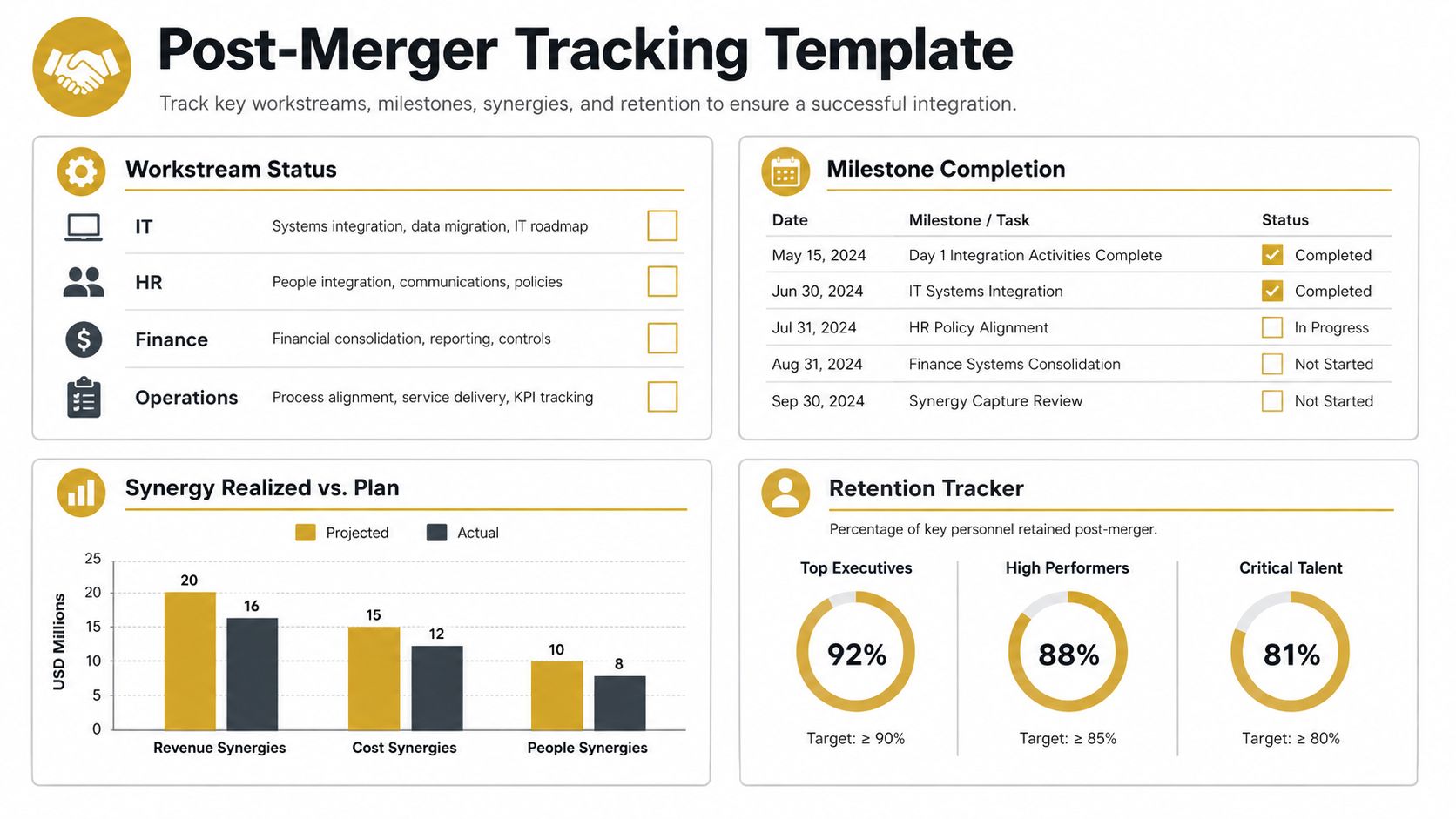
A plan no one tracks turns into a wish list. The simplest useful version is a single spreadsheet or Notion page with five columns, workstream status, milestone completion, synergy realized vs. plan, retention risk, and top three issues. That format is enough for a small buyer, a search-fund operator, or a portfolio COO to see what's moving and what's stuck.
Keep the meeting cadence tight
The first two weeks need a 15-minute daily standup. After that, run a weekly workstream review, then a bi-weekly steering meeting for decisions that need owner input. Short cadence beats a long monthly meeting because most integration problems are about sequence, not strategy.
Each meeting should force a different question. The daily standup asks what's blocked today. The weekly review asks which workstream slipped and why. The steering committee asks what decision unblocks the business fastest.
Make the tracker decision-oriented
Every line in the tracker should answer three things, who owns it, what changed since last week, and what decision is needed. If the status column says “in progress,” it's not enough unless the next step is named. If the retention risk flag is red, the buyer should know whether that means a compensation issue, a role issue, or a communication issue.
Build the sheet so an advisor can read it fast
A good tracker doesn't need color chaos or fifteen tabs. Keep one page visible, one tab for open issues, one tab for synergies, and one tab for retention. If an investor, lender, or operating partner can't understand the current state in under five minutes, the tracker is too complicated for a small-business integration.
The meeting is not the work. The meeting should change the work.
For teams that want a ready-made learning environment, Dealmaker Wealth Society offers acquisition training, templates, and community support around buying and integrating small businesses. That's useful when you need a practical starting point instead of a giant corporate integration binder.
Avoiding the Traps That Sink Otherwise Good Integrations
A deal can look finished on paper and still break in week two. The test is whether the combined business keeps the same customers, same people, and same cash discipline once the closing adrenaline wears off. In small-business integrations, that usually comes down to who owns decisions, how fast issues surface, and whether the buyer treats integration as operating work instead of a side project.
The founder trap
A founder who stays visible without a defined role can turn into a shadow decision-maker. Employees keep checking with the old authority figure, the buyer gets routed around, and the business never really resets. The fix is a written transition plan that spells out what the founder can decide, what they can influence, and the point at which their role ends.
That plan should also fit the business, not a corporate org chart. In a search-fund or bolt-on acquisition, the founder may still know customers, vendors, and tribal knowledge the buyer does not have yet. Give that knowledge a clear path into the new operating model, then remove the ambiguity before it starts creating split loyalty.
The budget trap
Cutting integration spend to protect returns sounds disciplined, but it usually creates more expensive problems later. The earlier discussion showed why buyers need to fund integration with intent, because people issues, system cleanup, and migration work are where small deals often stumble. If you do not budget for retention, data cleanup, advisor time, and the basic operational fixes that follow close, the business will pay for it through confusion and turnover.
Keep the budget tied to actual workstreams. Payroll changes, customer communications, accounting cleanup, and software overlap all cost real time, even when the acquisition itself was small. A buyer who tries to run integration on goodwill alone usually finds that goodwill is not a substitute for headcount.
The operating trap
Synergy tracking cannot sit only in finance. Commercial leaders, operators, and people managers need the same scorecard because that is where the work gets done and where slippage shows up first. For risk controls that fit that operating mindset, the risk mitigation approach for business integrations is a useful internal reference point.
The practical version is simple. Use one 12-month operating rhythm, name the founder transition in writing, and review the core levers every week with the people who can fix them. That is the point where Paradigm International strategies still make sense for a buyer, because integration risk has to be managed as live operating work, not filed away as a post-close note.
A strong post merger integration plan does not end when the first report looks clean. It keeps running until the combined business has one rhythm, one owner set, and one way of making decisions. If you are buying your next company, or cleaning up the one you just closed, visit Dealmaker Wealth Society for training, templates, and acquisition support built for real small-business integration work.
Generated with Outrank tool

From the Dealmaker Blog










A Creative Business Buying Fable