Leveraged Buyout Structure: A Complete Guide
Leveraged Buyout Structure: A Complete Guide
You've found a durable industrial services business, the seller's earnings appear dependable, and the purchase price looks achievable until you build the sources-and-uses schedule. Then the practical questions arrive. How much debt will lenders accept? How much equity must you contribute? What happens to cash flow if a major customer delays a contract, margins narrow, or interest expense rises?
Those questions describe the LBO structure, not an abstract Wall Street formula. The structure determines whether you can close, whether the company can continue investing after closing, and whether your equity still has value when the market turns against you. For a smaller acquisition, there's little room to hide a weak assumption. The interest rate, covenant package, repayment schedule, working-capital reserve, and size of your equity check all show up in the operating business.
Table of Contents
- Why SMB Acquirers Should Care About LBO Structure
- The Core Idea Behind a Leveraged Buyout
- Inside the Capital Stack and How It Is Layered
- Debt Types, Pricing, and Amortization in Practice
- How Equity Returns Get Built in an LBO
- Why the Modern LBO Looks Different From the Textbook
- Modeling Assumptions Worth Pressure-Testing
- Key Takeaways Before You Structure a Deal
Why SMB Acquirers Should Care About LBO Structure
An independent sponsor may be buying an industrial services company with recurring contracts, experienced employees, and enough cash generation to support acquisition debt. The buyer forms an acquisition vehicle, raises equity from partners, secures debt against the target's expected cash flow, and closes the purchase. On paper, the transaction may look straightforward.
The true test begins on the day after closing. The company still needs to pay wages, replace equipment, carry receivables, renew insurance, and deliver every customer contract. Debt service is another fixed claim on the same cash flow. If the structure leaves too little liquidity, a modest operating setback can force the owner to choose between funding growth and satisfying lenders.
Practical rule: Structure the debt around the cash the business can reliably produce, not the cash flow you hope to create after closing.
The historical logic of the LBO explains why this matters. Research from the National Bureau of Economic Research on leveraged buyouts describes financing with 60% to 90% debt and records 17,171 private-equity-sponsored buyout transactions from January 1, 1970, through June 30, 2007. The acquired company's own cash flows support repayment, which distinguishes an LBO from a conventional purchase funded mainly with the buyer's balance sheet.
That debt structure can make a viable acquisition possible for an operator who couldn't pay the full price in cash. It can also magnify losses. If EBITDA falls, the debt balance doesn't automatically adjust, and interest still comes due. In a smaller deal, the sponsor has fewer divisions, geographies, or layers of management to absorb the shock.
The structure affects more than returns
Your financing choices influence the seller's certainty of closing, the amount of cash retained in the business, and your freedom to make decisions after the transaction. A lender may accept a lower purchase price with conservative debt, while a highly levered structure may support a higher bid but leave little room for error.
That's why an acquisition model should be read as an operating plan, not only as a returns calculator. If the model works only when collections accelerate, margins expand, and the exit valuation improves, the structure is carrying more risk than the headline IRR suggests.
The Core Idea Behind a Leveraged Buyout
A leveraged buyout is a purchase funded with a combination of borrowed capital and equity, where the acquired company's future cash flow helps repay the debt. The buyer typically creates a holding company or acquisition vehicle, contributes personal or sponsor equity, brings in co-investors if needed, and borrows against the target's earning power and assets.
The mechanics are easier to understand as a sequence:
- Set the purchase price. Establish the target's enterprise value and identify existing debt, cash, fees, and required working capital.
- Build sources and uses. Sources include senior debt, any junior financing, seller financing, and sponsor equity. Uses include the purchase price, refinancing of old debt, transaction expenses, and cash left on the balance sheet.
- Close through the acquisition vehicle. The new entity buys the operating company, while the debt becomes part of the post-close financing structure.
- Use operating cash flow carefully. Cash pays taxes, employees, suppliers, capital expenditures, interest, and scheduled principal. Excess cash may reduce debt if the documents require a sweep.
- Create value and exit. The sponsor eventually sells, refinances, or distributes value after debt has been repaid or reduced.
Think of the structure like buying a rental property. The mortgage lender receives payment before the owner takes profit, and the rent must cover maintenance as well as the mortgage. A larger mortgage lets the buyer control a more valuable property with less cash, but it also makes a vacancy or repair bill more dangerous.
For an acquisition entrepreneur, the private equity investment strategies guide can provide useful context on how sponsors evaluate opportunities, capital, and ownership. The central principle remains simple: debt increases the equity claim on success, but it also increases the fixed claims that must be honored when performance weakens.
Why lenders participate
Lenders aren't relying only on the buyer's promise. They examine recurring revenue, customer concentration, margins, asset coverage, management quality, historical cash conversion, and the company's ability to service debt under stress. The lender wants a repayment path that remains credible without requiring perfect execution.
The capital stack is the tool that allocates this risk. Senior lenders receive priority and generally charge less. Junior lenders accept greater exposure for higher compensation. Equity sits at the bottom, absorbs the first loss, and retains the residual upside.
Inside the Capital Stack and How It Is Layered
The capital stack ranks every source of acquisition funding by its claim on cash flow and assets. Payments generally move from the top layer to the bottom. The higher a claim sits, the greater its repayment priority and the lower its expected return. The lower it sits, the more risk it carries and the more upside it may receive.
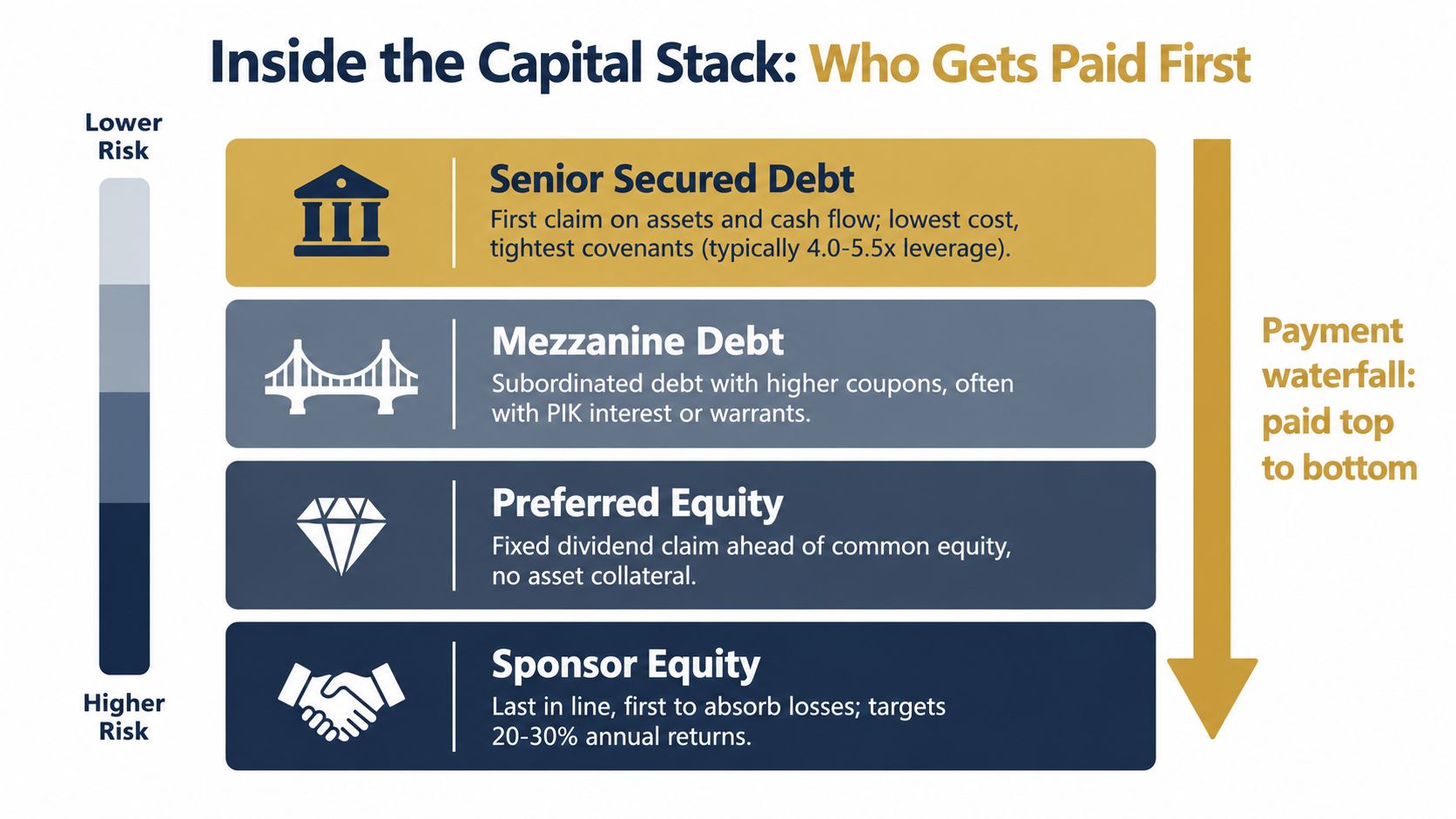
A rental property offers a useful comparison. The first mortgage lender has the strongest claim on the property and rental income. A second lender may receive payment after the first mortgage. A preferred investor may have a contractual return before the common owner, while the owner receives whatever remains after everyone else is paid.
Senior secured debt
Senior secured debt usually has the first claim on pledged assets and operating cash flow. It is often the cheapest borrowing layer because the lender has priority and security. A benchmark structure for mid-market transactions places senior debt at 5.0x to 6.5x EBITDA, priced at SOFR or LIBOR plus 300 to 500 basis points, according to the leveraged buyout acquisition financing guide from CTA Acquisitions.
Smaller borrowers may receive less debt capacity, different pricing, or a unitranche facility rather than a separate bank tranche. The exact answer depends on cash-flow stability, collateral, industry risk, and lender appetite.
Mezzanine and seller financing
Mezzanine debt sits below senior debt and above equity. The benchmark structure cited above places mezzanine at 1.0x to 2.0x EBITDA with pricing of roughly 10% to 14%. It may include cash interest, payment-in-kind interest, warrants, or other features that compensate the lender for taking a junior position.
A seller note can fill a financing gap when the seller accepts deferred payment. It may also help align the seller with the buyer after closing, but the note still competes with operating needs for future cash.
Preferred equity appears between debt and common equity when investors want a priority distribution without taking a secured claim on assets. Many smaller deals use a shorter stack, often senior debt plus sponsor equity, with seller financing or junior capital added only when the transaction requires it.
For a broader explanation of how multiple funding sources can be combined, Business Loan Warrior's capital stacking resource is a useful supplemental reference. Buyers should also compare the trade-offs between equity and debt financing in acquisitions before choosing a layer just because it increases purchasing power.
The shape of the stack matters as much as its total size. Two deals with similar debt levels can produce different outcomes if one has a large amortizing senior facility and the other relies on expensive junior capital. Priority, pricing, covenants, amortization, and repayment flexibility determine how much cash reaches the equity holder.
Debt Types, Pricing, and Amortization in Practice
For a smaller acquisition, debt capacity begins with cash flow rather than the lender's preferred product. Start with EBITDA, then subtract cash taxes, capital expenditures, working-capital investment, and other recurring uses. The cash left over must cover interest and scheduled principal before the owner receives a discretionary distribution.
Senior debt may amortize through scheduled principal payments. For deals where lenders size the facility against assets rather than cash flow, see this guide to the ins and outs of asset-based lending. A unitranche combines senior and junior economics in one facility, which can simplify documentation but may carry a higher all-in cost. Mezzanine debt fills a financing gap when senior lenders will not provide enough capital. A seller note creates a separate obligation whose timing and subordination require careful negotiation.
| Debt layer | Typical pricing | Tenor | Amortization | EBITDA multiple |
|---|---|---|---|---|
| Senior secured debt | SOFR or LIBOR plus 300 to 500 basis points in the benchmark structure | Negotiated with lender | Scheduled repayment and possible cash sweep | 5.0x to 6.5x in the cited benchmark |
| Unitranche debt | Bespoke pricing reflecting blended senior and junior risk | Negotiated with direct lender | Contractual amortization, often with repayment flexibility | Depends on cash flow and lender underwriting |
| Mezzanine debt | Roughly 10% to 14% in the benchmark structure | Negotiated, usually subordinate to senior debt | Cash interest, PIK interest, or both | 1.0x to 2.0x in the cited benchmark |
| Seller note | Negotiated rate and payment terms | Agreed with seller | Fixed schedule, bullet, or contingent structure | Depends on the total stack |
Interest applies to the outstanding loan balance. A company that starts with substantial debt and repays principal gradually pays less interest in later periods. Floating-rate exposure creates another risk. If the benchmark rate rises, interest expense rises too, unless the buyer hedges the rate or negotiates contractual protection.
A cash sweep sends part of excess cash toward debt repayment after required operating reserves and scheduled payments. Strong performance can therefore accelerate deleveraging. The same feature can restrict funding for acquisitions, equipment, hiring, or distributions. Review the sweep percentage and permitted reinvestment basket beside the debt schedule, rather than treating them as boilerplate.
For SMB acquisitions below the sub-$50M EBITDA range, private credit has made unitranche and other bespoke structures more visible in 2024 and 2025. That flexibility can shorten execution and reduce the number of intercreditor negotiations, but the borrower still pays for convenience through pricing, fees, covenants, or limited prepayment flexibility. Compare the full cash burden, not just the headline interest rate.
How lenders test repayment capacity
Lenders usually examine interest coverage and debt-to-EBITDA across several operating cases. Market benchmarks cited by the European Central Bank's financial stability analysis place interest coverage expectations around 2.0x to 3.0x and total debt to EBITDA commonly around 3.0x to 6.0x, depending on sector and conditions.
If the downside case breaches those coverage expectations, a lender may reduce debt sizing, require more equity, add tighter reporting, or demand a reserve. Run the same analysis before selecting a facility. A package that works only under the base case leaves little room for cyclical revenue, uneven collections, or an unexpected repair bill.
How Equity Returns Get Built in an LBO
An LBO equity return comes from three sources: EBITDA growth, debt paydown, and the change in the valuation multiple. Each source has a different level of control and risk. Operating improvement depends on execution. Debt paydown depends on cash conversion. Multiple expansion depends heavily on market conditions and the quality of the exit process.
Suppose you buy a company at a given enterprise value and fund part of the purchase with debt. At exit, the company's enterprise value equals exit EBITDA multiplied by the exit multiple. You then subtract remaining net debt. The residual belongs to the equity holders.
The bridge looks like this:
| Driver | Year 1 | Year 3 | Year 5 |
|---|---|---|---|
| EBITDA growth | Early initiatives begin to affect earnings | Recurring operating changes become visible | Exit earnings reflect the cumulative operating plan |
| Debt paydown | Scheduled repayment and cash sweep begin | Lower principal can reduce interest burden | Reduced net debt increases the equity value at exit |
| Valuation multiple | Entry multiple remains the reference point | Market sentiment may move above or below entry | Exit multiple determines how much of the operating progress is recognized |
| Equity value | Usually still exposed to execution risk | Benefits from earnings and deleveraging | Captures the residual after debt repayment |
A buyer shouldn't assume all three drivers will cooperate. A flat exit multiple with strong EBITDA growth and meaningful debt repayment can still produce a good result. Conversely, a higher exit multiple can hide weak operations in a model, but the buyer has little control over whether the next market will award it.
Dividend recapitalization adds another route to returning capital. The company raises additional debt and distributes proceeds to equity, subject to lender consent and available capacity. That can reduce the sponsor's remaining capital at risk, but it also increases future fixed obligations. It isn't a substitute for durable cash generation.
Read the return backward
Start with the exit. Estimate a defensible EBITDA level, apply a conservative multiple, subtract the expected debt balance, and compare the residual equity value with the initial equity contribution. Then remove one assumption at a time. If the deal only works with multiple expansion, the thesis depends on the market. If it only works with aggressive EBITDA growth, the thesis depends on execution. If it only works with rapid debt paydown, the thesis depends on cash conversion.
This reverse approach makes the return model easier to challenge and harder to dress up with optimistic assumptions.
Why the Modern LBO Looks Different From the Textbook
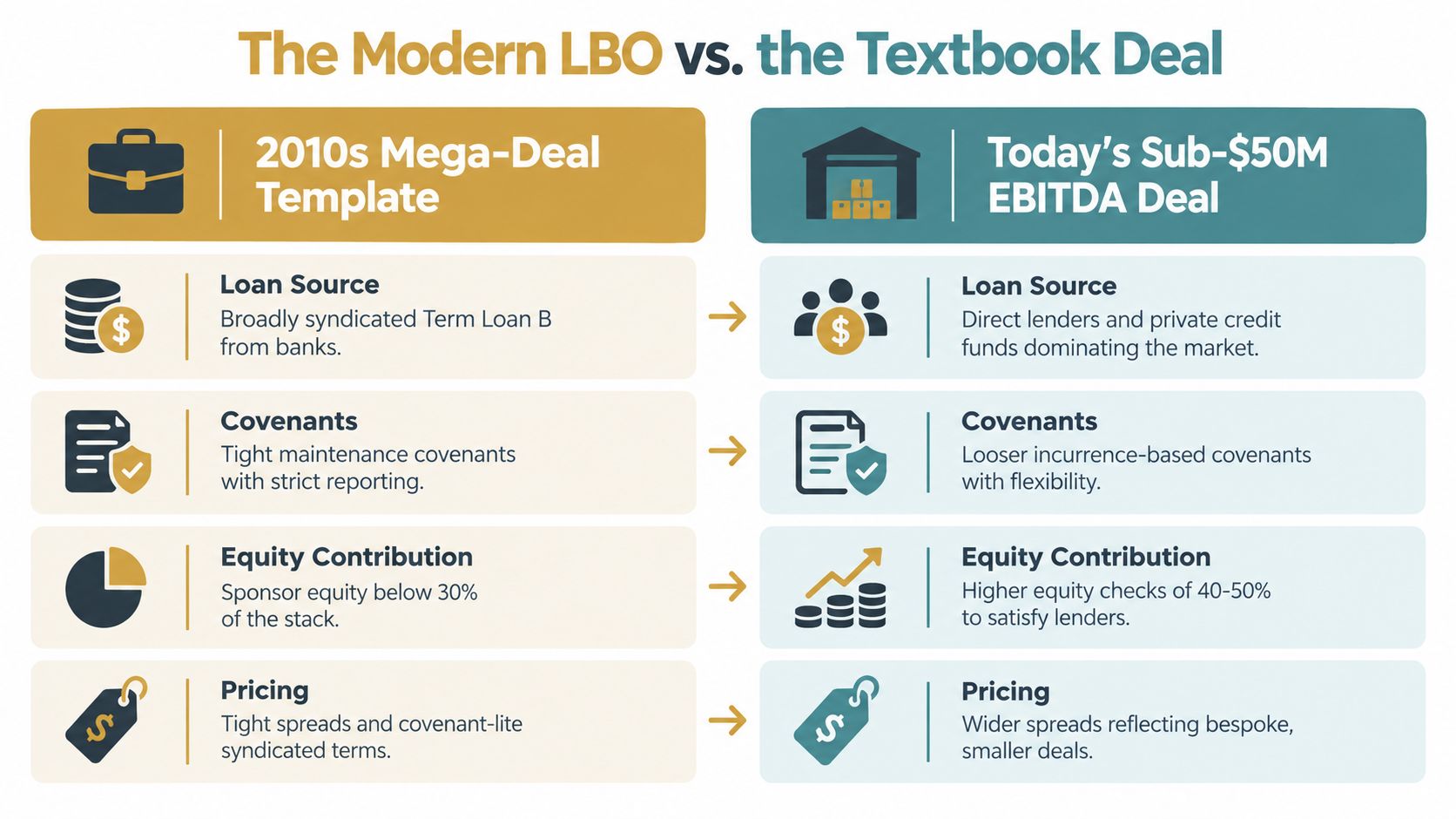
The classic bank-led LBO remains useful as a teaching model, but it no longer describes every smaller acquisition. Private credit has become a structural part of buyout financing. McKinsey reports that private lenders financed about 80% of global leveraged buyouts in 2024 and 2025, while direct lenders accounted for 58% of the sponsor LBO market from 2023 through 2025. The same McKinsey analysis of private credit reports that covenant-lite structures represented about one-third of 2025 deals above $50 million EBITDA and most large-cap deals.
For a smaller buyer, the practical implication is not that private credit is available. It's that the lender relationship, documentation, and underwriting process may look different from the syndicated loan model taught in older textbooks.
Direct lenders change the negotiation
A direct lender may underwrite and hold the loan rather than distribute it across a broad syndicate. That can create a more bespoke facility, with flexibility around acquisition add-ons, permitted investments, reporting, and prepayment. It can also concentrate relationship risk. You need to understand who makes decisions when performance misses the plan.
Covenant-lite doesn't mean risk-free. Incurrence tests may give the borrower more room during ordinary operations, but they can restrict acquisitions, additional debt, asset sales, dividends, or other actions when the company wants to act. Fewer maintenance tests can shift more monitoring discipline onto the buyer.
The market data also shows that borrowing multiples are not fixed. McKinsey reports that U.S. buyout debt levels fell in 2023 from 7.1x to 5.9x EBITDA for large corporate deals and from 5.0x to 4.1x for middle-market deals. The lesson for an SMB acquirer is straightforward: don't build a purchase price around yesterday's debt capacity.
Speed should not replace diligence
Private credit can offer certainty and customization, but a quick term sheet doesn't validate the seller's EBITDA adjustments. Ask how the lender defines EBITDA, which add-backs it accepts, what reporting it requires, and how excess cash is treated. Your model should reflect the signed documents, not the headline debt figure.
Modeling Assumptions Worth Pressure-Testing
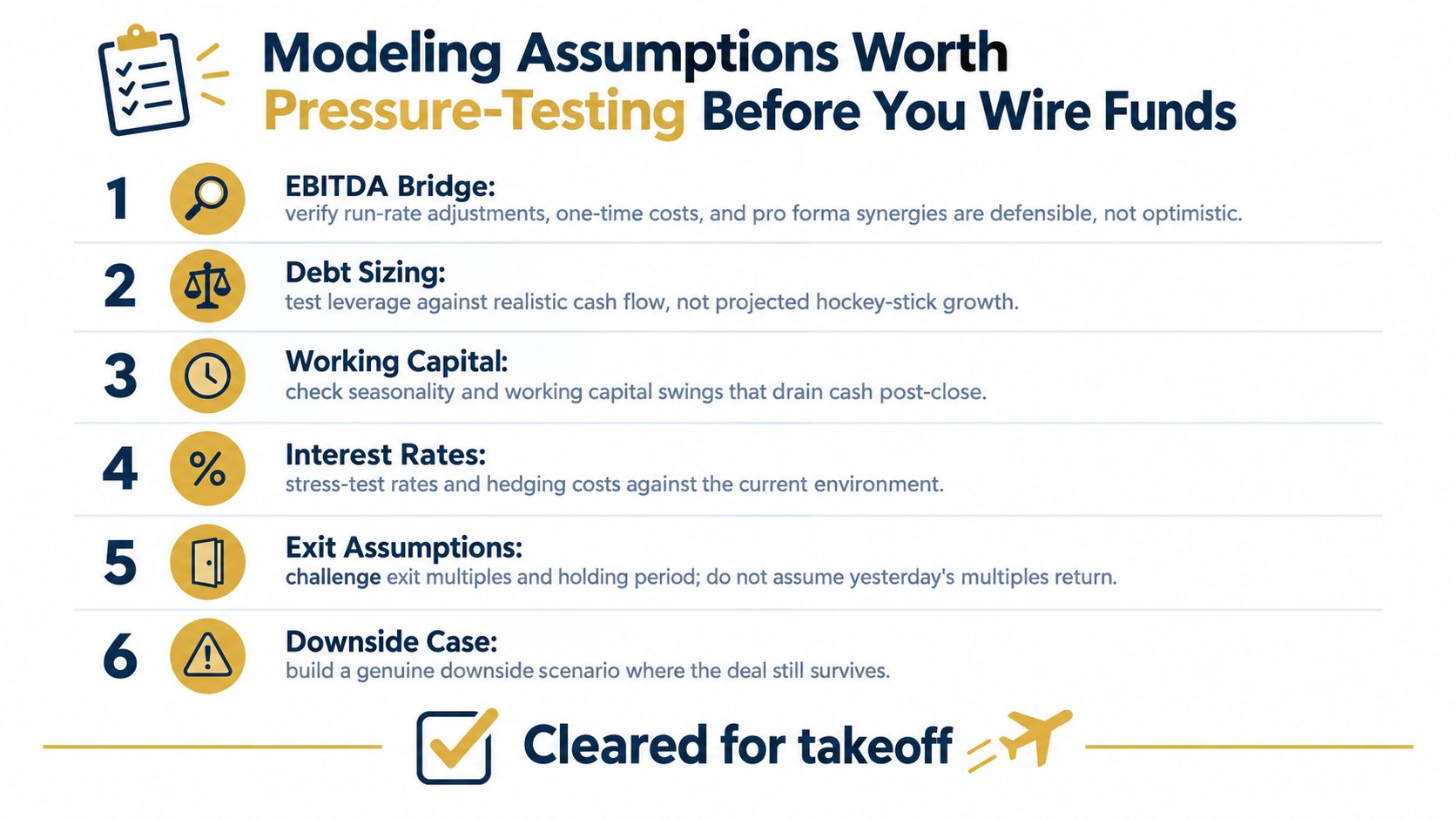
Treat the LBO model like a pre-flight checklist. The objective isn't to make the base case attractive. It's to identify which assumptions could cause a cash shortfall, covenant issue, refinancing problem, or loss of equity value.
Start with the earnings bridge
Separate reported EBITDA from adjusted EBITDA. Test every add-back against evidence such as payroll records, contracts, invoices, and historical financial statements. One-time expenses may be legitimate, but recurring costs disguised as one-time items will inflate debt capacity and distort the purchase price.
Then examine the revenue forecast. Identify the customers, contracts, salespeople, pricing changes, and capacity investments that support growth. If the model assumes stronger performance without naming the operational action that creates it, treat the assumption as unproven.
Test the financing mechanics
Run the debt schedule through a weaker operating period. Change interest rates, reduce cash conversion, delay collections, and increase working-capital needs. Then check whether scheduled amortization, cash sweeps, and minimum liquidity requirements still work.
The most important checks include:
- Entry valuation: Test whether the purchase price remains defensible if normalized EBITDA is lower than the seller's presentation.
- Debt sizing: Compare borrowing capacity with recurring cash flow, not with an aggressive forecast.
- Working capital: Model seasonal inventory, receivables, customer deposits, and payables separately.
- Capital expenditure: Preserve enough cash for maintenance spending before assuming debt repayment.
- Refinancing risk: Identify what happens if the business must refinance during an unfavorable credit market.
- Exit assumptions: Challenge both the exit multiple and the holding period instead of assuming a favorable sale window.
Make the downside case meaningful
A genuine downside case should show weaker revenue, tighter margins, slower collections, and reduced exit value at the same time. Don't offset every problem with an immediate cost-saving initiative unless management has a credible plan, budget, and timetable for delivering it.
Pay special attention to a model that produces an IRR above 25%. That result may be possible, but it deserves more scrutiny, not less. Trace the return to its sources and ask whether the outcome depends on a favorable exit multiple, unusually rapid deleveraging, optimistic EBITDA adjustments, or a contribution assumption that won't survive lender diligence.
A conservative model may lower the headline return. It gives you a better chance of owning the business through an ordinary operating setback.
Key Takeaways Before You Structure a Deal
Carry four mental models into every financing discussion.
First, the capital stack is a payment hierarchy. Senior lenders generally receive payment before junior creditors, preferred investors, and common equity. Equity has the greatest exposure to loss, but it also receives the residual value after other claims are satisfied. A lower-cost senior facility can be safer than a smaller amount of expensive junior debt, even when both structures show similar total financial gearing.
Second, debt is a fixed claim, not free purchasing power. The business must service it during strong quarters and weak quarters. Before signing a commitment, identify the cash reserve, minimum liquidity, covenant tests, mandatory amortization, and actions that require lender consent. A structure that leaves no room for working capital can damage the company you bought.
Third, returns come from three sources. EBITDA growth improves enterprise value. Cash flow reduces net debt. A higher exit multiple increases the value assigned to earnings. State clearly which driver carries the investment thesis, then model what happens when that driver fails. If the deal needs all three to outperform, the purchase price or debt load may be too aggressive.
Fourth, private credit changes the trade-off rather than removing it. Direct lenders can provide customized financing and may offer more flexibility than a traditional bank-led structure. Covenant-lite terms can give the owner operating room, but they also require stronger internal reporting and self-discipline. A borrower who notices trouble only when a formal covenant is breached has already waited too long.
Mistakes that damage otherwise good acquisitions
- Over-leveraging at close: The buyer maximizes debt capacity and leaves no cushion for underperformance.
- Underestimating working capital: Revenue growth consumes cash before customers pay.
- Treating cash as idle capital: The model sweeps cash to debt while the business needs equipment, inventory, or hiring.
- Ignoring the exit route: The buyer assumes a sale will be available without identifying likely strategic or financial buyers.
- Trusting the base case: The transaction works in one forecast but fails when two ordinary setbacks occur together.
- Chasing a modelled IRR: The buyer accepts structural risk because the spreadsheet produces an attractive return.
The right buyout structure fits the company's cash-generation pattern, the lender's protections, the sponsor's risk tolerance, and the operator's ability to execute. If you're evaluating your first acquisition, Dealmaker Wealth Society offers training, templates, mentorship, and peer support covering deal sourcing, due diligence, capital raising, and acquisition structuring. Visit Dealmaker Wealth Society to explore resources that can help you turn an acquisition thesis into a financeable, stress-tested deal.

From the Dealmaker Blog












A Creative Business Buying Fable