
M&A Deal Sourcing Playbook for SMB Acquisitions
M&A Deal Sourcing Playbook for SMB Acquisitions
Most buyers assume the hard part of M&A is finding a business for sale. It isn't. The harder problem is building a pipeline that fits your capital, operating ability, valuation discipline, and willingness to earn an owner's trust before a broker sends a process to every buyer in the market.
Browsing marketplaces and replying to listings is easy, which is why so many acquisition entrepreneurs do it. It also puts you in competition for the same visible opportunities, often after the seller has already hired an intermediary and shaped the process around maximum price. Effective M&A deal sourcing works in the opposite direction. You define what you can buy, map the right companies, develop relationships, screen without sentimentality, and measure which channels produce conversations that can become signed LOIs.
Table of Contents
- Why Most Buyers Chase Deals Instead of Sourcing Them
- What M&A Deal Sourcing Really Means
- The Full Channel Mix for Finding SMB Deals
- The Economics of Proprietary Deal Flow
- Screening Criteria That Kill Bad Deals Early
- Reaching Owners Before Their Business Is for Sale
- Let Financing Shape Your Sourcing Strategy
- Measuring Your Deal Flow and Next Steps
Why Most Buyers Chase Deals Instead of Sourcing Them
The popular advice is to “look at more deals.” That advice confuses activity with progress. A buyer can spend every morning scanning listings and still have no repeatable way to reach owners, no clear financing profile, and no evidence that the next opportunity will fit better than the last one.
Reactive deal hunting starts with whatever appears in front of you. A marketplace listing sets the industry, geography, asking price, and timing. A broker controls access to information. Other buyers receive the same materials. You respond to someone else's process instead of creating your own.
Systematic sourcing starts with a target universe. You decide which industries match your experience, what level of cash flow can support your intended financing, which owner characteristics matter, and what risks are unacceptable. Then you identify companies that fit, whether or not they have announced a sale.
The difference between luck and a pipeline
Institutional investors don't rely on one lucky introduction. A foundational study of 79 investment firms managing more than $750 billion in assets found that approximately 36% of closed deals were proactively self-generated, while 33% came through investment banks. The same study recorded smaller contributions from executive networks, deal brokers, company management, and other private-equity firms, showing that active origination and intermediated processes coexist rather than replace each other. The study of proprietary deal flow and private-equity sourcing also cautions that “self-generated” doesn't always mean completely unknown or exclusive to the market.
That distinction matters for an acquisition entrepreneur. Your objective isn't to avoid every broker or win some purity contest around off-market deals. It's to build enough channels that you can choose the process, compare opportunities properly, and avoid depending on one source of supply.
Practical rule: If your pipeline can't tell you who you want to buy, why they might sell, and how you can fund the purchase, you don't have a sourcing system yet.
The playbook is straightforward. Establish financing boundaries, build a focused target list, use several channels, approach owners with respect, screen early, and record every outcome. Within a few weeks, you'll know whether your bottleneck is target identification, credibility, qualification, capital, or follow-up. That diagnosis is more valuable than another hour spent refreshing a listings page.
What M&A Deal Sourcing Really Means
Deal sourcing is the repeatable process of identifying, qualifying, and advancing acquisition opportunities. Origination is the initial act of finding a potential target. Deal flow is the stream of opportunities produced by those activities. The terms overlap in casual conversation, but separating them helps you see where your process is breaking.
Think of the work as a funnel:
- Target universe: Companies that match your industry, location, ownership, size, and financing profile.
- Qualified targets: Businesses with enough evidence of fit to justify research or contact.
- Owner conversations: Direct or referred discussions about growth, succession, partnership, or a possible sale.
- Evaluated opportunities: Targets that pass your initial financial and operational filters.
- Indications of interest and LOIs: Opportunities where price, structure, and diligence terms become concrete.
A plumbing company with meaningful local demand might sit in your target universe for months without being for sale. If you learn who owns it, understand its service mix, and establish a relationship, you've created origination. If the owner later discusses succession and you review financials against your criteria, the opportunity has moved into sourcing and qualification.
Proprietary doesn't mean invisible
Buyers often describe a deal as proprietary when they found it through their own relationship or outreach. That doesn't necessarily mean no other person knew the company existed. It usually means you gained an information, timing, or access advantage before a broad sale process began.
A lightly brokered opportunity can offer a similar advantage. The owner may have spoken with an advisor, but the buyer might receive an exclusive conversation or a limited field of competition. The useful question isn't, “Is this completely off-market?” Ask instead, “How much competition exists, what do I know that others don't, and can I negotiate terms rather than only price?”
Quality beats raw volume
A large list of companies is not deal flow. It becomes useful only when each record has an owner, a reason for inclusion, a next action, and a clear status. Track the movement from target to conversation to LOI, not just the number of names collected.
That structure prevents a common mistake: celebrating lead volume while ignoring whether owners reply, whether businesses meet your screen, and whether the resulting terms are financeable. The buyer with fewer, better-fit conversations often has a stronger pipeline than the buyer with a crowded spreadsheet.
The Full Channel Mix for Finding SMB Deals
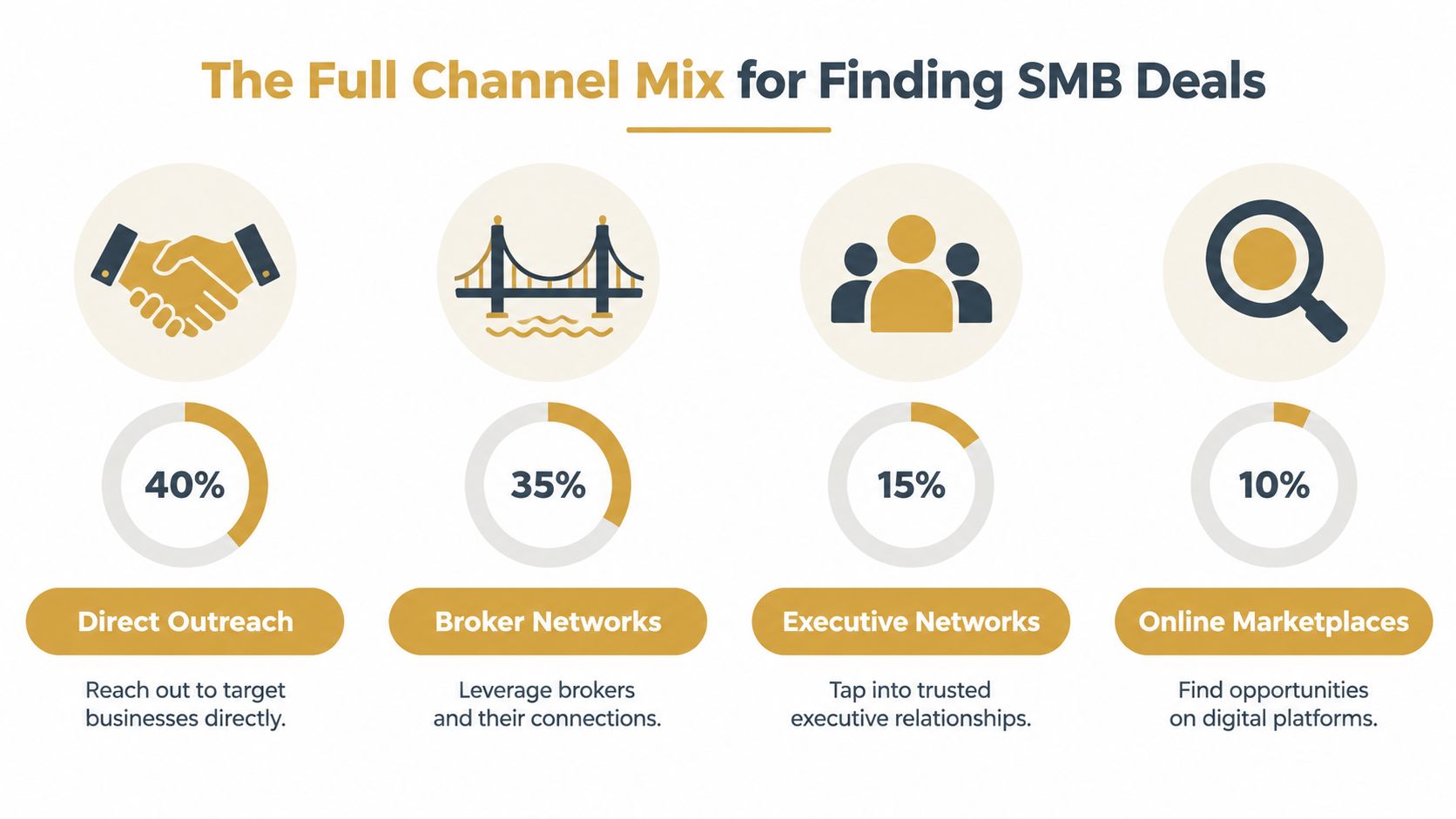
No channel deserves your total dependence. The private-equity sourcing evidence described earlier shows a substantial split between self-generated opportunities and investment-bank processes, with executive networks, brokers, management contacts, and peer firms contributing additional deal flow. The practical lesson is clear: M&A deal sourcing is a portfolio of channels, not a single proprietary funnel.
What each channel actually costs
Direct outreach gives you the most control over thesis, timing, and message. It also consumes research time and credibility. An owner who hasn't asked to sell can quickly disengage if your email looks automated or uninformed. Use a narrow target list, explain why the company fits your interest, and offer a low-pressure conversation.
Brokers and intermediaries provide access and process structure. They can save research time, but you're entering a competitive environment where the broker must protect the seller's process and reputation. Respond quickly, provide a credible buyer profile, and use strict bid/no-bid rules.
Executive and professional networks often produce better context than cold lists. Accountants, attorneys, lenders, industry operators, and former executives can identify ownership transitions before they become public. The cost is consistency. You must stay useful and memorable without turning every relationship into a request for leads.
Marketplaces and databases help you map a sector and spot patterns. They offer convenience, but visibility brings competition and listing quality varies. Use them as a discovery layer, then research the owner, business model, and strategic fit independently. A resource such as browse Dealfront by Grou can support structured company research when you're building that initial universe.
Banker-led processes suit buyers who can evaluate quickly and fund competitively. Referrals and partnerships suit buyers who have a clear reputation and can explain their value to owners. Your channel mix should reflect your available time, capital, operating background, and comfort with relationship development. A focused buyer can also review acquisition sourcing services when internal capacity is limited.
Use the video as a prompt for discussion, not a substitute for your own criteria and channel tracking.
| Channel | Effort Level | Competition | Best For |
|---|---|---|---|
| Direct outreach | High | Low to moderate | Thesis-driven buyers with patience |
| Brokers and intermediaries | Moderate | Moderate to high | Buyers who can screen and respond quickly |
| Executive networks | High relationship effort | Usually lower | Buyers with industry credibility |
| Marketplaces and databases | Low to moderate | High on visible listings | Building a target universe |
| Banker-led processes | Moderate | High | Well-prepared, financeable buyers |
| Referrals and partnerships | Moderate | Variable | Buyers with a trusted reputation |
The Economics of Proprietary Deal Flow
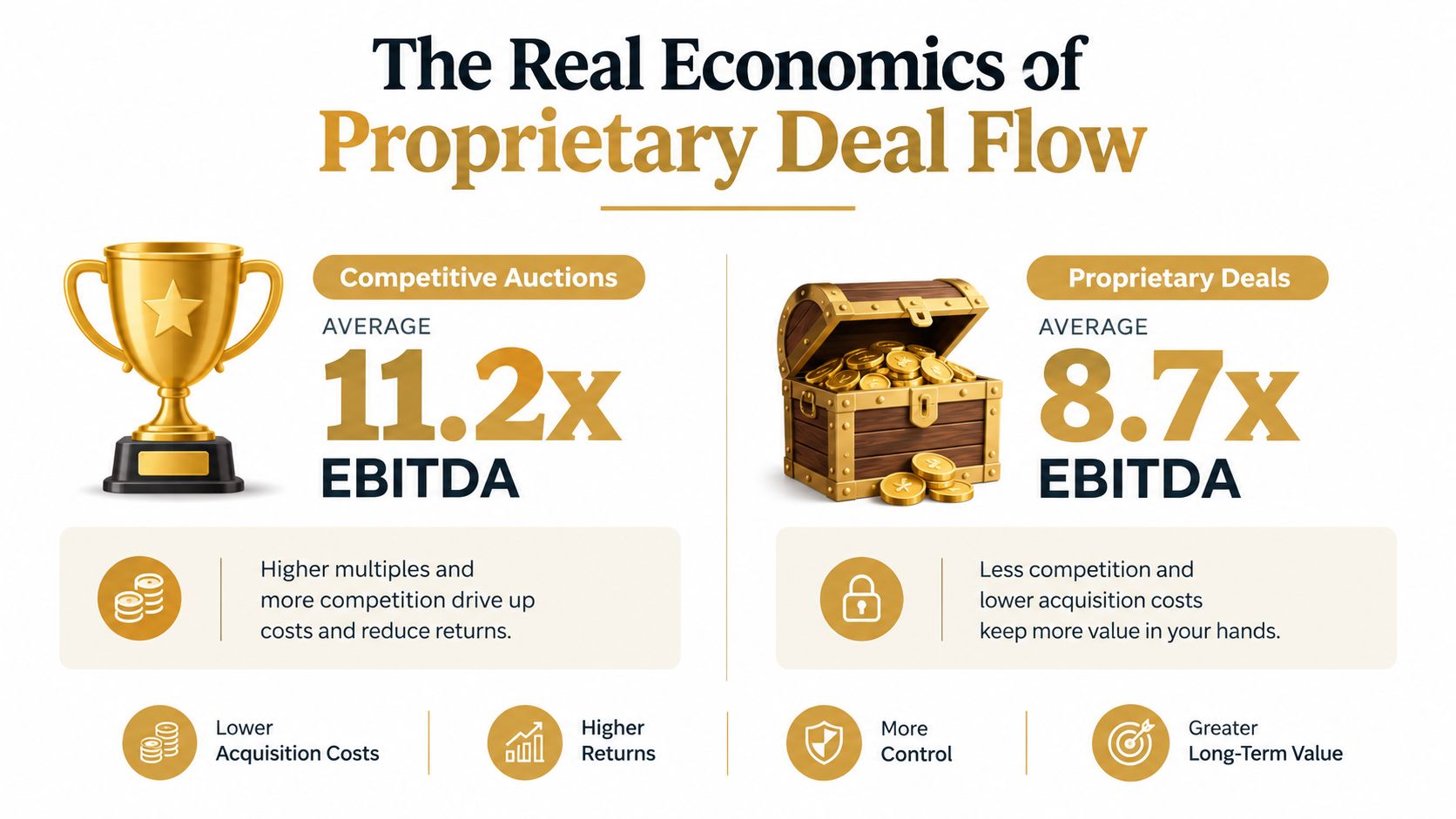
Sourcing method affects purchase economics because competition shapes negotiating power. Current deal-origination estimates place average purchase multiples at approximately 11.2x EBITDA for competitive auctions and 8.7x EBITDA for proprietary or lightly brokered transactions, a gap of 2.5 EBITDA turns. For a business producing $1 million of EBITDA, that difference represents approximately $2.5 million of enterprise value before financing, taxes, fees, or working-capital adjustments. The analysis of M&A deal origination economics provides the benchmark and cautions that the result will vary by target.
Why the gap can appear
A formal sale process may contact roughly 50 to 200 prospective buyers, making multiple strong bids more likely. Sellers in these processes can optimize price alongside certainty, timing, and terms.
Direct conversations create more room to discuss seller financing, earn-outs, rollover equity, exclusivity, or a longer diligence period. These tools cannot repair a weak business, but they can improve the structure of a sound transaction. A seller may value continuity, employee protection, or a gradual transition, giving a thoughtful buyer more negotiating variables than a sealed auction typically provides.
The advantage carries a cost. Direct sourcing may require months of contact before an owner is ready to engage. It can also uncover companies with weak financial reporting, excessive owner dependence, customer concentration, or outdated operations. Screening takes longer because you create the opportunity instead of receiving a polished memorandum.
Measure the advantage against auction alternatives
Measure sourcing performance by the entry multiple, contractual flexibility, and diligence access it produces. Off-market volume alone says little about transaction quality.
Compare every proprietary opportunity with the auction alternatives you could realistically pursue. A direct deal can offer a lower price while demanding an operational turnaround that your team cannot execute. A deal at an ordinary price may still work when the seller offers terms that fit your capital and operating plan.
The useful question is whether your access improves the risk-adjusted transaction you can close.
Screening Criteria That Kill Bad Deals Early
A good screen protects attention before it protects capital. The first review shouldn't attempt to prove that a company is wonderful. It should try to find the reason you should stop.
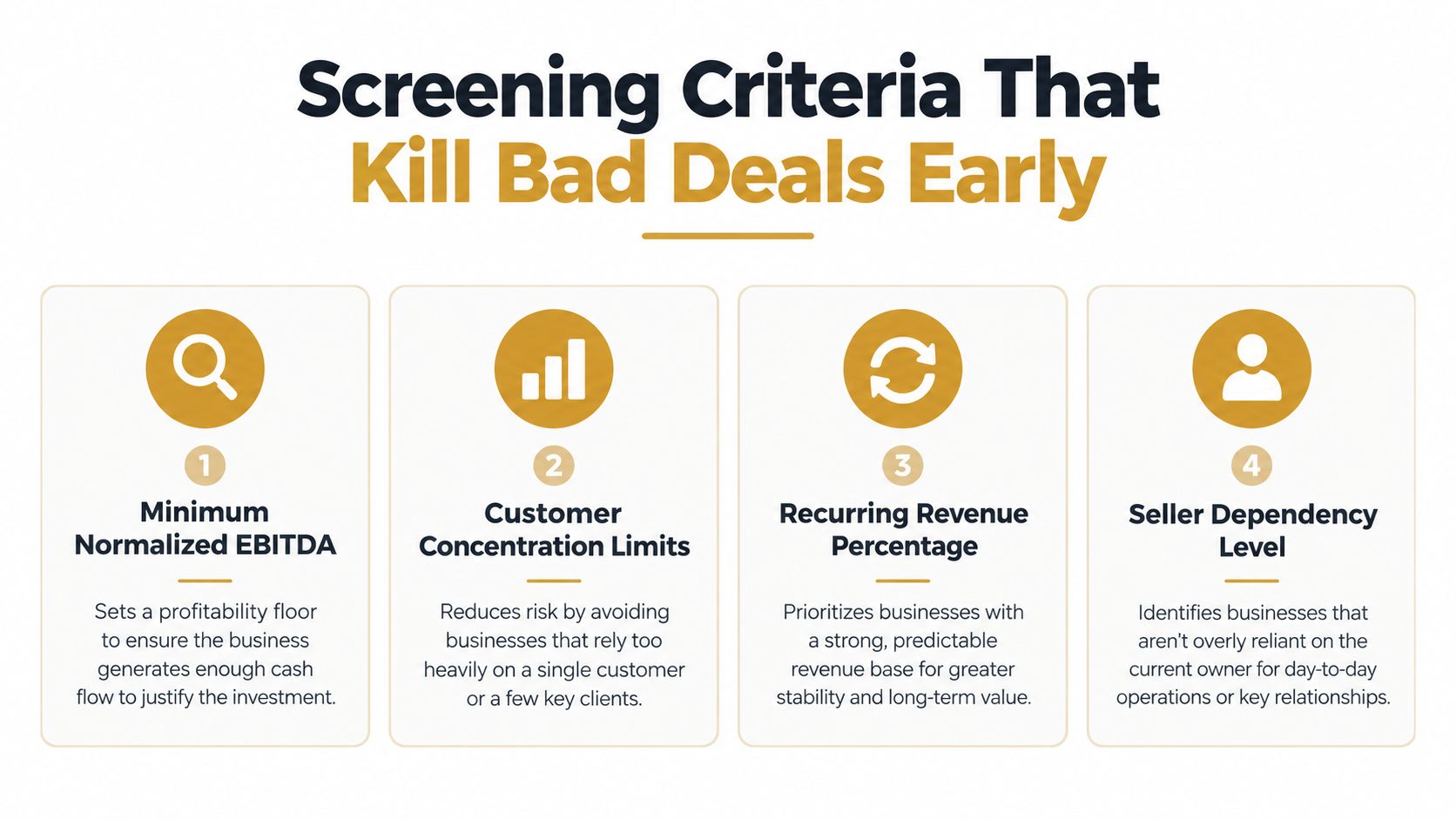
Start with a one-page scorecard that reflects your financing plan and operating capabilities. Apply it consistently to broker packages, referrals, marketplace listings, and direct conversations. A useful scorecard includes:
- Minimum normalized EBITDA: Adjust for owner perks, unusual expenses, one-time revenue, and expenses that won't transfer cleanly. If the normalized figure only works after generous assumptions, pass.
- Customer concentration: Identify whether one account carries an outsized share of revenue or gross profit. A customer loss can re-price the entire business, weaken lender confidence, and expose a relationship that belongs to the owner rather than the company.
- Recurring-revenue percentage: Separate contracted or repeatable revenue from project work and irregular purchases. Recurrence doesn't eliminate risk, but it makes cash-flow planning more reliable.
- Owner dependence: Ask who sells, prices, schedules, manages key employees, and maintains the largest relationships. A business that stops functioning when the owner leaves is partly a job, not a transferable asset.
- Debt capacity: Consider cash-flow stability, working-capital needs, capital expenditure, and downside performance before deciding what debt the company can support.
- Valuation ceiling: Set the maximum price before the seller's story changes your judgment. Compare the opportunity against relevant auction expectations and your required return.
A fast first-pass test
Suppose a target appears to fit your industry thesis, but its reported profit includes substantial owner expenses and its largest customer relationship sits entirely with the founder. You don't need a full diligence process to identify the danger. Normalize the earnings, test the customer relationship, price the transition risk, and decide whether the remaining cash flow fits your financing capacity.
For an intermediated process, establish a bid/no-bid rule before reviewing every attachment. If the target fails a mandatory filter, decline promptly and preserve the relationship. If it passes, request only the information needed to validate the next decision.
The deal evaluation framework for acquisition buyers can help turn these judgments into a repeatable workflow. The tool matters less than the discipline of recording why you passed, because those reasons improve your next target list.
Reaching Owners Before Their Business Is for Sale
The best pre-market outreach doesn't begin with an offer. It begins with a reason for contact that would make sense even if the owner never sells.
Consider an established business showing several public signals: the founder appears less involved in day-to-day operations, a key leadership role changes, the company adopts technology that alters its delivery model, or the industry faces a succession challenge. None of these signals proves transaction readiness. They justify careful research, not an aggressive conclusion.
Leading investors increasingly build sector knowledge before a confidential information memorandum arrives, combining CRM history, sector theses, hiring, and technology adoption signals to identify possible transaction readiness. The practical implication is that better sourcing depends on a narrow thesis and permission to continue the conversation, not on sending more outreach. Research on origination advantages among leading private-equity firms supports that approach.
A respectful first conversation
A useful first message identifies you, explains your interest in the sector, and makes no assumption that the owner wants to sell. Say what you do, how you fund acquisitions, and why you selected their company. Offer to speak about succession, growth, or partnership if those topics are relevant, then make it easy to decline.
Don't imply that you've monitored private activity. Don't exaggerate your ability to close. Don't ask for confidential financial information in the first exchange. An owner who hasn't announced a sale is evaluating your judgment before sharing anything sensitive.
If the owner responds, ask about the company's direction and their priorities. Listen for whether they want capital, operational help, a successor, a partial liquidity event, or just an industry conversation. Your next touch should reflect what they said, not a generic sequence.
Research without becoming intrusive
Use public information to form a hypothesis, then verify it directly. Keep a record of the source, date, and confidence level for each signal. AI-assisted research can help organize CRM history and public sector information, but it shouldn't invent facts, infer sensitive personal circumstances, or trigger unchecked outreach.
Respect privacy rules and anti-spam expectations. Limit follow-ups, honor a clear request to stop, and protect confidentiality if a conversation advances. Trust is an asset in pre-market sourcing, and careless automation can destroy it faster than a weak offer.
Let Financing Shape Your Sourcing Strategy
Most first-time buyers find a target, fall in love with it, and then ask whether the capital structure can work. Reverse that order. Define your debt capacity, equity appetite, seller-note tolerance, required liquidity, and acceptable downside before you build the target list.
Financing conditions influence which owners will take you seriously. A clear explanation of your funding plan makes your outreach more credible, while a vague promise to “raise the money” creates uncertainty. It also changes offer design. You may need to prioritize stable cash flow, transferable customer relationships, collateral, or a seller willing to support the transaction.
In the United States, acquisition and change-of-ownership transactions represented 20% of combined SBA 7(a) and 504 lending dollars in 2025. Those loans totaled $8.8 billion across more than 7,500 loans, 31% above 2024, while private-equity firms held a record $1.7 trillion of global dry powder at the end of 2025. The reported SBA and private-equity financing context illustrates why financing access differs sharply between an individual buyer and a large fund.
Build the target profile backward
Write a financing-first brief that states the cash flow quality you need, the industries you can operate, the maximum valuation you can support, and which deal structures remain viable. Then exclude targets that depend on optimistic growth, heavy reinvestment, or a seller expectation your capital can't meet.
This approach won't identify every attractive business. It will identify businesses you have a credible chance of closing. Buyers who want a deeper review of acquisition financing options can use that work to refine the brief before beginning outreach.
Measuring Your Deal Flow and Next Steps
A sourcing system becomes useful when it produces learning, not just names. Track each channel through qualified targets, owner conversations, indications of interest, signed LOIs, and closed deals. Record the time and direct cost attached to each stage so you can compare a warm referral with a broker process or a direct campaign.
Your CRM should segment companies by industry, geography, ownership profile, advisor relationship, and last-contact date. Create attribution rules for opportunities that arrive through multiple sources. If a broker introduces a company you first identified through direct research, record both the original discovery and the channel that created the active process.
A practical starting plan
Use the first phase to define your financing brief and screening scorecard. Next, build a focused target universe and contact a manageable group of owners, advisors, and intermediaries with a message adapted to your thesis. Then review the results, remove weak targets, improve the message, and continue only where the response quality justifies the effort.
Measure cost per qualified conversation, time to LOI, expected close probability, and the terms attached to each opportunity. A general guide to efficiency metrics can help you think beyond raw activity and apply the same discipline to your sourcing workflow.
Dealmaker Wealth Society offers acquisition training, sourcing playbooks, mentorship, capital-raising education, and peer support for people building this kind of pipeline. Visit Dealmaker Wealth Society to review its acquisition programs and use the available frameworks to turn your financing profile into a practical sourcing plan.

From the Dealmaker Blog











A Creative Business Buying Fable
