
How to Buy a Small Business with No Money: 10 Ways
How to Buy a Small Business with No Money: 10 Ways

Buying a small business with “no money” usually means layering financing to reduce your cash contribution, not avoiding financial obligations. A practical structure may still require at least 10% of total project cost as equity, including fees and working capital, even when the purchase price is funded largely by lenders and the seller.
That distinction matters because the market contains a counterintuitive mismatch. The median small-business sale price sits around $320,044 to $349,250, while 90% of prospective buyers expect seller financing, but only 29% of business owners plan to offer it. A zero-cash acquisition is therefore less about discovering a magic contract and more about finding a profitable target, satisfying lender rules, earning seller confidence, and allocating risk across several parties.
The strongest buyers don't approach a seller saying, “I have no money.” They present a credible operating plan, verified financial records, a lender-informed offer, and a capital stack that gives the seller a reasonable path to repayment.
Table of Contents
- Why Zero-Cash Business Acquisitions Are Rarer Than Advertised
- Understanding Lender Requirements and Equity Rules
- Creative Financing Layers That Make Deals Work
- Due Diligence Steps That Build Seller Confidence
- Real Deal Structure From Offer To Close
- Common Mistakes That Sink No-Money Deals
- Your Next Steps in the Acquisition Journey
Why Zero-Cash Business Acquisitions Are Rarer Than Advertised
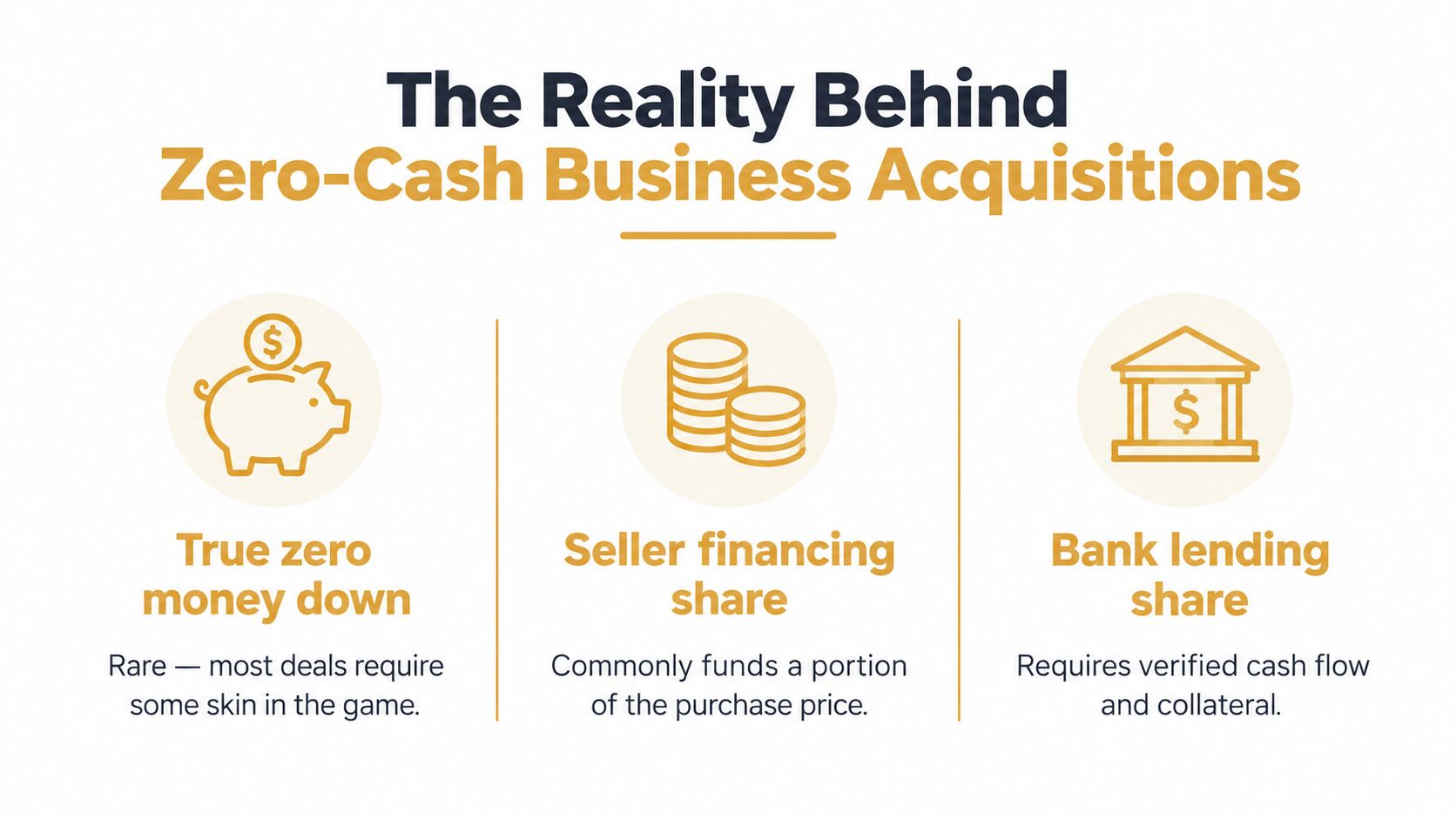
The strongest claim in a no-money-down deal is also the easiest to misunderstand: true zero-capital acquisitions are rare. Buyers usually mean they do not want to fund the entire purchase price from personal savings. An SBA-backed loan, seller financing, outside equity, an earnout, or a partner contribution can reduce the cash they bring to closing.
Every layer still creates an obligation. Debt requires repayment, seller notes create scheduled payments, earnouts require measurable performance, and outside investors expect a financial return or ownership. The buyer is choosing who carries the risk, when that risk becomes payable, and how the structure responds if the business underperforms.
Why the approach remains viable
Established businesses can generate the cash flow needed to support acquisition debt. BizBuySell's market data places the median small-business sale price at approximately $349,250, and 78% of surveyed buyers expected to use Small Business Administration financing for an acquisition (BizBuySell Insight Report).
Financing still depends on the target's quality. Lenders look for reliable earnings, operations that can transfer to a new owner, manageable customer risk, and a buyer capable of running the company after closing. A profitable service company with recurring demand may support financing more effectively than a larger business with unstable margins or an owner who personally controls every major customer relationship.
Practical rule: Start with the cash flow the business can prove, not the purchase price the seller wants.
The buyer must separate cash contribution from total financial commitment. Limited personal cash does not remove personal guarantees, debt service, working-capital needs, payroll, taxes, insurance, or operating shortfalls. It also does not guarantee that a seller note will count as equity. Lenders may require specific standby terms, leaving the buyer responsible for finding acceptable capital before signing a final structure.
What the market gap tells you
The 90%-expect and 29%-offer gap described above means seller motivation deserves as much attention as valuation.
A seller who needs liquidity at closing may reject a large deferred payment even if the price is attractive. A seller seeking tax deferral may accept a note, especially when the payment schedule and security are clear. Someone planning retirement may value a structured transition, while an owner who distrusts the buyer may demand cash or stronger guarantees.
Identify that motivation before spending months engineering terms the seller will never accept. The acquisition becomes feasible when the financing structure addresses the seller's reason for selling as well as the lender's underwriting requirements.
Understanding Lender Requirements and Equity Rules
No money down does not mean the lender ignores equity. The financing must cover the lender's definition of total project cost, which can be wider than the seller's asking price. Under current SBA 7(a) program guidance, a change-of-ownership transaction generally requires equity equal to at least 10% of total project cost, as summarized in the equity requirements lenders use.
Lenders may include these items in total project cost:
- Purchase price: The amount paid for the business and eligible assets.
- Closing expenses: Legal work, accounting, lender fees, and related transaction costs.
- Working capital: Cash needed to operate after closing while receivables arrive and expenses continue.
- Required reserves: Funds needed to prevent an immediate liquidity crisis.
That calculation creates the hidden equity requirement. A buyer who funds only the purchase price can still arrive at closing without enough cash for fees, post-close operations, or the lender's required injection. The business may be fully financed on paper and underfunded in practice.
How the standby rule changes seller notes
A seller note can help fill the equity gap, but it does not automatically count like buyer cash. A seller note may satisfy no more than half of the required injection when it is fully subordinated and on full standby for the entire SBA-loan term. Under those terms, the seller generally cannot receive principal or interest while the senior SBA loan remains outstanding, subject to lender and program requirements.
For a fuller comparison of how equity and debt interact in an acquisition, see our guide to comparing equity and debt financing in acquisitions.
Consider a $1,000,000 transaction. The required equity could be approximately $100,000 before fees and working capital. A compliant structure might use $50,000 of buyer or investor cash plus a $50,000 full-standby seller note, subject to lender approval and the final project-cost calculation.
The note still creates a deferred obligation. Full standby also removes the seller's expected income during the senior loan term, so the seller must have a reason to accept that trade-off. A seller seeking immediate proceeds may reject the structure. A seller focused on tax deferral or an ongoing relationship may consider it.
Build the offer around lender mechanics
Obtain lender indications before making a firm offer. Ask how the lender views the target's cash flow, borrower qualifications, collateral, equity sources, seller-note terms, and working-capital needs.
Your letter of intent should include a financing contingency, a quality-of-earnings review, tax-return reconciliation, customer concentration analysis, and a 13-week cash-flow forecast. These terms prevent a buyer from committing to a price that works only under optimistic assumptions.
The workable structure is the one that satisfies the lender's equity rules, preserves operating liquidity, and gives the seller a payment arrangement they can accept.
Creative Financing Layers That Make Deals Work
A workable low-cash acquisition usually combines several instruments rather than relying on one clever term. The three most useful layers are seller financing, outside equity, and deferred consideration through an earnout or rollover. Each solves a different problem, and each introduces a different form of risk.
Seller financing bridges a price gap and gives the seller a reason to remain engaged. Outside equity supplies required cash but dilutes ownership or creates investor expectations. An earnout reduces the amount payable at closing, but it transfers part of the valuation dispute into the post-close period.
| Tool | Best For | Key Requirement | Common Pitfall |
|---|---|---|---|
| Seller financing | Sellers willing to defer part of their proceeds | Clear priority, subordination, repayment, and default terms | Treating the note as immediately available cash |
| Outside equity | Buyers who need an equity injection or liquidity reserve | A defined ownership, return, and decision-rights agreement | Giving away too much value to solve a small cash gap |
| Earnout or deferred consideration | Businesses with uncertain future performance | Objective metrics, reporting access, and dispute procedures | Creating a payment formula neither party can measure consistently |
Seller financing
A seller note works best when the seller has a reason to accept future payments. Explain the tax treatment through the seller's advisers, define the transition role, and show how the operating plan protects repayment capacity. The note should specify payment timing, interest, subordination, standby status, default remedies, personal guarantees, control rights, and what happens if the senior lender takes action.
The buyer should also test the note under a downside case. If revenue declines, collections slow, or a major customer leaves, the business may not be able to service both senior debt and seller debt. A seller who wants strong protection may request guarantees or control rights that make the structure less attractive to the buyer.
Outside equity
An equity partner can fund part of the required injection, closing costs, or working-capital reserve. The partner may bring more than money, including industry experience, lender credibility, sourcing access, or post-close management support.
Don't accept equity casually. Document ownership, distributions, voting rights, future capital calls, transfer restrictions, deadlock procedures, and exit rights. A partner who contributes a modest amount but receives broad control can create a larger problem than the original cash shortfall.
Earnouts and rollover equity
An earnout ties part of the price to future results. It can make a seller's growth expectations financeable, but only if both parties can measure performance without ambiguity. Define revenue or earnings metrics, accounting policies, customer attribution, employee changes, reporting access, and the treatment of extraordinary expenses.
Rollover equity lets the seller retain an interest in the company rather than receiving the entire value at closing. It aligns the seller with future performance, but it also leaves the buyer sharing control and economics with the former owner. Document every instrument separately because contingent payments, goodwill allocations, and equity interests can receive different lender and tax treatment. Guidance on structuring these arrangements is available in this resource on earnouts in acquisition deals.
The right capital stack is the one that meets lender rules, preserves post-close liquidity, and gives the seller a credible economic reason to cooperate. Lowest cash at closing isn't the same as lowest risk.
Due Diligence Steps That Build Seller Confidence
A seller won't accept deferred payment because your idea sounds creative. The seller accepts it when your analysis shows that the business can support the obligations after closing. Lenders reach the same conclusion through their own underwriting.
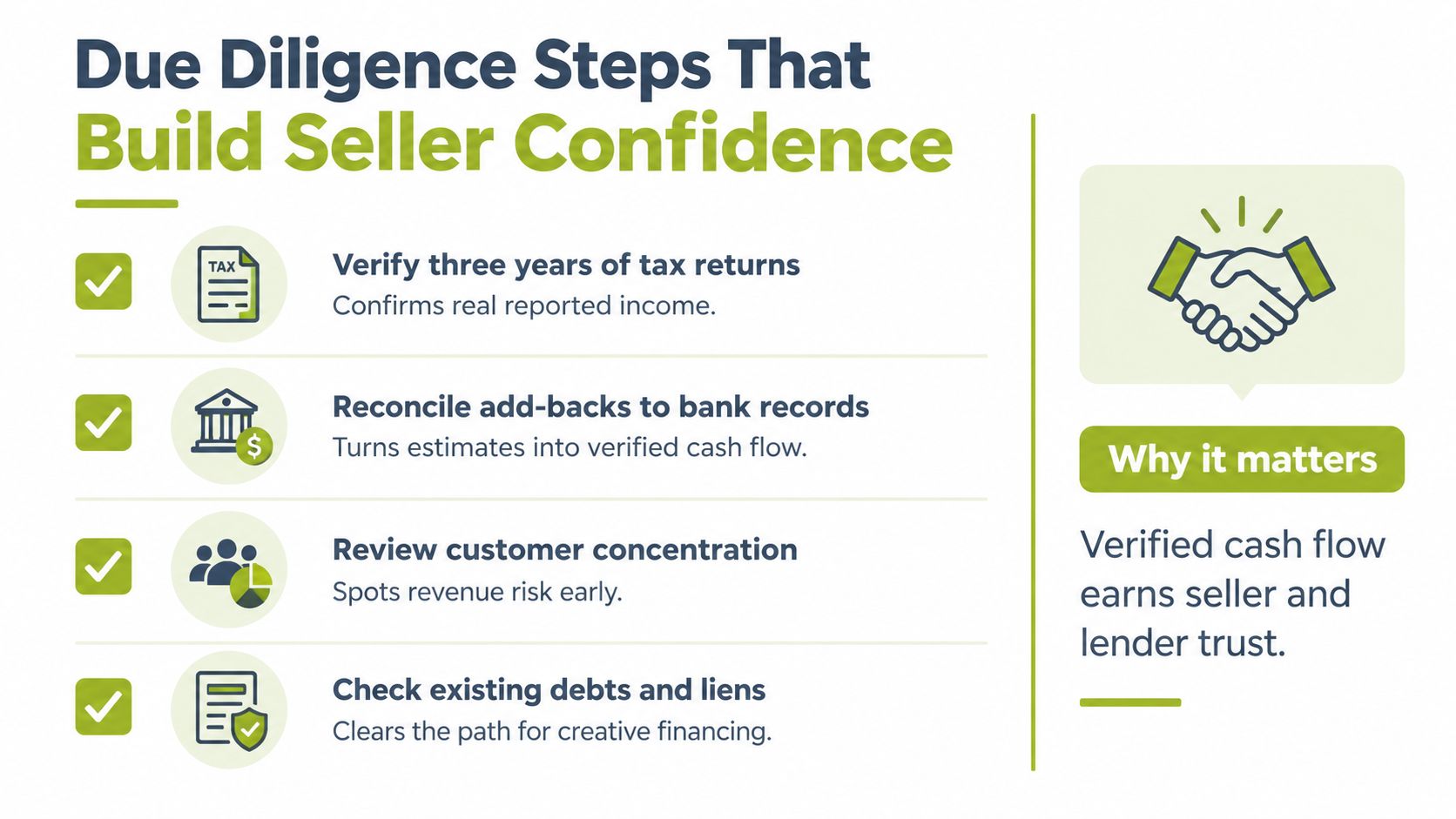
Start with normalized cash flow. Remove personal expenses, one-time costs, unusual owner compensation, and unsupported add-backs. Then reconcile the adjusted figures to tax returns, bank statements, financial statements, payroll records, and customer receipts. An add-back that exists only in a spreadsheet doesn't create repayment capacity.
Assemble the evidence package
A disciplined review should answer four questions:
- Are the earnings real? Compare tax filings, income statements, bank deposits, sales reports, payroll, and expenses.
- Can the cash flow continue? Review customer concentration, recurring revenue, contract terms, supplier dependence, and margin trends.
- Can the buyer operate the company? Identify owner-specific relationships, undocumented processes, key employees, licenses, and transition requirements.
- Are there hidden claims against the business? Check existing debt, liens, tax obligations, leases, litigation, and unrecorded commitments.
A formal quality-of-earnings review can convert seller claims into a defensible earnings base. A tax-return reconciliation can expose discrepancies before a lender discovers them. Customer concentration analysis can reveal that apparently diverse revenue depends on one relationship. A 13-week cash-flow forecast then shows whether the company can meet payroll, taxes, debt service, and supplier obligations during the transition.
For a broader reference, this essential due diligence for acquisitions checklist provides a useful way to organize the review without treating diligence as a box-ticking exercise.
Make the seller part of the proof
Share a concise findings memo with the seller. Show normalized earnings, known risks, proposed mitigations, transition duties, and the assumptions behind your financing request. This transparency can be more persuasive than just offering a higher price.
The seller should know what information you'll need, how quickly you'll review it, and which findings could change the offer. A buyer who asks for a seller note while refusing to explain repayment capacity creates fear. A buyer who documents the risk and proposes protections gives the seller something concrete to evaluate. The psychology and mechanics of seller resistance are explored further in why sellers don't always want cash.
Real Deal Structure From Offer To Close
A realistic low-cash transaction begins with a target that has stable, verifiable cash flow and operations a new owner can assume. The buyer doesn't lead with “zero money down.” Instead, the buyer presents a conditional offer that explains the proposed capital stack and makes clear that financing, diligence, and lender approval must come first.

Suppose the seller wants a price supported by the company's normalized earnings, but the buyer lacks enough liquid equity to fund the required injection and post-close reserve. The buyer first approaches lenders with the financial package, confirms the likely senior debt capacity, and identifies the remaining equity requirement.
The offer then allocates the gap across distinct instruments. A portion comes from a buyer or outside investor contribution. A portion may come from a seller note that satisfies lender standby rules. The remaining value could be deferred through an earnout tied to clearly defined performance, or the seller could retain rollover equity.
The negotiation sequence
The buyer's operating plan matters as much as the financing request. It should explain who will manage daily operations, how the seller will transition relationships, which expenses will change, and how working capital will be protected. Sellers are more likely to defer payment when they believe the buyer can preserve the income stream that supports the note.
A practical sequence looks like this:
- Screen the business: Reject targets with unverified earnings, fragile customer relationships, or operations dependent entirely on the seller.
- Obtain lender feedback: Confirm how the lender views the cash flow, borrower, collateral, equity sources, and proposed seller note.
- Submit a conditional offer: Include financing, diligence, and documentation conditions rather than promising an unconditional close.
- Verify the economics: Reconcile tax returns, bank records, customer data, debts, leases, and working-capital needs.
- Document each layer: Use separate loan, equity, earnout, rollover, and transition agreements.
- Close only when liquidity survives: Confirm that the buyer can fund fees, reserves, payroll, taxes, and early operating needs.
The seller may initially ask for cash at closing. The buyer can improve the proposal by offering a lower-risk structure, such as a modest cash contribution, a properly subordinated note, contingent consideration, and enforceable transition obligations. The seller receives a clear path to value, while the buyer avoids loading every obligation onto the first day of ownership.
A practical walkthrough of deal structuring can help buyers understand how these moving parts interact:
The deal fails if any party treats a contingent promise as guaranteed cash. The lender must approve the senior structure, the seller must understand priority and repayment risk, and the buyer must retain enough operating liquidity to manage reality after the handshakes are over.
Common Mistakes That Sink No-Money Deals
Low-cash deals usually fail for ordinary reasons, not because the buyer lacks imagination. The buyer overstates cash flow, forgets the costs around closing, or creates payment obligations the business can't support during its most vulnerable period.
Mistake one, believing every add-back
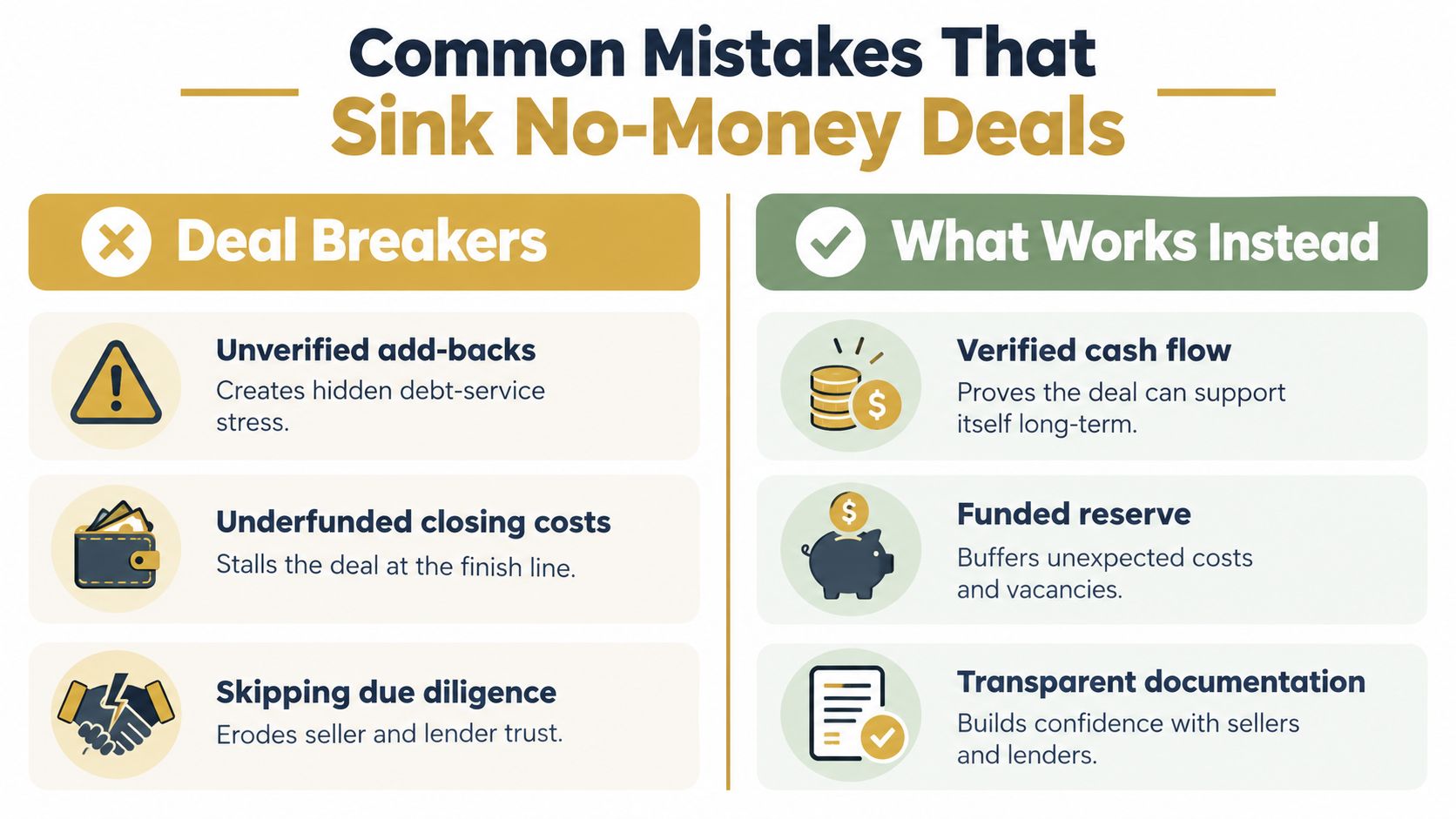
An add-back should have evidence, a clear reason, and a realistic expectation that the expense will disappear after closing. Personal expenses may not transfer cleanly. Owner compensation may need to be replaced with a market-rate operator. One-time expenses may recur under a different label.
Use bank records, invoices, payroll data, and tax filings to verify each adjustment. Then stress-test the acquisition using a lower earnings case. If the business only supports debt service after every optimistic add-back is accepted, the price or structure is too aggressive.
Mistake two, ignoring the cash needed after closing
Fees, diligence, insurance, payroll, taxes, inventory, repairs, and delayed receivables can consume liquidity quickly. Funding working capital with personal credit cards creates expensive pressure and may conflict with lender requirements or the intended standby structure.
Build the 13-week forecast before finalizing the offer. Identify the weekly cash balance, expected collections, unavoidable payments, and the point at which the business would need additional capital. A funded reserve isn't wasted cash. It protects the debt service and prevents a manageable transition problem from becoming a default.
Mistake three, leaving the earnout vague
“Pay the seller more if the company does well” isn't a contract. The agreement should specify the measurement period, accounting method, revenue recognition, customer ownership, expense treatment, reporting access, audit rights, and dispute process.
The buyer also needs to understand how operational decisions affect the formula. If the buyer changes pricing, shifts marketing spend, or moves a customer between business units, the parties should already know how the earnout is calculated. Transparent documentation and verified cash flow work better than optimistic promises.
A financing structure can reduce the cash needed at closing, but it can't remove the need for operating liquidity, credible records, or downside protection.
Marketing claims that omit fees, working capital, diligence, insurance, and minimum equity are incomplete. The buyer may contribute little personal cash, but someone still has to provide risk capital and absorb the consequences if the business misses its plan.
Your Next Steps in the Acquisition Journey
Your next move depends on the gap between your current capability and the requirements of a financeable acquisition. Don't begin by searching for a business advertised as “no money down.” Begin by determining what you can credibly bring to a transaction besides cash.
If you're starting from zero
Learn to read seller discretionary earnings, EBITDA, tax returns, bank records, debt schedules, and working-capital requirements. Build a lender-ready personal and professional profile, then practice screening targets before contacting sellers.
Your first acquisition file should contain a target profile, an operating plan, a financing hypothesis, a diligence checklist, and a downside cash-flow forecast. That preparation helps you reject weak opportunities quickly and speak with lenders and sellers in practical terms.
If you've found a target
Don't negotiate the final price before you understand normalized cash flow and project cost. Request the core records, identify owner dependencies, check customer concentration, and obtain lender feedback. Prepare a conditional letter of intent that separates senior debt, buyer or investor equity, seller financing, and deferred consideration.
Ask the seller what outcome matters most. Immediate liquidity, tax timing, a smooth transition, continued upside, and protection of employees can lead to very different structures. The answer may create more negotiating room than a small change in headline price.
If you've already closed deals
Use the same discipline to evaluate roll-ups and bolt-ons. Compare integration costs, management capacity, customer overlap, debt service, and the seller's continuing role before assuming that a second acquisition will strengthen the first. A repeatable acquisition process should protect liquidity, not just increase the number of businesses owned.
A structured program such as the 10-Day Business Buying Launch can help a first-time buyer organize sourcing, diligence, negotiation, and financing work. More experienced operators may need advanced playbooks for roll-ups, bolt-ons, capital raising, and post-acquisition integration instead.
The immediate action is straightforward: choose a target profile, prepare your personal and financial documentation, speak with a qualified lender, and build a downside case before submitting an offer. If the deal only works when the seller accepts every risk and the business never misses a forecast, it doesn't work yet.
Dealmaker Wealth Society provides acquisition training, live coaching, peer support, deal-structuring guidance, and feedback on active financing options for buyers pursuing small-business acquisitions. Visit Dealmaker Wealth Society to review the available acquisition programs and decide whether its resources fit your next deal.

From the Dealmaker Blog










A Creative Business Buying Fable
