
Acquisition and Integration: A Practical Playbook
Acquisition and Integration: A Practical Playbook

Maria had spent eighteen months searching for the right business. She finally bought a regional HVAC services company, celebrated at closing, and went home believing the difficult part was behind her. Three weeks later, her CFO still couldn't reconcile the target's revenue recognition, several salespeople had resigned, and the bank was asking uncomfortable questions about covenant compliance.
That sequence is common among first-time buyers. The purchase agreement transfers ownership, but it doesn't transfer operating discipline, customer trust, clean data, or institutional knowledge. Historical M&A research places the broader merger failure band between 70% and 90%, with post-close execution, leadership alignment, integration planning, and people management repeatedly identified as the dividing line (McKinsey's merger management compendium).
Acquisition and integration are therefore one operating problem. The work starts with sourcing and screening, continues through valuation, structuring, diligence, and financing, then moves into Day One readiness, the first hundred days, and an eighteen-month value-capture horizon. Closing isn't the finish line. For a buyer without a dedicated PMI office, it often creates more risk than it resolves.
Table of Contents
- The Deal Closed, Now What
- What Acquisition and Integration Really Mean
- Sourcing and Screening Deals That Integrate Well
- Structuring the Deal Without Creating Integration Debt
- The Post-Close Integration Playbook
- The People and Capacity Problem Most Buyers Underestimate
- Common Misconceptions and Your Integration Checklist
The Deal Closed, Now What
The first mistake is treating closing as an event instead of a handoff between two operating models. Before close, the buyer can ask questions, negotiate protections, and build a thesis. After close, employees decide whether they trust the new owner, customers decide whether service will remain reliable, and managers decide whether they'll stay long enough to help.
Maria's HVAC acquisition illustrates the collision. The financial model assumed the company's revenue could be reconciled using the buyer's existing reporting process. That assumption failed because the target recognized service revenue differently. The sales team had relationships and pipeline knowledge that never appeared in the data room. Meanwhile, debt covenants were being tested against numbers neither finance team fully trusted.
A buyer can't solve those problems with enthusiasm or a polished announcement. They need a short list of decisions, owners, and controls that work even while the business serves customers.

Treat closing as the midpoint
Before signing, build an integration register alongside the financial model. Every material diligence finding should have an owner, a remediation path, and a decision date. If the target has weak job costing, undocumented pricing rules, or a dependency on one dispatcher, those aren't footnotes. They're post-close work packages.
Use a practical sequence:
- Before close: Confirm systems access, payroll continuity, customer communications, authority levels, banking instructions, insurance coverage, and the Day One decision log.
- Day One: Keep customers served, employees paid, and critical vendors informed. Avoid unnecessary announcements about systems or policies you haven't tested.
- Week Four: Assign functional owners for finance, people, customers, technology, and operations. Establish a weekly review with clear escalation rules.
- Month Three: Decide which systems should be migrated, connected, or left alone temporarily. Validate reporting before removing the target's legacy process.
- Year One and beyond: Track the deal thesis against actual operating results, not against the original presentation.
Practical rule: If nobody owns a diligence finding after close, the buyer has accepted the risk without creating a plan to manage it.
The integration planning best practices that matter most are operational. They clarify who makes decisions, how information moves, and what the team will deliberately postpone. That discipline protects the acquired company's performance while the buyer builds the combined model.
What Acquisition and Integration Really Mean
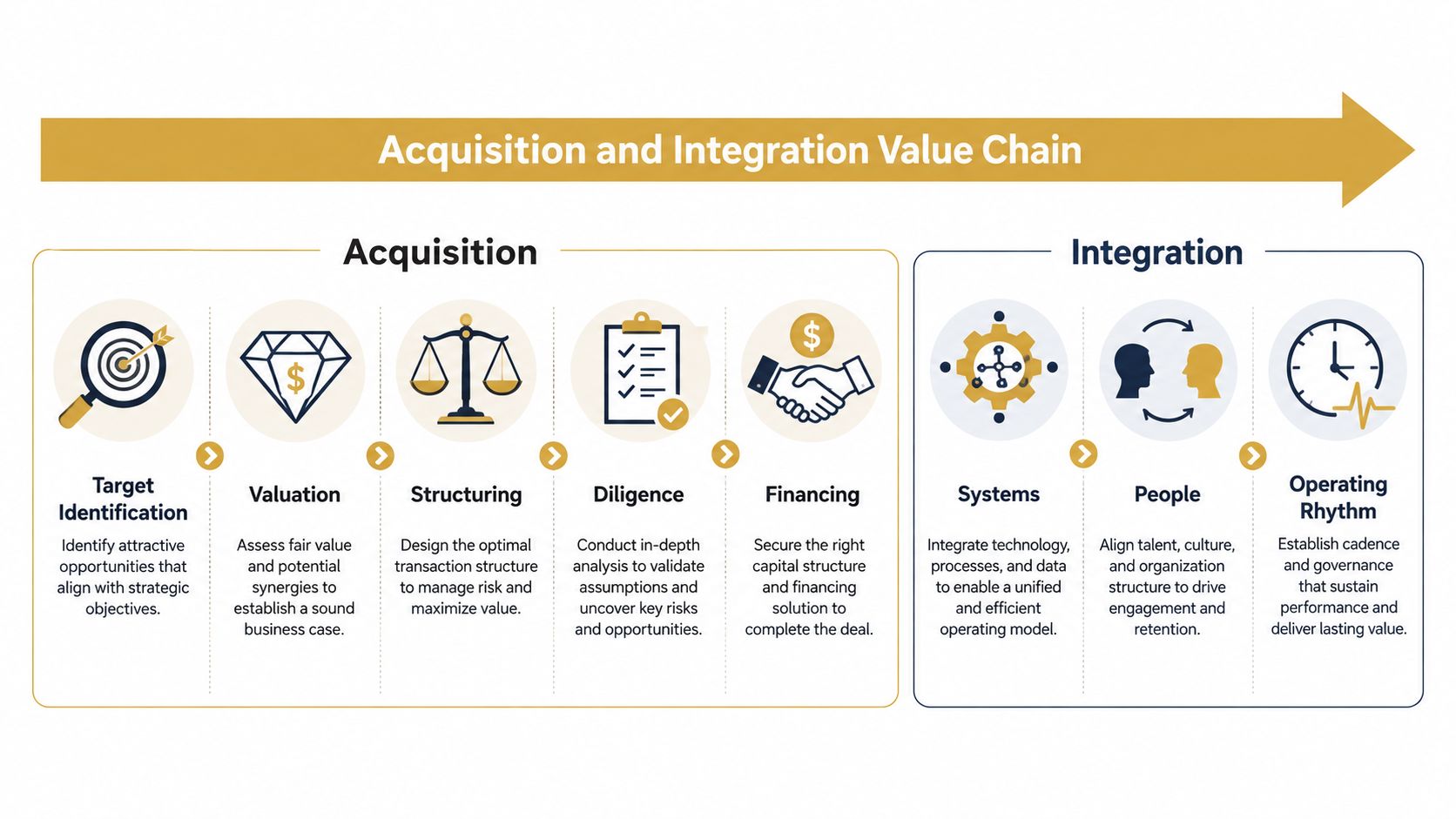
Acquisition is the process of identifying a target, valuing it, structuring the transaction, completing diligence, and arranging financing. Integration is the work of combining or coordinating systems, people, processes, controls, and leadership practices so the buyer can realize the investment thesis.
The two aren't separate workstreams for a small or mid-market buyer. They form a single value chain. A diligence answer changes the integration plan. A financing term changes the buyer's room to hire or replace systems. An earnout definition changes the seller's incentives. The integration plan, in turn, determines whether the forecasted synergies become operating results.
Every deal choice preloads future work
Suppose an earnout looks attractive in the letter of intent because it preserves cash and keeps the seller involved. The buyer then needs a CRM migration during the first month, but the earnout measures revenue using the seller's existing customer classifications. The seller now has a rational reason to delay the migration. The transaction structure has created an integration conflict before anyone has missed a target.
The same pattern appears elsewhere:
- A representation about customer contracts may transfer legal risk, but it doesn't preserve the customer relationship after ownership changes.
- A working-capital mechanism may protect the buyer economically while leaving the operating team confused about which expenses are essential.
- A debt package may fund the purchase but restrict the hiring, technology investment, or maintenance spending needed to stabilize the business.
- A diligence report may identify a weak control, but the buyer still needs a person, process, and deadline to fix it.
The empirical record reinforces the importance of the post-close period. A 2024 NBER working paper found that only 16.28% of acquirers disclosed post-integration progress after one year, increasing to 18.88% after two years, while the share explicitly classified as successful remained between 6.59% and 6.95% in the reported sample (NBER working paper). Those figures don't mean every undisclosed integration failed. They do show how rarely buyers communicate measurable progress and how slowly value capture becomes visible.
One team should own the chain
Large enterprises can staff separate deal, transformation, technology, and change-management offices. A small buyer usually can't. The same CEO, CFO, or operating partner may evaluate the target, negotiate the financing, approve the purchase, and lead the first operating reviews.
That constraint makes handoffs dangerous. The buyer should maintain one integrated register covering the deal thesis, risks, dependencies, owners, and measures. When a buyer asks, “What must be true for this deal to work?” the answer should include both the acquisition assumptions and the integration actions required to prove them.
Sourcing and Screening Deals That Integrate Well
The cheapest integration is the one you don't have to perform. Buyers often screen opportunities by asking whether the price is reasonable, whether earnings are durable, and whether financing is available. Those questions matter, but they don't reveal how much friction the combined company will absorb.
A target with a strong margin can still be a poor fit if it uses incompatible accounting software, depends on a founder for every customer decision, or operates in a geography where the buyer has no management coverage. Integration cost is usually a function of operating distance, not purchase price.
Score friction before you fall in love
Use a two-axis screen. Put strategic fit on one axis and integration complexity on the other. A high-fit, low-complexity target deserves fast attention. A high-fit, high-complexity target may still be worth pursuing, but the price, structure, and resourcing need to compensate for the work. A low-fit, low-complexity target can become a distraction, while a low-fit, high-complexity deal should usually be rejected.
Test each candidate against practical questions:
- Customer overlap: Will the companies compete for the same accounts, or can they share relationships without confusing customers?
- Accounting compatibility: Can the buyer reconcile revenue, expenses, inventory, and cash using comparable definitions?
- Geographic coverage: Does the target add density, or does it create another isolated location that needs management attention?
- Key-person dependency: Which customer, vendor, technical, or operational relationships exist only in one person's memory?
- Management compatibility: Does the leadership team communicate directly, document decisions, and accept accountability?
- Process maturity: Can the buyer observe how work moves from lead to delivery to collection?
Clean books can hide brittle operations
Sellers naturally present the business in its best light. Polished financial statements and organized diligence folders don't prove that the operation is resilient. Ask what happens when the owner is unavailable, a top technician leaves, a major customer changes its payment terms, or the company's primary system goes offline.
The buyer should also separate build-versus-buy decisions from emotional preference. If integration requires a new workflow, automation layer, or customer-facing system, the practical trade-offs in Refact on build vs buy can help frame whether internal development, a purchased tool, or an external partner fits the buyer's capacity.
A detailed review of determining post-acquisition integration needs should happen before the offer becomes emotionally difficult to withdraw. Screening is where the buyer decides which problems are acceptable, which require price protection, and which indicate that the target doesn't belong in the portfolio.
Structuring the Deal Without Creating Integration Debt
Deal structure is an integration preview. An asset purchase, stock purchase, seller note, earnout, escrow, or third-party loan can each reduce one risk while creating another. Buyers who discuss structure only in terms of tax, purchase price, and financial engineering miss the operating consequences that arrive after closing.
A stock purchase may preserve contracts, licenses, employees, and established relationships, but it can also carry legacy liabilities, union arrangements, undocumented practices, and inherited technology. An asset purchase can limit some liabilities, yet contracts may need reassignment, customers may need to consent, and employees may wonder whether their employment has continuity. Neither form is automatically cleaner.
Make diligence answer operating questions
Financial diligence should explain the past. Integration diligence must explain how the business works.
Review:
- Technology stack: Identify the ERP, CRM, payroll, scheduling, file storage, security tools, and reporting systems. Confirm ownership, access, renewal dates, data exports, and dependencies.
- Customer concentration: Determine which relationships require personal introductions, contract reassignment, or service assurances after closing.
- Change-of-control provisions: Review major customer, supplier, lease, franchise, licensing, and financing agreements before choosing the transaction form.
- People and culture: Look for unclear authority, compensation promises, founder-centered approvals, inconsistent policies, and managers who resist basic visibility.
- Control environment: Test who approves payments, changes prices, hires staff, grants system access, and reconciles cash.
An earnout can preserve seller involvement, but its measurement rules must align with the buyer's intended operating changes. Define who controls pricing, which accounting policies apply, how disputed revenue is treated, and what happens when the buyer changes systems. Ambiguity creates a second negotiation during the most fragile period of ownership.
Financing determines your options after close
Debt provides purchasing power but can reduce flexibility when the business needs investment. Covenant pressure may constrain hiring, equipment replacement, technology migration, or temporary duplication of systems. A buyer should model the cash demands of integration itself, not just the debt service.
Representations, warranties, and escrows transfer certain risks. They don't repair broken processes, retain a departing sales leader, or make incompatible systems exchange data. Keep a remediation budget and an operating contingency even when the legal documents look protective.
Before signing, confirm five decisions in writing:
- What must remain unchanged to protect customers and revenue?
- What must change immediately for safety, compliance, cash control, or reporting?
- Which seller obligations support the transition, and how will performance be measured?
- Which systems and contracts require consent, migration, or temporary parallel operation?
- Which financing restrictions could prevent the buyer from executing the plan?
Good structure preserves optionality. Bad structure forces the buyer to choose between violating the deal's incentives and delaying the integration.
The Post-Close Integration Playbook
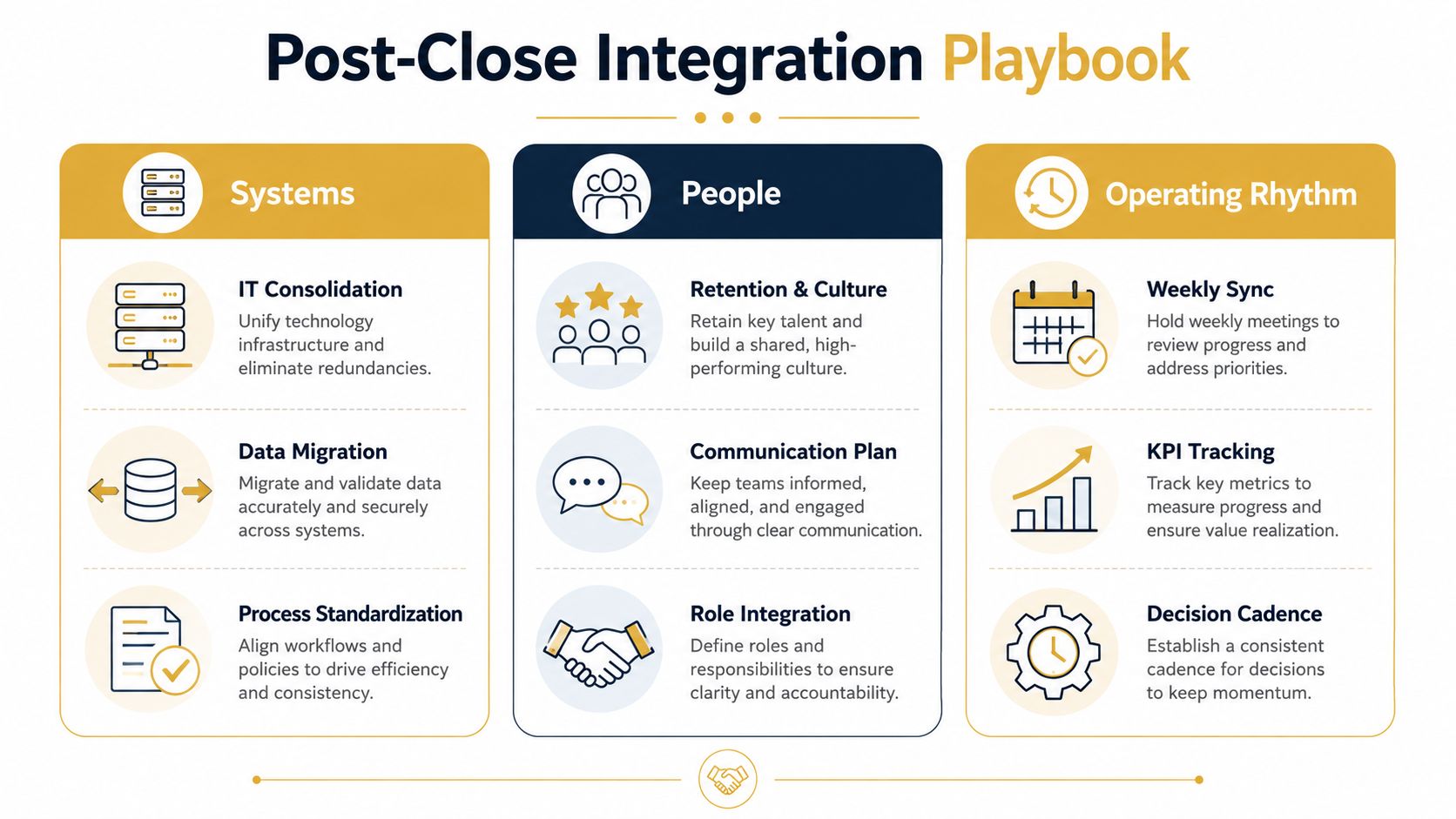
Post-close problems usually gather around systems, people, and operating rhythm. That framing is more useful than a generic calendar because it focuses the buyer on the mechanisms that either preserve performance or create confusion.
McKinsey reported that almost 70% of mergers in its database failed to achieve expected synergies in a key area, reinforcing that the deal thesis often breaks during execution (M&A performance research summarized in this integration study). The answer isn't more status meetings. It's a small number of accountable owners tracking measurable work.
Systems need sequence, not enthusiasm
Start with access, security, backups, reporting definitions, and data ownership. Don't migrate an ERP or CRM just because the buyer prefers it. First map the data fields, workflows, integrations, and reports that employees use to serve customers and close the books.
Some work can run in parallel. Identity access, cybersecurity review, payroll continuity, and basic reporting ownership can begin immediately. A CRM migration may require a controlled cutover weekend. A finance-system replacement may need to wait until the buyer understands the target's billing cycles, tax treatment, close process, and customer history.
Use a temporary bridge when necessary. A reliable weekly report assembled from two systems is better than a rushed migration that produces false confidence. Defer major changes when the target's operations are incompatible, undocumented, or already unstable. Revisit the decision after the buyer has enough evidence to design the future state.
People need clarity before optimization
Tell employees who reports to whom, which decisions remain local, how customer issues escalate, and what information the buyer needs. Clarify overlapping roles without turning every conversation into a public ranking exercise. Critical talent may need a retention arrangement, but the buyer should define the business reason, duration, expectations, and review process.
The operating rhythm makes the plan real:
- Weekly standup: Review open decisions, blocked work, customer risks, staffing changes, and financial controls.
- Single decision log: Record the decision, owner, date, rationale, and follow-up measure.
- Escalation path: Specify which issues go to the CEO, CFO, COO, lender, counsel, or technology lead.
- KPI review: Track the deal thesis through operating measures such as revenue quality, customer retention, staffing stability, service delivery, cash conversion, and synergy run rate.
For a practical lens on cultural compatibility, buyers can use this resource on culture assessment for M&A to structure conversations rather than relying on vague impressions.
A small buyer should recalibrate the plan quarterly as integration debt surfaces. The objective isn't to complete every task quickly. It's to preserve the business while moving deliberately toward a model that produces reliable information and accountable decisions.
The People and Capacity Problem Most Buyers Underestimate
The binding constraint in SMB integration is often not capital or technology. It's capacity. A buyer assigns integration to the CFO or COO on top of a full operating role, then watches progress slow once urgent customer, payroll, and lender issues consume the calendar.
The AlixPartners 2025 survey identified lack of dedicated resources as the biggest implementation risk, followed by weak communication and low leadership engagement (AlixPartners 2025 PMI insights). That finding matches what small buyers experience firsthand. The integration leader needs authority, time, and access to decision-makers. A title without those conditions is decoration.
Build a lean ownership model
You don't need a large PMI office. You do need named owners.
- Executive sponsor: Resolves conflicts and protects integration time.
- Integration lead: Maintains the workplan, decision log, dependencies, and escalation process.
- Finance owner: Reconciles definitions, reporting, cash controls, and covenant information.
- People owner: Handles communication, retention, compensation, role changes, and employment risk.
- Operations owner: Protects service delivery, customer commitments, scheduling, and quality.
- Technology owner: Controls access, security, migration decisions, and vendor coordination.
One person can hold more than one role in a smaller company, but every role must have a name and a decision boundary. An outside advisor, former operator, or part-time integrator can provide useful capacity without adding a permanent layer of management. The right support removes work from the operating team. It doesn't create another committee that requires updates.
Retain knowledge before you redesign roles
Identify critical people during the first thirty days. Focus on those who control customer trust, pricing knowledge, technical delivery, vendor relationships, scheduling, or undocumented processes. Ask what would stop working if each person left tomorrow, then document the answer.
Stay packages can help, but they should be targeted and explained consistently. If the buyer rewards one employee without clarifying the business need, other employees may interpret the arrangement as favoritism. Use written expectations, defined review points, and a clear end condition.
Not every role should be preserved. Non-essential positions can exit cleanly when the buyer communicates the reason, protects dignity, and transfers the work before departure. The objective is not to keep everyone. It's to avoid losing the people who hold the operating system in their heads.
For additional perspective on evaluating leadership depth, use this framework for evaluating management team capabilities. If the acquisition creates a sales-capacity gap, specialized support such as Hire SDRs may help the buyer add outbound capacity while the core team focuses on customers and integration.
Common Misconceptions and Your Integration Checklist
Three beliefs repeatedly damage small-business integrations.
The first is that speed alone creates value. Speed matters when it protects cash, customers, safety, or compliance. Speed becomes destructive when the buyer forces a system migration without understanding the data, changes reporting definitions before reconciling them, or removes a seller before transferring critical knowledge.
The second is that synergies should be visible in the first hundred days. Early months should establish control, continuity, and trustworthy measurement. Savings or growth opportunities may be identified early, but the buyer shouldn't call them realized until the operating change works consistently.
The third is that closing ends the deal. The NBER evidence described earlier shows that measurable integration progress often appears well after the announcement, while McKinsey's historical findings connect outcomes to post-close execution rather than signing alone. A 2025 enterprise survey also found that 86% of organizations said integration took longer than expected, with an average duration of eight months, and one in five taking more than a year (Enterprise Times coverage of the survey). SMB buyers should treat those findings as a warning against under-budgeting time and attention.
A practical pre-close to Day-365 checklist
Before signing
- Red flags: Review every unresolved diligence issue and assign a post-close owner.
- Deal thesis: Translate each expected synergy into an operating action and measurement method.
- People: Identify critical talent, key-person dependencies, and communication responsibilities.
- Systems: Map access, data, vendors, reporting definitions, security concerns, and migration dependencies.
- Financing: Confirm which covenant or liquidity limits could restrict integration spending.
Before Day One
- Continuity: Confirm payroll, insurance, banking access, customer coverage, vendor contacts, and operational authority.
- Communication: Prepare separate messages for employees, customers, lenders, suppliers, and managers.
- Governance: Publish the integration lead, functional owners, meeting cadence, decision log, and escalation route.
By Week Four
- Ownership: Make every workstream accountable to a named person with a defined decision boundary.
- People: Complete critical-talent conversations and document vulnerable processes.
- Reporting: Reconcile the first combined operating view before making major performance claims.
By Month Three
- Systems: Approve each migration, connection, or deferral based on tested data and customer risk.
- Processes: Standardize only the workflows that improve control or service without disrupting delivery.
- Customers: Review churn signals, complaints, service delays, and relationship coverage.
By Day 365
- Value capture: Measure realized synergies against the original thesis and explain variances.
- Operating model: Decide which temporary bridges can be retired and which require further investment.
- Capacity: Reassess whether the integration lead and functional owners still have the time and authority required.
- Next deal: Update the buyer's screening criteria and playbook using what this integration exposed.
Acquisition and integration work rewards buyers who make fewer assumptions, assign real owners, and protect the acquired company from avoidable disruption. The deal model matters, but the operating model decides whether the model survives contact with reality.
Dealmaker Wealth Society offers acquisition training, deal-structuring guidance, checklists, and peer support for buyers working through sourcing, diligence, financing, and post-close execution. Visit Dealmaker Wealth Society to explore the practical resources and community support available for your next acquisition.

From the Dealmaker Blog














A Creative Business Buying Fable
