Best Recession Proof Businesses to Buy in 2026
Best Recession Proof Businesses to Buy in 2026

Most businesses lose revenue when unemployment rises, but a small group of sectors keeps adding jobs. That's the starting point for this list, and it's why industry labels aren't enough on their own.
Research summarized by the Federal Reserve Bank of Philadelphia identifies utilities, government, and education and health services as the three major acyclical sectors in the U.S., accounting for approximately one-third of jobs. Since 1987, about 70% of net jobs created during U.S. recessions, excluding the COVID-19 recession, were in these sectors. They were typically the only sectors to expand while the broader economy contracted.
That pattern tells you where to look, not what to buy. I've ranked nine of the best recession proof businesses through an acquirer's lens, focusing on recurring revenue quality, payment urgency, margin durability, seller supply, and deal structure. A business can sound essential and still collapse if it's carrying high fixed costs, weak cash conversion, or concentrated customers.
You want the opposite. You want customers who can't defer the payment, contracts that renew without a resell, and cash flow that still covers debt service in a downside case. Get that right and you don't just survive a downturn, you own an asset a platform or private equity group will want later.
Table of Contents
- 1. Essential Residential Home Services (HVAC, Plumbing, Electrical)
- 2. Veterinary and Companion Animal Care Practices
- 3. Dental and Outpatient Healthcare Practices
- 4. Self-Storage Facilities
- 5. Accounting, Bookkeeping, and Tax Services
- 6. Vertical-Market B2B Software
- 7. Independent Insurance Agencies
- 8. Childcare and Early Education Centers
- 9. Automotive Repair and Maintenance Shops
- Recession-Resistant Business Types at a Glance
- From Recession-Proof List to Signed Deal
1. Essential Residential Home Services (HVAC, Plumbing, Electrical)
A failure is the sales engine here. When heat dies in January or a drain backs up, the homeowner doesn't shop for three weeks, they pay someone today.
Here's a technician on a typical service call, the kind of urgent, non-deferrable work that drives this model.

That urgency is also reflected in spending patterns. Fiserv data shows services represented 71% of tracked small-business spending versus 29% for goods. For a buyer, the lesson isn't that every service business wins, it's that repair versus replace economics protect ticket flow when big projects dry up.
Where the recurring revenue actually sits
Sort revenue into three buckets fast. Maintenance agreements are contracted and visit-driven, emergency repairs are urgent but unpredictable, and installs and remodels are the most cyclical. I favor shops where agreements create a steady base of inspections that feed repair work, not shops living on new construction.
Say a suburban HVAC operator services agreement members twice a year and converts failing units during those visits. That's a pipeline you can underwrite. A contractor tied to builders is a different risk entirely, even under the same trade name.
Watch the operational exit ramp before you price it. This walkthrough shows the dispatch and field workflow you'll need documented, not trapped in the seller's head.
Apex Service Partners shows why platforms chase this space, rolling up independent HVAC, plumbing, and electrical dealers, including manufacturer service networks. In diligence, check technician tenure, training pipelines, and CRM discipline. Structure a 6 to 12 month seller transition to protect relationships, and don't pay an install multiple for agreement revenue you haven't verified in the system.
2. Veterinary and Companion Animal Care Practices
Owners cut a lot before they cut care for a sick dog. That behavior, plus a steady stream of retiring independent owners, is why veterinary practices keep trading.
National Veterinary Associates and Thrive Pet Healthcare both grew by acquiring local hospitals and clinics. Their presence helps your exit, but it also means good practices rarely sell cheap. You're competing against consolidators who understand doctor retention and can spread back-office costs.
What to underwrite beyond revenue
Gross revenue hides weak clinics. Look at client retention and patient visit frequency, because preventive care, diagnostics, and chronic treatment plans are what turn one emergency into years of billing.
- Doctor concentration: If one veterinarian holds most client trust, your revenue walks if she leaves.
- Visit mix: Preventive and diagnostic work is steadier than discretionary elective procedures.
- Real estate: Decide early whether you're buying the building or negotiating a long, assignable lease.
Say a two-doctor practice has strong bookings but the selling doctor handles most surgeries and long-term clients. I'd tie part of the price to an earnout based on client retention and lock in retention contracts for the associate doctors before close. Without that, you're buying equipment and a lease, not a patient base.
Practical rule: In veterinary deals, protect the doctors first and the multiple second. Clients follow clinicians, not logos.
3. Dental and Outpatient Healthcare Practices
Healthcare demand doesn't wait for a good economy. During the Great Recession it moved in the opposite direction from the rest of the labor market.
A Bureau of Labor Statistics analysis of healthcare jobs and the Great Recession found total U.S. employment fell 6.9%, approximately 7.8 million jobs, while healthcare employment increased 6.6%, or about 850,000 jobs. That doesn't make every clinic defensive. Elective-heavy practices still feel pressure when patients delay treatment or lose coverage.
Structuring around payer and licensing risk
Heartland Dental and Aspen Dental show the support organization model at scale, but a first-time buyer usually targets a smaller general practice with hygiene-driven recall. Hygiene visits create recurring appointments, and membership plans where patients are paying directly for preventive dental care can smooth revenue outside insurance cycles.
For a step-by-step view of deal structure in this niche, see this guide on how to buy a dental practice before you submit a letter of intent. It'll help you frame questions on transition and ownership rules.
Say a practice looks profitable but depends on one payer contract and a single dentist nearing retirement. Test it hard. Verify payer mix and reimbursement rates, confirm your structure complies with state corporate practice rules, and audit patient records and billing practices. Clinician retention through contracts and incentives isn't a post-close project, it's a closing condition. Price delayed reimbursement and wage inflation into your downside case, not your base case.
4. Self-Storage Facilities
Self-storage is real estate with a service wrapper, and that's both the attraction and the trap. You're buying occupancy, pricing power, and location, not just a building with roll-up doors.
This is the everyday customer moment behind the model, a household in transition that needs space now.

Public Storage and Extra Space Storage operate at a scale you won't match, but their playbook is instructive. They win on revenue management, online leasing, and disciplined expense control. A smaller facility can copy those systems if the market fundamentals support it.
- Local supply pipeline: New facilities opening within a few miles can crush occupancy and street rates.
- Occupancy stress test: Model cash flow at lower occupancy before you model rent growth.
- Management upside: Underpriced units, poor collections, and no dynamic pricing are fixable, oversupply usually isn't.
Say you're looking at a mom-and-pop facility with paper leases and flat pricing for every unit size. That's a classic value-add case if competitor occupancy is healthy and no major supply is permitted nearby. Professional management, online rentals, and tiered pricing can lift revenue without adding square footage.
Don't ignore financing sensitivity. Month-to-month leases reprice quickly, which helps in inflation, but interest rate changes hit cash flow directly on a deal financed with debt. Underwrite conservative rent growth and leave room for delinquency to rise when households are stressed.
5. Accounting, Bookkeeping, and Tax Services
Tax deadlines don't move because GDP fell. Neither does payroll, sales tax filing, or a lender's request for clean financials.
That's why firms like Aprio, built through multiple accounting acquisitions, and regional firms merging for service lines and geography, keep attracting buyers. The best targets aren't seasonal tax shops. They're firms with monthly bookkeeping, payroll, and advisory contracts that bill year-round and become embedded in the client's operations.
Separating sticky compliance from seasonal work
Break revenue by service line and client. I want to see recurring monthly work, clear engagement letters, and no single client large enough to break debt coverage if they leave. Transactional year-end work is valued differently, and it should be.
Say a firm serves local contractors and e-commerce sellers with monthly close, payroll, and quarterly planning. Those clients can't pause bookkeeping without creating a bigger mess later, and you can cross-sell tax planning once trust transfers. That's a stronger downside case than a practice dependent on one-off returns.
In diligence, confirm partner transition plans and non-compete agreements, because relationships often live with the seller. Map staff capacity too. If margins depend on the owner doing senior work at below-market pay, normalize that cost before you value earnings.
Post-close, standardize software and workflows early. Moving clients onto one stack, documenting month-end checklists, and cleaning up billing cadence usually protects margins faster than chasing new clients in year one.
6. Vertical-Market B2B Software
Broad software can get cut in a downturn. Software that runs scheduling, compliance, billing, or field operations for one niche industry is much harder to rip out.
This comparison lays out the trade-offs buyers weigh in vertical software, from margin quality to technical risk.
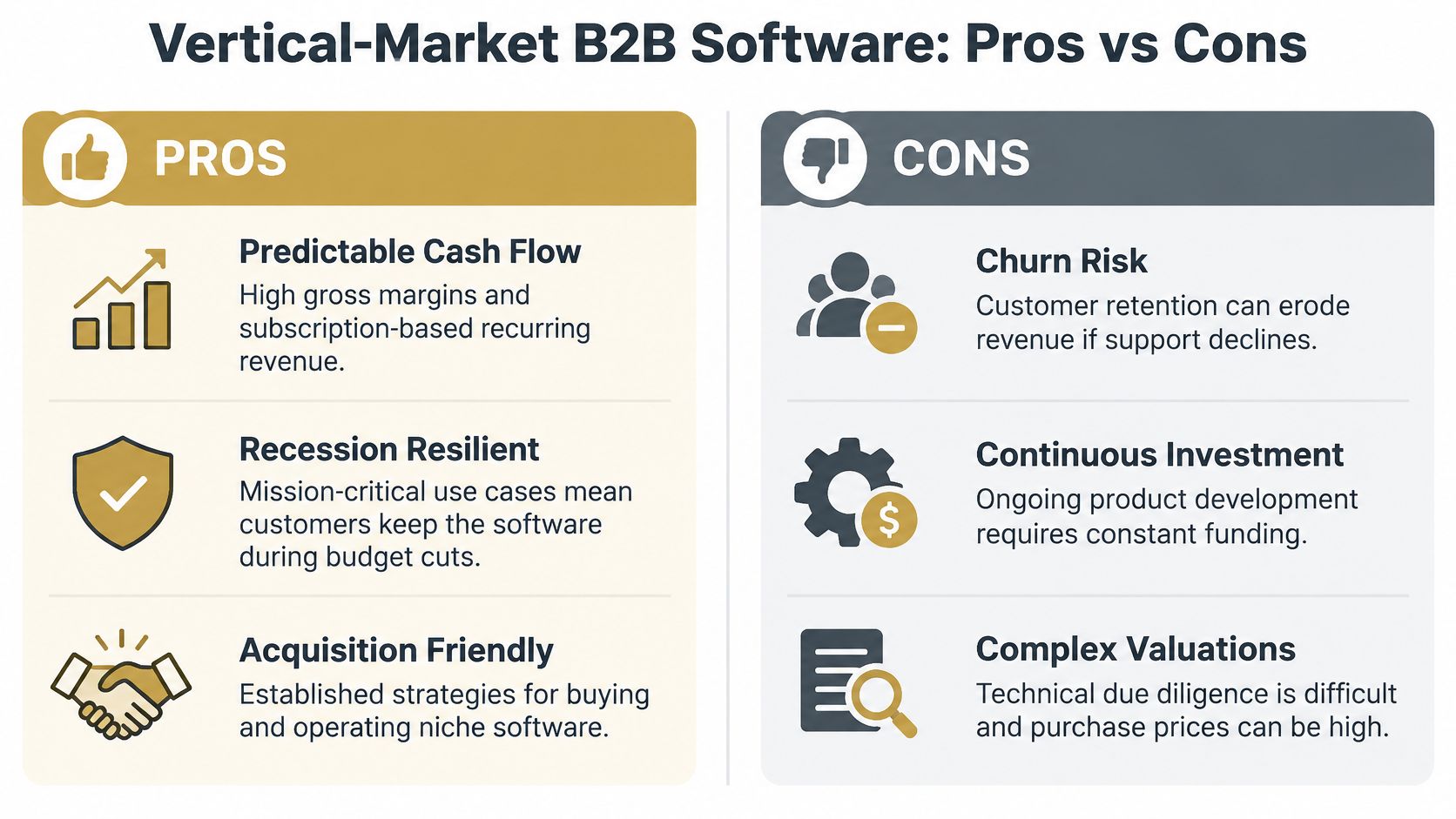
Constellation Software built its model by acquiring and holding exactly these businesses for cash flow. Smaller niche companies follow the same logic on a different scale, often with flat growth but durable subscription revenue.
Retention is the number to interrogate. Gartner's reported client-retention series has remained approximately 84.4% to 85.4% across the displayed periods, defined as the share of prior-year clients that remain current clients. That also means roughly 15% of customers leave before expansion, so don't confuse retention with guaranteed growth.
Calculate gross revenue retention, net revenue retention, logo churn, and customer concentration separately. Split churn by customer size and industry, and ask what happened during the last stress period. The framework in this piece on doing deals in the professional services sector applies here too, especially on client risk.
Say a compliance tool for property managers has modest growth but customers rely on it for required reporting. That's often safer than a faster-growing dashboard clients treat as nice to have. Assess code quality, security, and technical debt, keep product and support stable for the first year, and use seller financing or an earnout if transition knowledge sits with the founder.
7. Independent Insurance Agencies
Insurance renewal commissions are some of the cleanest recurring revenue you can buy in a small business. The policy renews, the agency gets paid again, and the client usually needs coverage whether the economy is growing or not.
Brown & Brown and Acrisure grew by acquiring independent agencies for exactly that reason. Essential categories also held up in broader spending, with retention driving value more than new sales in a soft market. For a related model on buying renewing revenue, this overview of how to buy a subscription business is a useful primer.
Buying the book, not just the agency
Value lives in the book of business. Analyze it by line, personal versus commercial, carrier, and producer. A diversified book with strong retention deserves a better multiple than a concentrated book tied to one industry that's about to lay people off.
An agency with average growth and excellent retention will usually outlast an agency with strong new sales and leaky renewals.
Say a local agency writes homeowners, auto, and small commercial policies, with service staff handling renewals and certificates daily. Clients stay because switching is a hassle and coverage gaps are risky. That's defensive if carrier appointments transfer cleanly.
Verify carrier appointments and transferability early, because losing a key carrier post-close can strand clients. Confirm producers and service staff will stay, and structure an earnout tied to retention of the book. Sellers who believe their retention story should be willing to share that risk.
8. Childcare and Early Education Centers
Working parents can't defer childcare the way they defer a vacation. If both parents work, care is a fixed requirement, not a lifestyle upgrade.
Education has a long record behind it too. Among establishments born in the second quarter of 1998, U.S. Bureau of Labor Statistics survival data show 73% of education and health-services businesses were still operating after two years, and 55% remained open after four years. Information businesses, by comparison, were at 63% and 38%. Longevity doesn't remove operational risk, but it supports the category.
Bright Horizons and KinderCare operate large networks, yet many local centers still trade to independent operators. Seller supply comes from owners who built around a license, a lease, and local reputation, then hit retirement without a successor.
- Licensing and inspections: Review status, inspection history, and any corrective actions in detail.
- Enrollment quality: Check trends, waitlists, and local population growth, not just current headcount.
- Staffing economics: Ratios are regulated, so retention and wage pressure flow straight into margins.
Say a center has a waitlist but high teacher turnover and a short remaining lease. I'd price that cautiously. Tuition looks recurring, but you can't run classrooms without staff, and you can't move a licensed facility quickly. Confirm facility lease terms and capital needs, interview key teachers where permitted, and stress-test enrollment if local employers cut jobs. Strong centers are defensive, poorly staffed centers are fragile at any point in the cycle.
9. Automotive Repair and Maintenance Shops
When money tightens, drivers keep cars longer. Older cars need brakes, tires, diagnostics, and routine maintenance to stay safe and pass inspection.
Here's the bay-level work that keeps that demand moving, inspection and diagnosis before a repair decision.

Driven Brands, with Meineke and Take 5 Oil Change, shows the multi-brand service model. Independent shops also join regional networks to share purchasing and marketing. For a buyer, a well-run general repair shop can be a platform for bolt-ons if systems and reputation transfer.
Reading the repair order
Don't start with revenue. Start with average repair order value and customer visit frequency. A shop doing honest maintenance and catching needed work on inspection builds repeat behavior. A shop discounting oil changes to buy traffic often hasn't built anything durable.
Say a shop services commuter vehicles for families who return for scheduled maintenance and approve safety repairs quickly. That's repair versus replace economics in your favor, because a repair bill beats a new car payment for most households.
Assess technician skills, certifications, and retention risk, and inspect equipment condition with upcoming capital needs priced in. Plan for electric and hybrid service requirements too. You don't need to rebuild the shop on day one, but you do need a training and tooling path before higher-value work starts going elsewhere.
Recession-Resistant Business Types at a Glance
| Business Type | Recurring Revenue Source | Downturn Behavior | Key Acquisition Consideration |
|---|---|---|---|
| Essential Residential Home Services (HVAC, Plumbing, Electrical) | Maintenance agreements and service plans | Repairs remain necessary; demand is relatively resilient | Assess maintenance-plan revenue, technician retention, and seller dependence |
| Veterinary and Companion Animal Care Practices | Preventive care, wellness visits, and repeat treatments | Pet owners often continue spending on essential animal care | Confirm veterinarian retention and client loyalty |
| Dental and Outpatient Healthcare Practices | Hygiene visits, checkups, and recurring outpatient care | Routine and essential care tends to remain steady | Verify payer mix and plan for clinician retention |
| Self-Storage Facilities | Month-to-month unit rentals | Demand may rise with downsizing, relocation, and household consolidation | Analyze local competition, supply, and occupancy |
| Accounting, Bookkeeping, and Tax Services | Monthly bookkeeping, payroll, and advisory contracts | Compliance work persists; recurring contracts support stability | Review client concentration and partner transition plans |
| Vertical-Market B2B Software | Subscription fees | Mission-critical software is often retained during budget cuts | Assess recurring revenue, churn, code quality, and technical debt |
| Independent Insurance Agencies | Policy renewal commissions | Renewal income continues even when new sales slow | Check retention, carrier appointments, and producer continuity |
| Childcare and Early Education Centers | Regular tuition payments | Working families continue to need childcare | Review licensing, enrollment trends, staffing, and facility costs |
| Automotive Repair and Maintenance Shops | Repeat maintenance and repair work | Owners often maintain existing vehicles rather than replace them | Assess customer frequency, technician retention, and equipment needs |
From Recession-Proof List to Signed Deal
The common thread across these nine categories isn't a magic industry label. It's recurring, necessity-driven revenue from customers who stay, combined with costs you can control when volume softens.
That's why revenue mechanics matter more than the word essential in a listing. Ask which payments are contracted, which are urgent but uncontracted, and which are deferrable. Then test gross margin, labor intensity, customer concentration, working capital, and debt service under a downside case. A heating contractor living on new construction, a clinic dependent on elective work, and a software tool users treat as optional can all look defensive in a teaser and fail that test in diligence.
We recommend acquiring only businesses that have weathered economic recessions, generate $1 million in gross revenue, and have a proven track record of steady profits. That filter won't give you the longest target list, but it gives you a financeable one. After buying, the job is to scale it from $1 million to $2 million and beyond with better marketing and sales, better pricing, and tighter operations, not with hope.
Buying beats starting from scratch for a practical reason. Startups face eight problems at once, no money, no product-market fit, no staff, no processes, no marketing, no sales, no revenue, and no time. An existing business in HVAC, accounting, insurance, or storage already has customers, employees, suppliers, and cash flow you can verify. You're underwriting a track record instead of funding an experiment.
Seller supply is on your side in most of these categories. Owners retire, partners split, and operators tire of managing technicians, clinicians, or producers. Your edge is showing up prepared with a clean structure, respectful transition terms, and financing you can close. Use seller financing or earnouts where retention risk is real, protect key employees early, and don't overpay for growth that only existed in a strong economy.
If you want a structured path, the 10-Day Business Buying Launch is presented as the first step for people new to business buying, and all of our top dealmakers started with it. It teaches creative deal structuring, and students receive real-time feedback and coaching on their own deals. We also have 50+ students who have replicated this process and acquired businesses for themselves, which matters because the process needs to work on live targets, not just on paper.
I recommend you pick one category from this list this week, define your downside test in writing, and start sourcing owners directly. Screen for recurring revenue, retention, and transferable staff before you fall in love with a multiple. The best recession proof businesses aren't the ones with the best story in a listing, they're the ones that keep collecting when customers get careful, lenders get cautious, and weaker competitors start cutting price to survive.
If you're ready to buy a business that keeps billing through a downturn, Dealmaker Wealth Society offers the 10-Day Business Buying Launch, live coaching, and playbooks for sourcing, structuring, and financing profitable acquisitions. Join to get real-time feedback on live deals, learn creative deal structuring and capital raising, and start screening recession-resistant targets with a community of active dealmakers this week.

From the Dealmaker Blog













A Creative Business Buying Fable