Bolt on Acquisitions: A Practical Playbook for SMB Buyers
Bolt on Acquisitions: A Practical Playbook for SMB Buyers

Bolt-on acquisitions are now a primary private equity growth path: they represented 62% of UK mid-market deals in H1 2022, while add-ons reached 54.2% of private equity deal activity in Q1 2026. A bolt-on is a small, operationally adjacent acquisition absorbed into an existing platform, and it works best when integration muscle is already in place.
You may be looking at a business across town that serves the same customers, uses similar technicians, and has an owner ready to retire. The price looks manageable. The lender understands the platform. The synergies seem obvious. Then closing arrives, and the COO is suddenly running payroll conversion, customer retention, vendor negotiations, and the next acquisition search at the same time.
That's where many bolt-on acquisitions lose their economics. Buying the target is only the visible part of the transaction. The work is deciding who owns integration, how much executive capacity the platform can spare, which systems must change first, and whether the combined business can grow without turning every new acquisition into a growth burden.
Table of Contents
- What a Bolt On Acquisition Actually Looks Like
- Why Bolt Ons Now Dominate the Deal Market
- When a Bolt On Beats a Bigger Platform Deal
- Sourcing Bolt On Targets That Fit Your Platform
- Valuation and Structuring Nuances for Add Ons
- A 100 Day Integration Playbook for Your First Add On
- The Hidden Cost Most Buyers Underestimate
- Scaling a Roll Up Without Breaking the Platform
What a Bolt On Acquisition Actually Looks Like
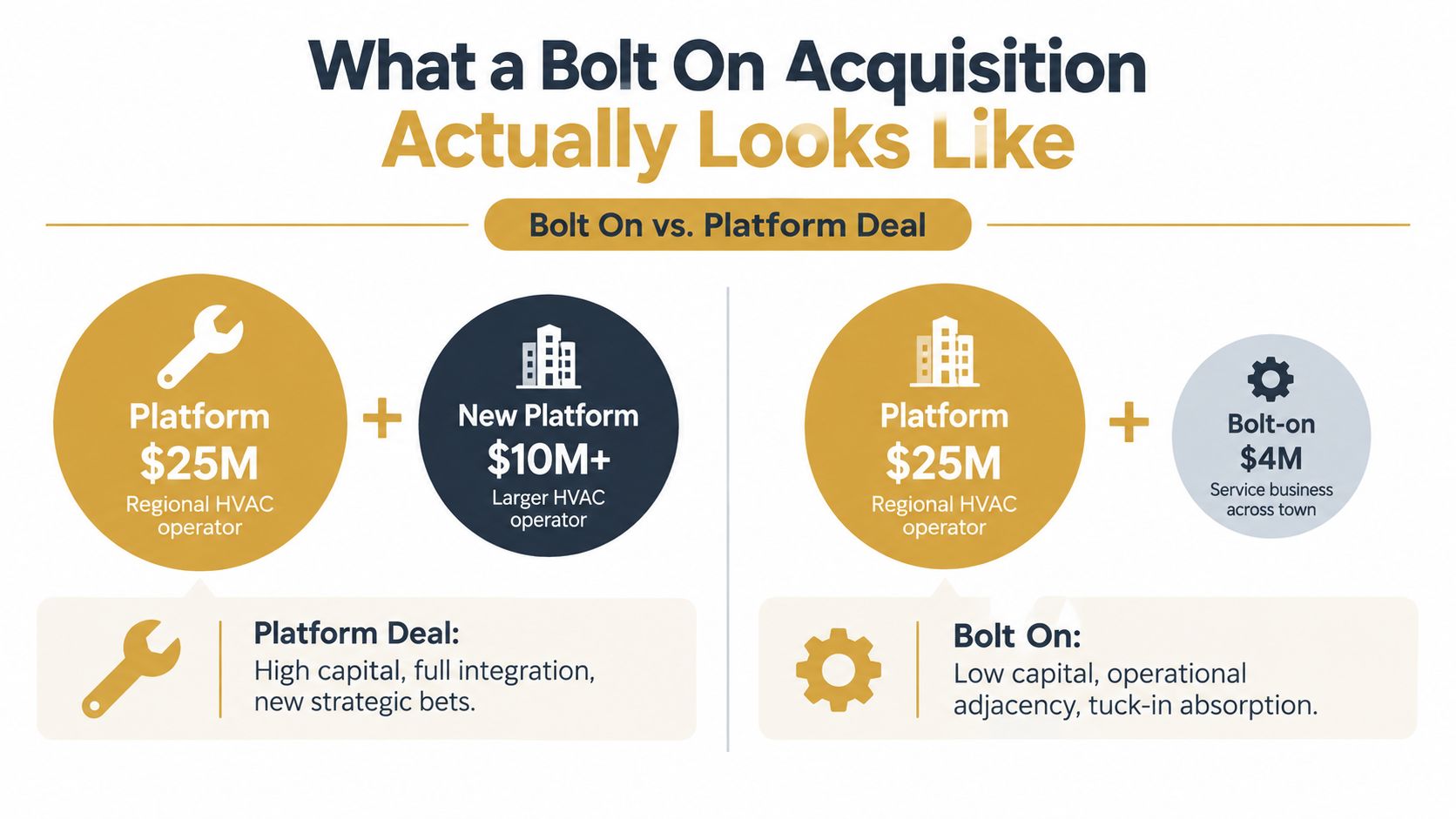
A regional HVAC operator with $25 million in revenue closes a $4 million service business across town. The target has a similar customer profile, uses comparable field technicians, and can share accounting, recruiting, purchasing, and dispatch support. That's the classic bolt-on pattern.
A bolt-on acquisition is a smaller business attached to an existing platform because the buyer already understands its market and has an operating structure ready to absorb it. The target may add local density, customer relationships, technicians, licenses, or a complementary service line. It isn't intended to become a second headquarters with an entirely separate strategic identity.
The distinction from a standalone platform acquisition matters:
- Day-one economics: A platform deal typically depends on building a new operating base. A bolt-on often includes expected synergies in the initial underwriting, so the buyer must verify those savings rather than treat them as optional upside.
- Integration runway: A bolt-on may be absorbed into existing operations over weeks rather than requiring a long, multi-quarter transformation. That speed only helps if systems, decision rights, and employee communications are ready.
- Financing: Buyers often fund the transaction through the existing credit facility or platform capital structure. That can simplify execution, but it also places the new debt and integration costs directly on the platform.
Operational adjacency is the central test. Research on acquisition outcomes supports the view that deals between companies with similar operations tend to produce healthier results than transformational combinations, which is consistent with the logic behind operationally adjacent transactions.
Practical rule: If the target requires a new customer model, unfamiliar systems, and a different management philosophy, you're probably evaluating a platform deal, not a tuck-in.
That's why a large-deal playbook can't be copied. Platform M&A tests whether the buyer can build or control a new business. Bolt-on M&A tests whether the buyer can repeatedly absorb businesses without weakening the one it already owns.
Why Bolt Ons Now Dominate the Deal Market
Bolt-ons have moved from a specialist private equity tactic to a central deployment channel. In the UK mid-market, 241 bolt-on transactions completed in H1 2022, representing 62% of all deals and an aggregate value of £12.7 billion, the highest half-yearly proportion recorded in that review, according to the Institute of Chartered Accountants in England and Wales.
Recent activity points in the same direction. In Q1 2026, firms completed 587 add-on acquisitions, equal to 54.2% of all PE deal activity in the relevant dataset, and add-on volume rose 35.9% compared with Q4 2025. The same market review reports that European bolt-ons reached 2,228 deals worth €225.8 billion in a single year, accounting for 67.4% of deal count and 55% of deal value. Those figures are summarized in the add-on market review from Dakota.
| Year | Add-on share of deal count | Add-on share of enterprise value |
|---|---|---|
| H1 2022 UK mid-market | 62% | Not provided |
| Q1 2026 dataset | 54.2% | Not provided |
| European annual data | 67.4% | 55% |
The reason is practical. When organic expansion slows or larger standalone acquisitions become more expensive, a sponsor can use a platform to pursue smaller, adjacent businesses. Fragmented markets offer many potential targets, and the buyer can apply existing systems, purchasing relationships, management practices, and customer access.
Why independent SMB buyers should care
The same mechanics affect buyers outside private equity. Owner fatigue, succession concerns, and a lack of obvious successors can create opportunities for an operator who has a credible integration plan. A serious buyer may also face a softer process when an owner prefers a practical transition to a broad auction.
But market popularity doesn't make every target attractive. The volume of bolt-ons creates competition for good businesses, while weaker targets can look appealing because they fit a familiar deal pattern. Your advantage isn't copying private equity's appetite. It's knowing exactly which businesses your platform can absorb and rejecting the rest.
When a Bolt On Beats a Bigger Platform Deal
A bolt-on wins when it strengthens a working operating model. It loses when the buyer uses a small acquisition to compensate for a weak core business.
Start with the platform's spare capacity. If the leadership team still struggles with reporting, hiring, pricing, or customer retention, new revenue won't solve the underlying problem. It may add complexity before the existing business has reliable controls.
A bigger platform deal makes more sense when the buyer needs a capability or market position that smaller targets can't provide individually. That might include a new geography, a distinct customer segment, or a management team with specialized expertise. The trade-off is a more demanding integration and a larger strategic bet.
Organic growth remains the right choice when the core unit economics aren't defensible. Hiring another salesperson, expanding service capacity, or improving conversion may produce better results than buying revenue that carries unfamiliar employees, contracts, systems, and obligations.
A practical comparison
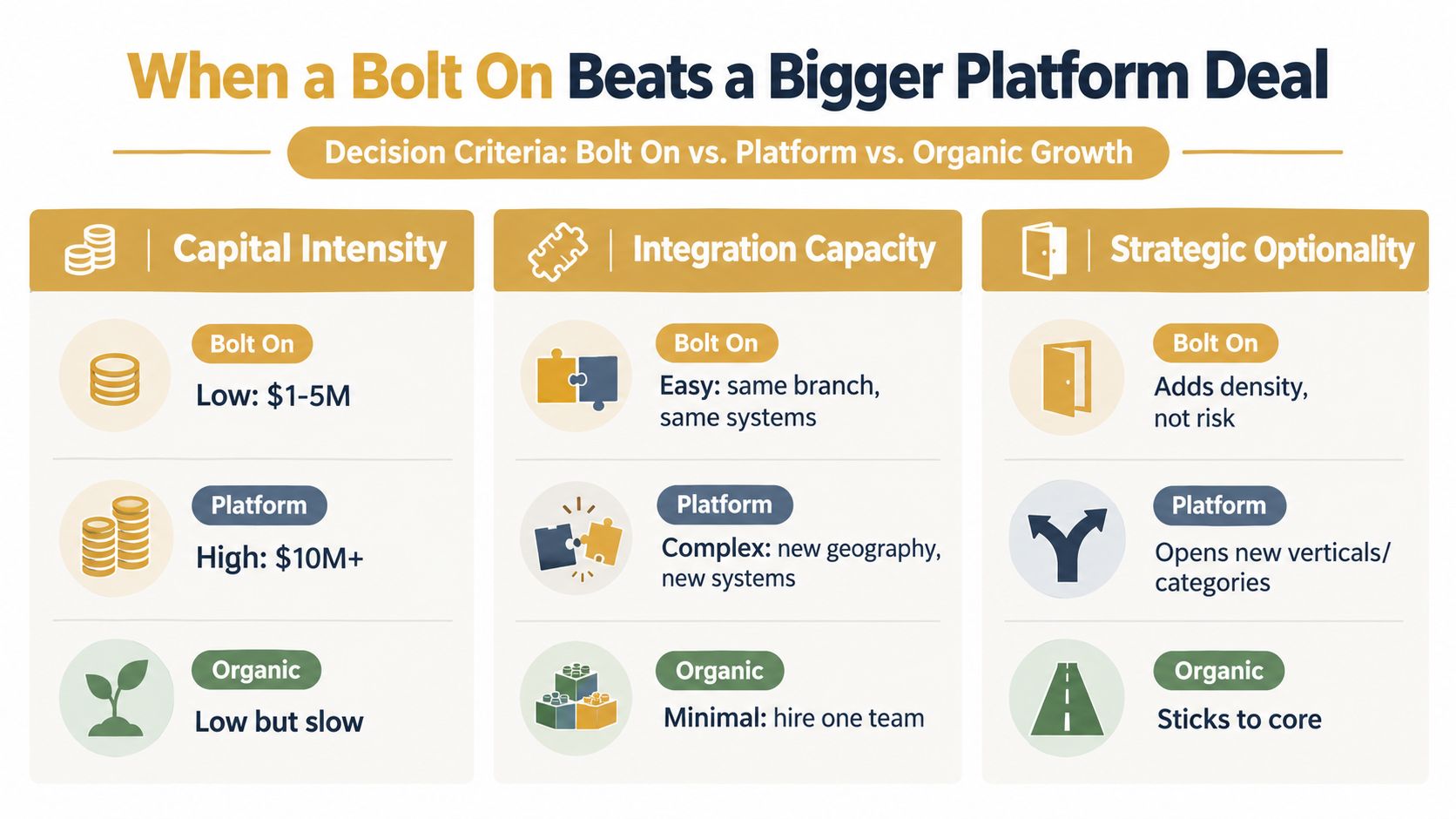
| Decision factor | Bolt-on acquisition | Bigger platform deal | Organic growth |
|---|---|---|---|
| Capital intensity | Lower relative burden, but still requires integration cash | Higher capital commitment and broader diligence | Lower cash requirement, slower expansion |
| Integration capacity | Best with shared systems and similar operations | Requires new processes, leaders, or geography | Minimal transaction integration |
| Strategic purpose | Adds density, capacity, or adjacent customers | Opens a new category or market | Deepens the existing model |
| Main risk | Integration drag and management overload | Strategic and execution complexity | Slow progress or underinvestment |
The first option is strongest when the platform has a tested integration playbook, a named owner, and enough operating capacity to protect the core. The second is strongest when the target provides something that cannot be assembled through smaller purchases. The third is strongest when the buyer still has obvious internal improvements to make.
Before opening a confidential information memorandum, apply one rule: if the platform can't name the integration owner, the first two synergy projects, and the capacity they require, it isn't ready to buy the target.
A short video can help frame the strategic differences before you build your own decision model.
Sourcing Bolt On Targets That Fit Your Platform
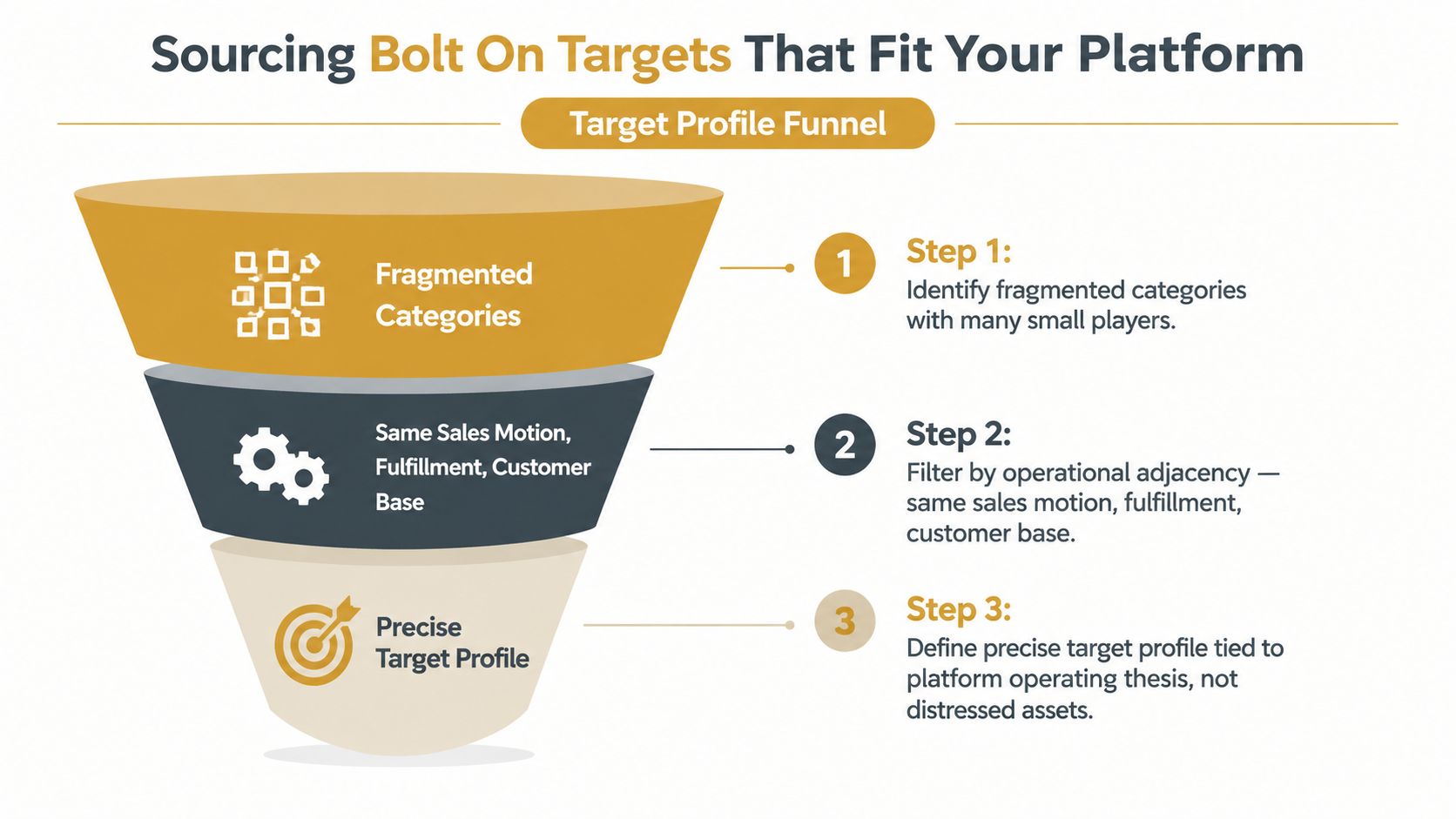
The best pipeline starts with an operating thesis, not a list of distressed businesses. Define the exact type of company your platform can absorb, then search for owners whose businesses fit that design.
A useful profile describes the target's customer base, sales motion, fulfillment model, geography, technology, licenses, management structure, and likely transition needs. It should also identify the two or three synergies that matter most. For example, the platform may be able to consolidate finance and purchasing while adding the target's customers to an established service network.
Build the target profile
Look for fragmented categories where the platform already knows how to sell, deliver, hire, schedule, and serve. Review:
- Ownership profile: Identify aging owners, succession concerns, and businesses where the founder is the main operational constraint.
- Revenue quality: Examine recurring work, customer concentration, contract terms, and renewal behavior.
- Operating compatibility: Compare software, licenses, pricing logic, service standards, and employee responsibilities.
- Cultural fit: Assess how managers communicate, handle customers, and respond to performance expectations.
- Integration load: Estimate the work required for payroll, CRM, accounting, branding, reporting, and vendor changes.
Brokers can introduce qualified sellers, but direct outreach often reaches owners before they enter a formal process. Build relationships with trade associations, accountants, attorneys, suppliers, and executives who know which independent operators are considering a transition.
A simple scorecard should force trade-offs into the open. Give each target a clear status, such as advance, hold, or reject, based on adjacency, owner transition, synergy credibility, data quality, and available leadership capacity. Don't advance a target because the revenue looks attractive if the integration depends on heroic cost cutting or unsupported cross-selling.
Each candidate should have a named executive sponsor, a documented synergy case, and a credible employee-retention plan before the buyer issues an LOI. Buyers building this process can also use sourcing services for acquisitions to supplement direct outreach and intermediary relationships.
The best target isn't merely available. It's a business the platform can absorb without pulling its strongest operator away from the core for too long.
Valuation and Structuring Nuances for Add Ons
Headline EBITDA multiples rarely tell the whole story in a bolt-on. The buyer should value the target on a standalone basis, then separately model the synergies that are measurable, time-bound, and assigned to a specific executive.
Separate cost savings from purchasing improvements, pricing changes, and cross-selling. Cost savings may be easier to validate than revenue synergies, but both require an owner, a timeline, and evidence. If the buyer pays upfront for optimistic assumptions, the platform may overpay for benefits it still has to earn.
Keep the structure aligned with operating risk
A modest upfront payment can be tied to verified quality-of-earnings findings. Seller financing can preserve cash for integration, while contingent consideration can keep the seller focused on retention and transition. Earn-outs work best when they rely on metrics the seller can influence, such as gross margin or customer retention, rather than ambiguous revenue goals that encourage discounting.
The purchase agreement should define working-capital normalization, debt-like items, customer churn, tax treatment, escrow, employee obligations, and the treatment of disputed receivables. Ambiguity in these areas creates friction precisely when management should be focused on customers and employees.
| Deal variable | Base-case assumption | Downside test | Required protection |
|---|---|---|---|
| Standalone earnings | Earnings reflect normalized operations | Remove unusual revenue or owner benefits | Quality-of-earnings adjustment |
| Cost synergies | Savings have a named owner and implementation path | Delay savings and include transition costs | Holdback or contingent consideration |
| Cross-selling | Customer fit is supported by evidence | Exclude unproven revenue | Do not pay upfront for speculative upside |
| Working capital | Normalized operating level is established | Test seasonal and collection pressure | Clear closing adjustment |
| Management retention | Key people remain through transition | Model vacancy and replacement time | Retention payments, rollover, or escrow |
| Debt service | Platform can carry acquisition debt | Include slower synergies and integration costs | Conservative leverage and cash reserve |
A useful guide to structuring earn-outs in acquisitions can help buyers compare seller financing, holdbacks, earn-outs, and rollover equity. The right structure isn't the one that produces the lowest reported multiple. It's the one that preserves cash, limits downside, and keeps the seller motivated without shifting every operating risk onto an already stretched platform.
A 100 Day Integration Playbook for Your First Add On
Consider a regional services platform acquiring a smaller company that works in the same market. The target is small enough to sit inside an existing branch, but important enough to disrupt customers and employees if the buyer treats integration as an administrative afterthought.
The first decision happens before closing. Assign one integration leader, protect the platform's strongest operators from being spread across every workstream, and classify the target's practices as keep, change, or exit. A committee can provide input, but one person must own the result.
Days 0 to 30 focus on continuity
The first month is about preventing avoidable disruption. Contact key customers and employees, preserve important licenses and vendor relationships, confirm payroll and benefits, and establish a weekly operating review.
Make safe changes quickly, such as purchasing cards, reporting templates, and approval rules. Delay changes that require customer consent, employee consultation, or a system migration until the team understands the operational consequences. The platform may discover that a local process works better than its own process.
Days 31 to 60 convert the thesis into projects
Baseline revenue, gross margin, labor utilization, and customer retention. Assign an owner to each initiative involving procurement, overhead, pricing, cross-selling, or systems. Run one customer campaign at a time and track the result rather than claiming success from activity alone.
Retention conversations deserve direct executive attention. Customers may stay because of a specific technician or local manager, and employees may leave if the buyer changes incentives before explaining the future operating model.
The integration planning best practices resource provides a useful framework for documenting responsibilities, milestones, and dependencies.
Days 61 to 100 create the combined cadence
Close obsolete entities where appropriate, standardize reporting, move suitable workloads to shared services, and record what failed. The platform should finish the period with a clearer operating model, not just a completed task list.
Before pursuing a second add-on, ask what the first deal exposed. Perhaps the platform needs a dedicated integration manager, a stronger CRM, a regional GM bench, or more disciplined working-capital reporting. The second acquisition should run on lessons from the first, not on optimism that the next deal will somehow be easier.
The Hidden Cost Most Buyers Underestimate
The most dangerous assumption in a roll-up is that more acquisitions automatically create more growth. Each deal consumes executive bandwidth, systems capacity, and management attention. In a small platform, the founder or COO may already be responsible for the core operation, the integration, the next diligence process, and the lender relationship.
Research on post-close value capture identifies five critical drivers: degree of integration, strategic alignment, collaboration, organizational maturity, and leadership discretion, as discussed in KPMG's M&A analysis. The deal doesn't create synergies by itself. Managers create them through decisions, communication, systems work, and follow-through.
Three lines of integration drag
Executive bandwidth is the first. Every add-on creates meetings, exceptions, personnel decisions, and customer escalations. If one executive owns several transactions at once, the platform may lose momentum in both the acquired business and the core.
Systems migration is the second. CRM conversion, payroll, finance, pricing, reporting, and brand decisions rarely happen without friction. A target can be operationally adjacent yet still carry inconsistent data, informal approvals, or undocumented customer knowledge.
The growth tax is the third. The central team must keep selling, recruiting, and building the pipeline while operational work rises. That can make the roll-up look busy while margins and service quality deteriorate.
| Cost line | Deal model assumption | Realized after 12 months |
|---|---|---|
| Executive time | Existing leaders absorb the work | Core priorities may receive less attention |
| Systems migration | Standardization is quick | Data cleanup and training consume management capacity |
| Customer retention | Relationships transfer automatically | Key relationships require active transition |
| Cross-selling | Sales teams adopt the opportunity | Results depend on trust, process, and follow-up |
| Overhead savings | Shared services reduce cost | Savings may arrive later than planned |
| Next acquisition | Pipeline activity continues normally | Diligence can compete with integration work |
One recent analysis cites Bain's 2025 Global M&A Report as finding that 72% of bolt-ons were still dragging on EBITDA eighteen months after close, as reported in the analysis of hidden integration costs. That figure is a warning about timing and execution, not a reason to reject every bolt-on.
Before signing the next LOI, ask one uncomfortable question: Who owns this add-on full time, and what will that person stop doing?
Also test whether the platform has enough cash for integration, enough managers to cover vacancies, and enough reporting discipline to distinguish real accretion from revenue growth that carries extra cost. A paper synergy case can look attractive while the operating model becomes slower.
Scaling a Roll Up Without Breaking the Platform
Repeated bolt-ons require a repeatable operating system. That system should be thin enough for managers to use and firm enough to prevent every acquired business from inventing its own reporting, approval, and customer processes.
Start with one integration owner per add-on. Use a consistent 30, 60, and 100-day cadence, with weekly issue reviews and clear escalation rules. A committee can review decisions, but it shouldn't own execution.
Make the operating model visible
Use shared KPIs, weekly pipeline reviews, and monthly profit-and-loss reporting by site or branch. Track the measures that reveal whether integration is working, including gross margin, labor utilization, retention, collections, safety, service quality, and progress against named synergy projects.
Organizational design becomes more important as the platform adds locations and managers. A practical resource on designing organizational structure can help buyers think through reporting lines, decision rights, and the difference between central control and local accountability.
A documented playbook should tell the next team what to repeat, what to avoid, and which tasks require specialist support. Each acquisition should become less dependent on founder intervention. If every transaction still requires the founder to negotiate vendors, reassure employees, approve schedules, and solve reporting problems, the platform isn't scaling. It's accumulating exceptions.
Use scale without confusing it for value
Multiple arbitrage can contribute to value creation when a platform acquires smaller businesses, improves their operations, and presents a more coherent combined company. The benefit depends on execution. A higher platform valuation won't rescue weak retention, poor reporting, or an integration backlog.
Talent density provides another compounding advantage. A platform with regional general managers and trained operations leaders can absorb new sites without pulling the same executive into every location. That bench is an asset worth building before the next LOI.
Use this buyer checklist before adding another business:
- Governance cadence: Are weekly operating reviews and monthly financial reviews happening consistently?
- Integration ownership: Does one accountable executive own the current add-on?
- Capital reserve: Can the platform fund integration, retention, and unexpected operating needs?
- System readiness: Can finance, CRM, payroll, and reporting support another location?
- Exit readiness: Can management explain the combined model, performance, and integration status to a future buyer?
Bolt-on acquisitions work when the platform becomes stronger after each attachment. They fail when the buyer measures success by deal count instead of operating quality.
Dealmaker Wealth Society offers acquisition education, deal-structuring training, sourcing guidance, and post-acquisition playbooks for buyers building small-business platforms. Visit Dealmaker Wealth Society to explore practical support for evaluating bolt-ons, financing transactions, and integrating the businesses you acquire.

From the Dealmaker Blog










A Creative Business Buying Fable