Buying a Business vs Starting One: A Decision Framework
Buying a Business vs Starting One: A Decision Framework
You've handed in your resignation, you have enough savings to create some breathing room, and two possibilities keep competing for your attention. One is the business you've wanted to build for years. The other is an established company with customers, employees, and cash flow, but also a seller who may be far more important to the operation than the listing suggests.
That decision in buying a business vs starting one. Starting gives you a blank page. Buying gives you a functioning company, along with every promise, habit, relationship, and unresolved problem embedded in it. The right path depends less on whether you prefer entrepreneurship and more on whether you can accurately judge the assets and risks you're about to own.
Table of Contents
- The Real Question Most Comparisons Skip
- What the Survival Data Actually Says
- A Side-by-Side Look at Both Paths
- The Owner-Transition Trap Nobody Warns You About
- Financing Options and the Real Cost of Capital
- Which Path Fits Which Buyer
- Your First 100 Days After Closing
- Decision Checklist and Common Questions
The Real Question Most Comparisons Skip
A corporate professional usually reaches this decision after a very specific moment. The resignation is drafted, the acquisition listings are bookmarked, and the business idea has a name. One option feels creative and clean. The other appears faster, safer, and more financially grounded.
Then the diligence questions arrive. Why do customers buy from this company? Who holds the important relationships? Which employee knows how the operation works but has never documented it? What happens when the seller stops answering the phone? At that point, buying no longer looks like purchasing revenue. It looks like taking responsibility for an existing network of expectations.
Starting a company means creating the product, customer base, processes, reputation, and operating rhythm yourself. Buying a company means selecting those assets from an existing operation and testing whether they'll survive a change in ownership. You're not buying certainty. You're buying evidence, and then deciding whether that evidence is transferable.
The practical reframe: Don't ask only whether you should buy or build. Ask whether you're prepared to inherit the seller's transition problem.
That problem can include a loyal workforce attached to the previous owner, customers who expect personal access, suppliers who rely on informal arrangements, and procedures that exist only in someone's memory. A company can show attractive historical cash flow while remaining fragile at the handoff.
The framework is straightforward. First, interpret survival data without confusing survival with profitability. Then compare capital, speed, control, lifestyle, and exit options. Next, inspect seller readiness, financing, and buyer fit. Finally, treat the first 100 days as part of the acquisition itself, not as an administrative period after closing.
The decision isn't “Which path has no risk?” Neither does. The useful question is which risk you understand better, can finance responsibly, and are equipped to manage.
What the Survival Data Actually Says
The Small Business Administration's Office of Advocacy tracked new employer establishments from 1994 through 2022. Its data shows that 67.7% survived at least two years, 49.2% survived five years, 33.9% survived ten years, and 25.5% survived fifteen years. These figures come from the SBA's small-business survival data.
The five-year figure is the one most useful for decision-making. Nearly half of comparable new establishments were no longer operating by their fifth anniversary. That doesn't mean every failed company was a bad business, or that every surviving company was profitable. It means a founder must survive the period when the company is still building its offer, acquiring customers, hiring people, developing systems, and generating dependable cash flow.
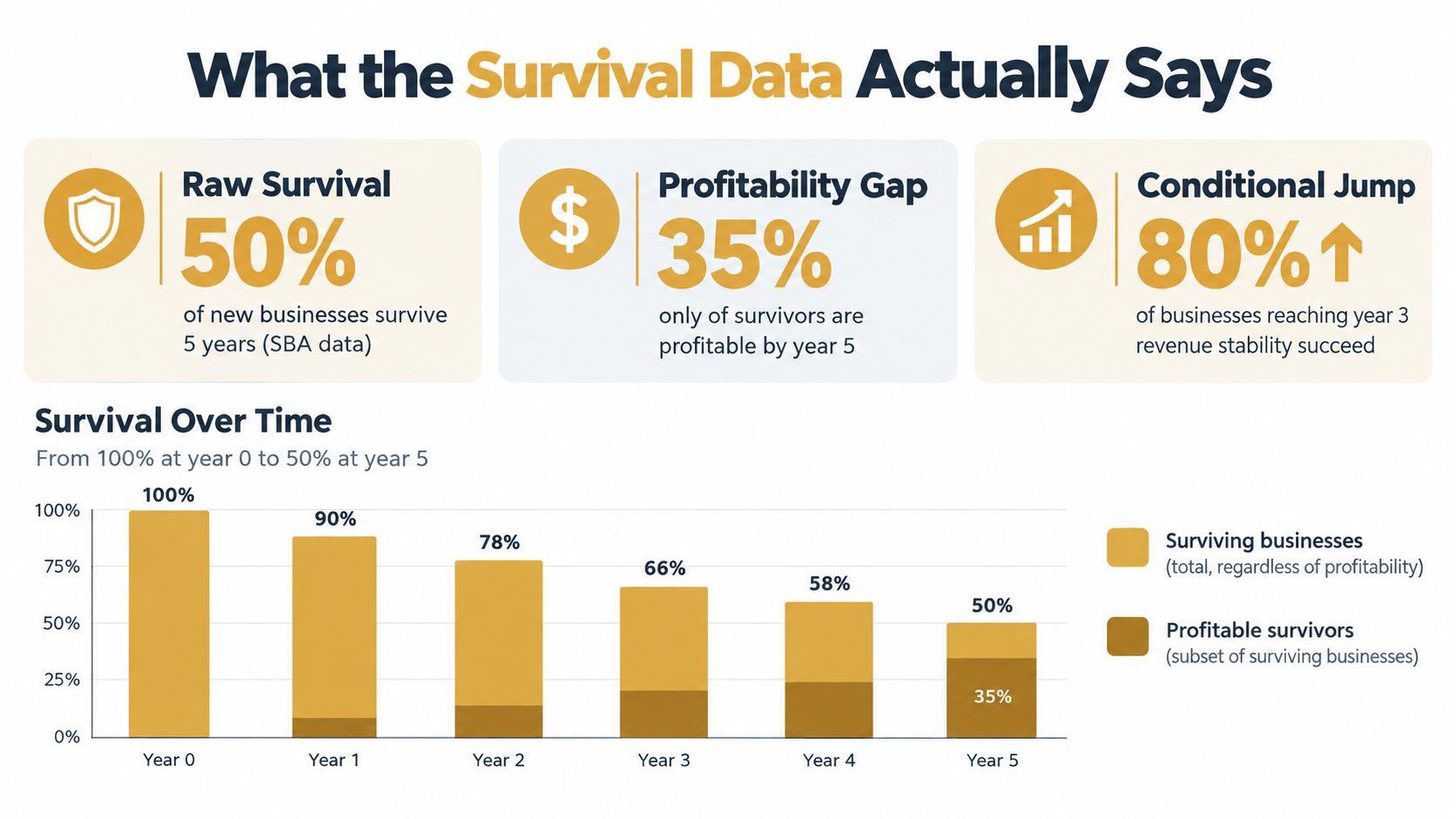
The same SBA source reports that 69.5% of businesses reaching five years subsequently reached ten years. That conditional figure matters. Reaching the first durable stage changes the risk profile, but it doesn't prove that a startup becomes safe or that an acquisition will perform well after closing.
What the numbers don't prove
Survival is not profitability. A company can remain open while producing weak owner compensation, consuming working capital, or relying on a founder who is underpaying themselves. Likewise, an acquired business can have years of operating history and still deteriorate when the owner, pricing model, management team, or customer relationships change.
Buying substitutes some market-creation risk with diligence risk. You can review revenue history, customer concentration, payroll, contracts, systems, and margins before committing capital. But the buyer also introduces financing risk, key-person risk, and transition risk. Debt service begins immediately, even if the business needs time to adjust.
Starting gives you freedom to choose the market, brand, technology, and operating model. It also forces you to prove demand without historical evidence. Buying gives you evidence to test, but the evidence may depend on conditions that disappear at closing. Read any survival statistic as a description of one risk environment, not as a recommendation.
For a useful counterpoint on startup outcomes, compare the data carefully with this discussion of startup failure. The important question isn't which headline sounds scarier. It's whether the underlying definition matches the decision you're making.
A Side-by-Side Look at Both Paths
The fastest way to clarify the choice is to compare the operating consequences, not the emotional appeal. The table below is a screening tool, not a substitute for diligence.
Buying vs Starting at a Glance
| Criterion | Buying a Business | Starting a Business |
|---|---|---|
| Upfront capital required | Usually substantial purchase capital, transaction costs, and working capital | Can begin lean, but founders fund product development, marketing, hiring, and operating losses |
| Time to cash flow | Existing customers may produce revenue immediately, subject to verification and retention | Revenue begins only after the offer, market, and customer-acquisition process work |
| Level of control | You control the company after closing, but inherit contracts, systems, staff, and customer expectations | Maximum control over brand, product, team, pricing, and processes |
| Lifestyle demands | Transition can demand intense attention while the buyer learns the operation | Early years often require the founder to cover multiple functions personally |
| Exit options | An operating history and transferable systems can support a future sale | Exit value depends on creating durable demand, processes, and management depth |
Capital is the first dividing line. A startup can begin with a narrow offer and expand as demand appears, although founders often underestimate the cash required to reach repeatable sales. An acquisition requires you to fund the purchase and protect the business while you learn it. A cheap acquisition with no working-capital cushion is often more dangerous than a properly funded, higher-priced deal.
Time to cash flow also looks different. Buying may provide revenue from the first operating day, but only if customers stay, employees remain, and the underlying economics are real. Starting offers no such inherited base, yet it lets you build the company around the market you discover instead of the market the seller previously served.
Control has two meanings. A founder controls the design of the business. An acquirer controls decisions after closing, but starts with obligations, habits, and people who may resist unnecessary change. Lifestyle follows the same pattern. Neither path guarantees freedom. The buyer inherits an operating machine and must keep it running. The founder becomes the product manager, salesperson, recruiter, and finance lead until the company can support specialists.
Starting creates assets from scratch. Buying substitutes selection and diligence for market creation.
Exit options depend on transferability. A buyer should look for documented processes, recurring customer relationships, capable managers, and clean financial records. A founder must build those assets before an outside buyer will value them. If you're evaluating real-estate-heavy entrepreneurship alongside operating businesses, a practical house flipping starter guide can help clarify how project-based capital and execution differ from acquiring an ongoing company.
The Owner-Transition Trap Nobody Warns You About
A seller can be ready to sell financially and completely unready to transfer the business. That distinction is where many acquisition comparisons fall short.
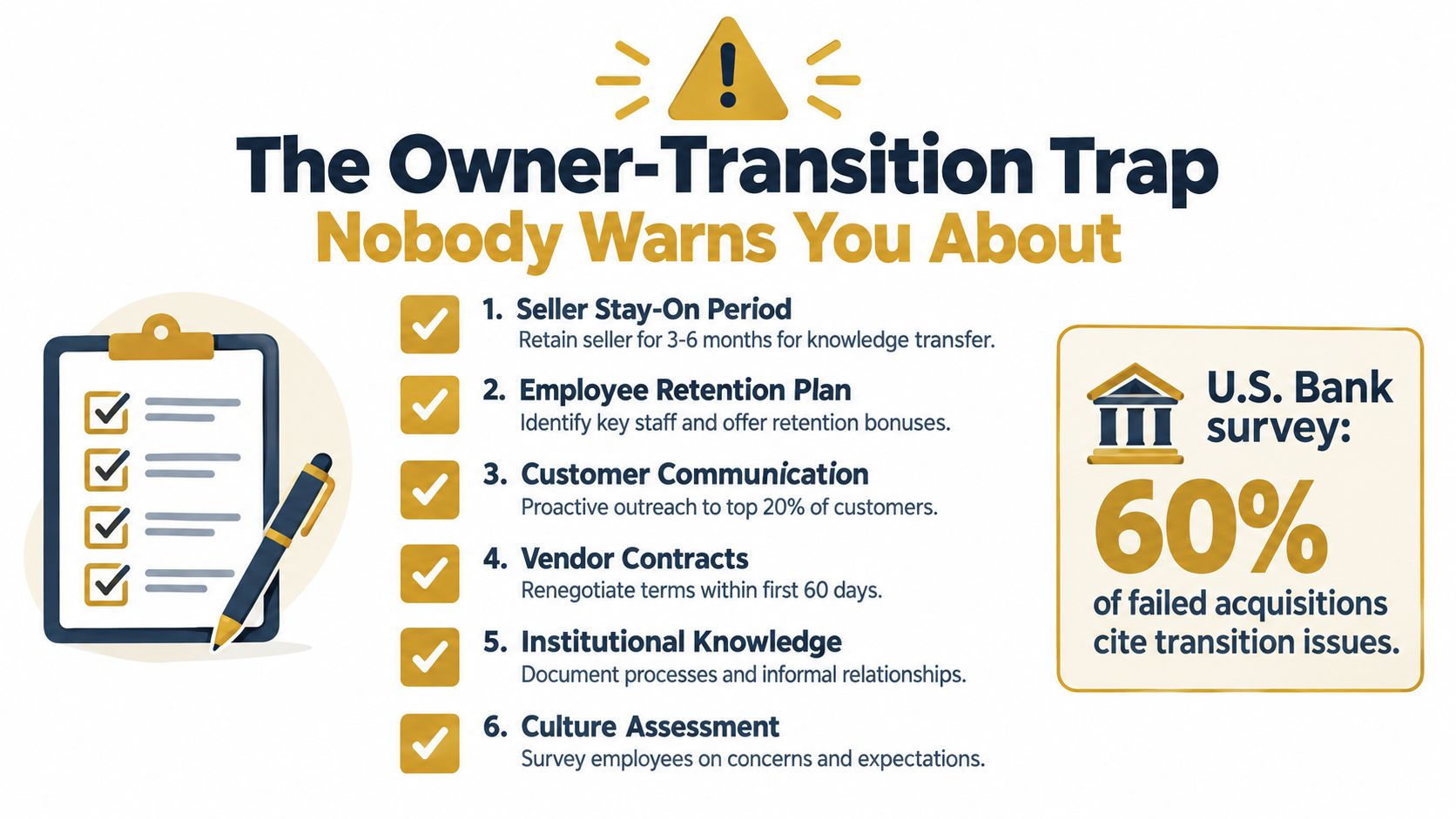
A 2025 U.S. Bank survey found that more than half of U.S. small-business owners are over 55, while only 54% have a formal succession plan. The survey also found that 56% worry they won't receive a reasonable price and 53% lack the resources or guidance to plan their exit. Its findings are summarized in the U.S. Bank survey on small-business succession.
Those gaps create a human problem inside the transaction. A seller may want liquidity but still want to approve every decision. Employees may interpret the sale as a threat. Customers may believe the relationship belongs to the departing owner rather than the company.
Five transferability tests
Start with seller dependency. Ask which sales, approvals, vendor negotiations, and employee decisions require the owner personally. Review calendars, email patterns, customer introductions, and the seller's daily schedule. If the owner is the brand, salesperson, technical expert, and conflict resolver, the purchase price must reflect a transition burden.
Then test the operating record. Written procedures matter, but so do undocumented routines. Identify who knows how to handle exceptions, which customers receive special treatment, and what breaks when the owner is absent.
Employee retention deserves direct attention. A buyer should identify key staff before signing, understand their concerns, and build a communication plan that doesn't depend on vague assurances. Customer transferability requires the same discipline. Determine whether customers contract with the company, rely on personal relationships, or can leave without friction.
Finally, ask about the seller's desired legacy. Some owners want a clean exit. Others want a long handoff, advisory involvement, or influence over the company's identity. Both can work, but ambiguity creates conflict.
Three questions to ask before the LOI
- What decisions and relationships still depend on you personally, and how will we transfer them?
- Which employees or customers may reconsider their relationship after a change in ownership?
- What do you want the company to preserve, and what are you expecting the buyer to change?
Before you commit, it's useful to browse business sale guides for additional transaction context. Treat seller readiness as a deal term, not a courtesy conversation.
Financing Options and the Real Cost of Capital
Acquisition financing should begin with your personal balance sheet and operating capacity, not with the lender you happen to know. The structure determines how much pressure the company carries from the first day.
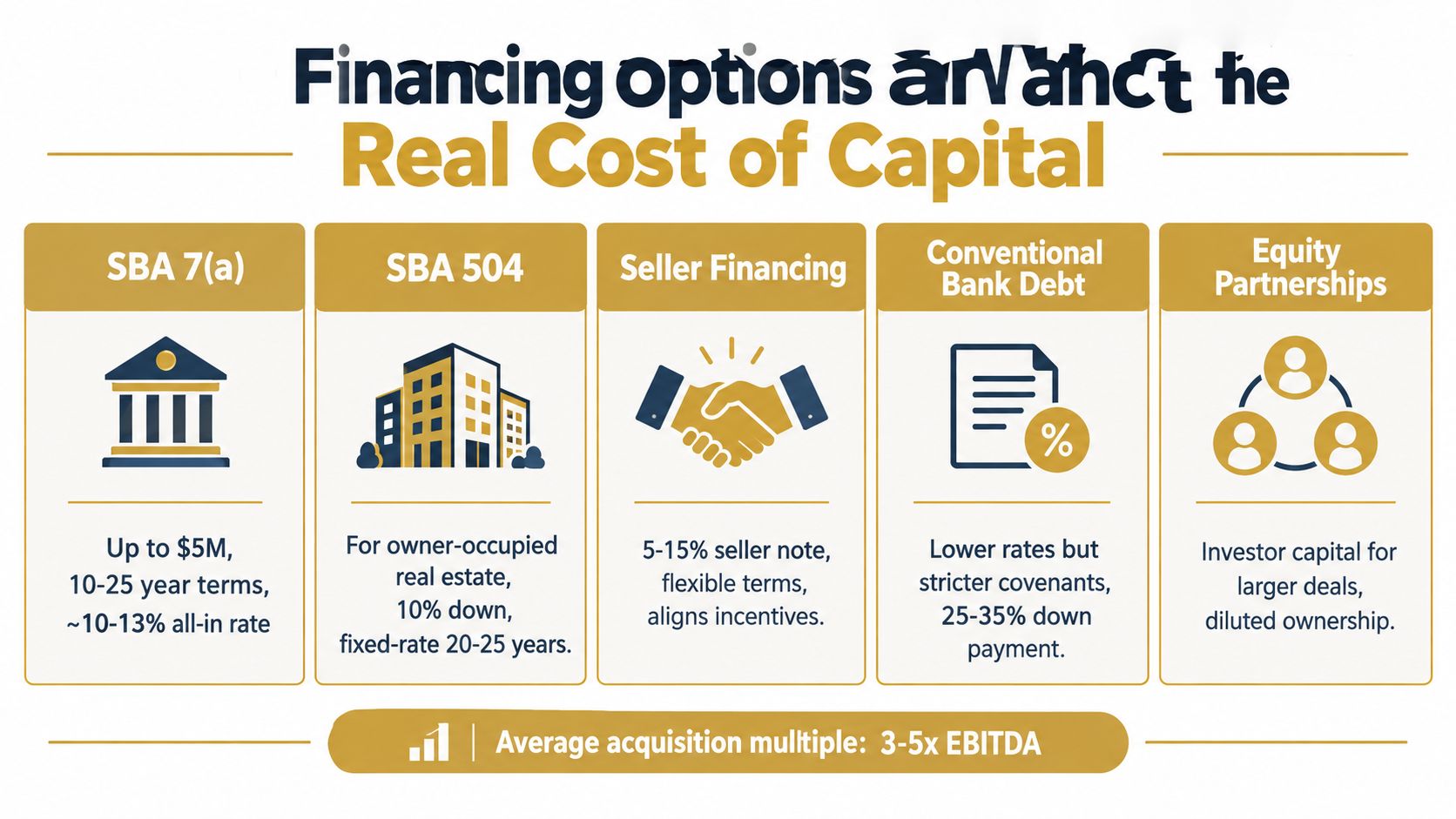
The common lanes include SBA 7(a) loans, SBA 504 financing for eligible owner-occupied commercial real estate, seller financing, conventional bank debt, equity partnerships, and combinations of these. Each option changes the buyer's cash contribution, speed, control, collateral exposure, reporting obligations, and tolerance for a bad month.
Match the structure to the risk
SBA 7(a) financing can suit an acquisition where the business has defensible cash flow and the buyer can meet lender requirements. The lender will care about historical performance, repayment capacity, collateral, management experience, and the buyer's personal financial commitment. Don't model the deal using optimistic projections. Model debt service against a weaker operating period.
SBA 504 financing is a different tool, generally associated with qualifying owner-occupied commercial real estate. It can be useful when the property is central to the operating business, but it shouldn't be treated as a general-purpose acquisition solution.
Seller financing can align incentives because the seller retains financial exposure after closing. It can also bridge a valuation gap, but only if the seller accepts the buyer's operating plan and the repayment terms leave the company adequately funded.
Conventional bank debt may offer attractive pricing to a strong borrower, but banks often impose tighter covenants and expect more equity. Equity partnerships reduce immediate debt pressure, yet they dilute ownership and introduce governance questions. Decide in advance who controls hiring, distributions, reinvestment, and a future sale.
Starting has a different cash pattern. A founder may spend gradually while testing the offer, although the company can consume cash for a long time before demand becomes repeatable. An acquirer takes on a purchase obligation and immediate debt service. That means the first-year cash flow model must include repayment, working capital, owner compensation, maintenance spending, and transition costs before any growth initiative.
Before discussing terms with a lender, build three cases: the operating plan, a conservative case, and a downside case that includes customer loss or employee turnover. For broader acquisition-financing concepts, review the acquisition financing options and take the structure to a qualified lender and transaction attorney.
The right financing is the one that leaves the company able to operate when your first improvement takes longer than expected. Cheap capital with excessive restrictions can be expensive in practice. Flexible capital with unrealistic repayment obligations is no better.
Which Path Fits Which Buyer
The corporate escapee often has capital, professional discipline, and no history of running a small company. For this buyer, a stable, straightforward acquisition usually beats a blank-sheet startup. The target should have understandable operations, a team that already performs essential work, and customers who buy for reasons the buyer can preserve. The buyer's first advantage is management consistency, not a dramatic reinvention.
The first-time searcher with more time than cash faces a different equation. This person may need to find an owner-operated business where the seller's workload suppresses reported performance or where basic systems can unlock capacity. Sweat equity can create value, but it doesn't replace diligence, working capital, or the need to serve customers competently from the first day. A business that is “cheap because it is messy” can be attractive only if the mess is fixable.
The operator pursuing scale
An established operator rarely needs to start from zero. A bolt-on can add a territory, capability, customer group, or talent pool while the core company supplies management infrastructure. A roll-up can make sense when the buyer has a repeatable integration playbook and enough discipline to preserve what works.
This buyer should be ruthless about strategic fit. A target that adds revenue but creates incompatible systems, conflicting cultures, or excessive management complexity may not improve the platform. The acquisition has to solve a specific constraint, not just make the company larger.
For each profile, the recommendation is direct:
- Corporate escapee: Buy a small, understandable operation with a transferable team and a seller transition plan.
- First-time searcher: Consider buying only where you can explain exactly how your time and skills will replace owner dependency.
- Established operator: Prefer bolt-ons or a structured roll-up over rebuilding a new company, unless the new concept fills a genuine strategic gap.
The best path isn't determined by ambition. It's determined by the assets you already have and the operating weaknesses you can realistically repair.
Your First 100 Days After Closing
Closing day transfers legal ownership. It doesn't transfer trust, knowledge, or customer loyalty. Those move only when people experience competent communication and consistent decisions.

The first week
Meet employees quickly and explain what will remain stable, what you're reviewing, and how decisions will be made. Don't promise that nothing will change. Promise that you'll learn before changing what customers and staff rely on.
Contact important customers and suppliers with a consistent message. The seller should participate where the relationship is personal, but the buyer must become visible. Confirm payment terms, delivery expectations, renewal dates, and any informal commitments that weren't obvious in the data room.
The first 30 days
Audit the operating system before installing new software. Review sales workflow, payroll, scheduling, inventory, billing, customer support, cybersecurity, and management reporting. Separate critical weaknesses from personal preferences. A buyer who changes everything immediately creates confusion and destroys useful comparison points.
Document the routines that the seller and key employees perform automatically. Record vendor contacts, exception handling, customer history, pricing approvals, and recurring compliance tasks. The goal isn't bureaucracy. It's to make the company less dependent on memory.
Days 31 through 60
Rebuild the cash flow view using actual post-close information. Check collections, payroll, gross margin, discretionary spending, customer concentration, and working-capital needs. Review pricing with evidence from costs and customer behavior, not with a blanket increase designed to signal new ownership.
At this stage, identify the smallest operational changes that improve visibility or reliability. A cleaner weekly cash report may matter more than a new brand. A documented sales pipeline may matter more than an ambitious marketing campaign.
Days 61 through 100
Test the original acquisition thesis. Which assumptions held? Which failed? Has the team retained its key people? Are customers behaving as expected? Is the seller's involvement declining without revenue or service deterioration?
The Kauffman Foundation's 2025 early-stage entrepreneurship report states that 77.9% of new U.S. business establishments survived at least one year in 2025, compared with 79.4% in 2024, with both figures below pre-pandemic levels. The Kauffman entrepreneurship report also reinforces why survival figures alone can't decide an acquisition. Buying exchanges market-creation risk for transition and integration risk.
At day 100, either apply the thesis with confidence, revise it based on evidence, or stop pursuing initiatives that create more disruption than value. For practical guidance on this stage, review these business transition strategies.
Decision Checklist and Common Questions
Run this checklist before choosing a path:
- Capital: Can you fund the purchase or startup period without starving the business?
- Time: Do you need operating revenue quickly, or can you build patiently?
- Risk: Are you more comfortable creating demand or inheriting and diagnosing problems?
- Experience: Can you operate the industry, manage people, and read the financials?
- Goal: Do you want creative control, personal income, scale, or a future sale?
If the evaluation becomes document-heavy, a service such as HireParalegals Virtual legal assistants can help organize transaction support, while legal counsel remains responsible for legal advice and drafting.
Common questions
When is starting better? Start when you have a specific insight, need design freedom, lack the capital for a sensible acquisition, or can't find a target with transferable customers and management.
How do you know whether a seller is ready? Ask for a documented handoff plan, identify owner-dependent relationships, speak directly about employee and customer reactions, and make transition support part of the negotiated terms.
What's the most common post-close mistake? Changing the business before understanding it. New owners often confuse visible activity with value creation and disrupt the routines that produced the historical results.
Dealmaker Wealth Society provides training, mentorship, deal-structuring education, and post-acquisition guidance for people evaluating and executing small-business acquisitions. Visit Dealmaker Wealth Society to turn your buy-versus-build decision into a concrete search, diligence, financing, and first-100-days plan.

From the Dealmaker Blog






A Creative Business Buying Fable