Change Management in Mergers and Acquisitions Playbook
Change Management in Mergers and Acquisitions Playbook
Seventy to ninety percent of mergers and acquisitions fail to meet their intended strategic or financial objectives, according to a widely cited post-merger integration benchmark summarized by Transjovan Capital. Poor integration, not the announcement or valuation, is frequently identified as the main reason. That changes how an acquirer should think about the transaction. Signing is a legal milestone. Integration is where the deal either becomes an operating company or starts leaking value.
Change management in mergers and acquisitions isn't a communications campaign added after close. It's the discipline for protecting critical talent, clarifying decision rights, transferring knowledge, and helping people adopt the processes that make the investment thesis possible. That matters even more for SMB acquisitions and roll-ups, where a founder, operations manager, or technical specialist may hold relationships and know-how that never appeared in the data room.
Table of Contents
- Why Most Acquisitions Fail After the Deal Closes
- The Three Pillars of Change Management in M&A
- Your Integration and Communication Roadmap
- Retaining the Non-Executive Talent That Actually Delivers Synergies
- Phased Versus Big-Bang Integration
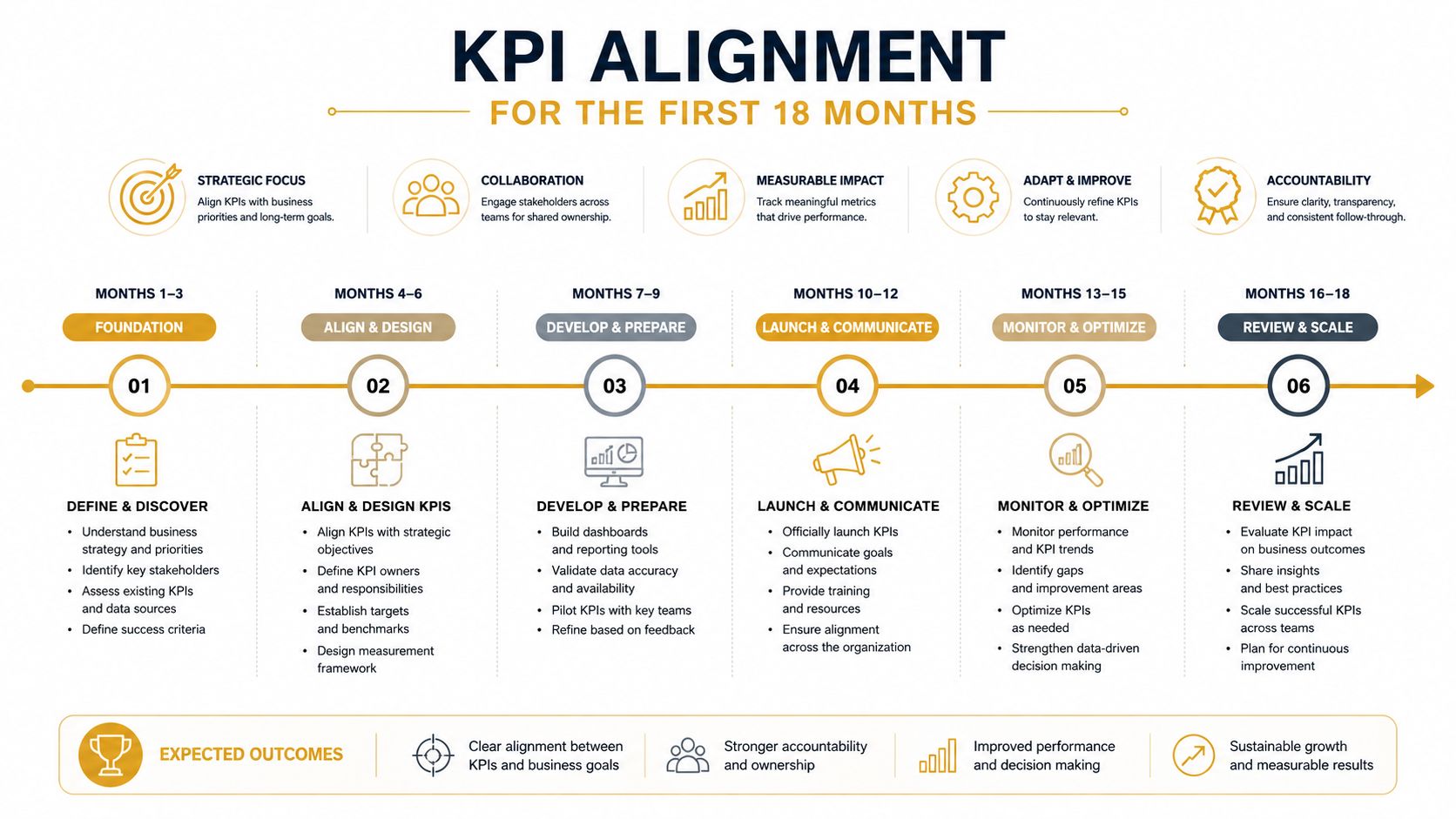
- KPI Alignment for the First 18 Months
- Common Pitfalls and a Pre-Close Change Readiness Checklist
Why Most Acquisitions Fail After the Deal Closes
The purchase agreement transfers ownership. It does not build trust, reconcile workflows, transfer customer knowledge, or tell a capable employee whether a future exists in the combined business. Those responsibilities start after close, often while leaders are under pressure to deliver the synergy case that supported the purchase.
The commonly cited failure range is 70% to 90%. One McKinsey-based result found that only 17% of deals underperforming peers 18 months after close managed to turn performance around. The operating lesson is blunt: once missed handoffs, disengaged managers, customer disruption, and key departures begin leaking value, recovery becomes harder. Strategies for minimizing acquisition failures therefore start with execution capacity, not a polished announcement.
Operator's rule: Treat the first 12 to 18 months as the transaction's decisive operating phase, not administrative cleanup.
The handoff problem
Deal teams are rewarded for sourcing, negotiating, and closing. Integration teams inherit the assumptions. If the deal team disappears at close, the integration management office may lack the reasoning behind the synergy model, the informal power structure, and commitments made during diligence.
A functioning IMO should be active before closing. Its workstreams should cover people, process, systems, customers, finance, and culture. Each needs an accountable owner, a decision path, a dependency log, and a clear definition of what must be true on Day 1. A synergy slide becomes an operating plan only when leaders can specify which people must change which process, with what support, and by when.
That sequencing also protects talent. Employees judge the transaction through decisions about authority, workload, systems, and customer ownership. Communication without those decisions creates more uncertainty, not less.
Why small deals are exposed
Large acquirers may have dedicated change leaders, HR partners, and integration specialists. A small buyer may have one operating partner, a finance lead, and an already overloaded manager covering all three roles. Formal change management still matters. Limited capacity makes prioritization and sequencing the practical requirement.
The buyer's ability to manage change, not only the purchase price, determines whether expected value survives. For SMB acquisitions and roll-ups, phased integration often gives managers time to retain knowledge, test process changes, and identify talent risk before a broader rollout. The next priorities are people, process, and culture, applied through communication cadence, non-executive retention, integration pace, measurement, and pre-close readiness.
The Three Pillars of Change Management in M&A
A practical methodology runs in three stages: diagnose, execute, and measure. The approach is supported by merger-focused field research in which respondents most often identified a climate of trust, structured use of cultural differences, and integration seminars or information meetings as important enablers. The study recorded trust and seminars at 7 of 12 responses, and structured use of cultural differences at 6 of 12 in its reported findings.
Diagnose the change surface
Start by mapping what will change across structure, process, people, and change type. Don't ask only whether the target will adopt the buyer's systems. Ask who loses authority, which customer promises depend on local knowledge, where two approval paths conflict, and which roles carry undocumented expertise.
A pre-close listening tour with the target's top 30 non-executives can expose risks that executive interviews miss. The point isn't to promise outcomes. It's to identify dependencies, rumors, critical relationships, and practical objections before the IMO locks in a design.
Execute the people levers
Trust must show up in operating behavior. A Day 1 integration seminar with cross-company workstream leads gives managers a shared forum to hear the rationale, test assumptions, and identify contradictions. A 30-day manager activation kit should include talking points, escalation routes, role-clarity FAQs, meeting templates, and a process for submitting unanswered questions.
Culture also needs to be used deliberately rather than treated as a slogan. Map the artifacts, rituals, language, and decision habits that help each organization perform. Keep what supports the deal thesis, adapt what creates friction, and retire practices only after people understand the replacement.
Buyers without organizational development staff can use an organizational readiness checklist to make readiness visible and assign ownership. A checklist won't replace judgment, but it can prevent basic omissions from hiding inside a busy close process.
Measure adoption, not activity
Count whether managers held the meetings, but don't stop there. Test whether employees understand their role, whether decisions are moving, whether critical processes are being followed, and whether people can explain where to raise a problem. A completed training session is an activity. Consistent use of the new process is adoption.
Use the results to adjust the design. If trust is weak, leadership needs to answer difficult questions directly. If middle managers are silent, give them authority and practical materials. If a process is technically sound but operationally impractical, pilot it before forcing enterprise-wide adoption.
Your Integration and Communication Roadmap
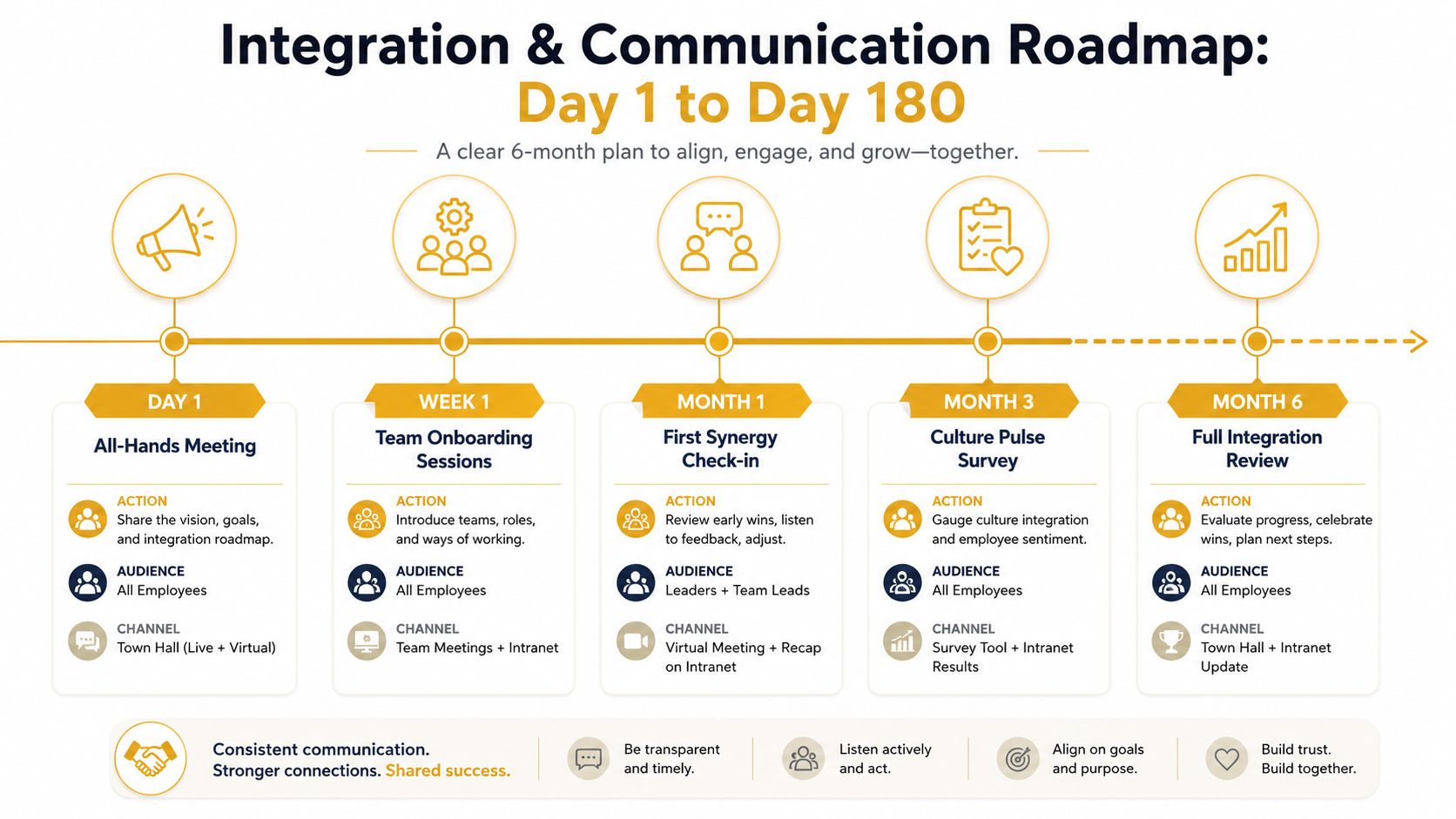
Communication should follow the decisions employees need to make, not the calendar of corporate announcements. Executives need confidence in value delivery and escalation. Managers need enough detail to answer questions consistently. Individual contributors need to know what changes, what stays stable, and how decisions affect their work.
Day 1 establishes the contract
The acquiring CEO should lead an all-hands meeting that explains the strategic rationale, immediate priorities, and known uncertainties. Run a parallel town hall for the target so employees aren't left waiting for a message filtered through the buyer. Publish the recording and written answers through the intranet, then open a Slack or Teams integration channel for questions.
The first message shouldn't pretend every answer is available. Credibility improves when leaders separate confirmed decisions, active reviews, and decisions that require consultation.
| Timing | Audience and action | Channel | Operating purpose |
|---|---|---|---|
| Day 1 | All employees, CEO-led rationale and immediate priorities | Town hall and intranet | Reduce speculation and establish the decision frame |
| Week 1 | Cross-company teams, onboarding and dependency review | Team sessions and manager 1:1s | Surface practical disruption |
| Day 14 | People managers, activation toolkit and escalation rules | Manager meeting and shared workspace | Give managers usable answers |
| Day 30 | IMO and executives, first integration scorecard | Weekly IMO update and executive review | Test readiness and expose stalled work |
| Day 60 | Process owners, cross-company process mapping | Workshop and documented workflow | Resolve handoff conflicts |
| Day 180 | Executive team and business owners, synergy checkpoint | Value review and operating handoff | Confirm benefits and remaining risks |
Change the message by level
Executives need the link between integration choices, risk, and the investment thesis. Middle managers need decision rights, staffing implications, customer guidance, and a way to escalate exceptions. Individual contributors need concrete information about reporting lines, tools, workflows, training, and workload.
A single email can't do all three jobs. Use weekly IMO updates for the program, manager 1:1s for sensitive role questions, team sessions for process adoption, and an always-open question channel for issues that don't fit a scheduled meeting.
Make cadence operational
At Day 14, distribute the manager toolkit and require each manager to confirm that their team received a briefing. At Day 30, review the scorecard with workstream owners, not just the finance team. At Day 60, map the processes that cross company boundaries, because most integration friction appears at handoffs rather than inside isolated functions.
For additional guidance on structuring messages and ownership, use this communication planning resource for merger transitions. At Day 180, don't declare success because the communications calendar was completed. Ask whether employees are using the target process, customers are receiving the intended service, and finance can validate the benefits.
Retaining the Non-Executive Talent That Actually Delivers Synergies
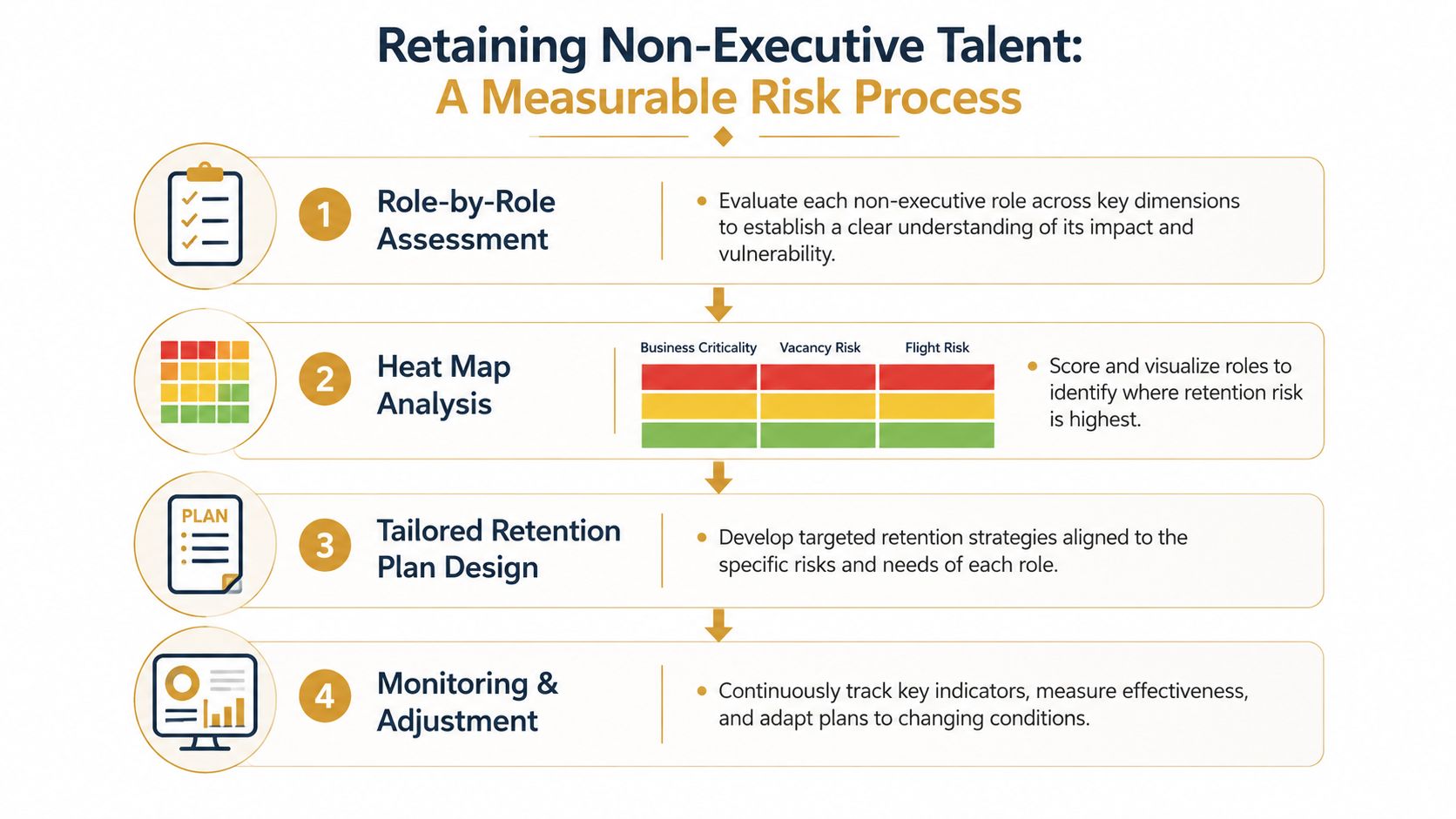
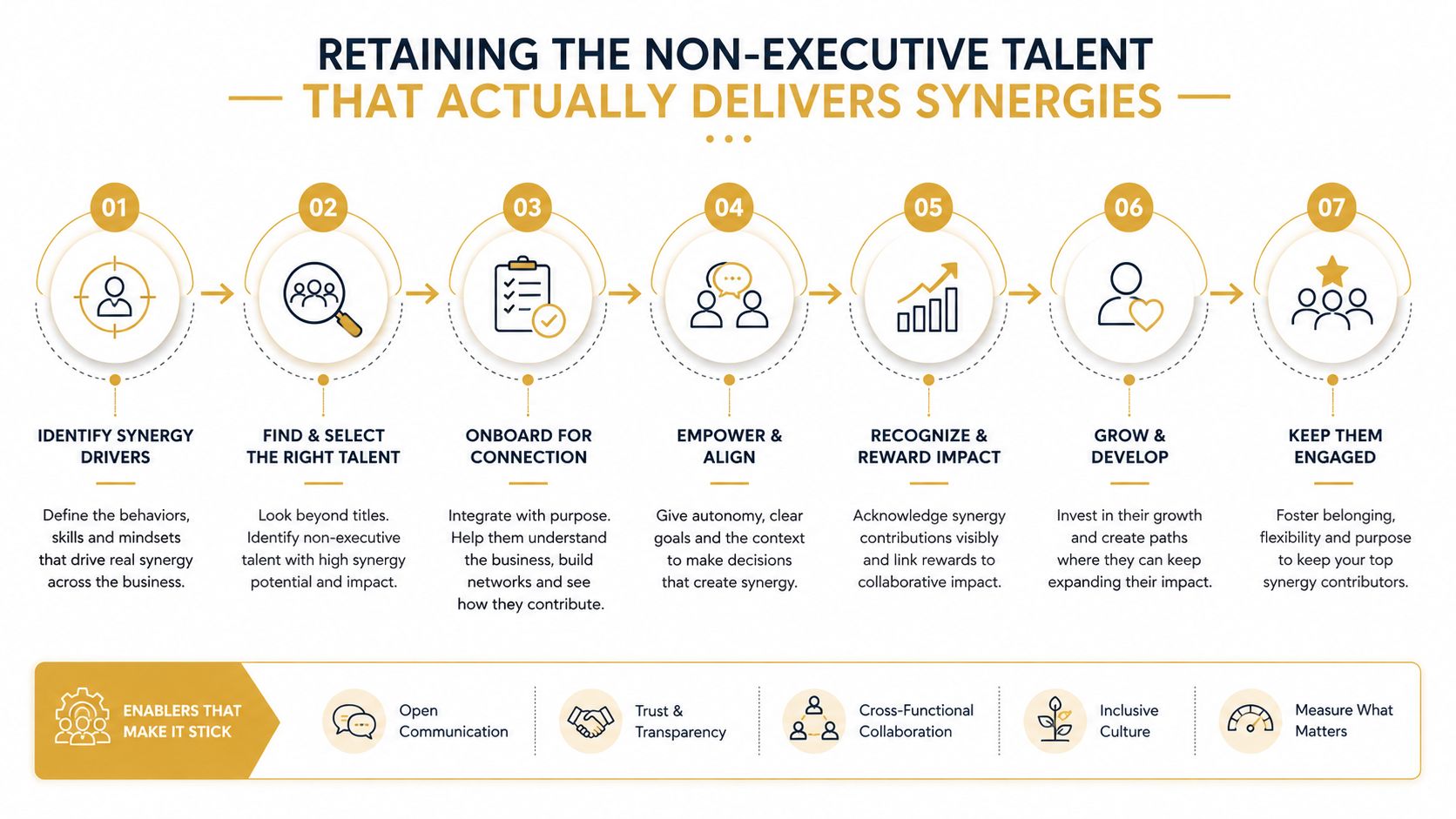
Retention starts with a role-by-role risk assessment, not a list of senior names. A 2025 WTW survey found that 78% of respondents ranked key talent below executive level as their highest due-diligence priority, while non-executive talent retention was the leading integration-success metric at 50%, ahead of leadership retention at 29% as reported in the survey summary.
Those figures are diagnostic, not a forecast for your transaction. They tell you where to look. In a small acquisition, the operations manager who understands scheduling, the account lead who holds customer trust, or the technician who knows a fragile system may matter more to value delivery than a visible executive.
Build the heat map before close
Score each critical role against:
- Business criticality: How directly does the role support the deal thesis?
- Vacancy risk: How difficult would replacement be?
- Flight risk: Is the employee exposed to uncertainty, competing offers, or a damaged relationship?
- Dependency risk: Do customers, systems, intellectual property, or key processes depend on this person?
- Transition exposure: Will the role lose authority, status, or familiar support?
Then design selective actions. Role clarity, protected technical authority, development opportunities, recognition, manageable workload, and time-bounded incentives can matter more than a broad cash promise. Any incentive should have a defensible purpose, clear expiry, and explicit conditions.
Sequence clarity before incentives
During the first 30 days, managers should explain what is confirmed, what remains under review, and how decisions will be made. By Day 90, publish reporting lines, decision rights, workload expectations, and available career paths. Follow with stay interviews and pulse checks that ask about practical obstacles, not whether employees feel generally positive.
Track regretted attrition, critical-role vacancies, internal fill rates, engagement signals, manager action closure, and time to productivity. Review those indicators frequently enough to intervene while a problem is still local.
A company-wide retention package can create visible inequity and reward employees who were never at risk. A targeted approach is harder to administer, but it connects resources to the roles that protect customers and deliver synergies. Buyers building that discipline can supplement their operating model with this practical guide to keeping top talent, then adapt the recommendations to the deal's specific risks. A focused post-acquisition employee retention strategy should always connect communication, role design, manager behavior, and measurement.
Phased Versus Big-Bang Integration
Integration pace should follow the economics and operating reality of the deal. A tightly coupled acquisition may need rapid standardization. A culturally distinct business with incompatible systems may need protection from unnecessary disruption. The right question isn't whether fast integration sounds decisive. It's whether the pace is the fastest defensible route to value.
Recent evidence highlights why a universal template is risky. A 2025 European study reported that only 46% of surveyed companies had launched a formal change-management program for cultural integration, while only 40% of transactions achieved expected synergies, according to the study's published account. Those findings support deliberate sequencing, particularly where the target's local relationships or founder-led operating knowledge are central to value.
| Decision Factor | Prefer Phased | Prefer Big-Bang |
|---|---|---|
| Systems | Interfaces are incompatible or data quality is uncertain | Systems are compatible and migration is well tested |
| Culture | Trust is fragile or local identity supports performance | Behaviors and decision norms are already close |
| Operations | Customer commitments cannot tolerate disruption | Processes are tightly coupled and duplication is costly |
| Synergy urgency | Benefits depend on learning and validation | Rapid standardization is essential to the business case |
| Leadership capacity | The buyer lacks change bandwidth | A dedicated, empowered IMO can support the transition |
| Reversibility | Decisions are difficult or expensive to unwind | The target state is clear and low risk to implement |
Use a hybrid when risk isn't uniform
Move high-confidence decisions immediately, such as governance, reporting discipline, and selected shared services. Put reversible initiatives behind validation gates. Hold high-risk workstreams, including ERP, compensation, or sensitive reporting-line changes, until owners, controls, support capacity, and employee impacts are understood.
Review the pace monthly against synergy deadlines, attrition, service levels, customer impact, and employee feedback. Phasing isn't gradualism for its own sake. It protects the capabilities that made the target worth buying while creating evidence for the next decision.
KPI Alignment for the First 18 Months
A useful integration dashboard separates health, execution, adoption, and value. Finance should validate claimed savings, but finance can't diagnose why a workstream is stalled or why an important employee is preparing to leave.
Deloitte's integration survey found that the most cited success factors included executive leadership support at 16%, involvement of managers from both sides at 15%, and an appropriate integration plan at 14% in its reported benchmark. Treat those figures as signals about program design, not universal target weights for every deal.
Use a layered scorecard
Integration health should cover executive sponsorship, employee trust, manager participation, decision velocity, issue closure, and cultural-program coverage. These indicators reveal whether the organization can absorb the planned changes.
Plan quality should show accountable workstream owners, dependencies, milestone confidence, readiness criteria, and whether each initiative has a benefits baseline. A green milestone without an owner or baseline is decoration.
Business outcomes should connect integration to realized revenue and cost synergies, one-off costs, customer retention, service levels, sales pipeline, productivity, and time to productivity. Keep outcome measures separate from diagnostic indicators. Missed synergies require workstream intervention. Weak trust requires a people intervention.
Set the review rhythm
Before close, assign every metric a definition, source, baseline, target, owner, confidence rating, reporting frequency, and escalation threshold. During the first 100 days, review leading indicators weekly and hold an executive integration review every two weeks. From Day 101 through Day 365, shift to monthly reviews focused on adoption, synergy validation, and benefits leakage.
Through Month 18, maintain quarterly value tracking and hand temporary PMI measures to business-as-usual owners when the program no longer needs dedicated reporting. The dashboard should show measure, baseline, target, actual, trend, owner, confidence, and corrective action. A traffic light without a response owner doesn't manage risk.
Common Pitfalls and a Pre-Close Change Readiness Checklist
Nearly 30% of respondents said integration fell short of success, and the most cited failure mode was a difficult transition or unexpected challenges at 63%, according to Deloitte's integration survey cited above. The numbers point to an execution problem, but the warning signs are usually visible before close.
Five failure patterns
- Leadership silence: Executives announce the deal, then disappear into other priorities. Employees fill the vacuum with rumors. The early signal is an unanswered question log with no executive owner.
- Vague Day 1 scope: The team promises continuity without defining what stays unchanged, who approves decisions, or how customers should be handled. The early signal is a Day 1 plan written as principles rather than actions.
- Volunteer staffing: Integration work lands on helpful employees who have no protected capacity or authority. The early signal is a workstream roster with names but no allocation, decision rights, or escalation route.
- Unfocused retention spending: Leaders draft broad packages before managers identify the roles carrying operational risk. The early signal is an incentive plan that doesn't reference critical processes, customers, or dependencies.
- Financial-only measurement: The dashboard tracks synergy accounting while ignoring trust, manager participation, process adoption, and service levels. The early signal is a benefits report with no people or customer indicators.
Run the gate two weeks before close
Use a binary answer, a named owner, and a deadline. A “no” isn't a reason to delay every transaction, but it is a reason to document the exposure and assign a remedy.
Deal readiness
- Thesis translated: Has each expected synergy been linked to a process, owner, dependency, and adoption requirement?
- IMO authorized: Does the integration office have executive sponsorship, decision rights, and protected capacity?
- Handoff complete: Has the deal team transferred assumptions, commitments, risks, and stakeholder intelligence?
People readiness
- Critical roles mapped: Has the buyer identified non-executive roles tied to customers, systems, expertise, and continuity?
- Manager briefed: Can every people manager explain confirmed decisions, open questions, and escalation routes?
- Retention actions approved: Are targeted actions documented with purpose, owner, timing, and conditions?
Process readiness
- Day 1 defined: Are payroll, customer service, approvals, security, reporting, and communications assigned to named owners?
- Dependencies visible: Have cross-company handoffs been mapped and tested where practical?
- Issue route open: Can employees submit questions and receive tracked responses?
Culture readiness
- Differences understood: Has the team identified the rituals, language, and decision habits that affect performance?
- Listening completed: Have target employees had a safe channel to surface concerns before close?
- Change pace chosen: Is the decision to phase, combine, or delay each major workstream documented with its rationale?
A buyer who can't answer these questions shouldn't hide behind a polished integration deck. The checklist is valuable because it turns change readiness into an operating decision, not an optimistic assumption.
Dealmaker Wealth Society offers acquisition training, playbooks, mentorship, and peer support for buyers working through due diligence, deal structuring, and post-close integration. If you're preparing an SMB acquisition or roll-up, visit Dealmaker Wealth Society to explore resources that connect transaction execution with the people and operating disciplines required to make the deal work.

From the Dealmaker Blog








A Creative Business Buying Fable