
Due Diligence Technology Checklist for SMB Buyers
Due Diligence Technology Checklist for SMB Buyers
One of the hardest lessons in tech diligence is that the damage usually shows up after closing, not before. A modern due diligence technology checklist is meant to catch that early, especially when one source says 53% of acquirers discover cyber issues after closing and 70% face disruption from technical debt (transjovancap's 2026 M&A technology checklist). That's why the checklist matters less as a document list and more as a deal-economics tool. It helps you decide whether to reprice the deal, tighten escrow, stretch integration, or walk.
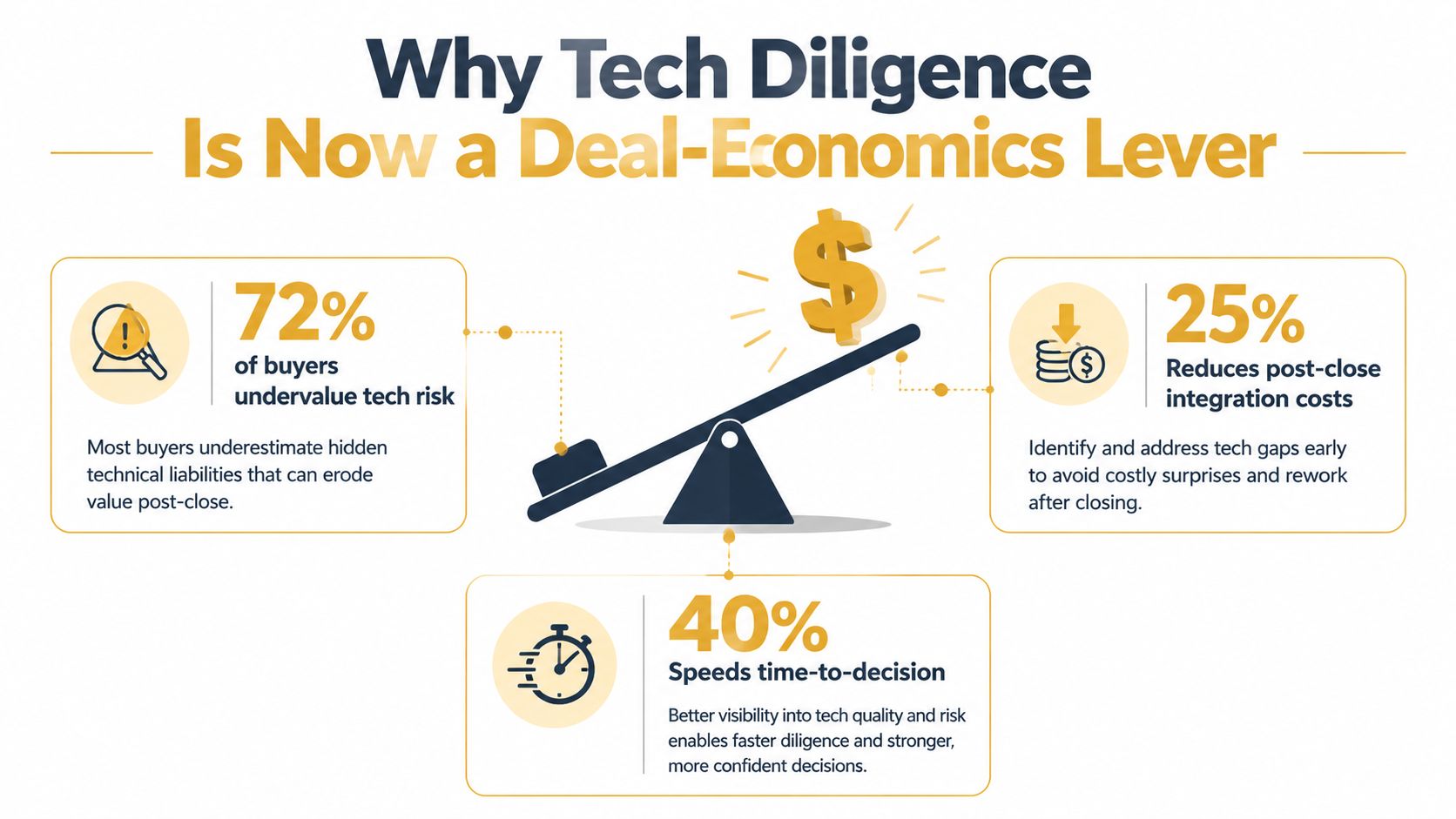
A buyer who treats diligence as a formality ends up paying for uncertainty twice, once at close and again during integration. The better model is to view every finding as a line item on the deal sheet. If infrastructure resilience looks weak, that affects continuity risk and post-close spend. If security evidence is thin, that changes negotiation leverage. If the stack is hard to merge, the purchase may still be attractive, but the integration timeline and staffing plan need to reflect reality.
For buyers looking for a broader acquisition workflow, a practical companion resource is the compliance checklist for ITAD vendors, especially when the transaction touches hardware handling, asset disposition, or regulated equipment chains.
Table of Contents
- Why Tech Diligence Is Now a Deal-Economics Lever
- The Eight Control Areas Every Checklist Should Cover
- What to Request in the Data Room and What Its Absence Means
- Security, Vulnerabilities, and Compliance Evidence
- The AI Dependency Question Most Checklists Still Skip
- Integration Readiness and the Hidden Integration Tax
- Turning Findings Into Price Escrow and a 90-Day Plan
Why Tech Diligence Is Now a Deal-Economics Lever
The old habit was to send IT a request list, skim the answers, and move on. That approach doesn't survive modern software exposure, cloud dependencies, or buyer expectations around integration. A structured due diligence technology checklist is now part of valuation discipline, because hidden technical debt and cyber gaps affect the price you should pay and the speed you can safely operate after close.
Technical risk changes the economics, not just the workload
When a target can't show clean architecture, clear ownership, or current security evidence, you're not just looking at an IT cleanup job. You're looking at a stronger case for a lower price, a larger escrow holdback, or a more cautious earnout structure. Buyers often assume they can “fix it later,” but the cost of later usually lands inside integration, when the deal team has less influence and more pressure.
Practical rule: if a finding will require a specialist, a migration, or a remediation sprint after close, it already belongs in the deal model now.
That's why diligence is economic, not administrative. A buyer who sees weak disaster recovery, poor access discipline, or fragile vendor dependencies can quantify the downside before signing. A buyer who doesn't, inherits the issue at the worst possible time.
Structured diligence turns uncertainty into a decision
Modern checklist practice has moved toward confirmatory diligence, where architecture, infrastructure, security, applications, data, CRM and martech, digital presence, and vendors are separate workstreams rather than one loose IT interview. That structure matters because it makes targets comparable and helps a buyer isolate where the risk sits. It also keeps the conversation tied to evidence, such as incident logs, access matrices, load-testing results, and pen-test reports.
If you want a useful mindset shift, stop asking whether the tech “looks fine.” Ask whether the current evidence justifies the valuation, the close schedule, and the post-close plan. That framing makes the checklist do actual work in the transaction.
The Eight Control Areas Every Checklist Should Cover
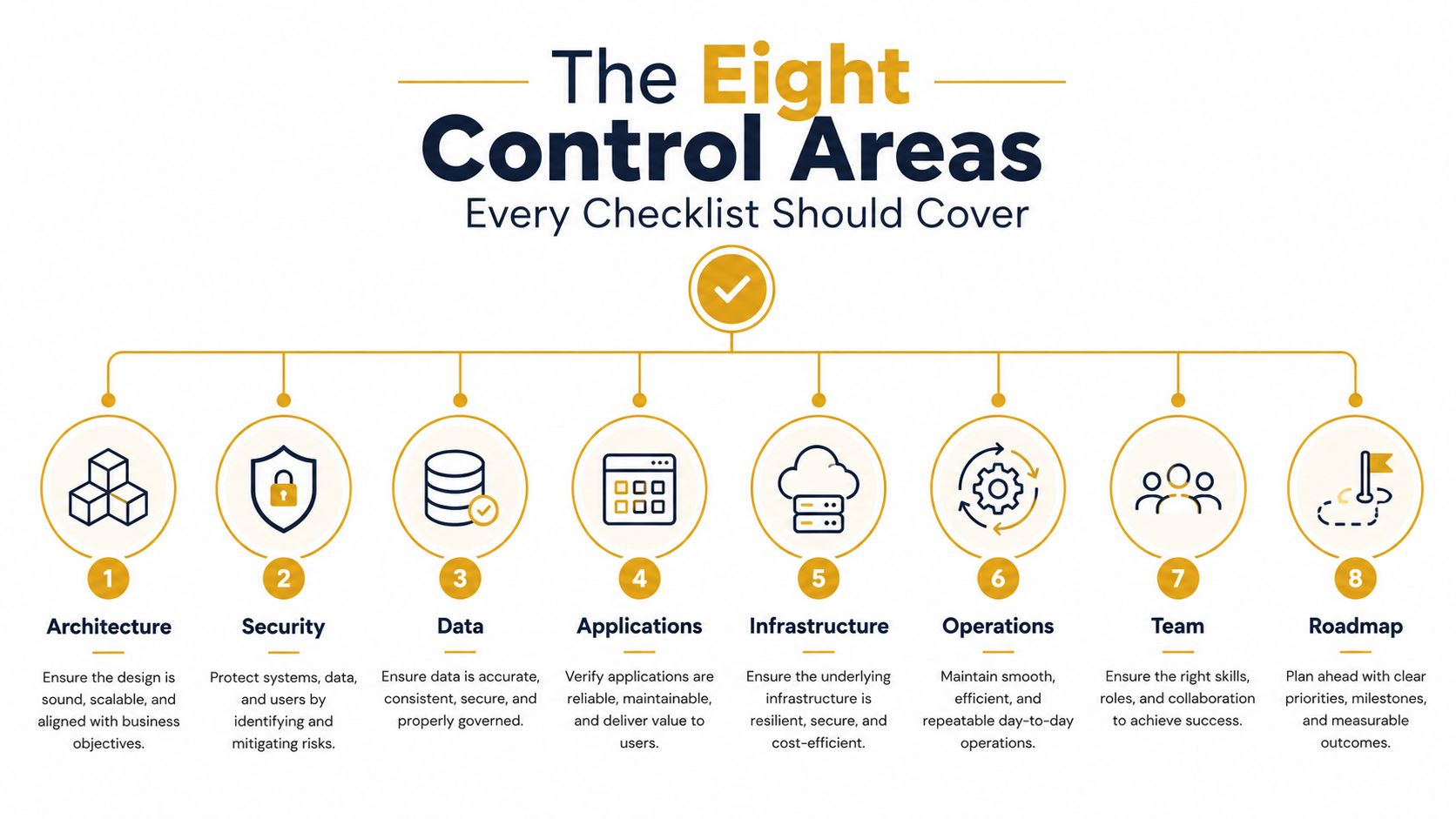
A useful checklist isn't a single review of “the stack.” It's a set of control areas that let you compare one target against another on the same dimensions. That's the only way to avoid improvising under LOI pressure and confusing a polished demo with operational maturity.
Start with architecture, infrastructure, and security
Architecture answers a simple question, how does the system fit together. Ask for current-state diagrams, service maps, and dependency graphs. If the target can't produce its own architecture diagram, that's a material finding, not a polite follow-up.
Infrastructure tells you where uptime risk, cloud spend, and recovery exposure live. Request inventories, load-testing results, and disaster-recovery evidence so you can see whether the environment is durable or just functional. Security is where access, authentication, and incident history show up in usable form. You're looking for MFA, penetration-test evidence, and access matrices, not generic claims of being “serious about security.”
Use data, applications, and digital as separate lenses
Data should cover lineage, ownership, retention, and the places where records move between systems. If data flow isn't understood, integrations and reporting can break in ways the seller didn't model. Applications helps you see what's custom, what's off-the-shelf, and what's fragile because only one person understands it.
Digital presence and CRM or martech deserve their own review because they often hide the buyer's future operating burden. A target can have a working website and still have broken analytics, weak attribution, or a CRM process that won't merge cleanly with the buyer's stack. That's why it helps to request scalable ERP for enterprise growth contextually when a target's systems are already near the limit of what the current workflows can support. It keeps the diligence conversation tied to operating reality, not software wish lists.
Don't ignore vendors, operations, and people
Vendors show concentration risk, hidden lock-in, and contract constraints. Operations covers incident handling, logging, and how work really gets done during outages. Team is about ownership, concentration, and whether knowledge lives in one person's head.
A checklist that skips the people layer usually misses the reason the tech looks stable on paper.
The best checklists tie each area to an output, a risk note, a remediation cost, or a negotiation point. That makes the review useful to finance, legal, and post-close operations, not just to technical staff.
What to Request in the Data Room and What Its Absence Means
A data room request list should do more than collect PDFs. It should force the seller to reveal how the business runs, where knowledge sits, and what breaks when one person is unavailable. The quality of the response matters as much as the document itself.
Ask for the documents that expose operating reality
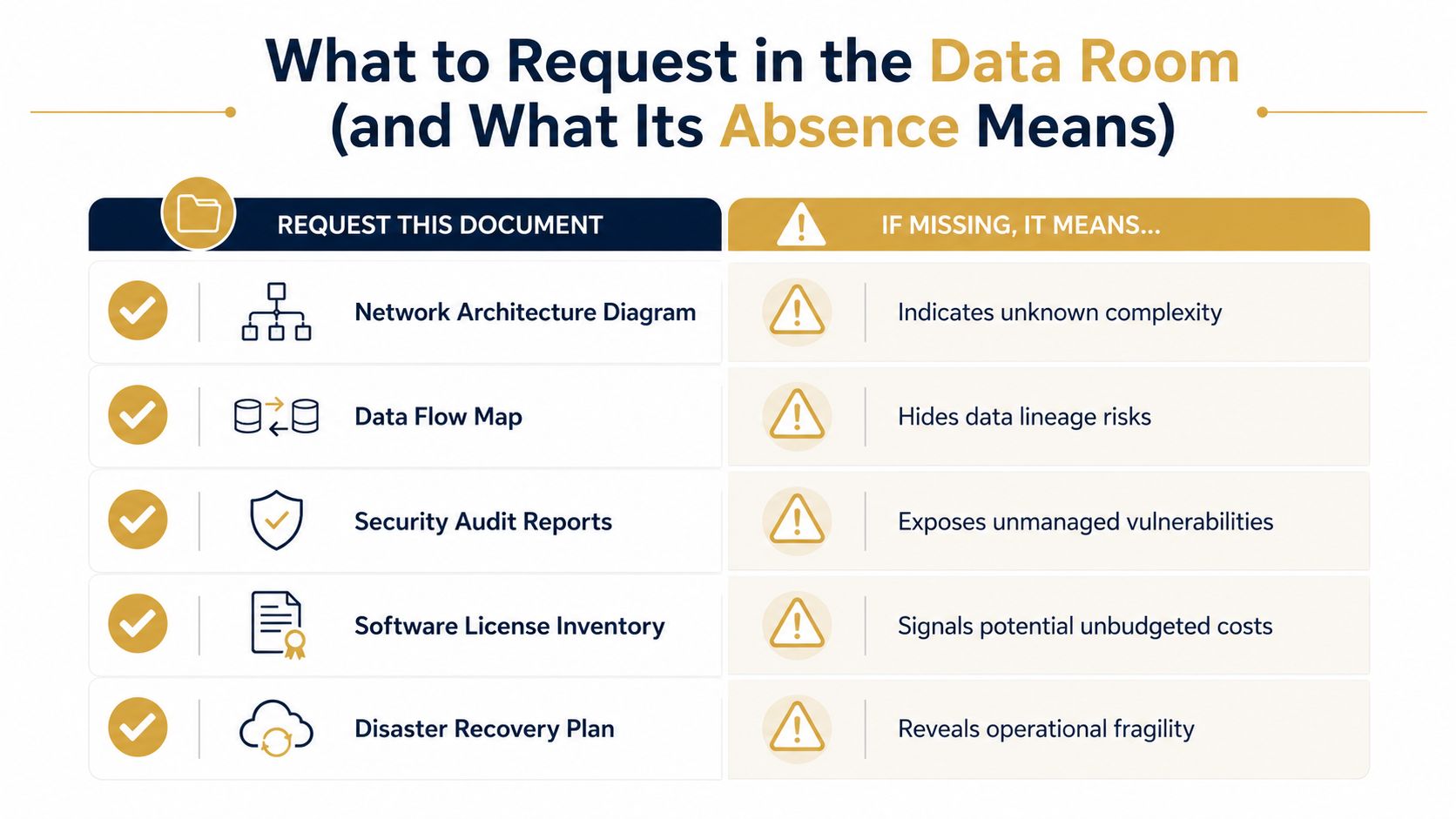
Start with the basics, architecture diagrams, infrastructure inventories, vendor contracts, IP-assignment language, and security reports. Then ask for source-code repository access or at least a controlled readout from the engineering lead, because screenshots and verbal summaries rarely show how the codebase is maintained. You also want incident logs, recovery evidence, and any material security-incident history that spans multiple years, because one clean quarter doesn't tell you much.
The most valuable request is often the one that sounds obvious. Current-state diagrams force the seller to explain systems in a way that surfaces contradictions. If they can't provide them, you've already learned something important about institutional knowledge and process maturity.
Read the absence as a signal, not a delay
A missing architecture diagram usually means one of three things, the system is poorly understood, documentation is stale, or the team is relying on tribal knowledge. None of those are harmless. A missing software license inventory can point to unbudgeted costs. A missing disaster-recovery plan can expose operational fragility. A missing data-flow map can hide lineage risk and compliance exposure.
Missing artifacts are findings. They're not just tasks for next week.
That's why a disciplined buyer maps each document into a service inventory, dependency graph, and data-flow picture. You're trying to understand what the business depends on, who owns it, and where hidden coupling sits. The more contradictions you find between documents, the more likely you are dealing with a stack that only looks orderly from the outside.
For a practical operational cross-check, the assessing operational due diligence factors page is useful because it keeps the technology review aligned with how the business runs, not just how its file structure is organized.
Security, Vulnerabilities, and Compliance Evidence
Security diligence gets deal-changing fast because it's one of the clearest places to separate confidence from evidence. Buyers often hear that a target is “compliant,” but compliance language only matters when it's backed by artifacts that show how the controls behave.
Look for controls, not comfort
The review should start with MFA, access policy, incident response, and a real asset inventory. Then ask for SOC 2 or ISO 27001 evidence, but treat those as proof points, not finish lines. A certification says the company has a framework. It doesn't tell you whether access is still too broad, whether source code is overexposed, or whether the remediation backlog is growing.
Dependency review matters too. If the target ships software, check third-party libraries and known vulnerabilities, and make sure penetration-test findings are tied to actual remediation. A stale pen test is often worse than no test, because it can create false confidence.
Use frameworks to structure the questions
A strong security diligence process can be aligned to a framework like NIST CSF 2.0 and, for software-heavy targets, the OWASP Top 10. That gives you a language for checking identification, protection, detection, response, and recovery without getting lost in vendor marketing. It also keeps the conversation focused on whether controls exist, who owns them, and how fast they get updated when the environment changes.
The internal question that matters most is simple: who can get into what, and how fast can that change be reversed. Access matrices should show more than a list of names. They should show whether joiners, movers, and leavers are handled cleanly, whether privileged access is limited, and whether termination access removal is enforced.
Treat the evidence trail as the real asset
The best sellers can show testing cadence, issue tracking, and signed-off remediation. The weaker ones can only show policy language. That gap tells you a lot. If the last penetration test is stale, if vulnerabilities sit open without ownership, or if incident history is thin, the buyer should assume the post-close burden is higher than management is admitting.
The internal link to compliance requirements in acquisitions is useful here because compliance only has value when it supports a specific deal view, not when it exists as a badge on a slide deck.
The AI Dependency Question Most Checklists Still Skip
Most public diligence checklists still treat AI like a feature box. That misses the actual risk, which is dependency. If the product, support workflow, or analytics layer depends on a third-party model, the buyer needs to know what is owned, what is rented, and what breaks if the vendor changes the rules.
Ask what the business owns, not just what it uses
The first question is whether the target owns the prompts, fine-tuning assets, evaluation harnesses, and operational workflows that make the AI useful. If those are undocumented or trapped in one vendor's interface, the buyer may be inheriting a fragile dependency rather than a durable capability. The second question is whether the system can keep working if pricing, terms, or API access changes.
That's the concentration risk most checklists miss. A product can look differentiated while still being one vendor decision away from a degraded user experience. If the model provider changes access, latency, or commercial terms, support response times, product functionality, and margins can all move at once.
Separate AI governance from AI enthusiasm
A practical review asks who approves model use, how prompts are managed, where training data comes from, and whether output is monitored for drift, bias, or misuse. It also asks whether the target has a fallback path if a model call fails or becomes too expensive. Those are operating questions, not innovation questions.
Here's the key point. AI diligence should not stop at “Are they using the right model?” It should ask whether the model is a commodity input, a strategic dependency, or a hidden single point of failure.
If the answer to “What breaks if this vendor changes terms?” is “a lot,” you've found a diligence item that needs price and integration implications.
That's why AI belongs in the checklist alongside architecture and security, not after them. Buyers who skip this layer often discover after close that the product roadmap, customer support process, or analytics stack depends on undocumented prompts and rented intelligence rather than controlled systems.
Integration Readiness and the Hidden Integration Tax
For SMB buyers doing roll-ups or bolt-ons, the question is usually not whether the tech works today. It's whether the target can be absorbed into the buyer's environment without creating a hidden integration tax. That tax shows up as extra staff time, migration risk, and delays that weren't visible during management presentations.
Mergeability is a diligence output
Look at CRM adoption, marketing-stack inventory, analytics verification, vendor concentration, and disaster-recovery evidence together. Those pieces tell you whether the target's workflows are already close to the buyer's stack or whether every system has to be translated later. A target with clean tools but fragmented data and inconsistent process discipline can be far more expensive to absorb than a less polished business with a simple, consistent environment.
Integration feasibility matters more than feature completeness. If the CRM is barely used, if reporting is built on unverified analytics, or if key vendor relationships sit in a single contract with no flexibility, the buyer should assume integration will take more effort than management says.
Estimate the tax before you sign
The best buyers build a rough integration view during diligence. They don't need a full implementation plan, but they do need enough clarity to know whether the target can be moved, consolidated, or left alone. That means asking who will migrate what, which systems are staying, which data sets are hard to reconcile, and what work has to happen in the first post-close wave.
For buyers dealing with post-close system consolidation, the technology integration challenges in mergers resource is a helpful reminder that a technically functional system can still be a poor fit for the acquirer's operating model.
A cheap target can become an expensive integration if the workflow, data model, and vendor stack all fight the buyer's standard operating rhythm.
That's the practical difference between “tech works” and “tech is mergeable.” One is a status check. The other is a forecast.
Turning Findings Into Price Escrow and a 90-Day Plan
A checklist that doesn't change the deal isn't doing its job. The point is to turn findings into action, whether that means a price adjustment, a bigger escrow, tighter indemnity language, or a 90-day post-close plan that reflects the work ahead.
| Finding | Price Impact | Escrow / Indemnity | Post-Close Action |
|---|---|---|---|
| Weak architecture visibility | Supports a lower price or a contingency | Expand indemnity scope where appropriate | Build a current-state map and dependency inventory |
| Thin security evidence | Justifies a more conservative valuation stance | Hold back against remediation or incident exposure | Re-test access, patching, and incident response |
| Fragile recovery posture | Can reduce confidence in continuity assumptions | Add specific recovery-related protections | Validate backup and restoration procedures |
| High vendor concentration | Raises migration and lock-in risk | Add contractual protections if possible | Create vendor exit and replacement options |
| AI dependency on one model provider | Increases operational and roadmap risk | Cover dependency-related misrepresentation carefully | Document fallback paths and ownership of prompts and assets |
| Poor integration readiness | Raises expected integration cost | Tie protectives to hidden migration issues | Sequence system consolidation before broad rollout |
The final buyer checklist should stay compact. Ask, in this order, can I understand the architecture, can I trust the security evidence, can I rely on the data, can I manage the vendors, can I survive the AI dependencies, and can I absorb the stack without burning too much time or cash. If one of those answers is shaky, the deal sheet should change before close, not after.
Dealmaker Wealth Society gives buyers structured training, checklists, and community support for acquisitions, due diligence, and post-close execution. If you're reviewing a target and need a practical framework for technology risk, visit Dealmaker Wealth Society and use the resources there to pressure-test the next LOI before you sign it.

From the Dealmaker Blog











A Creative Business Buying Fable
