7 Post Merger Integration Issues and How to Fix Them
7 Post Merger Integration Issues and How to Fix Them
The deal closes, but the operating problems start immediately. Leadership is still learning each other's names when two sales teams quote different prices to the same customer. The first consolidated report arrives weeks late because both businesses define revenue, margin, and active customers differently.
These post merger integration issues rarely come from one dramatic failure. They come from predictable gaps that compound after close: unclear roles, incompatible systems, uncertain employees, inconsistent customer messages, and assumptions no one owns. McKinsey has estimated that roughly 70% of mergers fail to achieve their intended objectives, and its research found that pre-merger due diligence didn't provide an adequate roadmap for capturing synergies in 42% of transactions (McKinsey merger integration research).
The practical response is a sequence, not a slogan. Treat the first 100 days as an operating program with named owners, visible milestones, and weekly decisions.
Table of Contents
- 1. Cultural and Talent Integration
- 2. Systems and Technology Integration
- 3. Financial and Accounting Integration
- 4. Customer and Revenue Integration
- 5. Supply Chain and Vendor Integration
- 6. Regulatory, Legal, and Compliance Integration
- 7. Brand, Marketing, and Go-to-Market Strategy Integration
- Post-Merger Integration: 7-Area Comparison
- Turn These Issues Into a 100-Day Action Plan
1. Cultural and Talent Integration
Employees don't experience an acquisition as an organization chart. They experience it through new managers, changed priorities, unfamiliar language, and unanswered questions about their jobs. If leaders leave those questions open, critical people may accept competing offers while the combined company is still trying to define its operating model.
The first 100 days need a retention plan, not just an announcement. Interview key employees before close where permitted, identify roles that carry customer or process knowledge, and document who can make decisions during the transition. A retention package can help, but money won't repair unclear authority or a culture that treats the acquired team as a problem to be absorbed.
Companies have used different approaches for a reason. Microsoft kept GitHub's leadership and autonomy to protect the product's identity, while Google has often allowed acquired founders and leaders to operate with independence. By contrast, executive departures at AOL and Time Warner weakened continuity and contributed to a broader integration failure. These examples point to a trade-off: standardization can improve control, while autonomy can protect talent and speed.
A 100-day retention sequence
- Name critical roles: List employees whose departure could affect customers, revenue, compliance, or operational knowledge.
- Clarify reporting lines: Give each person a manager, decision path, and near-term responsibilities before broader redesign.
- Schedule knowledge transfer: Pair departing or transitioning employees with successors and document recurring processes.
- Create mixed-team work: Use a focused customer, operations, or reporting project to build working relationships quickly.
- Set a communication rhythm: Hold regular leadership updates and provide a channel for questions that doesn't depend on hallway conversations.
Practical rule: Retain knowledge before you reorganize it.
Use a structured approach to employee retention strategies after an acquisition and give managers specific answers they can repeat consistently. Cultural alignment also requires deliberate work on building a good company culture, not a one-time values workshop.
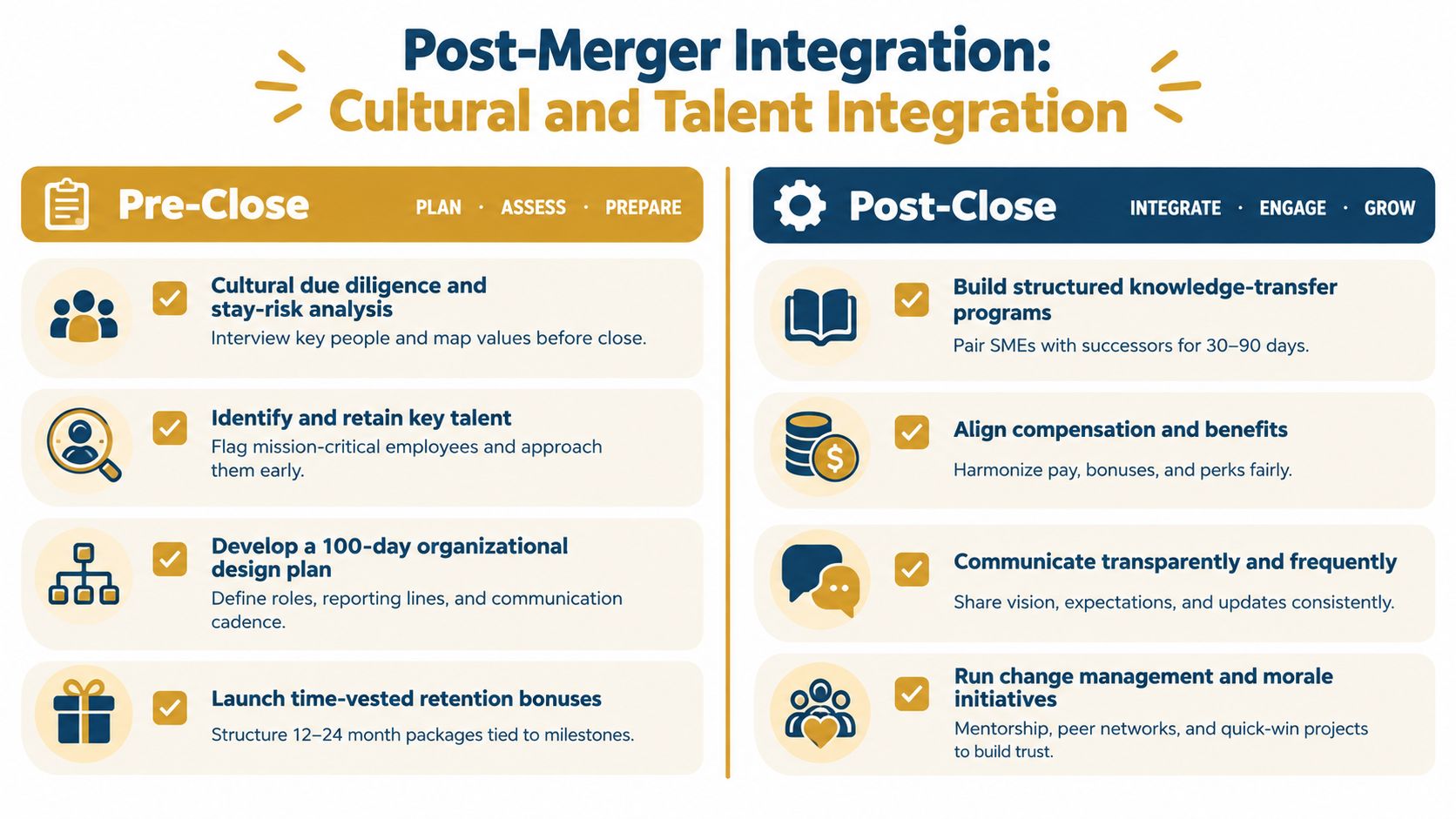
Start this week: create a retention register with each critical role, current owner, successor, departure risk, knowledge-transfer action, and executive responsible for follow-up.
2. Systems and Technology Integration
Technology integration fails when teams confuse connected systems with usable information. Two CRMs may exchange records while salespeople still see duplicate accounts, different price books, or conflicting renewal dates. A rushed migration can interrupt billing and customer service, while indefinite parallel operation creates reporting confusion and duplicated costs.
KPMG found that 82% of surveyed U.S. M&A executives considered obtaining key technologies an important transaction objective, while technology integration remained one of the leading post-close challenges (KPMG M&A integration findings). The same research found that only 63% rated employee-retention efforts during integration as successful, with 37% rating them highly successful. Technology and people therefore belong in one workstream. A system change that employees can't use is an operating failure, not merely an IT delay.
Start with an inventory. Record applications, owners, interfaces, licenses, custom code, manual workarounds, access controls, and security exposure. Then classify each system as retain, retire, replace, or integrate. The right answer may differ by function. Finance might need immediate reporting alignment, while a lower-risk operational tool can remain independent until its replacement is tested.
For acquisition teams, leveraging technology in business acquisitions means connecting technology choices to customer impact and deal value rather than selecting a platform because it is familiar.
A phased cutover usually beats a big-bang migration. Run parallel reporting where the risk justifies it, reconcile sample records, define rollback conditions, and measure help-desk volume after each change.

Give the integration team a decision log. It should show the system decision, business owner, dependency, test result, cutover date, and fallback plan.
Start this week: build a system map showing which applications hold customer, employee, financial, and operational data, then mark the records that must remain accurate on Day One.
3. Financial and Accounting Integration
The first consolidated report can expose a hidden deal problem. If the buyer and seller use different chart-of-accounts structures, accrual policies, revenue definitions, or close calendars, leadership cannot tell whether performance changed or the measurement changed.
During the first 100 days, protect financial continuity while the combined model takes shape. Payroll, accounts payable, billing, collections, lender reporting, and tax obligations must continue without interruption. A documented bridge from seller reporting to consolidated statements is more useful early on than a system replacement that produces figures nobody trusts.
The finance lead should record every material difference between the businesses, including revenue recognition, inventory treatment, deferred costs, customer credits, unpaid liabilities, intercompany charges, and working-capital definitions. Earnout and working-capital calculations need clear methods and owners. Ambiguity can turn an accounting question into a dispute between the parties.
Build a finance control room
Assign one owner to each deliverable:
- Close calendar: Set deadlines for source ledgers, reconciliations, review, and executive sign-off.
- Account mapping: Map both charts of accounts to a common reporting structure while preserving original detail. Use this opportunity to browse the UK waste accounting guide when testing category definitions.
- Cash bridge: Separate recurring operating cash from one-time integration costs and timing effects.
- Exception log: Track unreconciled balances, unusual entries, missing support, and unanswered seller questions.
- Decision record: Document accounting judgments, approvers, and supporting evidence.
PwC reports that 83% of successful dealmakers realized their expected synergies, compared with fewer than half of unsuccessful dealmakers (PwC post-merger integration research). Measurement discipline makes that result usable. For example, a procurement saving counts only when the negotiated change produces a reduced unit cost on the consolidated P&L for the same period, with the supplier, volume, and baseline recorded.
A smaller acquisition may not have a full-time finance team. A dedicated post-close accounting lead or fractional CFO can maintain close discipline when the former owner held reporting knowledge informally.
Start this week: choose one reporting date, map both businesses' revenue and expense categories into a temporary consolidated view, and list every manual adjustment still requiring review.
4. Customer and Revenue Integration
Customers often tolerate an ownership change when the service they value remains predictable. They react badly when the new company changes pricing, contacts, invoices, product promises, and support procedures at the same time.
The first 100 days should protect revenue before pursuing aggressive cross-sell. Identify strategic accounts, renewal dates, open service issues, contractual obligations, and customers dependent on a particular employee. Give account owners a short, consistent explanation of what changes and what won't. If the acquired brand has trust in its market, keeping it temporarily may be safer than replacing it on the same day as the legal transaction.
Sales teams also need one commercial rulebook. It should define approved pricing, discount authority, product names, contract terms, commission treatment, and escalation paths. Without that rulebook, two sales teams can quote different prices to the same account, creating margin leakage and damaging credibility.
Customers don't need a perfect integration story. They need one accountable contact and a reliable answer.
A transition-focused customer-success team can monitor complaints, delayed deliveries, renewal risk, billing confusion, and unresolved product issues. Cross-sell should follow evidence of fit and customer readiness, not an internal target that forces salespeople to push unfamiliar products. Twilio's combination with SendGrid illustrates the commercial value of connecting communication capabilities while clearly articulating the customer benefit. The lesson is less about copying the deal and more about explaining why the combined offer improves the customer's situation.
Use customer health signals throughout the transition. Track changes in support volume, renewal conversations, payment behavior, and account-owner escalations. A single metric won't explain the cause, so require a named owner and next action for each material risk.

Start this week: prepare a top-account sheet with the customer's decision-makers, contract terms, renewal timing, service risks, assigned owner, and approved transition message.
5. Supply Chain and Vendor Integration
A supplier contract can look like a cost opportunity until the combined business discovers that the vendor also holds essential product knowledge, flexible payment terms, or a workaround for an unreliable process. Cutting every overlapping supplier immediately may reduce visible spend while increasing stockouts, quality failures, or customer delays.
Start with continuity. Build a supplier map that includes contracts, renewal dates, minimum commitments, payment terms, service levels, concentration risk, substitutions, and internal owners. Identify which vendors are operationally critical before asking procurement to consolidate them.
The buyer can use combined volume to negotiate common materials, freight, software, packaging, or professional services. That buying power shouldn't become a reason to abandon strategic small vendors. A smaller supplier may provide customization or responsiveness that a larger provider won't match. The correct comparison includes total operating risk, not just quoted unit price.
Sequence procurement decisions
- Validate the records: Compare purchase orders, invoices, contract terms, and supplier master data.
- Confirm physical reality: Count inventory and investigate obsolete, damaged, or missing stock before relying on book values.
- Segment vendors: Separate strategic, critical, replaceable, and transactional relationships.
- Test capacity: Ask whether each supplier can support the combined volume, schedule, quality standard, and geographic footprint.
- Negotiate selectively: Combine volume where the business can tolerate a change, and preserve continuity where it can't.
Amazon's acquisition of Whole Foods is a useful illustration of the operational upside available when logistics and inventory visibility improve. It also shows why technology, procurement, and frontline execution need to move together. A new purchasing platform won't fix inaccurate stock records or unclear approval authority.
Start this week: create a supplier-risk register with contract owner, renewal date, operational dependency, substitution option, volume exposure, and next decision.
6. Regulatory, Legal, and Compliance Integration
A customer renews, the invoice entity has changed, and the renewal fails tax validation because the operating license was never reassigned. Similar gaps appear when an employee policy conflicts with local requirements or customer data enters a system with different access controls. During the first 100 days, these problems can trigger service interruptions, audit findings, renewal delays, or customer escalations.
Assign one accountable compliance owner immediately after close. That person should maintain a dated register covering licenses, permits, filings, insurance, employment obligations, privacy requirements, cybersecurity controls, and industry-specific duties. Legal counsel can advise on jurisdictional questions, while operational managers own the actions that keep each control working.
Preserve coverage before harmonizing policies or systems. Update filings and insurance information, confirm signing authority, and review whether the entity name or ownership requires amended corporate documents using this guide for changing company name. Verify permits and data-access permissions before moving operations into shared systems. A SaaS acquisition may need privacy and security controls aligned before customers enter a common environment. An industrial business should review environmental obligations before changing a site or process.
Use post-acquisition integration plans for compliance requirements to convert legal findings into named owners, deadlines, and evidence. A risk list alone does not show that a control operates.
- License check: Confirm every required authorization belongs to the correct entity and remains valid after closing.
- Access review: Remove unnecessary access, verify privileged accounts, and document data owners.
- Insurance update: Confirm named entities, coverage limits, renewal dates, and operational exclusions.
- Policy alignment: Compare employment, privacy, safety, records, and incident-response policies.
- Training evidence: Record required attendees, completion status, and outstanding training.
Compliance work is complete only when someone can prove the control operates.
Start this week: ask legal, HR, IT, finance, and operations to submit their top three post-close compliance risks. Consolidate the responses into one dated action register with an owner and next action for each item.
7. Brand, Marketing, and Go-to-Market Strategy Integration
Brand decisions create a different kind of post merger integration issue because customers can interpret a name change as a change in quality, ownership, or promise. A full rebrand may simplify operations, but it can also erase trust that took years to build. Keeping both brands may preserve demand while increasing marketing complexity and duplicate technology.
Choose the brand model deliberately: merge, retain separately, or co-brand. Tie the decision to customer segments, product overlap, channel economics, search visibility, legal rights, and the reason customers buy. Facebook kept Instagram independent, and Google retained Waze as a distinct brand, reflecting different audiences and product identities. Independence isn't automatically better, but it can protect a brand whose value depends on its existing community.
The first 100 days should focus on preventing confusion. Align core positioning, sales language, pricing rules, campaign ownership, and lead-routing logic. If digital properties are consolidated, map redirects, preserve important content, update analytics, and monitor search and conversion signals. A poorly executed domain change can make a healthy business look weaker only because customers can't find the right page or offer.
Make the commercial operating model explicit
- Audience ownership: Define which team owns each customer segment and channel.
- Message hierarchy: Create approved product descriptions, proof points, and transition language.
- Pricing governance: Test proposed changes with controlled customer groups before broad rollout.
- Lead management: Set one process for capture, qualification, routing, attribution, and follow-up.
- Performance review: Separate brand health, demand generation, sales conversion, retention, and acquisition costs.
Thrasio's roll-up model demonstrates the potential efficiency of coordinating multiple eCommerce brands, but consolidation only works when customer intent and channel economics remain visible. The operator's job is to remove duplication without flattening useful differences.

Start this week: write a one-page brand decision brief covering the intended architecture, affected audiences, customer risks, digital-property actions, and executive approver.
Post-Merger Integration: 7-Area Comparison
| Integration Area | Implementation complexity 🔄 | Resource requirements ⚡ | Expected outcomes 📊 | Ideal use cases 💡 | Key advantages ⭐ |
|---|---|---|---|---|---|
| Cultural and Talent Integration | High, leadership alignment, role redesign, change management | High, HR, change managers, retention incentives, time | Preserve institutional knowledge; reduce long-term turnover if successful | Acquisitions where human capital and founders are critical | Retains key talent; accelerates post-close decision-making |
| Systems and Technology Integration | High, legacy compatibility, data migration, security integration | High, engineers, integration tools, licenses, phased effort | Unified data and lower tech debt; risk of downtime during cutover | Deals with disparate CRMs, ERPs, or complex IT stacks | Consolidated platform, better analytics, improved security |
| Financial and Accounting Integration | Medium–High, chart of accounts, tax structure, reconciliations | Medium, accountants, auditors, tax advisors, integration timelines | Accurate consolidated reporting and improved cash visibility | Transactions requiring lender/investor-ready financials or earnouts | Streamlined reporting; clearer working capital and tax position |
| Customer and Revenue Integration | High, contracts, pricing, CRM consolidation, sales realignment | Medium–High, sales/CS teams, comms, tooling, training | Increased cross-sell and CLTV if managed; churn risk if not | Customer-facing businesses aiming for revenue synergies | Protected revenue base; unified customer experience |
| Supply Chain and Vendor Integration | Medium, contract consolidation, inventory reconciliation | Medium–High, procurement, operations, physical counts | Lower COGS and inventory holding; risk of supply disruption | Product-based, eCommerce, or manufacturing roll-ups | Volume discounts; optimized inventory turns and forecasting |
| Regulatory, Legal, and Compliance Integration | High, multi-jurisdictional rules, filings, permits | High, legal counsel, compliance teams, time for approvals | Reduced legal risk and stronger governance; possible timeline extensions | Regulated industries or cross-border transactions | Mitigates fines/operational stoppage; aligns governance |
| Brand, Marketing, and Go-to-Market Integration | Medium, brand decisions, SEO preservation, messaging | Medium, marketing, design, SEO, rebranding budget | Stronger market perception and CAC efficiency; short-term performance dip possible | Consumer-facing or differentiated product brands | Unified messaging; improved marketing ROI and cross-promotion |
Turn These Issues Into a 100-Day Action Plan
The seven issues are connected, so don't manage them as seven unrelated projects. A pricing conflict may come from customer-data problems, which may come from systems fragmentation, which may persist because no one owns the integration decision. Your plan needs a single operating cadence that exposes those dependencies early.
Create an integration management office, even if it consists of only a few people for a smaller acquisition. PwC reports that successful acquirers typically integrate at least two functions within the first six months and nearly all remaining functions within one year; only 29% reported that integration took longer than originally planned (PwC integration success factors). Speed matters, but coordinated execution matters more than rushing a technical cutover.
Use this working checklist:
- Assign owners: Name one accountable executive for talent, systems, finance, customers, suppliers, compliance, and brand.
- Set first milestones: Date the first retention conversations, system inventory, consolidated report, key-account outreach, supplier review, compliance register, and brand decision.
- Define evidence: Specify what proves completion, such as signed approvals, reconciled records, trained users, contacted customers, or tested rollback procedures.
- Review weekly: Bring leaders from both businesses together to review overdue actions, unresolved decisions, customer risks, employee signals, and synergy progress.
- Separate value types: Distinguish recurring savings, one-time restructuring benefits, revenue synergies, ordinary growth, and accounting estimates.
- Escalate quickly: Give the integration lead authority to raise decisions that cross functional boundaries or threaten continuity.
- Transfer ownership: Move completed workstreams into business-as-usual management with a named operator and ongoing metric.
McKinsey found that companies outperforming peers 18 months after a transaction had a 79% likelihood of continuing to outperform three years later, while only 17% of deals underperforming peers at 18 months subsequently recovered (McKinsey integration performance analysis). That makes the first 100 days an early control window, not an administrative phase.
Dealmaker Wealth Society's playbooks, templates, and live coaching can help acquisition entrepreneurs build and pressure-test an integration plan around an active deal. Start before close, assign the owners, and make the first weekly review a real decision meeting rather than a status presentation.
Dealmaker Wealth Society provides acquisition training, post-close integration guidance, playbooks, templates, and live coaching for entrepreneurs buying and scaling small businesses. Use its checklists and deal support to turn the first 100 days into an accountable operating plan, then visit Dealmaker Wealth Society to explore the available programs and community.

From the Dealmaker Blog











A Creative Business Buying Fable