Negotiating a Deal for SMB Acquisitions
Negotiating a Deal for SMB Acquisitions
Most advice on negotiating a deal starts in the wrong place. It tells buyers to argue over the headline price, wait for the seller to name a number, and push for the lowest possible valuation. That approach misses where small-business transactions usually become difficult: the allocation of uncertainty after closing.
A lower price can still produce a poor acquisition if the buyer inherits customer concentration, owner dependence, weak working capital, undocumented liabilities, or an integration plan built on optimism. A higher price can be rational when the seller provides financing, supports the transition, protects against known risks, or accepts contingent consideration tied to outcomes neither party can verify today.
The practical objective isn't to “win” the bargaining session. It's to build a transaction in which price, risk, timing, control, and future performance fit together. That requires preparation before the first offer, disciplined questions during diligence, and conditional concessions all the way through the purchase agreement.
Table of Contents
- Building Your Quantified Negotiation Brief
- Deploying Defensible Anchors in Pricing Discussions
- Engineering the Risk Architecture of the Transaction
- Navigating Asymmetric Information with Owner Operators
- Constructing a Value Bridge Before Signing
- Executing Conditional Concessions and Finalizing Terms
Building Your Quantified Negotiation Brief
A buyer who focuses only on price is negotiating with incomplete information about their own position. Before speaking with an owner, document what the transaction must accomplish, what you can trade, and what would make walking away the better decision.
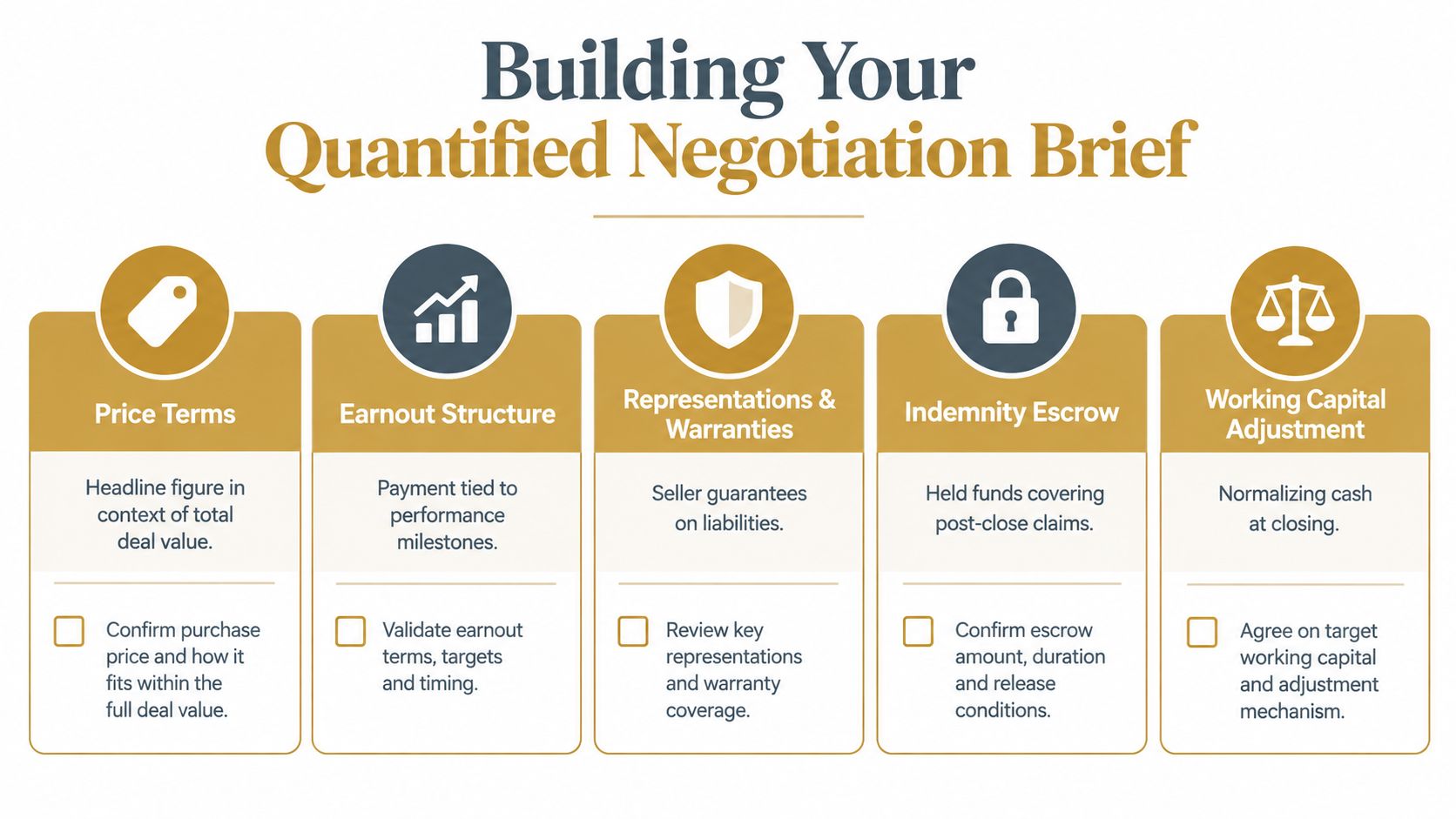
A useful brief has five parts:
- Target outcome: Define the preferred structure, not just the desired valuation. Include cash at closing, financing, transition support, working-capital treatment, restrictive covenants, and the level of operational control you need.
- Reservation point: Set the maximum economic exposure you can accept after modeling downside scenarios. This is your walk-away point, not a figure you reveal to the seller.
- BATNA: Write down your best alternative to a negotiated agreement. It might be another target, continued sourcing, a different financing route, or preserving your capital and time.
- Non-price priorities: Rank terms such as certainty of closing, seller training, employee retention, customer introductions, indemnity protection, and access to records.
- Tradable variables: Decide what you can exchange. A buyer might accept a higher headline price in return for a seller note, stronger representations, an escrow, or a longer transition period.
Turn the model into a negotiating instrument
Your financial model should show how the business performs under base, downside, and upside assumptions. Normalize owner compensation, remove unusual expenses only when you can defend the adjustment, test customer concentration, estimate working-capital needs, and separate recurring earnings from one-time results.
A useful financial forecasting framework for potential acquisitions can help organize those assumptions. The point isn't to create a beautiful spreadsheet. The point is to know which terms protect your actual return if the seller's forecast proves too optimistic.
Write a sentence beside every major assumption: “If this changes, which term changes with it?” If normalized earnings fall, the answer might be a lower price. If the seller's involvement is essential for customer retention, the answer might be a transition obligation, retention payment, or deferred consideration.
Practical rule: Never enter a negotiation with one number and no structure around it.
Your brief should also define decision rights. Know who can approve a revised offer, what requires lender consent, which diligence findings trigger a pause, and how quickly your team can respond. A seller often interprets hesitation as weak conviction, but rushed decisions create expensive mistakes.
Finally, separate internal limits from external messaging. You can present a collaborative proposal while privately maintaining a firm reservation point. That discipline keeps seller enthusiasm, sunk costs, and fear of losing the deal from overriding your acquisition thesis.
Deploying Defensible Anchors in Pricing Discussions
The popular advice to let the seller name the first price sounds cautious, but it can surrender control of the bargaining range. Research associated with Daniel Kahneman and Amos Tversky showed that people making judgments under uncertainty rely heavily on the first number introduced, even when that number is arbitrary or extreme. Harvard's Program on Negotiation describes the first offer as an anchor that shapes the discussion that follows, and notes that the effect can persist even when negotiators know the initial figure may be unreliable. Harvard's analysis of anchoring in negotiation provides the behavioral foundation.
That doesn't mean every buyer should fire out an aggressive number immediately. The first offer works when it has a credible relationship to normalized earnings, quality of earnings, comparable transactions, customer durability, capital requirements, and downside risk. An unsupported figure feels like an insult. A reasoned figure gives the seller something concrete to challenge.
Build the range before you state the number
Start with an independent valuation range rather than a single “fair price.” Model the business using maintainable earnings, then test what happens if a major customer leaves, the owner exits sooner than expected, margins normalize, or required investment rises. The output should tell you not only what the business might be worth, but also which risks make the upper end unjustifiable.
For sellers who want a separate perspective on what your service business is worth, an external valuation resource can help frame the conversation before both sides become attached to a number. It shouldn't replace transaction-specific diligence.
When you make the offer, explain the logic in plain language:
- Earnings foundation: “We're valuing the business on maintainable operating performance, not the strongest reported period.”
- Risk adjustment: “The customer concentration and owner involvement require protection until we verify retention and transferability.”
- Structure: “We can improve certainty for you through a stronger closing payment if we can resolve the working-capital and warranty points.”
- Evidence: “The proposed range reflects the quality of earnings and the investment needed after closing.”
The offer should be ambitious enough to serve your interests, but defensible enough to keep the conversation alive. Kellogg's negotiation research notes that prepared negotiators generally benefit from making the first offer when it is ambitious but supported, while an extreme anchor can provoke resistance and reduce the chance of settlement. Its practical guidance on negotiating acquisition prices is useful when turning valuation work into offer mechanics.
Avoid false precision. A price with elaborate calculations can still be weak if the underlying earnings adjustments aren't reliable. State what you know, identify what remains uncertain, and tie unresolved uncertainty to a term rather than pretending the uncertainty doesn't exist.
Engineering the Risk Architecture of the Transaction
The most important negotiation often happens after both parties agree that the business is strategically attractive. At that point, the buyer must decide who carries the risk that the forecast is wrong.
Recent Southern European M&A data reported that earn-outs increased in 53% of transactions in H1 2025, while warranties and indemnities increased in roughly one-third of reported transactions. The same report found that transactions below €5 million represented nearly half of the market, with deals below €2.5 million comprising 26%. The Southern European M&A Monitor illustrates why risk architecture matters particularly in smaller transactions, where the buyer and owner often negotiate directly.
| Mechanism | Primary Purpose | Key Buyer Risk | Key Seller Risk |
|---|---|---|---|
| Earn-out | Bridge a valuation gap through future performance | Measurement disputes, seller influence over operations, and incentives that distort decisions | Payment depends on post-close results and buyer execution |
| Seller financing | Defer part of the consideration and maintain alignment | Seller may seek restrictive controls or remedies if payments are missed | Credit exposure to the buyer and the acquired business |
| Representations and warranties | Allocate responsibility for the truth of historical facts | Claims may be difficult to prove or recover | Broad liability for matters the seller didn't know about |
| Indemnity escrow | Secure funds for defined post-close claims | Escrow may be too small, released too early, or subject to procedural barriers | Part of the proceeds remains unavailable after closing |
| Working-capital adjustment | Deliver the business with an agreed operating level | Disputes over the normalized target and accounting policy | Final proceeds can fall if closing working capital misses the target |
Match each uncertainty to the right tool
An earn-out is appropriate when the seller's projected value depends on measurable future performance, but it creates conflict if the buyer controls pricing, staffing, marketing, or investment after closing. Define the metric, accounting rules, reporting access, approval process, treatment of extraordinary events, and what happens if the seller's role changes. “Revenue growth” is usually too vague unless the parties define recognition, returns, customer credits, and the period being measured.
Seller financing can make a deal financeable and keep the seller economically connected to a successful transition. It also exposes the seller to your execution and repayment capacity, so expect negotiation around interest, subordination, default rights, and information access. Don't use a seller note as a substitute for understanding whether the business can support the debt.
Warranties and indemnities work only when they're specific, time-limited, and financially meaningful. If a seller provides broad promises but has no escrow, insurance, or retained proceeds, the protection may be difficult to enforce. The buyer should prioritize known risks, including tax, employment, customer contracts, intellectual property, regulatory compliance, and undisclosed liabilities.
The strongest structure doesn't push every risk onto one side. It assigns each risk to the party best able to control or verify it, then gives the other side enough certainty to remain engaged.
Navigating Asymmetric Information with Owner Operators
An owner-operator rarely sees the business the way a buyer does. The owner remembers the customer who stayed through a difficult period, knows which employee solves emergencies without fanfare, and understands which "recurring" account depends on a personal relationship. Those facts may never appear in the management accounts.
Start with respect, not suspicion. Say, “You know the operating reality better than anyone. I want to understand what makes the business work, including the parts that aren't obvious in the financial statements.” That phrasing invites disclosure while making clear that you intend to test the story.

Ask questions that reveal dependencies
Don't ask only whether revenue is recurring. Ask how the relationship renews, who speaks with the customer, what happens if the owner stops answering calls, and whether the customer has a contract, purchasing habit, or personal loyalty.
Useful prompts include:
- Customer durability: “Which customers would notice the ownership change first, and why?”
- Employee dependence: “Who makes decisions that aren't written down anywhere?”
- Operational fragility: “What breaks when you're away for a week?”
- Supplier exposure: “Which vendor relationship depends on your personal history?”
- Forecast confidence: “Which assumption in the plan would you be least comfortable guaranteeing?”
- Transition reality: “What would you need to teach me before you could step away?”
Listen for changes in language. “They always renew” isn't the same as a signed commitment. “The team runs itself” may mean the owner has delegated tasks, or it may mean one trusted employee is carrying undocumented knowledge. Ask for evidence without turning every answer into an accusation.
A buyer also needs to understand the seller's reason for exiting. The guidance on understanding seller motivations in acquisitions can help connect price and structure to what the owner actually values. A seller seeking retirement certainty may prefer cash and a clean handoff. A seller concerned about employees may value continuity and a longer transition more than a modest increase in price.
Trust is not a substitute for diligence. It is what makes honest diligence possible.
Use neutral third parties where specialist judgment matters. Insurance terms, exclusions, claims history, and coverage gaps deserve independent review. The distinction between a broker for your business vs insurer can matter when you evaluate how risk is identified, placed, and transferred.
A practical discussion of owner knowledge and buyer preparation can also benefit from this short video:
Don't demand every answer in one meeting. Establish a pattern in which the seller can explain the business, you can verify the explanation, and discrepancies become topics for structure rather than personal conflict.
Constructing a Value Bridge Before Signing
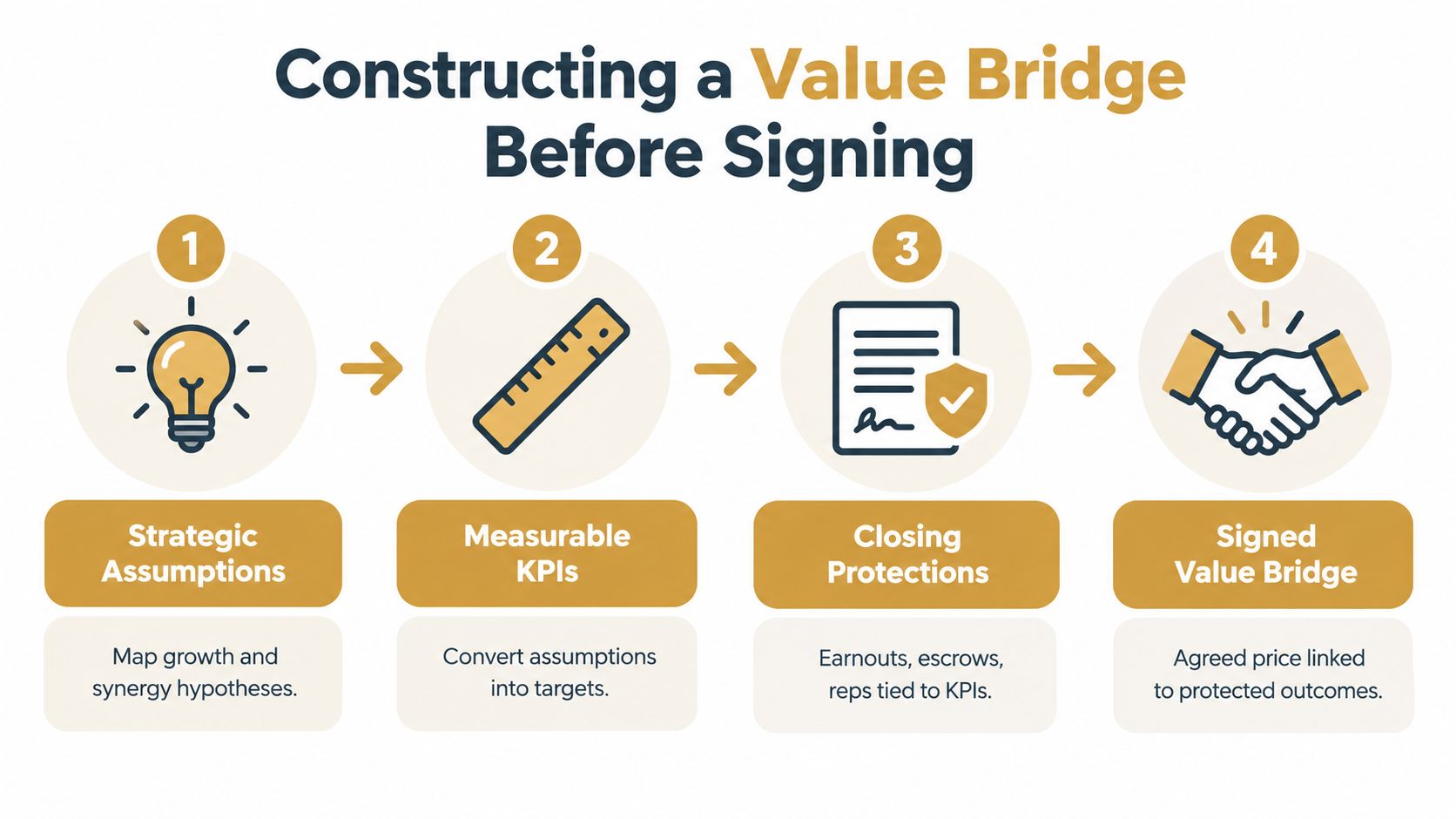
A strategic rationale isn't a valuation. “We can cross-sell,” “we'll improve operations,” and “the team will grow” are hypotheses until someone defines the baseline, the measurement, the cost, and the protection if the result doesn't arrive.
McKinsey's analysis reports M&A failure rates of approximately 66% to 75%, says diligence can overlook as much as 50% of potential merger value, and found respondents judged diligence inadequate in more than 40% of deals. McKinsey's M&A analysis supports a simple conclusion: don't sign on the basis of strategic enthusiasm alone.
Separate value from hope
Build the bridge in distinct layers:
- Standalone earnings: Establish what the target produces without assuming your improvements.
- Operational synergies: Identify savings or capacity gains, then assign an owner and implementation date.
- Revenue opportunities: Define the customer, offer, conversion mechanism, and evidence supporting the opportunity.
- Integration costs: Include systems, people, rebranding, training, professional fees, and management time.
- Capital requirements: Model equipment, technology, inventory, working capital, and other investment needed to reach the plan.
- Execution risk: Record dependencies that could delay or reduce the expected benefit.
Every material assumption needs five fields: an owner, an evidence source, a measurement formula, a deadline, and contractual treatment. If the seller claims a customer will remain after closing, identify who will confirm that, how retention will be measured, and whether a transition obligation or contingent payment is appropriate.
Cultural understanding belongs in the same bridge. McKinsey found that 92% of surveyed respondents believed their deals would have benefited from greater cultural understanding before closing. That doesn't turn culture into a soft topic. Management retention, decision authority, reporting habits, systems compatibility, and integration milestones directly affect execution.
Protect the bridge in the documents
An earn-out can protect a disputed growth assumption. A purchase-price adjustment can address normalized working capital. Escrow can support indemnity exposure. A representation can force the seller to stand behind a historical fact. A condition precedent can prevent closing until a critical contract, consent, or financing requirement is resolved.
Don't place every assumption into an earn-out. Some matters are better handled through diligence, a warranty, or a closing condition. Earn-outs become difficult when the buyer's post-close decisions determine the metric but the seller still expects control over the result.
The bridge should exist before the letter of intent becomes emotionally binding. Once the buyer and seller treat an optimistic projection as agreed value, it becomes much harder to convert that projection into a measurable protection.
Executing Conditional Concessions and Finalizing Terms
Late-stage negotiations create pressure to give something merely because the parties have invested time. Resist that reflex. Every concession should purchase a reciprocal improvement in price, risk, timing, certainty, or control.
A conditional concession sounds like this: “If the seller accepts the normalized working-capital target and provides the agreed transition support, we can increase the closing payment.” An unconditional concession sounds like this: “We can pay more because we want to get this done.” The first changes the structure. The second teaches the other side that persistence produces value.
Use a concession ledger
Record each movement in a simple table:
| Buyer movement | Seller movement required | Evidence or trigger |
|---|---|---|
| Higher cash payment | Stronger indemnity protection | Specific liability schedule and escrow |
| Faster closing | Complete diligence access | Delivered records and resolved exceptions |
| Reduced escrow | Narrower warranty scope | Excluded risks documented and priced |
| More flexible working capital | Clear accounting methodology | Agreed balance-sheet definitions |
| Longer transition payment | Defined services and availability | Written schedule and response obligations |
Use objective criteria such as normalized EBITDA, quality of earnings, customer concentration, working-capital needs, and comparable transactions. Document why each movement occurred. This record protects the commercial agreement when lawyers begin drafting language and different stakeholders reinterpret what was settled.
Review the letter of intent line by line against the purchase agreement. Check the purchase price formula, working-capital target, treatment of debt and cash, earn-out definitions, seller note terms, escrow release, indemnity caps and baskets, representations, restrictive covenants, transition services, closing conditions, and remedies.
Don't rely on labels. “Earn-out” can describe very different economic arrangements. “Working capital” can produce a dispute if the accounting principles, exclusions, and sample calculation aren't clear. Attach examples where a formula could be interpreted in more than one way.
Take a pause before signing if a new issue appears late. A short delay for analysis is cheaper than accepting a risk you haven't priced. The deal is finished only when the signed documents preserve the economics you negotiated and the operating realities you uncovered.
Dealmaker Wealth Society offers online acquisition training, coaching, deal-structuring guidance, and peer support for buyers working through valuation, seller notes, earn-outs, escrows, warranties, and post-close execution. Visit Dealmaker Wealth Society to explore its acquisition programs and deal support resources before you make your next offer.

From the Dealmaker Blog









A Creative Business Buying Fable