
How to Do DCF Analysis Without Getting Burned
How to Do DCF Analysis Without Getting Burned
You've got the teaser deck, the broker's CIM, and a P&L that looks clean until you ask a few uncomfortable questions. The seller says the business has “room to run,” your lender wants a grounded case for debt service, and you need a number that won't fall apart the moment someone asks what's inside the EBITDA. That's where how to do DCF analysis becomes useful for a buyer, not as a classroom exercise, but as a way to see whether the price you're about to offer makes sense.
Table of Contents
- What DCF Analysis Actually Means for a Buyer
- Forecasting Free Cash Flow for a Private Target
- Choosing a Discount Rate That Survives the LOI Call
- Terminal Value Methods and Why Terminal Value Dominates the Answer
- Running Sensitivity Analysis the Right Way
- Building the DCF Model in Excel Step by Step
- When DCF Should Be a Sanity Check, Not the Answer
What DCF Analysis Actually Means for a Buyer
A buyer usually isn't trying to impress an investment committee. The core problem is simpler, and more dangerous. You have a target's P&L, a broker's valuation story, and a price expectation from the seller, and you need to decide what the business is worth to you without getting fooled by either the narrative or the spreadsheet.
DCF, or discounted cash flow, answers a basic question in buyer terms, what are the business's future cash flows worth today? The model estimates free cash flow, then discounts each future dollar back to present value because a dollar received later is worth less than a dollar received now. That idea is the core of the income approach, and it's the reason DCF can act as a reality check against unsupported multiples and pitch-deck optimism. For a related valuation lens, see the income approach overview at Dealmaker Wealth Society's income approach valuation page.
What the model gives you
A buyer's DCF normally produces three useful outputs. First is enterprise value, which is the value of the operating business before debt and excess cash. Second is equity value, which is what's left for the buyer after debt is considered. Third is the range of outcomes, because a single-point answer is usually too brittle to trust in a small private business deal.
Practical rule: if you can't explain the drivers of value in plain English, the DCF is not finished yet.
That's why a DCF matters less as a precision instrument and more as a discipline. It forces the buyer to test assumptions about growth, margins, reinvestment, and exit value before writing a letter of intent. If the broker's multiple says the deal is cheap but the DCF says the cash flow doesn't support the debt, the model did its job.
The other reason DCF matters is that it exposes where the story is carrying the valuation. When the answer depends mostly on a far-off terminal assumption, the buyer should treat the output as a range, not a fact. That distinction matters far more in small private acquisitions than in public equities, where analysts can lean on cleaner reporting and more comparable market data.
Forecasting Free Cash Flow for a Private Target
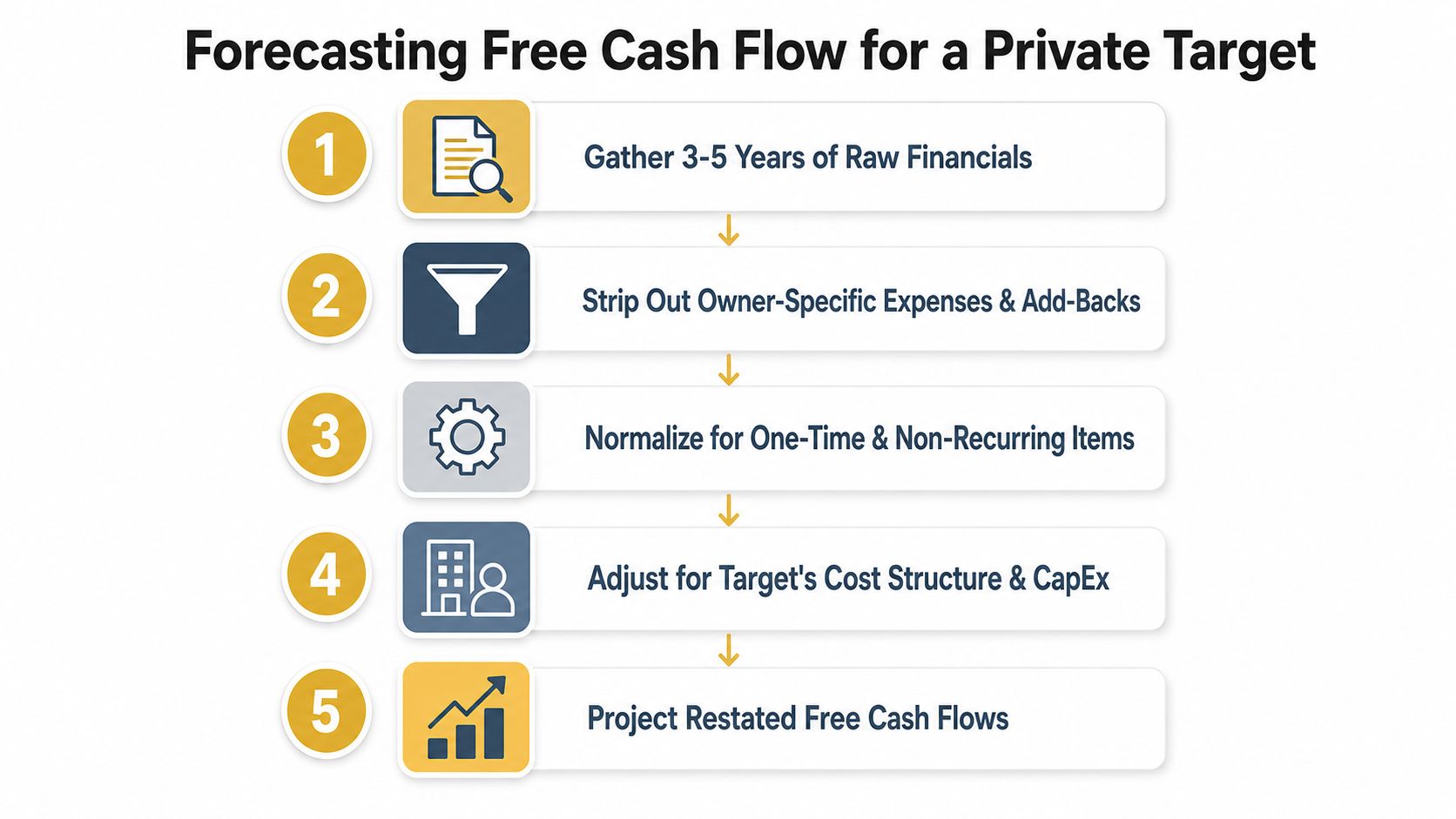
Private-business DCF work usually goes sideways. The target's books rarely arrive in investment-grade shape, and the historical numbers often reflect the owner's habits as much as the business's economics. Independent valuation guidance for private companies says to restate 3 to 5 years of financials, remove owner-specific distortions and non-recurring items, document the adjustments, separate maintenance CapEx from growth CapEx, and cross-check the DCF against other valuation methods rather than relying on one output alone, as outlined in Valutico's guidance on DCF valuation for private companies.
Normalize the historicals before you project anything
Start with at least three years of statements if you have them, and five is better when the business has changed hands, added locations, or absorbed one-off expenses. Then strip out owner salary that's above or below market, personal travel, family payroll, related-party rent, and any expense that wouldn't survive a sale. If the owner's cousin owns the warehouse, that rent needs to be normalized before you trust the margin.
One-time legal fees, emergency repairs, cleanup costs, and unusual professional fees also need to be labeled and treated carefully. Don't bury them inside “other expenses” and hope the issue goes away. A real buyer wants a written adjustment log that shows what changed, why it changed, and whether it should recur after closing.
Separate maintenance CapEx from growth CapEx
This is one of the biggest blind spots in generic DCF tutorials. Maintenance CapEx keeps the business where it is, while growth CapEx is the extra spend that creates a bigger future business. If you mix them together, your free cash flow line becomes too optimistic or too conservative depending on how the owner has been reinvesting.
A private buyer should ask what it costs to keep the current revenue base functioning, then what extra capital is required to expand it. That split is especially important in service businesses, light manufacturing, and asset-heavy local companies, where equipment replacement, software upgrades, and facility spend can be easy to understate.
Build the projection from the normalized base
Once the historicals are clean, project revenue, margins, working capital, and CapEx from the normalized base. Use assumptions that reflect how the buyer will operate the business, not how the seller described it in the CIM. If you're documenting the forecast inside a deal process, a practical companion resource is this financial forecasting checklist for potential acquisitions.
A simple projection template works well for most SMB deals:
- Revenue growth: tie it to customer concentration, pricing power, and sales capacity.
- Operating margin: reflect owner replacement, hiring, and vendor normalization.
- Working capital: model receivables, payables, and inventory with conservative judgment.
- Maintenance CapEx: keep it separate from expansion spend.
- Free cash flow: use the rest as the cash available to the business owner and buyer.
The key is not complexity. The key is clean inputs. A DCF built on sloppy historicals just turns bad accounting into confident-looking nonsense.
Choosing a Discount Rate That Survives the LOI Call
A lot of buyers spend too much time debating whether the business can grow and too little time asking what return they require for the risk they're taking. The discount rate is the lever that converts future cash into today's value, and in a private SMB deal it's usually the most sensitive input in the whole model.
Use a private-company rate, not a public-company shortcut
Public-company WACC is often the wrong starting point for a small private target. Public firms have deeper capital markets, more liquidity, broader access to debt, and less key-person risk than a typical owner-operated business. A buyer pricing a private company should think in terms of a build-up rate or a private-company WACC that reflects size, concentration, and execution risk.
The practical range many private SMB deals land in is often discussed around 15% to 25% in buyer-side practice, but the exact number has to be justified from the deal itself, not copied from a template. If you want to defend the rate in a memo or to a partner, explain the pieces in plain English.
A workable WACC frame for a leveraged deal
WACC, or weighted average cost of capital, blends the after-tax cost of debt and the cost of equity based on the capital structure you expect after closing. If the acquisition uses debt, the debt rate should reflect the actual financing terms, not a theoretical public-market coupon. For a private target, the equity side usually deserves a premium because the buyer is taking illiquidity, concentration, and operating risk.
A simple example helps. If the buyer targets a 1.5x debt-to-EBITDA structure, borrows at 9% interest, and requires an 18% equity cost, the resulting WACC sits between those two costs based on the debt and equity mix. That's not a textbook exercise, it's the kind of rate structure a buyer can defend in a deal discussion.
Practical rule: if the rate sounds comfortable, it's probably too low for a small private business.
The biggest mistake is using a rate that makes the deal work. The rate should come first, because it reflects risk. If the valuation collapses once you use a realistic private-company return requirement, that's not a model error. It's information.
Terminal Value Methods and Why Terminal Value Dominates the Answer
Most buyers think the forecast period is where the valuation is earned. In practice, the terminal value often carries most of the weight, which means the answer can swing more on a long-run assumption than on the five-year operating forecast. That's why DCF is more honest when it shows a range, not a single number, especially in today's rate environment, where the terminal assumption can overpower the rest of the model. For a market-oriented discussion of exit multiples, understanding valuation multiples in deals is a useful companion.
Gordon Growth versus exit multiple
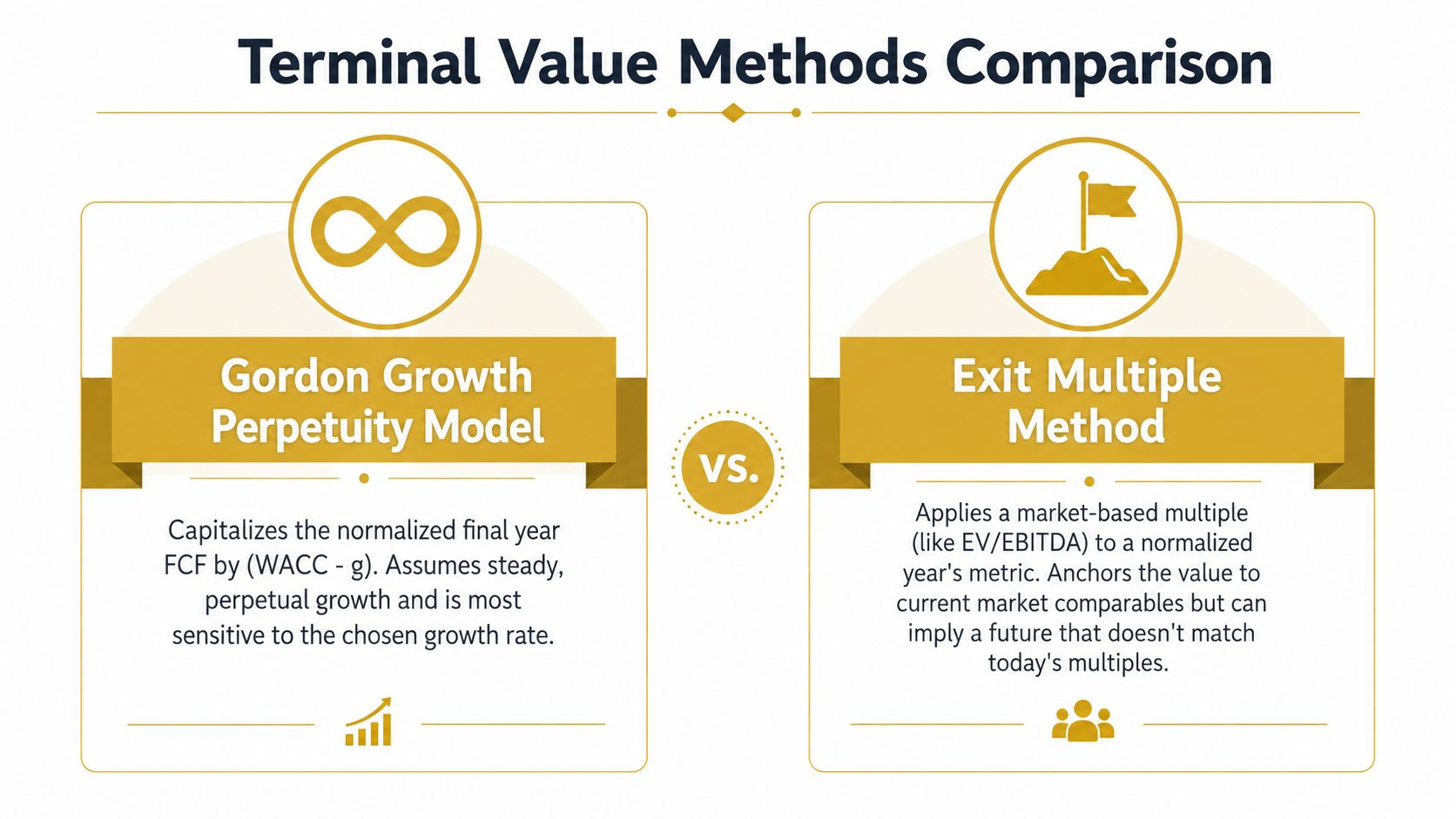
The Gordon Growth method assumes the business grows free cash flow at a steady perpetual rate after the explicit forecast period. That makes sense when the company is stable, boring in a good way, and likely to keep compounding within a narrow band. The risk is that if the growth rate is too close to the discount rate, the terminal value can become unrealistically large or mathematically unstable.
The exit multiple method takes a market-based multiple, often on EBITDA or another normalized metric, and applies it to the final forecast year. This is often a more grounded anchor for a private buyer because it reflects what similar businesses trade for, rather than assuming an abstract forever-growth rate.
Why the terminal value drives the decision
The problem isn't just which method you choose. It's that the terminal value can dominate the total valuation, which makes the model highly assumption-sensitive. Harvard Business School and other analytical sources emphasize that the discount rate and terminal value assumptions largely determine the result, so the DCF is better treated as a range-generating tool than a precise intrinsic-value machine, as noted in Street of Walls' DCF analysis guidance.
That sensitivity is the point. If a slight change in the terminal assumption makes the deal look wildly different, the buyer should stop pretending the number is stable. In those cases, an exit multiple grounded in current market comparables is often the more honest choice, while Gordon Growth works better when the long-run operating picture is predictable.
Running Sensitivity Analysis the Right Way
A single-point DCF is an opinion dressed up as precision. Sensitivity analysis is what turns that opinion into a usable decision tool, because it shows how much the valuation moves when the assumptions move. For a buyer, that matters more than the neatness of the base case.
Build two tables, not one
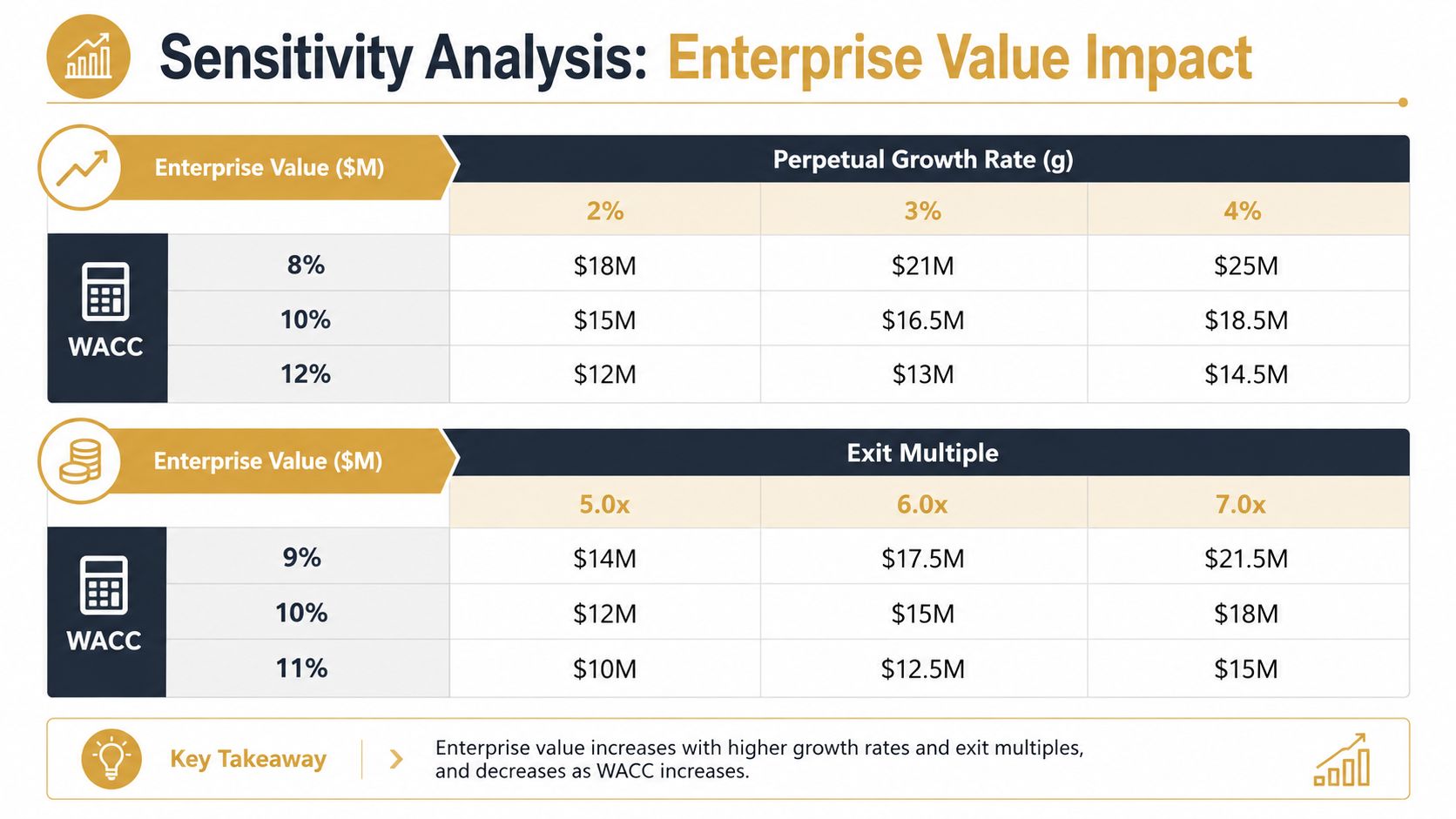
The first table should test WACC versus perpetual growth if you're using Gordon Growth. The second should test WACC versus exit multiple if you're using a market exit. A buyer doesn't need a hundred scenarios, just enough to see where the valuation is fragile.
Use a compact grid and keep the ranges realistic for the deal. A small change in the discount rate often moves value more than a similar change in growth, so don't treat those inputs as equally important. A tornado chart can help, but only if you use it to focus attention on the biggest drivers instead of decorating a slide.
Read the output as a band, not a target
Base case, downside case, and upside case are more useful than one exact price. The point is to show where the valuation lands if the buyer is conservative on reinvestment or the seller is aggressive on growth. If the range is wide enough to make a LOI uncomfortable, that's useful information, not a failure.
The model is telling you that the assumptions aren't stable enough to anchor a price yet.
Monte Carlo simulations can be helpful in complex or highly uncertain deals, but they're usually overkill for a straightforward SMB acquisition. In most lower-middle-market deals, a disciplined two-way sensitivity table gives you enough signal to decide whether the valuation can survive a negotiation call.
Building the DCF Model in Excel Step by Step
Excel is still the tool most buyers use because it's flexible, auditable, and easy to stress test when someone asks, “What happens if we lower the terminal multiple?” The trick is to build the file so one assumption change flows through the whole model without hidden hardcodes.
Structure the workbook so the logic is visible
A clean layout usually starts with Assumptions, Historicals, Projections, WACC, DCF, and Sensitivity tabs. Keep the source financials separate from the forecast, and keep the WACC inputs separate from the valuation output. That way you can inspect each layer instead of hunting through one giant sheet for the broken cell.
For example, if the target has $1.2M in SDE, you can translate that into owner-adjusted cash flow, map it to projected free cash flow, and then discount it across the forecast period. The exact dollar amount doesn't matter as much as the discipline of linking each number back to a source or assumption.
Use formulas that update cleanly
The core formulas are simple:
- Present value: future cash flow divided by the discount factor.
- NPV: the sum of discounted free cash flows minus the purchase outlay.
- Terminal value: either a Gordon Growth capitalization or an exit multiple.
- IRR: the rate that equates the discounted cash flows to the initial investment.
The danger is not formula complexity. It's bad spreadsheet hygiene. Hardcoded numbers buried inside formulas make the model brittle, circular references can creep in if you try to model debt too aggressively, and inconsistent date periods can distort the output.
Keep the model auditable enough for a buyer memo
A buyer should be able to trace every major number back to an assumption or source. That's where disciplined accounting files matter, and why it helps to build an Excel accounting system that keeps the historicals organized before you layer on valuation logic.
If you want the model to survive diligence questions, add an assumption log next to the DCF tab. Document what came from the seller, what was normalized, and what you inferred. That one habit does more to protect the deal than any fancy formula ever will.
When DCF Should Be a Sanity Check, Not the Answer
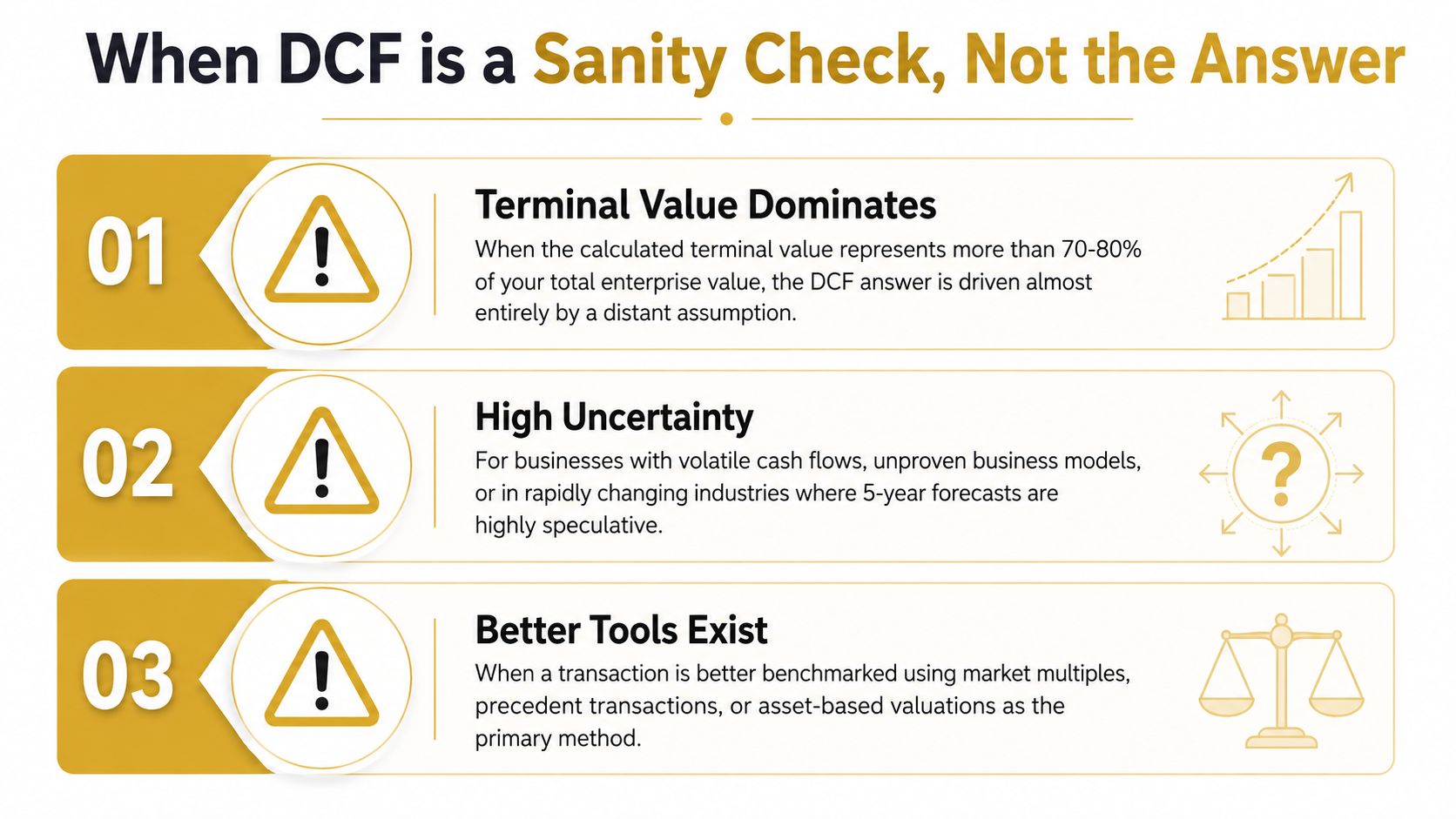
There are times when DCF is still useful, but it should sit behind other valuation tools instead of leading the conversation. If terminal value is doing almost all the work, if the cash flows are unstable, or if the industry is changing too fast to support a clean long-term forecast, the model becomes a stress test rather than a pricing engine. That's a normal outcome in private deals, not a flaw.
Use other methods when the story is still moving
Market comps and precedent transactions matter when the buyer can find relevant comparables. In those cases, DCF can set a floor, a ceiling, or a reasonableness check, but it shouldn't pretend to be the sole answer. That's especially true when the ask price is being justified by an asset story, a turnaround story, or a growth story that doesn't show up in the current cash flow.
For startups or early-stage companies with thin operating history, the valuation conversation often needs DCF paired with comps rather than DCF alone, and DCF and comps for startups is a useful reference point if you're comparing methods. The same logic applies in a smaller private business when the forecast is still too speculative to anchor a price by itself.
Run a short pre-LOI checklist
Before you submit an offer, every credible SMB DCF should include:
- Normalized three-to-five year financials: restated and documented.
- Maintenance versus growth CapEx: separated clearly.
- Discount rate: stated with a build-up or WACC rationale.
- Terminal value: grounded in Gordon Growth or exit multiples.
- Sensitivity table: shown as a range, not a point.
- Comp cross-check: at least one market-based sanity check.
- Assumption log: written so a third party can follow the logic.
If your DCF range is wider than your gut says the deal is worth, the model is warning you that the assumptions aren't stable enough yet. That's the right time to slow down, not to force the math into a tidy answer.
A DCF is not a price, it's a stress test for a price you already have a thesis for.
Dealmaker Wealth Society teaches acquisition buyers how to evaluate small businesses, pressure-test cash flow, and build deal models that hold up in diligence. If you're pricing a target and want a more grounded framework for DCF, valuation, and LOI decision-making, visit Dealmaker Wealth Society and use the training and templates to sharpen your next offer.
Composed with Outrank app

From the Dealmaker Blog














A Creative Business Buying Fable
