8 Leveraged Buyout Case Study Examples
8 Leveraged Buyout Case Study Examples

Debt gets too much credit in most LBO conversations. Debt can magnify returns, but only when the business can carry it, the operator can improve it, and the buyer has a real exit path. The better leveraged buyout case study examples show something less glamorous and more useful, careful financing, operational discipline, and a plan for what happens if credit tightens or growth slows. If you're comparing deals or building a smaller acquisition strategy, start with this guide to debt-financed acquisitions, then judge each transaction by the same core questions, why it made sense, how the capital stack worked, what the sponsor changed after close, where it broke, and what transfers to SMB buying.
Table of Contents
- 1. Dell Technologies LBO by Michael Dell
- 2. Blackstone's Acquisition of Hilton Hotels
- 3. Clayton Dubilier & Rice's Acquisition of Hertz
- 4. KKR's Acquisition of First Data Corporation
- 5. Silver Lake Partners' Acquisition of Skype
- 6. Hellman & Friedman's Acquisition of Freescale Semiconductor
- 7. TPG Capital's Acquisition of Bausch + Lomb
- 8. Carlyle Group's Acquisition of BCI Holdings
- Comparison of 8 LBO Case Studies
- Turn LBO Case Studies Into a Deal Execution Checklist
1. Dell Technologies LBO by Michael Dell
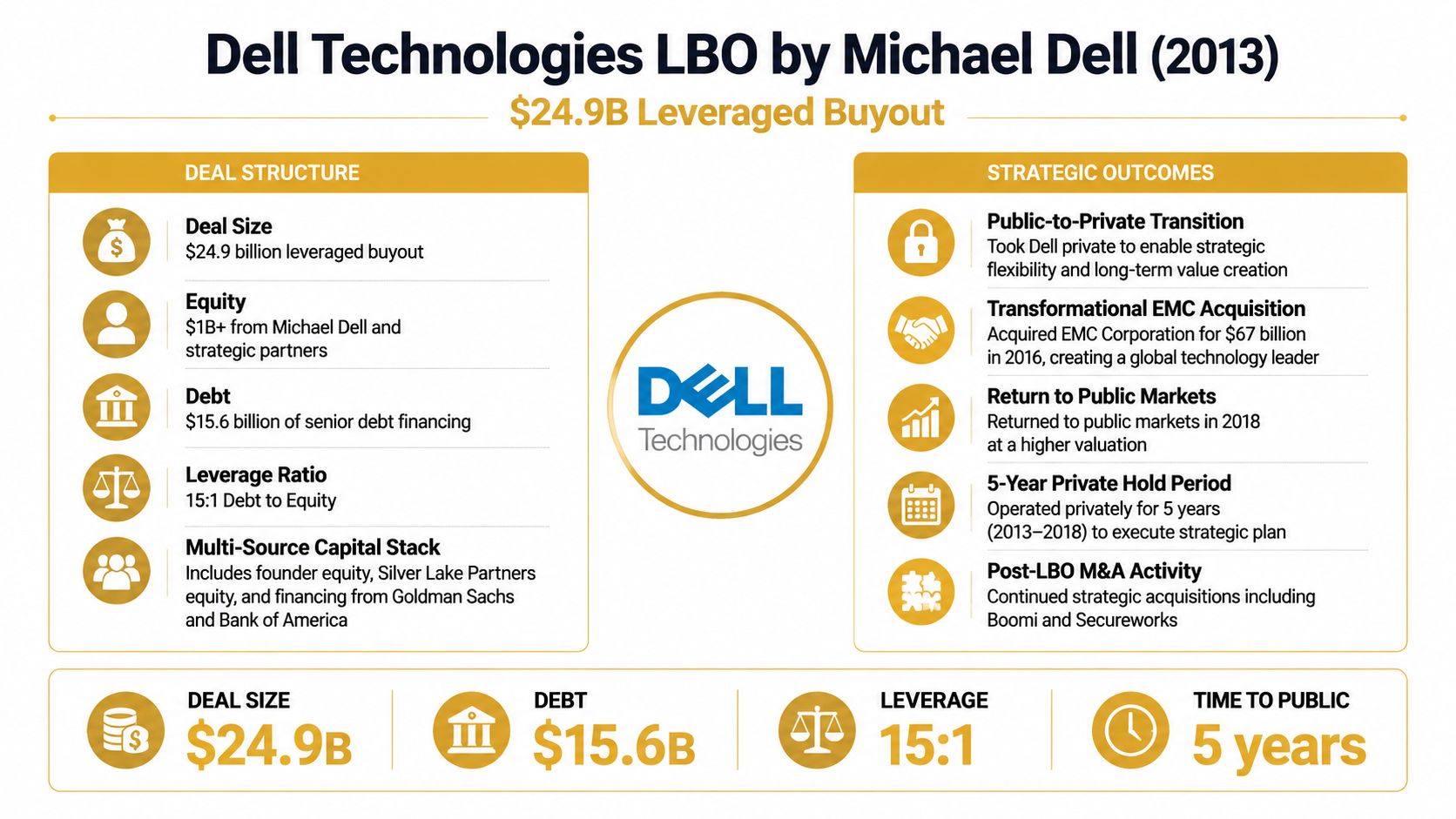
Michael Dell's 2013 take-private of Dell Inc. is a strong opening case because it shows how a founder can use outside capital to escape public-market pressure and buy time for a reset. The deal paired $15.6 billion in debt financing with $1 billion in equity, a structure that helped support one of the largest public-company buyouts ever documented in the plan notes. The strategic logic was straightforward, move the business out of quarterly scrutiny, keep leadership continuity, and give management room to rework the company without having to explain every move to public shareholders.
What the deal structure teaches
The most useful lesson for smaller acquirers is not the scale, it's the financing discipline. Multiple capital sources reduce dependence on any single lender, and that matters even more when your business won't have the kind of scale Dell had after the buyout. For SMB deals, the parallel is using a mix of senior debt, seller support, and possibly equity partners instead of forcing one lender to carry the whole deal.
Practical rule: build your financing stack so the deal still closes if one source moves or tightens. That's not just safer, it makes your offer look more credible to a seller.
The internal logic of Dell also maps well to management continuity. A buyer who keeps the operating team intact usually has a cleaner path through the first year, because the people who know the customer base and vendor relationships stay in place. For SMB acquisitions, that can mean retaining the seller for a transition period, writing clear role expectations into the closing documents, and planning refinancing windows before the ink dries on the purchase agreement. For readers comparing financing structures, understanding acquisition financing options is the next step if you're trying to match structure to control.
2. Blackstone's Acquisition of Hilton Hotels
Blackstone's 2007 purchase of Hilton is the classic reminder that a strong operating asset can survive a brutal cycle if the buyer manages the debt path carefully. The deal sat near the top of the pre-crisis market, and the plan notes say it used about $20 billion in debt. Then the financial crisis hit, and the test became refinancing, lender relationships, and whether the business could keep producing cash while the credit market seized up.
A hospitality asset is useful as a case study because it shows why debt should be underwritten against recurring cash flow, not just headline asset value. Hilton's eventual public exit in 2013 through a $13.3 billion IPO showed that the sponsor could preserve value through a very bad cycle, but the holding period depended on staying disciplined while the market recovered. That's a different lesson from “debt creates upside,” it's really “debt survives when operations stay visible and lenders keep extending patience.”
What small buyers should copy
The transferable lesson is covenant planning. Smaller acquisitions rarely have the luxury of broad capital markets access, so the first draft of your credit structure needs to anticipate stress, not just normal performance. That means thinking through lender waivers, amendment language, and refinancing timing before close, not after problems appear.
Media note, the hospitality image below helps anchor the asset-heavy nature of the deal.

A few practical implications stand out for SMB buyers:
- Model debt against conservative cash flow: If the business is seasonal or cyclical, don't size debt to the best quarter.
- Treat lender relations as an operating function: Sponsors that communicate early usually buy themselves more flexibility.
- Use operational improvement as the primary return engine: The case's logic wasn't just financial engineering, it was also better execution.
One more point matters for operators buying local or regional businesses. The ability to refinance cleanly can matter as much as the entry multiple, because a good asset with bad financing can still become a forced sale. For a sponsor or entrepreneur, the lesson from Hilton is to treat debt as a living constraint, not a static line item.
Deal sourcing and private equity strategies become more useful once you understand that the right target and the right financing can't be separated.
3. Clayton Dubilier & Rice's Acquisition of Hertz
Hertz is a strong example of what happens when a deal thesis is built around operational cleanup in a cyclical industry. In 2005, Clayton Dubilier & Rice partnered with Carlyle Group to buy Hertz from Ford Motor Company for about $15 billion. The thesis leaned on restructuring, cost-base improvement, and a more modern operating model for car rental, which made sense before ride-sharing and the later collapse in travel demand changed the scenario.
The deal is useful because it separates early execution from later outcome. A sponsor can improve the business, tighten systems, and still get hurt if a structural shift shows up later. Hertz eventually filed for bankruptcy in 2020, but the pre-crisis playbook still offers a clean lesson for buyers, especially anyone acquiring a business whose cash flow depends on travel, utilization, or consumer behavior that can change quickly.
Why cycle risk changes leverage math
For SMB acquirers, Hertz argues for conservative debt sizing in industries with unpredictable demand. A business can look stable in a normal year and still become fragile if its revenue depends on a cycle, a platform, or consumer habits that can shift fast. That means underwriting to trough conditions, not optimistic normalized performance.
Underwrite the downside first. If the deal only works when demand stays healthy, it isn't a resilient buyout, it's a bet on a smooth economy.
The other lesson is technological disruption. The deal was structured before ride-sharing became a mainstream alternative, which shows why no LBO memo should treat disruption as a footnote. If your target depends on an established customer behavior, ask what replaces it, who owns the customer relationship, and how fast the market can move.
The internal integration resource below fits this case because post-close value creation often lives in process discipline, not just debt service.

Integration planning best practices matter because a deal like this fails as much from execution slippage as from the financing structure itself. For a smaller buyer, that means writing out the top five operating changes before closing, not after closing.
4. KKR's Acquisition of First Data Corporation
First Data stands out because it shows how messy a large, synergy-heavy buyout can become when the sponsor is combining multiple platforms at once. KKR's 2007 acquisition of First Data Corporation was valued at $29 billion, and the financing stack included about $24 billion in debt. The deal tried to combine Certegy, EFTPOS, and First Data's core business into a payment-processing platform with more scale, more integration, and more cross-selling potential.
That kind of transaction teaches an important lesson for SMB buyers who are tempted to overpay for “synergies.” Synergies don't close themselves, they require systems, accountability, and management bandwidth. The more platforms or customer groups you try to combine, the more the hidden cost shifts to IT integration, process harmonization, and internal coordination.
The hidden cost is integration
For a smaller roll-up, the practical risk is simple, the spreadsheet synergies may be real but the operating lift takes longer than expected. That means debt covenants need room for the integration period, because the cash benefits may not show up immediately. KKR's later partial IPO in 2015 and refinancing activity also underline another point, big debt-financed deals often need a second round of capital-market work before the sponsor fully exits.
A practical structuring approach looks like this:
- Tie management equity to synergy milestones: This helps keep teams focused on the integration work, not just the headline close.
- Budget for system conversion and data cleanup: The first integration bill is rarely the last one.
- Keep lender updates regular: Sponsors that explain progress early tend to reduce surprise at refinancing time.
The biggest mistake in synergy deals is assuming the operating model will converge on its own. It won't.
For SMB buyers, First Data is a warning against treating roll-ups like simple arithmetic. Combining businesses can create real value, but only if the buyer understands where the friction sits and funds enough runway to absorb it.
5. Silver Lake Partners' Acquisition of Skype
Silver Lake's 2009 acquisition of Skype is a good reminder that not every buyout funded by debt is about heavy engineering. The plan notes describe a deal price of $8.56 billion, followed by operational simplification, monetization changes, and a focus on Skype Credit sales before Microsoft later acquired the business in 2011. The sponsor's challenge wasn't just financial, it was making a product business more legible, more monetizable, and more exit-ready.
Tech LBOs are different because product relevance can change faster than lenders want to admit. If the business depends on network effects, user trends, or product adoption, debt structure needs more caution than in a stable industrial or services business. Skype shows that a buyer can clean up operations and still face a narrow exit window if the market moves toward a strategic buyer rather than a long hold.
What founders and SMB buyers should take from it
The key lesson is to treat monetization as part of diligence, not a post-close experiment. A user base does not automatically become cash flow. Buyers should ask how revenue is created today, what's missing, and whether the product has enough pricing power to support debt if growth slows.
A few SMB parallels are worth stressing:
- Stress-test demand assumptions: If a business depends on digital adoption, check whether the customer base is loyal or merely convenient.
- Prefer simpler capital structures: Platform businesses with disruption risk usually need less debt, not more.
- Plan for strategic exits: In fast-moving sectors, the best buyer may be a larger company that values distribution, not just financial return.
The Skype case also reinforces a broad principle from the buyout case study playbook, operational restructuring matters more when the asset is intangible. If the product doesn't have hard collateral behind it, then debt support depends on how believable the future cash flow is.
6. Hellman & Friedman's Acquisition of Freescale Semiconductor
Freescale Semiconductor is a solid example of how sponsors use divestitures and industry focus to rescue debt-heavy manufacturing deals. Hellman & Friedman acquired the business from Motorola in 2006 for $17.6 billion, and the transaction included about $13.6 billion in debt. The sponsor worked through operational restructuring, non-core asset sales, and a sharper focus on automotive and industrial segments, which were more resilient than consumer demand.
That shift matters. In a cyclical manufacturing deal, the buyer doesn't just need cost cuts, it needs segment discipline. If some end markets are less volatile, the sponsor has to lean into them quickly and stop pretending that every revenue stream deserves equal capital. Freescale's later IPO in 2011 and eventual acquisition by NXP in 2015 show how long-horizon stabilization can preserve exit optionality.
Why this case is useful for smaller manufacturers
For SMB acquirers, the practical takeaway is to build a divestiture map before close. If the business has non-core products, underused equipment, or distracting side operations, those assets may be part of the financing solution. Debt paydown becomes easier if the buyer can sell what doesn't belong in the core plan.
In manufacturing deals, the buyer often discovers that simplification creates more value than expansion.
This case also supports a more conservative underwriting posture in businesses with inventory exposure, supplier dependence, and margin swings. If debt service only works at a healthy utilization level, the buyer should assume a tougher operating environment and size the financing accordingly. That's the difference between a stable control deal and a fragile one.
The broader lesson for SMB buyers is to connect operational focus to exit planning from day one. The best exit may be a strategic acquirer that wants the core business, not a financial buyer that needs a cleaner story.
7. TPG Capital's Acquisition of Bausch + Lomb
Bausch + Lomb is the clearest reminder that hidden liabilities can overwhelm a good operating plan. TPG Capital bought the business in 2007 for $3.6 billion, with about $2.7 billion in debt financing. The sponsor pushed manufacturing efficiency, SG&A reduction, and portfolio cleanup, but litigation tied to contact lens solution products created a risk profile that the initial operating improvements couldn't fully solve.
That is exactly why healthcare and product-adjacent deals need legal diligence as aggressively as financial diligence. A buyer can improve margins and still lose the investment thesis if contingent liabilities show up later. The company's eventual public return in 2013 and later bankruptcy in 2014 show how a mixed outcome can coexist with strong near-term execution.
Why this matters outside healthcare
SMB buyers often underwrite visible earnings and ignore latent legal exposure. That's a mistake in any business with product liability, regulatory oversight, warranties, or customer claims. If the downside is tied to a recall, lawsuit, or compliance issue, debt can make the problem much worse.
A practical acquisition posture looks like this:
- Review litigation and compliance history in depth: Don't stop at the seller's summary.
- Reserve for contingencies where appropriate: The deal needs enough cushion to survive a surprise.
- Insist on strong reps and warranties coverage: Insurance won't fix everything, but it can reduce one layer of exposure.
- Inspect facilities and supply chains carefully: A product business can hide defects in plain sight.
Bausch + Lomb is also a useful reminder that “improved margins” doesn't automatically mean “safe debt levels.” Debt remains a fixed claim, while litigation is often an open-ended one. That mismatch can wreck even a well-run operational turnaround.
8. Carlyle Group's Acquisition of BCI Holdings
BCI Holdings, built around Burger King franchise consolidation, demonstrates how a roll-up strategy can translate to smaller acquisition sizes. Carlyle combined multiple franchise units into a centralized platform through a $1.5 billion multi-unit franchisee transaction supported by about $1 billion in debt financing. The operating plan centered on supply-chain consolidation, labor scheduling, digital ordering, franchisee training, and same-unit-sales improvement.
The transaction's relevance to SMB buyers lies in the connection between capital structure and operating execution. It was not merely a purchase of additional locations. The platform later sold to a larger franchisee group, with sponsors reportedly returning about 3-4x capital. That outcome indicates how a repeatable operating system can matter as much as expansion, provided the buyer can identify measurable improvements before closing.
Why franchise roll-ups are different
Franchise systems can support financial structuring when unit-level economics are stable and back-office work can be centralized. Debt sizing still needs to reflect store-level variability, local labor conditions, and brand economics. A conservative debt range is therefore usually more appropriate for franchise acquisitions than for asset-light service businesses.
If labor scheduling, purchasing discipline, and digital ordering drive the value, each initiative belongs in the closing plan, with an owner, a baseline, and a measurable target.
For smaller buyers, the transferable model is operational standardization. Centralized procurement, consistent reporting, and better throughput can improve performance without the capital base available to a large sponsor. The main failure mode is treating location count as the value driver. More units can increase coordination costs, while a simpler operating model can improve cash generation across the existing base.
A practical SMB structure would tie acquisition debt to conservative store-level cash flow, preserve liquidity for labor or sales volatility, and make further purchases conditional on integration performance. Buyers should also test whether franchise agreements permit the intended consolidation, technology changes, and purchasing arrangements.
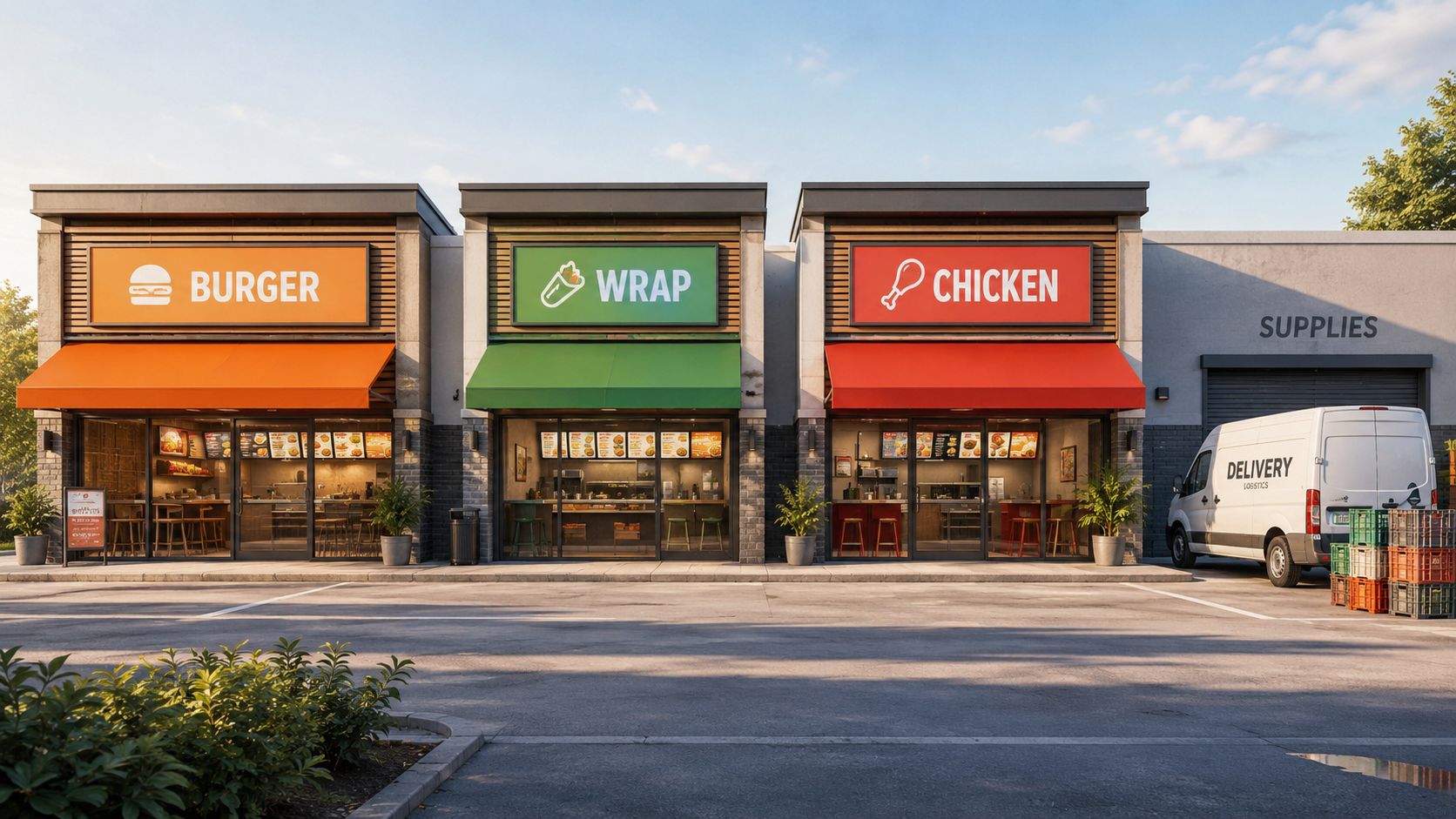
Franchise consolidation therefore provides a practical bridge between institutional LBO methods and SMB acquisition execution, especially when debt sizing follows verified unit economics rather than projected scale.
Comparison of 8 LBO Case Studies
| Deal | 🔄 Implementation Complexity | ⚡ Resource Requirements | 📊 Expected Outcomes | ⭐ Key Advantages | 💡 Ideal Use Cases & Tips |
|---|---|---|---|---|---|
| Dell Technologies LBO (Michael Dell, 2013) | Very high, multi-source capital stack, large-scale integration | $24.9B deal; ~$15.6B debt; ~15:1 leverage | Private restructuring, major add‑ons (EMC), IPO after ~5 years; strong equity uplift | Founder control + strategic flexibility; transformative M&A | Mega-cap restructurings; use diverse financing, plan refinancing windows |
| Blackstone → Hilton (2007) | High, cross‑collateralization, dividend recaps, crisis refinancing | $26B deal; ~$20B debt; 7–8x leverage | RevPAR-driven recovery; IPO 2013; substantial sponsor returns despite 2008 stress | Predictable cash flows; operational uplift in hospitality | Asset‑heavy hospitality plays; stress test covenants; prioritize RevPAR improvements |
| Clayton Dubilier & Rice → Hertz (2005) | High, multiple tranches, tech & fleet overhaul | ~$15B deal; $10B+ debt; 6–7x leverage | Initial EBITDA margin gains but long‑term disruption; eventual bankruptcy (2020) | Operational transformation and tech investment | Cyclical industries: stress‑test trough EBITDA and underwrite disruption risk |
| KKR → First Data (2007) | Very high, multi‑platform consolidation, complex debt stack | $29B deal; $24B+ debt; 8x+ leverage | Synergy capture → partial IPO (2015); material cost savings if integration succeeds | Recurring revenues; large synergy potential from platform consolidation | Synergy-heavy rollups: rigorous IT/operating plans and management alignment |
| Silver Lake → Skype (2009) | Medium, product simplification and monetization focus | $8.56B deal; $2–3B debt; 3–4x leverage | Operational restructuring; exit to strategic buyer (Microsoft) near acquisition price | Large user base with monetization upside | Tech platforms: require proven monetization; use lower leverage and short maturities |
| Hellman & Friedman → Freescale (2006) | High, manufacturing consolidation, divestitures, cyclical exposure | $17.6B deal; $13.6B debt; ~8x leverage | Margin expansion, IPO (2011), later strategic sale (NXP) after multiple refinancings | Focus on automotive/industrial segments to reduce cyclicality | Manufacturing: stress‑test at trough, build divestiture plan, covenant step‑downs |
| TPG → Bausch + Lomb (2007) | Medium, operational turnaround with regulatory/litigation risk | $3.6B deal; $2.7B debt; ~7x leverage | Short‑term margin gains and IPO (2013) but later litigation led to bankruptcy (2014) | Recurring healthcare revenue; operational improvement opportunities | Healthcare: exhaustive liability review, contingency reserves, R&W insurance |
| Carlyle → BCI Holdings (Burger King roll‑up) | Medium, roll‑up integration across many units | $1.5B deal; ~$1B debt; 4–5x leverage; 20+ units consolidated | Same‑unit sales & cost savings → exit ~3–4x sponsor returns in successful cases | Scalable roll‑up playbook; procurement and POS synergies | Franchise/equipment roll‑ups: prioritize supply‑chain savings, standardize ops, use conservative leverage |
Turn LBO Case Studies Into a Deal Execution Checklist
The common thread across these deals is not “use as much debt as possible.” It's far more practical than that. The strongest transactions started by validating durable cash flow, then stress-tested the downside, matched debt levels to volatility, diversified financing sources, documented operating changes, protected against legal or technology risk, and defined refinancing and exit triggers early. The weaker cases got into trouble when buyers assumed growth, stability, or refinancing would arrive on schedule.
The pattern is especially relevant for smaller acquisitions because SMB buyers don't have much room for mistakes. A seller roll-over, a lender amendment, a delayed integration project, or a surprise liability can change the return path quickly. That's why the best acquisition plan looks more like an operating playbook than a financing memo, with clear responsibilities, realistic cash assumptions, and a timeline for when debt gets paid down or refinanced.
A useful way to apply these lessons is to separate what scales from what doesn't. Large-cap buyouts can rely on broad syndicates, public-market exits, and complex capital stacks. Smaller deals usually need simpler structures, stronger downside protection, and a tighter link between operational changes and debt service capacity. If you're buying a local service business, a franchise platform, or a niche manufacturer, the correct question isn't how much financing you can use. It's how much debt the business can carry while still giving you room to fix it.
That's where acquisition training and peer support become useful. Dealmaker Wealth Society's education, mentorship, and deal-structuring resources are built for buyers who need help turning theory into offer terms, financing plans, and post-close execution. For readers working through a first or second acquisition, the practical next move is to use these frameworks to build a deal you can operate, refinance, and exit on your terms.
If you're translating these buyout lessons into a real small-business deal, Dealmaker Wealth Society can help you pressure-test the structure, the financing, and the post-close plan. Visit Dealmaker Wealth Society to explore training, mentorship, and deal support that fits acquisition entrepreneurs working on SMB buyouts.

From the Dealmaker Blog








A Creative Business Buying Fable