Leveraged Buyout Valuation: A Dealmaker’s Guide 2026
Leveraged Buyout Valuation: A Dealmaker’s Guide 2026
A common error when buying a business is focusing on the wrong question: what it's “worth,” as if there's one clean, objective number hidden in the math. In debt-funded buyout valuation, the smarter question is simpler and more useful, what is the most you can pay and still hit your return target.
That shift matters because an LBO isn't built to discover abstract intrinsic value. It's built to test whether a buyer can use cash flow, debt capacity, and exit pricing to justify a bid without breaking the deal on the back end. If you're coming from traditional valuation thinking, accounting valuation definitions are still useful, but they don't answer the financing question a sponsor cares about.
For SMB buyers, that difference is everything. A company can look expensive on a public-company comp screen and still be perfectly buyable in an LBO if the debt stack, cash generation, and exit plan work. That's why dealmakers study multiples, but they underwrite the maximum affordable price, not a philosophical fair value.
Table of Contents
- Rethinking Valuation for Business Acquisition
- The LBO Mindset Thinking Like a Sponsor
- Building the LBO Model A Step-by-Step Breakdown
- The Three Levers of LBO Value Creation
- Valuation in Practice Ability-to-Pay and Exit Scenarios
- Common Pitfalls in SMB Leveraged Buyout Valuation
Rethinking Valuation for Business Acquisition
Traditional valuation tries to estimate a broad economic value. LBO valuation asks a tighter question, and that question is pivotal to securing deal funding. A buyer can still use DCF, comps, or asset-based methods to frame the opportunity, but once debt enters the purchase, the ultimate test becomes ability to pay.
A rental property purchase makes the logic easier to see. The price has to work with the rent the asset can produce, the debt a lender will extend, and the cash the buyer needs to earn on exit. An LBO follows the same discipline. The rent is EBITDA, the mortgage is acquisition debt, and the sale price is the exit value.
That is why valuation multiples matter as a practical ceiling. They help define what a buyer can support given the cash flows, the amount of debt that can be carried safely, and the return target the buyer has set. For a useful primer on how buyers frame pricing ranges, the internal guide on understanding valuation multiples in deals is a clean starting point.
Practical rule: if a price only works when everything goes right, it is too aggressive for a disciplined LBO.
The historical record supports that discipline. Analysts in the NBER working paper NBER working paper show that LBO pricing moved in cycles, with aggregate deal value rising from just under $1 billion in 1980 to over $60 billion in 1988 as credit got easier and borrowing capacity expanded. That pattern shows up in every cycle. Buyers pay a different price when debt is cheap and plentiful than they do when financing is tight.
The practical takeaway is simple. In debt-financed buyout valuation, the question is how much you can pay and still keep the deal within your return target. For that reason, accounting valuation definitions can help with terminology, but they do not answer the acquisition question on their own.
The LBO Mindset Thinking Like a Sponsor
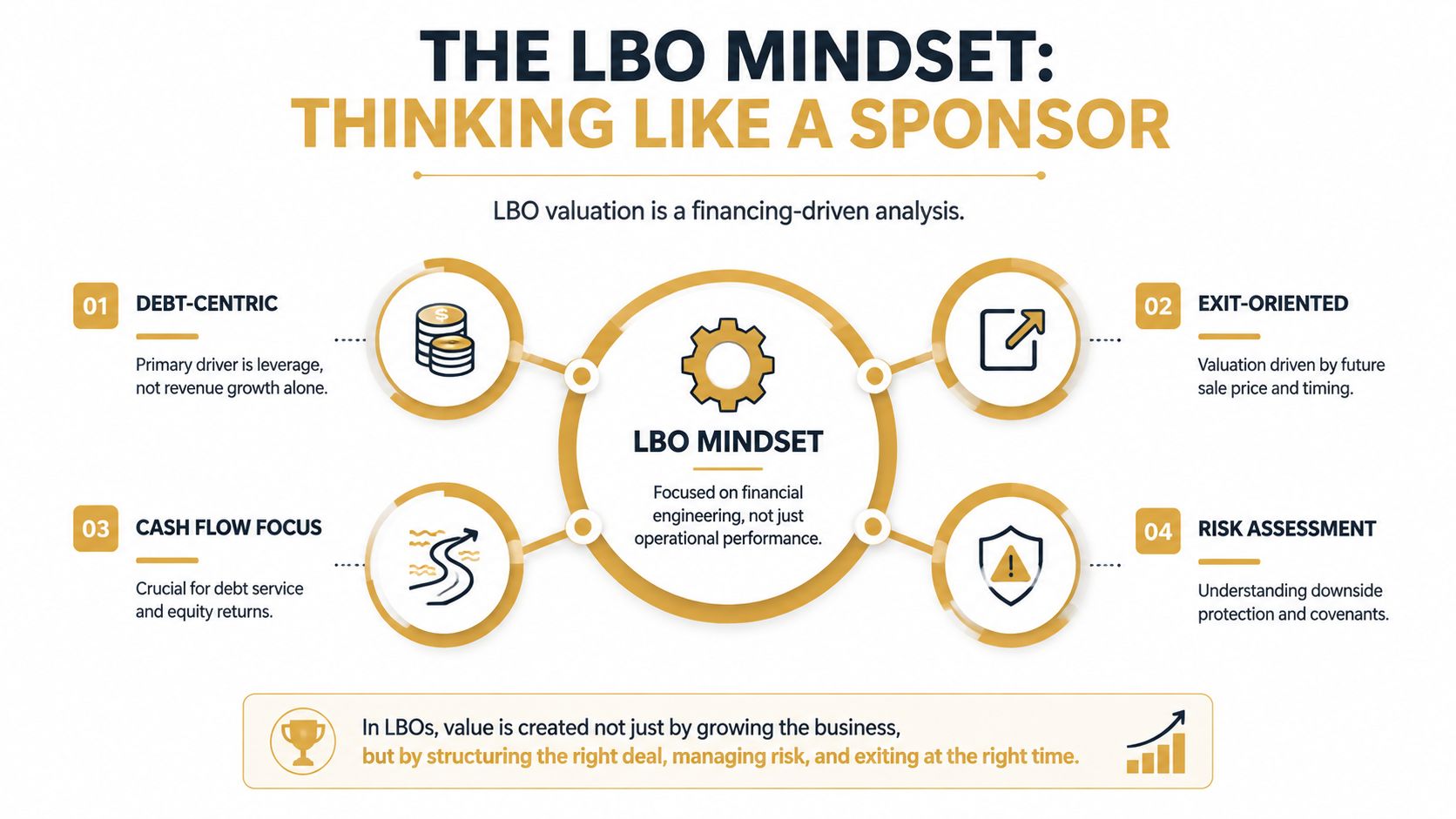
A sponsor starts with a different question from a strategic buyer. The first question is what the business can support, and what return the buyer needs to earn from the equity check. That is the core mental model in debt-financed acquisition valuation, and it keeps the discussion tied to financing capacity, cash flow, and exit value.
Debt sets the frame
Debt capacity comes first because it sets the ceiling on the price. In SMB deals, buyers often begin with a practical range around 6x to 10x EBITDA, and many sponsors look for IRRs above 25%, with some accepting about 20%, while higher debt can improve returns and also raise bankruptcy risk (Sofera Advisors). That range is not a valuation truth. It is a funding constraint that shapes how much equity the buyer can safely put in.
Market conditions change that ceiling. As noted earlier, LBO pricing has moved with credit availability and financing conditions, because buyers can pay more when debt is easy to obtain and less when lenders tighten up. Price follows the capital stack, and the capital stack follows the market.
IRR is the sponsor's north star
The sponsor mindset is exit-oriented. A critical question is whether the entry price, debt service, and eventual sale can produce the return the buyer underwrote. A buyer who knows the target return can work backward. A buyer who only knows the asking price is guessing.
That also explains why the same company can support different bids. A stronger operator can produce more cash flow, carry a tighter repayment schedule, or sell at a better multiple, so the maximum price rises. A weaker operator needs more cushion, because there is less room for a miss in operations or financing.
The usual LBO framework projects EBITDA, chooses an exit multiple, and discounts the proceeds back to today. Practical modelers spend more time on the assumptions than on the spreadsheet polish, because the exit multiple and operating forecast drive whether the deal clears the return hurdle. A useful financial modeling resource helps tighten those mechanics before a buyer commits to a live deal.
A disciplined financing mindset keeps the analysis honest. Heavy debt can make the equity return look attractive on paper while leaving the business too fragile in practice. The guide to three way forecasting helps first-time buyers see why that matters, because profit, balance sheet, and cash flow have to move together for the deal to hold up.
Building the LBO Model A Step-by-Step Breakdown
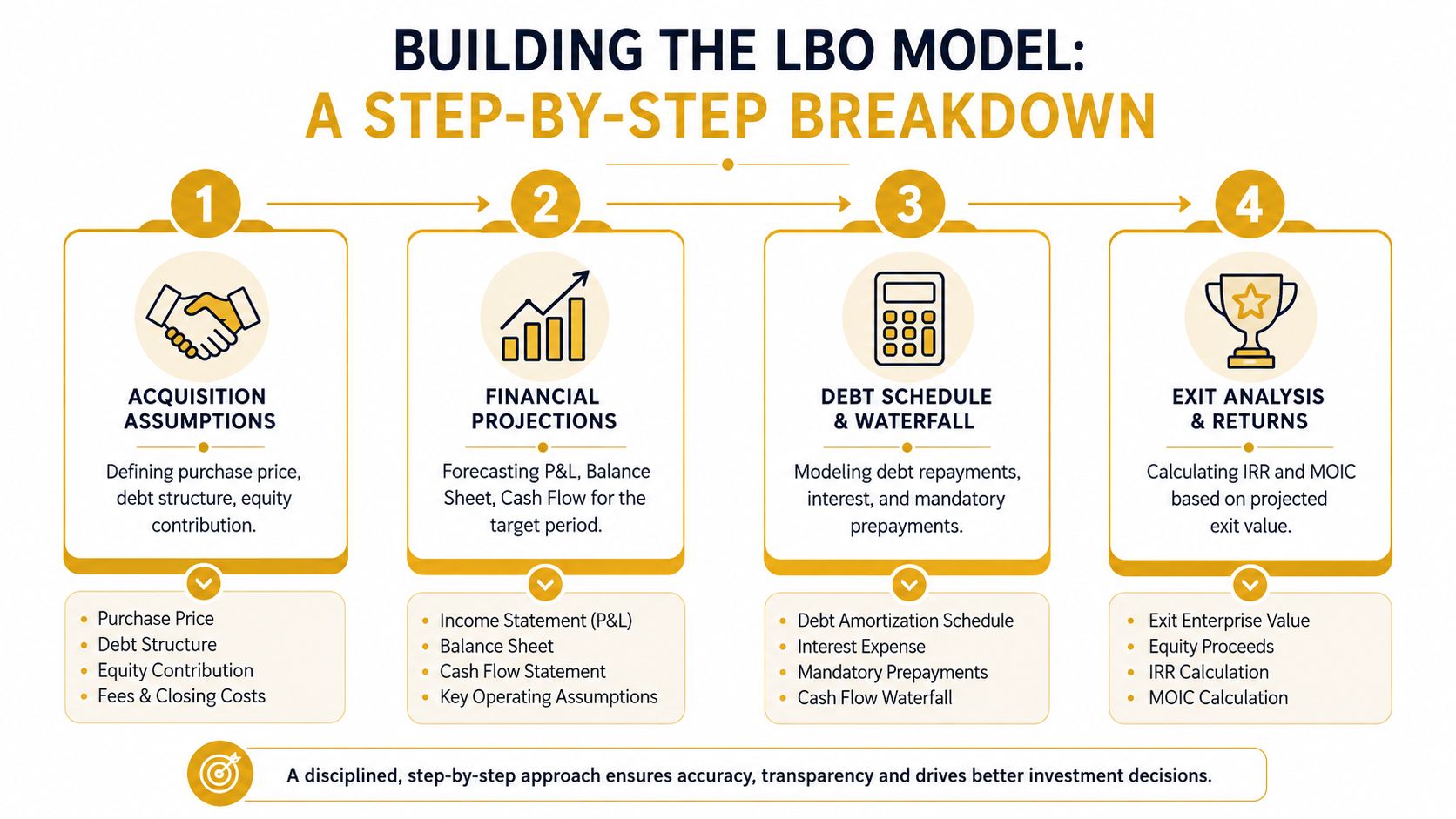
The cleanest way to read an LBO model is as a financial blueprint. Every line in the model serves a job, and if one part breaks, the return math usually breaks with it. A strong model isn't complicated for the sake of being complicated, it just connects the deal terms to the operating reality.
Start with the sources and uses
The first block is the transaction itself. Sources show where the money comes from, debt, equity, and any other funding piece. Uses show where it goes, purchase price, refinancing, fees, and any other deal cost.
That table matters because it keeps the buyer honest about what is being bought. If the uses don't match the sources, the model isn't complete, no matter how polished the spreadsheets look. A buyer can also use the internal financial modeling resources to tighten the mechanics before underwriting a live deal.
Then build the operating forecast
Once the transaction is framed, the business itself has to be projected. Revenue, EBITDA, working capital, and capex all matter because they drive free cash flow, and free cash flow is what services debt. If the forecast is loose, the entire bid ceiling gets distorted.
Practical rule: never let an aggressive purchase price hide a weak operating forecast. Debt gets paid with cash, not optimism.
That's where the exit math begins to take shape. In the standard LBO method, the sponsor forecasts exit EBITDA, applies an exit EV/EBITDA multiple, subtracts exit net debt, and discounts the result back at the target IRR. The sponsor then backs out the entry enterprise value from the debt available at close (FE Training).
A model is only useful if the forecast is tied to the actual business plan. For SMB buyers, the best habit is to test whether the forecast is believable under normal operations, not just under a perfect operating year. That's what makes the purchase price defendable in front of lenders and, just as important, in front of yourself.
Finish with debt and exit analysis
The debt schedule shows how fast the debt is reduced. Principal paydown, interest expense, and mandatory repayments change the equity value over time, so they're not side calculations. They're part of the return engine.
The final block is the exit. A sponsor wants to know what the equity could be worth when the business is sold and whether that value supports the target return. In a practical deal, a seller's asking price gets tested against the buyer's financing structure and return hurdle.
| Debt / EBITDA at Entry | EV / EBITDA at Exit | Maximum Affordable Entry EV |
|---|---|---|
| Lower leverage | Lower exit multiple | Lower entry price ceiling |
| Lower leverage | Higher exit multiple | Higher entry price ceiling |
| Higher leverage | Lower exit multiple | Tighter entry price ceiling because risk rises |
| Higher leverage | Higher exit multiple | Highest ceiling, but only if the business can truly support it |
That table is intentionally simple. The point is not to forecast every decimal, it's to show how debt and exit assumptions move the ceiling. For SMB acquisitions, the useful question is often not “What does the business deserve?” but “What price still works if the exit is merely decent, not heroic?”
The Three Levers of LBO Value Creation
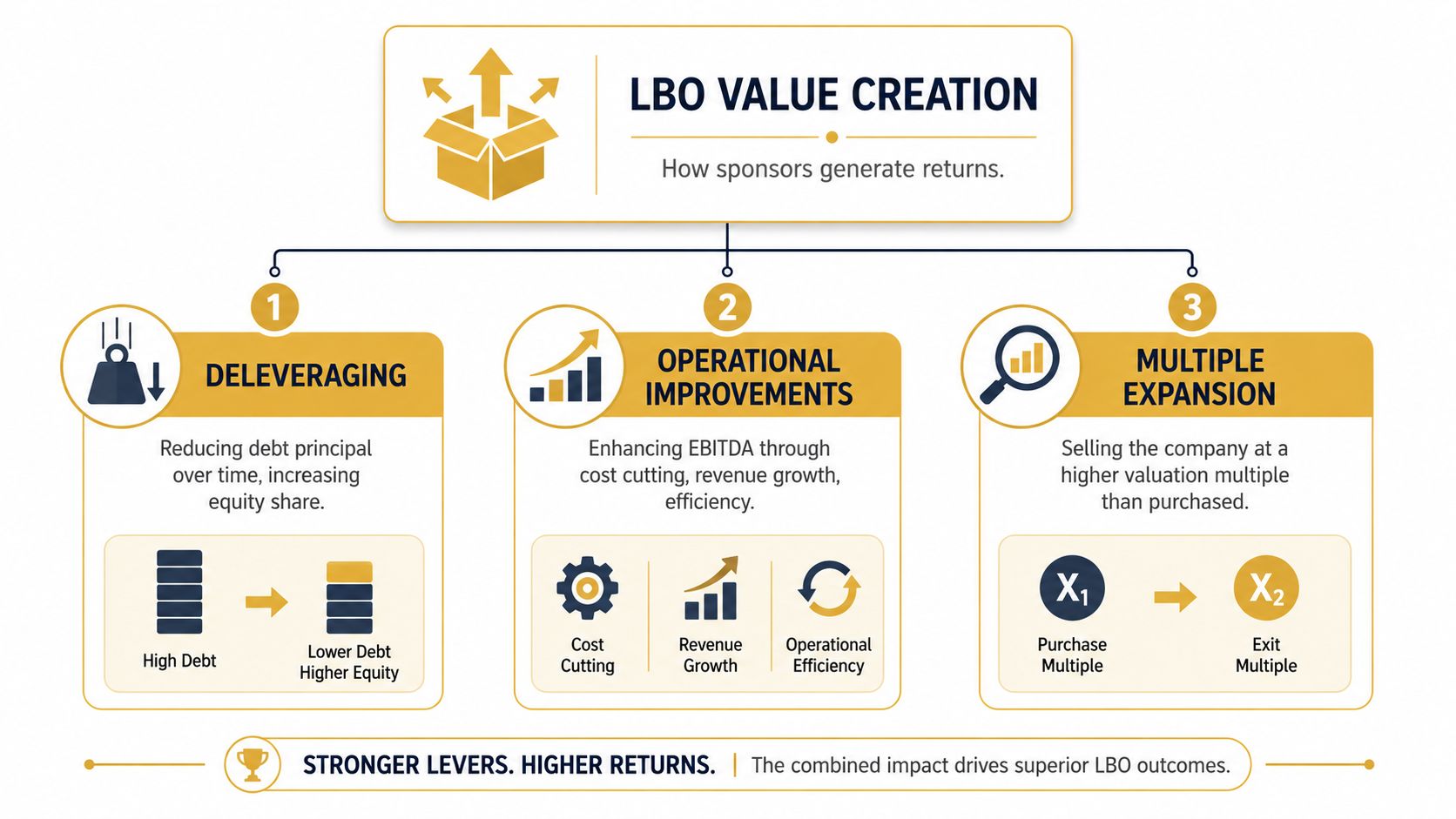
LBO returns come from three places that a buyer can underwrite: debt paydown, operating improvement, and the exit multiple. That is the practical test. If a buyer cannot explain how each lever contributes to the equity return, the valuation is too abstract to guide a deal.
Deleveraging creates equity through time
Debt paydown is the quiet workhorse in an LBO. Each dollar of principal reduction shifts more of the enterprise value into the equity holder's pocket, which is why sponsors care so much about cash conversion and repayment speed. The business does not need to be exciting for this lever to work, it needs to keep generating cash and using it to reduce debt.
That is also why financing terms matter so much. If the debt stack is set well, the buyer can choose acquisition financing with the right mix of senior debt and equity and give the company room to pay down borrowings without choking growth.
Operational improvement makes the company stronger
The second lever is EBITDA growth. Better pricing discipline, lower waste, tighter overhead, and a cleaner customer mix can all improve the earnings base. That matters because LBO valuation is usually tied to EBITDA, so stronger operating performance can support more debt service and a better exit.
The operating side is where a buyer has real control, but only if the work is specific. Cost cuts that weaken service can backfire, while process changes that improve margins and cash flow create more room for debt reduction and less pressure on the business. A practical way to boost financial profitability is to focus on the margin lines that move free cash, not just the ones that look good in a presentation.
Multiple expansion is the most fragile lever
The third lever is multiple expansion. If you buy at one valuation multiple and sell at a higher one, equity value rises faster. Buyers should treat that as the least dependable lever, because it depends on market conditions, buyer appetite, and how the business is viewed when it is time to sell.
That caution matters because entry prices can get stretched when the market is enthusiastic. A period of heavy activity pushed global LBO transaction value higher, and large deals like HCA and TXU showed how aggressively capital can be deployed when financing is abundant (NBER working paper). History also shows the other side. In a later review of older deals, a meaningful share of sampled LBOs ended up in Chapter 11 or default, which is a blunt reminder that debt and optimism can work against each other when the exit does not cooperate (NBER working paper).
Multiple expansion belongs in the model, but it should not carry the deal. If the price only works because the buyer assumes a richer market later, the valuation is fragile from the start.
Valuation in Practice Ability-to-Pay and Exit Scenarios
A first-time buyer usually wants one clean number. The better habit is to think in ranges. The bid ceiling moves when debt capacity changes, and it shifts again when the exit assumption changes, which is why ability-to-pay analysis is more useful than chasing a false point of precision.
A clean practical example is a business with $1 million in EBITDA. If the buyer is aiming for a specific return, the highest price they can justify depends on how much debt can be placed at close and what multiple the company might sell for later. Two buyers can look at the same target and still land on very different answers.
A simple sensitivity view
The table below keeps the decision visible by showing how entry value changes under different debt and exit assumptions.
| Debt / EBITDA at Entry | EV / EBITDA at Exit | Maximum Affordable Entry EV |
|---|---|---|
| Lower debt capacity, with a conservative exit multiple | Lower ceiling on entry value | The buyer has to stay disciplined on price |
| Lower debt capacity, with a stronger exit multiple | Some additional room, but still limited | A higher bid is possible, though only within a narrow band |
| Higher debt capacity, with a conservative exit multiple | Better ceiling, but less margin for error | The buyer can pay more, but the structure is tighter |
| Higher debt capacity, with a stronger exit multiple | Highest ceiling if cash flow can support it | The buyer can stretch furthest here |
What matters is the shape of the decision, not a fake exact answer. If debt capacity rises, the buyer can usually pay more today, but the risk profile also gets sharper. If the exit multiple improves, the equity holder looks better, but that assumption is often the weakest part of the model.
That is why lenders and sponsors care so much about exit realism. A business can look attractive at the asking price and still fail the underwriting test if the exit case depends on market sentiment the buyer cannot control. For practical deal review, the internal financing options for acquisitions resource is useful because it keeps the conversation grounded in structure, not wishful thinking.
Practical rule: if the deal only works when you assume a better exit multiple than you paid, your valuation is probably overstated.
The historical record reinforces that caution. Buyout pricing tends to run up when capital is abundant, and peak-period deals can look convincing right up until credit tightens or the market reprices risk. Valuation quality, in practice, comes from the buyer's ability to support the entry price through real cash flow and a believable sale path.
Common Pitfalls in SMB Leveraged Buyout Valuation

The biggest mistake SMB buyers make is treating the model like a yes-or-no verdict instead of a pressure test. A solid LBO valuation does not prove the deal is right. It shows where the deal breaks, and that is far more useful at the table.
The exit multiple assumption can distort the answer
One of the easiest ways to overstate value is to assume a clean exit at a multiple the market may not give you. A buyer can buy a business at one multiple and still sell it at a different one, but that outcome is not something the model can assume away. If the return case only works because the exit multiple stays high despite tighter credit, softer sentiment, or weaker growth, the valuation is already leaning on a hopeful outcome.
A concrete example makes the problem obvious. A buyer pays up because the business has strong recurring revenue and steady margins. The model then assumes those same conditions will still justify a premium exit, even after a few years of debt paydown and a more cautious market. If the exit market rerates the company even modestly lower, the equity return can fall sharply, even if operations hold up reasonably well. The deal did not fail because the company was bad. It failed because the buyer paid for a future the market did not have to deliver.
Forecasts and debt capacity need to stay conservative
Overly optimistic EBITDA growth can make a bad price look acceptable. The same happens when a buyer underestimates capital spending, ignores working capital swings, or assumes cash conversion will be cleaner than it really is. In an LBO, those misses do not stay small. Debt sits ahead of equity, so a forecast error hits the buyer twice, once in the return math and again in the ability to service the structure.
That is why conservative underwriting matters more than elegant spreadsheets. The buyer needs room for missed timing, delayed collections, and uneven integration, especially in smaller businesses where one customer, one repair bill, or one inventory mistake can change the year quickly. A model that only works if everything goes right is not a strong valuation. It is a fragile one.
Good discipline beats clever structuring
A sponsor can improve the odds with structure, but structure does not rescue a weak acquisition thesis. If the business cannot support debt comfortably, if the sale case depends on a generous rerating, or if the entry price leaves no cushion for operating noise, the deal is too tight. The financing may still close. That does not make it a good buy.
The practical lesson is straightforward. Treat debt-financed buyout valuation as an ability-to-pay exercise, not an abstract search for truth. The right price is the highest one that still leaves room for real operating performance, debt service, and a sober exit.
Dealmaker Wealth Society gives acquisition entrepreneurs a practical path to the same kind of deal thinking covered here, from valuation and financing to structuring and post-close execution. If you want a buyer's framework for working backward from return targets instead of guessing at “fair value,” visit Dealmaker Wealth Society and use the training, templates, and coaching to pressure-test your next acquisition.

From the Dealmaker Blog











A Creative Business Buying Fable