M&A Deal Structuring for Small Business: Options Compared
M&A Deal Structuring for Small Business: Options Compared

You've found a profitable small business, reviewed the tax returns, and agreed on a headline purchase price with the owner. That feels like the finish line, yet it's where risk begins. Two buyers can pay the exact same $1.5 million for the exact same company and walk away with completely different lives after closing.
One buyer drains personal savings, takes on rigid bank debt, and spends the next two years praying no major client leaves. The other spreads the payment across bank financing, a seller note, and a performance milestone, keeping cash in the operating account and sharing post-closing risk with the founder.
That difference comes down to M&A deal structuring. Price tells you what a business is worth on paper, while structure decides who writes the checks, who controls daily operations, and who absorbs the hit if revenue dips in month four.
Table of Contents
- Deal Structure Options Side by Side
- Building the Capital Stack from Cash Flow
- Seller Financing Terms That Protect Both Sides
- Equity Partners and Rollover Equity
- Earnouts and Milestone Payments
- Choosing a Structure by Buyer Situation
- Confirm the Structure Before You Sign
Deal Structure Options Side by Side
A deal structure is the set of choices defining how an acquisition price gets paid, who funds each piece, and who carries the risk once the keys change hands. Think of the purchase price as your destination and the structure as the route you take to get there. Two routes to the exact same dollar figure can leave you with wildly different monthly cash strain.
Rarely does a small-business acquisition rely on a single funding source. Most buyers combine three or four mechanisms so no single party bears all the risk. Before you draft a letter of intent, compare the six primary building blocks side by side.
Main deal structures compared
| Structure | How it pays | Main buyer risk | Best when |
|---|---|---|---|
| All-cash from buyer equity | Buyer pays the full price at closing | Heavy upfront cash need and no leverage | Buyer has liquid capital and the seller wants certainty |
| Senior bank debt | Lender funds the largest share, secured by business assets | Debt service and covenant tests | Business generates steady cash flow to cover payments |
| Seller note | Seller finances part of the price and is repaid over time | Default and subordination terms | Seller trusts the buyer and accepts a gradual exit |
| Equity partner | Outside investor buys a share of the company | Shared control and diluted profits | Buyer needs capital or operating expertise |
| Rollover equity | Seller keeps a stake in the company after closing | Seller influence over decisions | Seller believes in future growth |
| Earnout | Part of the price is paid only if agreed targets are met | Disputes over how targets are measured | Buyer and seller disagree on future performance |
Putting several of these pieces together creates paperwork that moves fast once diligence starts. Buyers who want to keep legal drafting and document review organized without inflating attorney fees often bring in fractional legal support through services like Hire Paralegals alongside their lead M&A counsel.
Two Tests Before You Pick a Structure
Before you start negotiating terms on any row in that table, run two basic filters on the deal. They eliminate half of the bad structures before you ever talk to a lender.
- Cash-flow debt capacity: Can the company's actual operating cash flow comfortably cover principal and interest payments every single month, even during a slow quarter? If not, heavy senior debt won't work regardless of how low the interest rate looks.
- Seller risk appetite: Is the owner willing to keep skin in the game after closing through a note, rollover stake, or contingent payment? A seller demanding 100% cash at the closing table forces you to either lower your offer or raise outside equity.
Everything else in deal design flows from how those two questions get answered. Once you know what the business can carry and what the seller will accept, you can assemble the exact layers of funding.
Building the Capital Stack from Cash Flow
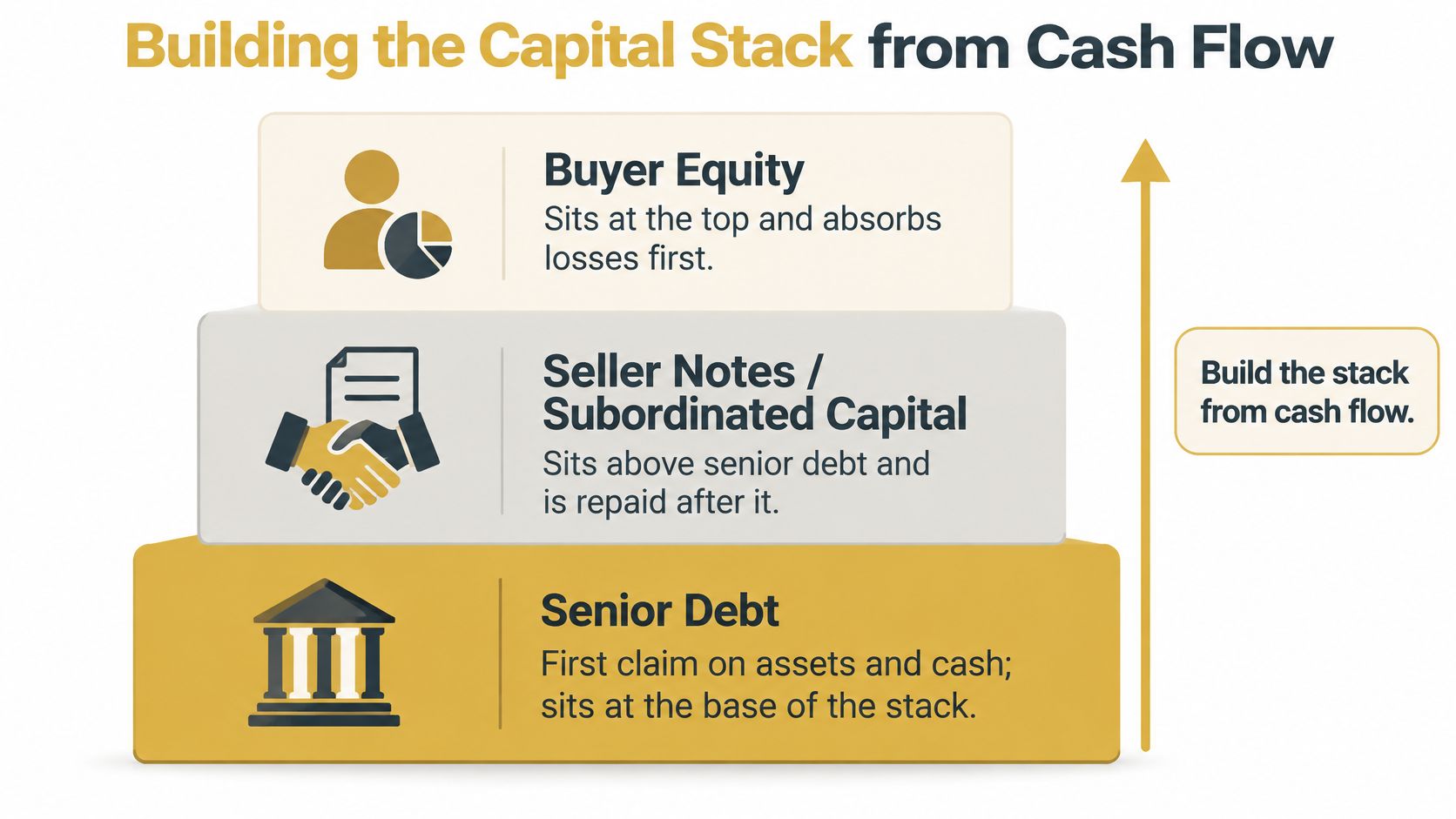
Acquisition funding sits in layers known as the capital stack, ranked by who gets paid first and who absorbs losses first. At the base sits senior debt, which holds the first claim on company assets and operating cash flow. Above it sits subordinated capital, usually a seller note, which gets repaid only after the senior lender stays current.
At the very top sits buyer equity. Equity holders capture the upside if the business grows, yet they take the first hit if earnings fall short. That hierarchy explains why banks charge lower interest rates than equity partners expect in returns.
Normalizing EBITDA Before You Size Debt
Lenders don't size loans off a broker's marketing sheet, and you shouldn't either. At Dealmaker Wealth Society, we recommend acquiring only businesses that have weathered economic recessions, generate $1 million in gross revenue, and have a proven track record of steady profits. Even with a durable target, you must calculate normalized EBITDA before calculating a single debt ratio.
Start with reported EBITDA and strip out inflated or one-time add-backs the seller claimed. Next, deduct the market salary of a general manager if the founder currently handles sales or operations. Factor in working-capital swings, integration expenses, and any margin risk tied to concentrated accounts. For a deeper walkthrough on validating those numbers before approaching lenders, review our guide on analyzing cash flow requirements for acquisitions.
Once you have real cash flow, test your proposed debt load against regulatory benchmarks. The U.S. interagency leveraged-lending guidance points to total debt above 4.0x EBITDA or senior debt above 3.0x EBITDA as indicative debt-financed transaction thresholds, while noting that post-asset-sale total debt exceeding 6.0x raises supervisory concerns for most industries. The same guidance framework cites FDIC analysis showing reported borrower debt on M&A debt-financed loans reached 5.4x earnings in the first half of 2019, up from 3.9x in 2010. Those markers aren't hard closing caps for small-business deals, yet they give you an objective sanity check.
A Worked Capital Stack Example
Say you're buying a commercial HVAC company for $1.5 million that generates $400,000 in true normalized EBITDA. Here's how a disciplined buyer builds the stack from the bottom up:
- Senior bank loan ($1.0 million): This sits at 2.5x EBITDA, safely below the 3.0x senior-debt benchmark, leaving room for bank debt-service and fixed-charge coverage covenants.
- Seller note ($300,000): Subordinated behind the bank, bringing total debt to $1.3 million, or 3.25x EBITDA. That stays under the 4.0x total-debt threshold while keeping the seller invested in a clean handover.
- Buyer equity ($200,000): Your cash injection sits on top, covering the remaining gap and signaling commitment to both the lender and the founder.
Now run a downside test on that exact stack. If normalized EBITDA drops 15% in year one, both your total debt ratio and your senior debt ratio rise, yet both figures still remain inside conservative guardrails, meaning the company stays solvent while you fix the operational dip.
Cash-flow rule: Size your debt to the lowest realistic earnings year, not the seller's best year, and make sure the stack survives a 15% drop in earnings without tripping a covenant.
Seller Financing Terms That Protect Both Sides
A seller note is a direct loan from the business owner to you, repaid out of future company cash flow over an agreed schedule. Sellers rarely accept a note out of charity. They agree because it earns steady interest, widens the pool of qualified buyers who can meet their asking price, and spreads out their post-closing cash stream.
Before you draft a promissory note, align the terms with how the business earns money. A structured seller note agreement takes shape when both sides sit down to negotiate.

Terms to Negotiate in Order
Negotiating a seller note works best when you settle the major economic terms before haggling over legal remedies. Work through these items in sequence:
- Principal amount and interest rate: Lock in the exact dollar balance financed by the seller and whether the interest rate is fixed for the life of the loan.
- Repayment term and payment schedule: Decide the total length and whether payments go out monthly or quarterly. Adding an initial interest-only period gives you breathing room during the first few quarters of transition.
- Security and collateral: Clarify whether the note is unsecured or backed by a junior lien on business assets. Any lien must sit strictly behind the senior bank.
- Subordination and standstill rights: Senior lenders almost always demand a formal subordination agreement placing the seller note behind bank debt. A standstill clause prevents the seller from demanding payment or forcing collection if you ever fall behind on senior loan covenants.
- Default triggers and cure periods: Require written notice and a defined cure window (often 15 to 30 days) before a late payment counts as a formal default.
- Set-off rights: Build in the right to deduct verified indemnification claims directly from your remaining seller note balance if the seller misrepresented financials or hid an unpaid tax liability.
To see how these clauses behave under stress, imagine you carry a five-year seller note of $300,000 alongside a senior bank loan. If a seasonal slowdown triggers a temporary bank covenant breach, the standstill clause pauses seller note payments until the senior lender is satisfied, keeping you out of cross-default. On the flip side, if you discover an undisclosed vendor liability six months after closing, an explicit set-off clause lets you reduce the note principal instead of chasing the seller through civil court.
For a walkthrough on pitching seller financing without spooking a hesitant owner, watch this short breakdown.
Buyer and Seller Trade-Offs
Both sides give something up when a seller note enters the capital stack, so it pays to look at both viewpoints clearly.
- Buyer advantages: Reduces upfront cash requirements, lowers reliance on bank financing, and gives the seller a financial motive to support a smooth client transition.
- Buyer drawbacks: Adds a second fixed payment obligation and can create friction if operational disputes bleed into debt collection.
- Seller advantages: Generates interest income, supports a higher headline sale price, and helps close deals when bank underwriting tightens.
- Seller drawbacks: Delays full liquidity and exposes the seller to default risk if the buyer mismanages the company.
One practical step saves weeks of legal rework: get your senior bank's exact subordination requirements in writing before your attorney drafts the seller note. Rewriting a signed note to satisfy a bank credit committee right before closing is an avoidable headache.
Equity Partners and Rollover Equity
When cash and debt still leave a gap, ownership itself becomes part of the financing structure. Two mechanisms show up most often in small-business deals, and confusing them creates expensive governance surprises.
An equity partner is an outside investor who puts fresh cash into the acquisition in exchange for an ownership share and a defined return. Inside our own community, over 60% of deals closed in 2024 were partnerships, largely because pairing an operator with capital gets bigger, stronger companies across the finish line. Rollover equity, by contrast, involves no outside investor. Instead, the seller leaves a slice of their sale proceeds invested in the newly formed entity, keeping a minority stake alongside you after closing.
Deciding how much equity to sell versus how much debt to carry reshapes your long-term wealth. If you're weighing that trade-off right now, examine our breakdown on comparing equity and debt financing for acquisitions.
Governance Clauses That Trigger Later Disputes
Say you bring deep industry operating experience to a deal, yet you're short on cash and bring in an equity partner for a 30% stake. You still own 70%, so you assume you call every shot. That assumption falls apart the moment you read the operating agreement.
Even a minority investor or a rolling seller will negotiate specific reserved matters requiring their written consent. Common triggers include taking on new debt, changing executive salaries, approving large capital purchases, or selling the company. You also need clear rules on board or voting seats, how annual profits get distributed, and when an exit happens.
Cheap equity doesn't exist. You either pay for capital in cash today, in interest over five years, or in a permanent slice of future profits and control.
Four legal clauses cause the sharpest conflicts years after closing if left vague:
- Tag-along rights: Allow a minority owner to sell their shares alongside you on the exact same terms if you sell your majority stake.
- Drag-along rights: Allow you, as the majority owner, to require the minority investor or rolling seller to join a company sale so a small shareholder can't block a future exit.
- Buy-sell provisions: Spell out exactly what happens if owners hit a deadlock, or if one partner dies, becomes disabled, or wants to leave early, including the exact valuation formula used to price their stake.
- Vesting on rollover equity: Ties part of the seller's retained stake to transition milestones or time served, preventing a seller from walking away on day ten while keeping full upside.
Questions to Put in Writing Before Signing
Answer these five questions in your term sheet before paying lawyers to draft a full shareholders' agreement:
- Who holds final authority over hiring key managers, setting customer pricing, and approving budgets?
- What dollar threshold of new debt or capital spending requires minority partner consent?
- How much cash stays in the company as working capital before profits get distributed to owners?
- Under what conditions can either party force a buyout or trigger a full company sale?
- If one owner wants out early, which independent valuation method sets the buyout price?
Earnouts and Milestone Payments
Sometimes a buyer and seller agree on every operational detail except one: what the business will earn next year. The seller points to a new sales pipeline and demands a premium multiple. You see unproven forecasts and refuse to overpay for revenue that hasn't hit the bank account.
An earnout bridges that valuation gap by making part of the purchase price contingent on post-closing performance. If the business hits agreed targets, the seller collects the extra payout. If performance falls short, you don't pay for phantom growth.
What Transaction Data Shows About Earnouts
Earnouts aren't rare edge cases, and real transaction data reveals how experienced buyers keep them disciplined. A Purdue University study of merger earnouts analyzed U.S. SEC filings for deals completed between 1994 and 2003. Among 498 transactions with an identifiable performance metric, 52% (261 deals) tied payouts to profitability measures like cash flow, pretax income, gross profit, net income, or earnings per share rather than raw top-line revenue.
That same Purdue analysis found buyers heavily favor capped structures: 42% used a linear formula with a maximum payout, while 40% used a stepwise formula subject to a cap. Performance periods averaged 2.57 years, with 77% of deals measuring results annually rather than quarterly or semiannually.
More recent middle-market patterns show buyers keeping contingent exposure tighter even as earnouts become more frequent. According to the Seyfarth 2026 Middle-Market M&A SurveyBook, earnouts appeared in 19% of surveyed 2025/2026 transactions, up from 13% in the prior period. Yet 67% of those earnouts accounted for 10% to 50% of the total purchase price, while only 15% represented at least 50%, down sharply from 45% previously. Experienced dealmakers are using earnouts more often while limiting how much of the total price hangs on post-close operating debates.
Writing an Earnout That Stays Out of Court
Small-business buyers can adapt these exact mechanics through milestone payments, revenue-linked seller notes, or cash-flow targets. Say you agree to a $400,000 earnout tied to collected revenue over 24 months, measured annually, with a hard dollar cap and a strict definition of eligible recurring revenue. Without tight drafting, however, earnouts quickly spark arguments over whether you cut marketing spend to dodge a payout or shifted accounts to another entity.
Lock down six definitions in the purchase agreement so both parties can audit the math without hiring litigators:
- Metric definition: State whether the target measures billed revenue, collected cash, gross profit, or EBITDA, and specify how refunds, discounts, and customer churn get treated.
- Measurement period: Set exact start and end dates, and align them with annual financial statements.
- Accounting policies: Require calculations to follow the exact same accounting methods the seller used prior to closing, so shifting from cash to accrual accounting can't distort results.
- Cap and floor: Establish both the maximum payout and the minimum performance hurdle required before any dollar becomes payable.
- Operational control and information rights: Clarify who controls pricing, hiring, and marketing spend after closing, along with what financial reports the seller gets to inspect each quarter.
- Dispute process: Name an independent CPA firm to resolve calculation disagreements rapidly, avoiding expensive courtroom battles.
Choosing a Structure by Buyer Situation
Knowing every tool in the kit still leaves the hardest question: which combination belongs in your specific deal? Lending conditions make this discipline mandatory. In the U.S. lower middle market, the CIBC US Middle Market Monitor Q1 2026 reported that transaction volume fell to 2,806 deals in 2025, compared with a pre-pandemic average of roughly 4,300, while total debt averaged 3.6 times EBITDA. Institutional M&A-related loan volume also declined 12.5% year over year to about $439 billion in 2025, even though overall M&A financing volume rose 9.9%.
Lenders are still writing checks, yet they demand durable capital structures and genuine equity cushioning rather than financial engineering. Follow a fixed four-step decision order so you don't build a deal backward from your personal wish list.
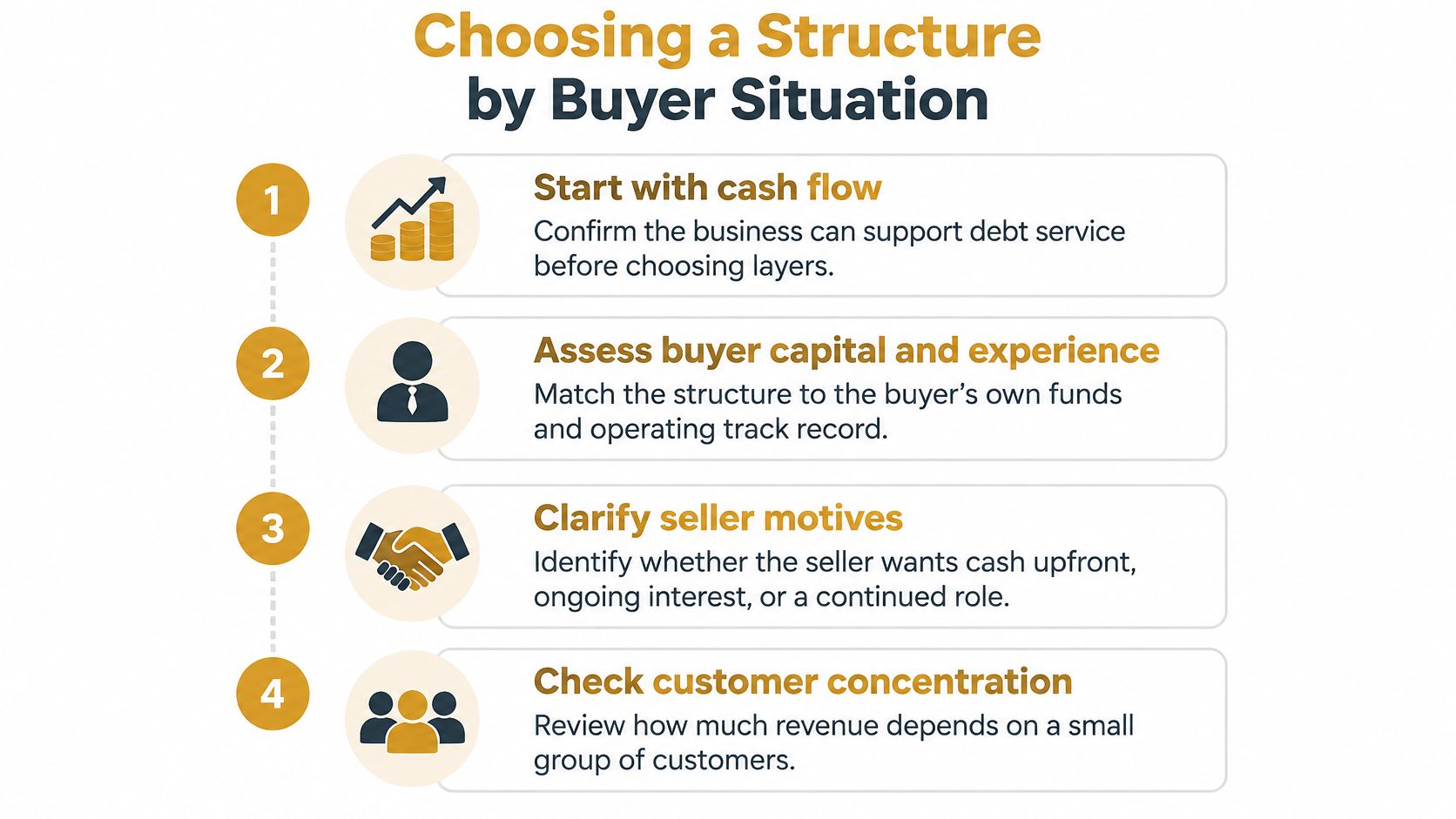
Start with cash flow to set your hard debt ceiling. Next, take an honest inventory of your liquid capital and operating track record. Third, clarify what the seller wants out of the exit (certainty today, ongoing income, or upside in a bigger exit). Finally, audit customer concentration before locking in your terms.
Matching the Deal to Your Position
In our customer concentration analysis, one customer generating over 15% of revenue is a weakness, over 25% is a risk factor that must be priced into the offer, and over 40% changes the entire deal structure. Use the matrix below to match your real-world constraints to a resilient setup.
Buyer situation and the structure that usually fits
| Buyer situation | Lead structure | Supporting structure | Watch for |
|---|---|---|---|
| Strong cash flow and limited own cash | Senior bank debt | Seller note for the remaining gap | Debt service below lender headroom |
| Seller expects growth the buyer doubts | Earnout | Milestone payment | Vague metric definitions |
| Buyer short on capital and experience | Equity partner | Rollover equity | Shared control and exit terms |
| Seller wants long-term alignment | Rollover equity | Seller note | Seller influence over daily decisions |
| Largest customer 25% to 40% of revenue | Earnout tied to retention | Holdback from price | Price already adjusted for the risk |
| Largest customer above 40% of revenue | Restructure the whole deal | Earnout and holdback | Structure must change, not only the price |
Watch the hidden price: A lower headline number isn't safer if tight financing drains the cash you need for hiring, inventory, or keeping your top accounts.
Don't overlook contract transferability when revenue leans on key accounts. Any material customer or vendor contract without an assignment clause needs a written customer consent letter before the deal closes. If a major client refuses to assign their agreement to your new entity, even a generous earnout won't save your debt coverage.
Stress Tests for Customer and Cash Risk
Before you commit to a final offer, run five sensitivity scenarios through your financial model. If any single test pushes operating cash below zero, swap bank debt for seller financing, rollover equity, or a retention holdback:
- Slower growth: Model flat revenue for 24 months instead of assuming the seller's recent upward trend continues.
- Margin compression: Drop gross margin by several percentage points to simulate supplier price hikes or wage inflation.
- Delayed collections: Stretch accounts receivable by 15 to 30 days to confirm your working-capital line can absorb slow-paying clients.
- Refinancing risk: Test what happens if a balloon seller note or variable-rate loan resets at a higher interest rate before maturity.
- Loss of the largest customer: Remove your top account's gross profit completely on day one and verify whether the business can still meet payroll and senior loan obligations.
Confirm the Structure Before You Sign
A sound strategy on a spreadsheet means nothing if the final legal documents contradict it. Equally important, how you allocate the purchase price across assets affects your after-tax cash flow for years. Under SEC-filed ASC 805 purchase price allocation rules, buyers must assign consideration to acquired assets and assumed liabilities at acquisition-date fair values, with any residual recorded as goodwill. Assigning more value to finite-lived intangibles like customer relationships or technology creates amortization expense that alters reported earnings and potentially cash taxes, so negotiate allocation mechanics alongside price rather than treating them as an afterthought.
Five Checks Before Execution
Run through this exact five-step routine before signing the definitive purchase agreement:
- Build a complete sources and uses table: Account for every single dollar of the purchase price, working capital, lender fees, and legal expenses, matching each dollar to its exact funding source.
- Model three operating cases: Run your capital stack through a base case, a slower-growth case, and a top-customer loss scenario to confirm cash stays positive.
- Audit every core contract: Review customer agreements, supplier terms, and facility leases to verify which contracts require formal assignment or a pre-closing consent letter.
- Verify written definitions on every contingent term: Check that seller notes, earnouts, and equity agreements spell out clear formulas, timelines, cure periods, and dispute mechanics.
- Get specialized legal and tax review: Have an experienced M&A attorney and transaction accountant inspect the final structure and tax allocation before you sign. You can also review our guide on evaluating business sale agreements to spot hidden clauses before closing.
If you're looking at a live target and want a second set of experienced eyes on your numbers, you can book a coaching call to review a specific deal. Inside our programs, students receive real-time feedback and coaching on their own deals, mentored directly by Carl Allen and our elite group of M&A coaches. Remember that your deal structure is only as strong as the exact terms written into the final agreement.
Structuring your first acquisition doesn't have to mean guessing through lender covenants, seller notes, and legal clauses on your own. Dealmaker Wealth Society gives aspiring buyers and business operators step-by-step training, deal-structuring playbooks, and live mentorship from practitioners who have closed hundreds of small-business acquisitions. Visit Dealmaker Wealth Society to explore our programs and get hands-on guidance for your next deal.

From the Dealmaker Blog













A Creative Business Buying Fable