
M&A in Finance: How Deals Really Get Done
M&A in Finance: How Deals Really Get Done

The headline numbers can mislead first-time buyers. One 2026 market report recorded $3.98 trillion in global reported deal value in 2025, up from $2.81 trillion in 2024, while deal count rose only 1% to 44,817. The recovery came from larger transactions, not a flood of smaller ones, with billion-dollar deals increasing from 514 to 644 and their combined value reaching $3.00 trillion. Reuters' coverage of the global M&A study captures the central lesson: M&A in finance is less about signing an exciting agreement and more about proving that the price, funding, accounting, and operating plan can survive contact with reality.
For an SMB buyer, the mechanics are smaller but not simpler. You may not need a public bond issue or a multinational merger-control strategy, but you still need to establish what the business earns, determine what it is worth, assemble a workable capital stack, and make the acquired company report accurately after closing. A deal creates value only when the combined business turns assumptions into dependable cash flow.
Table of Contents
- What M&A in Finance Actually Means
- The Deal Drivers Behind Most M&A Transactions
- Valuation Methods Buyers and Sellers Actually Use
- How M&A Financing Really Works in 2026
- Accounting Implications That Shape the Deal
- The Finance Function During Post-Close Integration
- Common Misconceptions First-Time Buyers Should Drop
What M&A in Finance Actually Means
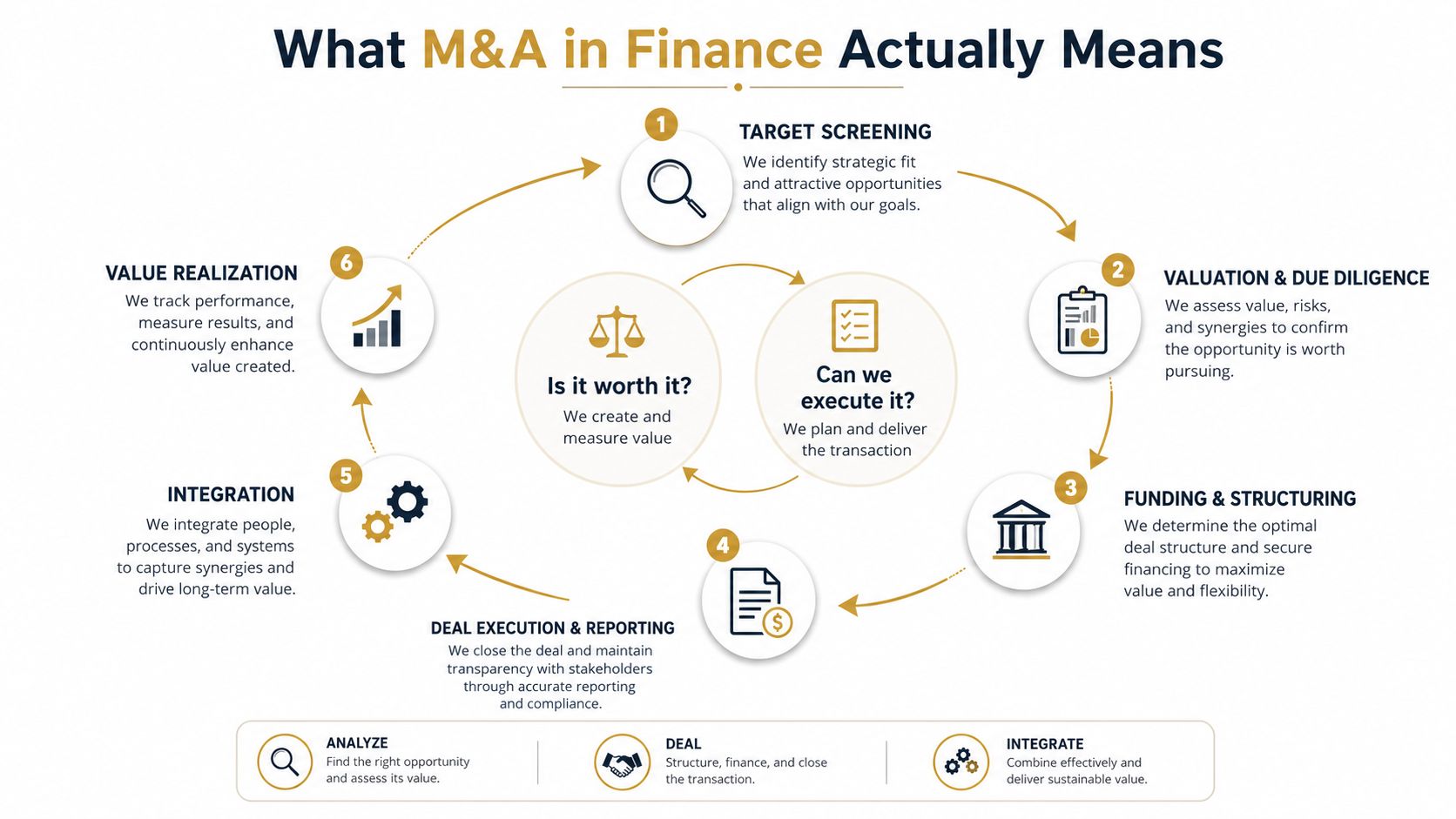
M&A in finance is the discipline that answers two practical questions:
- Is the transaction worth pursuing?
- Can the buyer fund, report, and integrate it successfully?
A merger combines businesses into one operating and reporting structure. An acquisition gives one company or buyer control over another through a cash purchase, a stock exchange, or a combination of both. The legal form matters, but the finance function connects that form to the economic result.
Finance models the investment case, tests the proposed purchase price, identifies funding limits, estimates transaction costs, and measures whether expected benefits become cash. It also organizes diligence around historical earnings, working capital, debt, tax, legal liabilities, customer concentration, and revenue quality. The finance director's job isn't to make a deal look attractive. It's to expose the assumptions that could make it fail.
The same mechanics apply at different sizes
A sub-$10 million acquisition might use seller financing, an SBA-backed loan, buyer cash, or an equity partner. A public company may use cash on the balance sheet, newly issued shares, syndicated debt, or several instruments at once. The documentation and scale change, but the questions remain consistent:
- What exactly is being bought?
- What earnings can the buyer rely on?
- What price reflects the target's risk?
- Which funding sources can support the purchase?
- How will the buyer record the assets and liabilities?
- Who will make the combined operation work after closing?
The five mechanics are deal drivers, valuation, financing, purchase accounting, and post-close integration. Each depends on the prior one. A strategic rationale without a defensible valuation is a story. A valuation without financeable cash flow is an offer the buyer can't close. A closed transaction without disciplined integration is only a transfer of ownership.
Practical rule: Treat closing as the midpoint of the finance process, not the finish line. Forecasts become operating results, and those results must enter the buyer's reporting systems quickly.
The Deal Drivers Behind Most M&A Transactions
Start with the economic reason for buying. The legal agreement tells you how ownership changes, but the deal driver explains why the buyer believes the combined business will be worth more than the target on its own.
A useful analogy is a food company buying a bakery. If the buyer wants the bakery's ovens, delivery routes, customer list, and production staff to strengthen an existing operation, it's a strategic acquisition. If the buyer wants the bakery as a standalone source of cash flow, the logic is primarily financial. If the buyer plans to combine several bakeries, standardize purchasing, and share administration, the transaction also serves a consolidation strategy.
Strategic buyers are purchasing capabilities
A strategic buyer may acquire customers, products, distribution, technology, intellectual property, or skilled employees. The alternative is to build those capabilities internally, which may take too long or require management attention the company can't spare.
That rationale changes diligence. The buyer must test whether the target's customers will remain, whether the technology can connect to existing systems, and whether key employees have reasons to stay. A claimed synergy needs an owner, a timetable, a cost estimate, and a measurable cash impact. “More scale” isn't a synergy until someone explains which costs will fall or which revenue opportunity can realistically be captured.
Financial buyers care about cash and exit value
A financial buyer evaluates recurring cash generation, debt capacity, downside risk, and the potential return on invested equity. A private-equity sponsor may purchase a platform business and add smaller companies around it, using shared systems and management resources to create a larger group.
For an individual buyer, the objective may be different. The business may need to provide dependable income, support debt repayment, and offer the owner a manageable operating role. A target with aggressive growth but weak cash conversion can be less suitable than a slower-growing company with clean earnings and resilient working capital.

SMB scenarios don't follow one template
Typical sub-$10 million situations include:
- A competitor purchase: The buyer wants customers, territory, staff, or capacity and may consolidate overlapping functions.
- An owner-operator acquisition: The individual buyer wants a profitable business that can support personal income and loan repayment.
- A platform and add-on strategy: A sponsor or experienced operator buys a core company, then pursues bolt-ons with compatible customers or operations.
These drivers can overlap, but they shouldn't be blended casually. A competitor acquisition may justify integration savings. An owner-operator deal may depend more heavily on seller transition support. A buy-and-build model requires repeatable systems and a financing plan that can accommodate future transactions.
The broader market has increasingly favored consolidation structures. Add-on activity accounted for more than 72% of buyout activity in 2025, according to Align Business Advisory's lower-middle-market analysis. For an acquisition entrepreneur, that means a partnership, bolt-on, or creative equity arrangement may be more financeable than a standalone purchase designed around maximum borrowing capacity.
Valuation Methods Buyers and Sellers Actually Use
Business valuation is a range supported by evidence, not a single answer produced by a calculator. Sellers emphasize growth, customer relationships, and strategic value. Buyers focus on normalized earnings, risk, financing capacity, and the cash they can retain after debt service and reinvestment.
Three methods, three types of evidence
Comparable companies analysis applies trading multiples from similar public businesses. The analyst adjusts for size, growth, margins, customer concentration, liquidity, and market conditions. This method can provide useful context, but a small private company rarely resembles a much larger listed business closely enough for the multiple to transfer without adjustment.
Discounted cash flow analysis estimates the cash the target can generate and discounts it back to present value. It's powerful when management forecasts are credible and the business has a clear economic model. It's also sensitive to assumptions about growth, margins, capital expenditure, working capital, and the discount rate. A small change in an important assumption can produce a meaningfully different valuation.
Precedent transactions analysis examines prices paid for similar acquired businesses. It can reflect actual control premiums, but the evidence may be distorted by strategic synergies, competitive bidding, unusual financing, or market conditions that no longer apply.
For a sub-$10 million transaction, buyers often combine a modified precedent set, normalized owner earnings, industry benchmarks, and a practical cash-flow model. This overview of valuation methods can help buyers distinguish the mechanics rather than treating every multiple as interchangeable.
| Method | Core calculation | Best use in a sub-$10M deal | Key limitation |
|---|---|---|---|
| Comparable companies | Apply adjusted public-company multiples | Establish a broad market reference | Public companies are often much larger and more liquid |
| Discounted cash flow | Discount forecast cash flow to present value | Test a target with credible forecasts | Results depend heavily on assumptions |
| Precedent transactions | Apply multiples from completed acquisitions | Compare control prices in a relevant sector | Synergies and deal-specific terms can distort the evidence |
A simple earnings example
Assume a target produces $1.5 million of normalized owner earnings. At 4.0x, the implied value is $6.0 million. At 5.0x, the implied value is $7.5 million. The difference isn't a minor negotiation detail. It changes the equity requirement, debt burden, seller-note size, and the buyer's margin for operating underperformance.
The buyer should reconcile the methods before discussing final price. Then adjust for debt, cash, normalized working capital, transaction expenses, and the buyer's expected synergies. A buyer may create additional value after closing, but that doesn't mean the buyer should pay the seller for every projected benefit. Competitive value is not automatically payable value.
A valuation model is useful only when its assumptions can be traced to diligence, financing terms, and an operating owner.
How M&A Financing Really Works in 2026
A capital stack is the funding recipe for the purchase. Start with the least risky money to the lender and move toward the money that absorbs the greatest risk.
Senior debt usually sits at the top. It has priority repayment and often represents the largest debt layer. Pricing commonly references SOFR plus a spread linked to the company's debt load, business quality, collateral, and lender appetite. Mezzanine debt fills part of the gap when senior lenders won't provide enough capital, but it carries a higher return requirement and may include payment-in-kind interest, warrants, or other protections. Buyer or sponsor equity sits at the bottom and takes the first economic loss if the business underperforms.
The mix changes with interest rates, lender confidence, recurring cash flow, customer concentration, and the quality of financial records. In U.S. syndicated LBOs, equity contributions rose above 50% of transaction financing for the first time in the referenced dataset, while average debt on newly issued broad syndicated LBO debt fell to 4.71x EBITDA, the lowest quarterly reading since 2012. The financing report covered by Yahoo Finance links the pressure to higher borrowing costs, weaker interest coverage, and the need for buyers to contribute more equity.
Private debt has also become a major part of the LBO market. It funded 77% of global leveraged buyouts in 2024, compared with 23% for banks, according to S&P Global Market Intelligence's analysis of private-debt financing. Direct lenders can close bespoke deals quickly, but their pricing and covenant terms can materially shape the buyer's operating flexibility.
Two financing paths
| Layer | SBA 7(a) Acquisition | PE LBO |
|---|---|---|
| Senior funding | SBA-backed bank loan | Unitranche or syndicated term loan |
| Equity | Buyer injection and possible partners | Sponsor equity and seller rollover |
| Personal exposure | Personal guarantee is commonly central | Sponsor structure typically separates owner and company liability |
| Underwriting focus | Cash flow, borrower, collateral, and repayment ability | Leverage, quality of earnings, covenant capacity, and exit value |
| Gap fillers | Seller note or earn-out | Mezzanine, seller rollover, preferred equity, or other hybrid capital |
For SMB buyers, SBA lending is growing but isn't effortless. U.S. SBA 7(a) lending reached a record $37.3 billion across 78,078 loans in FY2025, while acquisition-specific lending represented about $8.29 billion across roughly 7,003 deals, up 34.6% year over year, according to the U.S. middle-market financing discussion from CIBC. The same source describes a more selective environment for larger borrowers, with higher equity checks and more conservative debt.
Seller notes and earn-outs can bridge the difference between the seller's headline price and the amount a lender will support. They also shift risk back toward the seller, so definitions, payment priority, covenants, and performance measures need careful drafting.
For readers studying how strategic value can emerge from a product's changing direction, these pivot lessons from the Slack story provide useful context before building an acquisition thesis. Buyers who want to compare funding routes can also review acquisition financing options before approaching lenders.
Accounting Implications That Shape the Deal
Purchase accounting answers a basic question: what does the buyer put on the consolidated balance sheet after acquiring control?
Suppose the buyer pays $15 million for a target with $4 million of book equity. The $11 million premium cannot remain an unexplained difference. The buyer allocates it among identifiable assets and liabilities, including customer relationships, technology, trade names, non-compete agreements, asset-value step-ups, and residual goodwill.

Why the allocation changes reported results
Identifiable intangible assets are valued separately when they meet the recognition requirements. Analysts may use methods such as multi-period excess earnings for customer relationships or relief-from-royalty for trade names and technology. The residual after recognizing identifiable assets and liabilities becomes goodwill.
That split matters because identifiable intangibles generally amortize through the income statement over their useful lives, while goodwill is tested for impairment when the acquired business underperforms. In the transaction framework described in the brief, identifiable intangibles may reduce reported earnings for 5 to 15 years, while goodwill doesn't produce the same scheduled amortization expense.
A higher allocation to amortizable intangibles can create larger future tax deductions under Section 197 or a stepped-up tax basis. The trade-off is lower headline GAAP earnings during the amortization period. Finance must explain that difference to owners, lenders, managers, and anyone whose compensation depends on accounting results.
Deal metrics can move after closing
Purchase accounting can affect earn-out targets, management bonuses, and covenant tests tied to EBITDA. The parties need to define which metrics exclude acquisition-related amortization, transaction expenses, integration costs, or other agreed adjustments. Otherwise, the buyer may believe the acquired team missed an operating goal when the reported shortfall came from accounting allocation rather than weaker trading.
A finance and operations reference such as this finance and operations module overview can help non-finance managers understand why the balance sheet, reporting process, and operating decisions need to stay connected.
The finance team should involve valuation specialists, tax advisers, and accounting counsel before closing, not after the first audit request. The allocation affects future reporting, tax planning, performance measurement, and the way management interprets the acquisition's results.
The Finance Function During Post-Close Integration
A signed purchase agreement transfers control. It doesn't automatically transfer cash discipline, reporting accuracy, or operating accountability. The finance workstream should begin with a practical 30/60/90-day plan that protects liquidity first, creates reliable reporting next, and then measures performance and synergy capture.
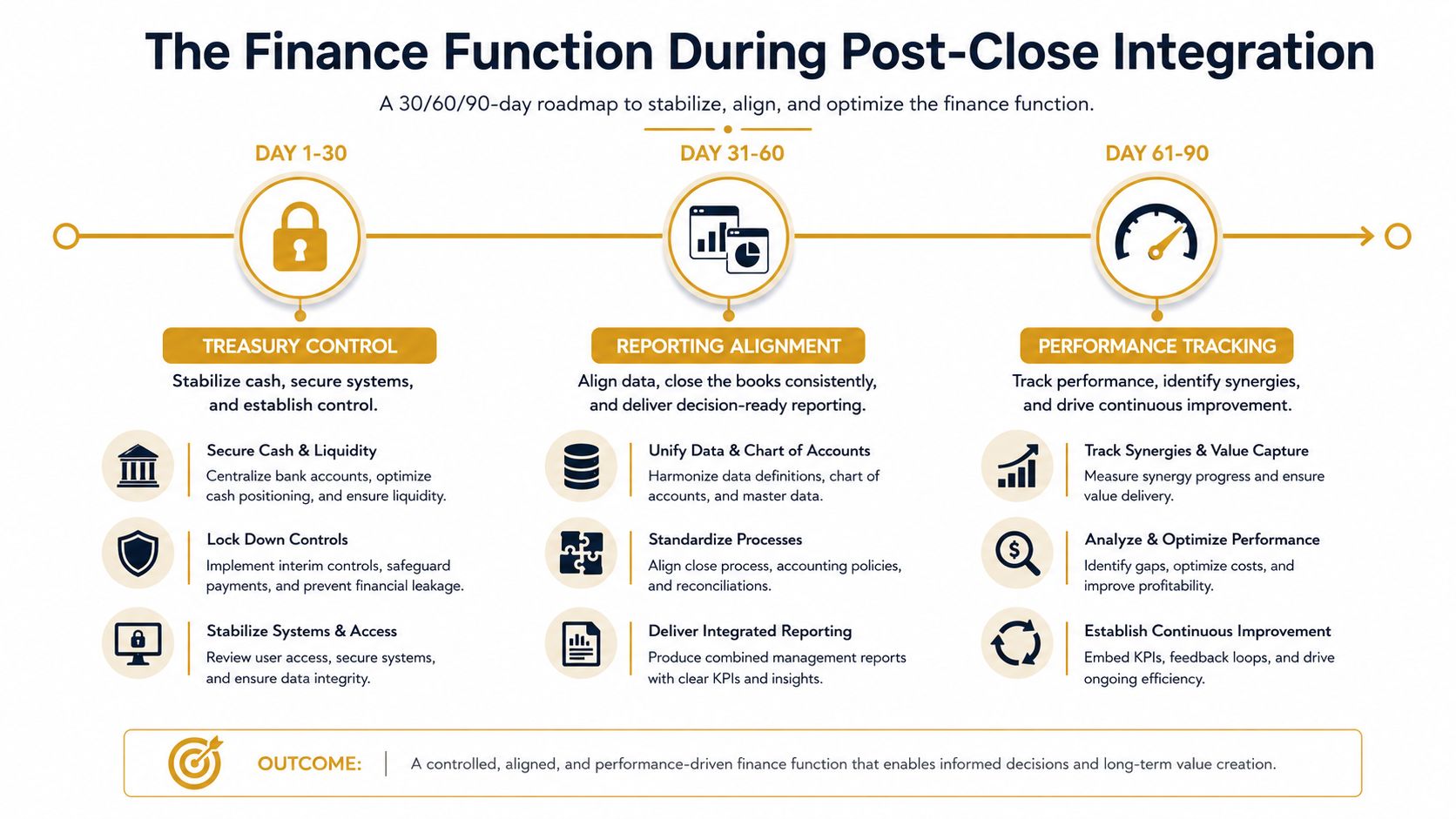
Day 1 through Day 30 focuses on control
The opening period is about knowing where the money is and who can move it.
- Treasury control: Consolidate or coordinate bank accounts, confirm authorized signers, and lock down disbursement authority.
- Opening cash validation: Reconcile cash balances, outstanding checks, debt payments, payroll obligations, and restricted funds.
- Liquidity forecasting: Stand up a 13-week cash forecast that combines both entities and highlights tax, payroll, supplier, and debt-service dates.
The buyer shouldn't wait for a perfect system migration before establishing controls. A simple, reconciled cash schedule is more valuable than a complex dashboard populated with inconsistent data.
Day 31 through Day 60 builds reporting alignment
The next phase aligns the chart of accounts, accounting policies, close calendar, and management reporting. Finance should produce the first consolidated month-end close, reconcile intercompany balances, and document differences between the legacy target records and the buyer's policies.
Hidden friction often appears. One business may record revenue when invoiced, while another records it when delivered. One may classify contractor costs above gross profit, while the other puts them in operating expenses. Those differences can distort margins unless finance creates a common definition and applies it consistently.
Day 61 through Day 90 measures performance
The combined company needs shared definitions for revenue recognition, bookings, recurring revenue, gross margin, customer retention, and other operating indicators. If one team reports ARR while another reports GAAP revenue, the leadership group can't compare performance without translating the terms.
The final layer is synergy capture. Finance should track hard savings such as vendor consolidation, redundant roles, and real-estate changes against the costs required to achieve them. The board or lender should receive synergy reporting on the same schedule used for covenant compliance.
For a practical checklist covering integration planning best practices, buyers should assign an owner to every task, define the evidence of completion, and escalate exceptions before they affect the close or cash forecast.
Common Misconceptions First-Time Buyers Should Drop
Cheap debt doesn't make an SMB acquisition easy. The lender still needs confidence that the company can service the debt after paying employees, suppliers, taxes, and necessary reinvestment. The buyer also needs enough equity to absorb volatility when the target misses a forecast.
For small acquisitions, SBA 7(a) and conventional bank financing often rely heavily on borrower strength, historical cash flow, repayment capacity, personal guarantees, and clean documentation. A sponsor-style unitranche facility evaluates the transaction through a different lens, with close attention to the debt load, quality of earnings, covenant capacity, and exit value. Neither path removes diligence.
Five assumptions to pressure-test
“The seller's add-backs are all real.”
Rebuild earnings from bank statements, payroll, tax filings, general-ledger detail, and supporting invoices. A personal expense may be removable, but a recurring owner function may require replacement labor.“The asking price is the financeable price.”
A lender underwrites debt service from dependable cash flow, not from the seller's preferred multiple. Model the purchase price, working capital, fees, interest, principal repayment, and an operating downside case together.“An LOI means the deal is committed.”
A letter of intent usually precedes financing conditions, confirmatory diligence, material-adverse-change provisions, and representations-and-warranties negotiations. Either side may walk when evidence changes the risk assessment.“The target's working capital can stay untouched.”
A business may need cash to fund payroll, inventory, receivables, and supplier terms immediately after closing. Normalize working capital before setting the purchase-price adjustment.“Integration can wait until the transaction closes.”
Bank access, payroll, customer communications, reporting ownership, and employee retention can affect the first week of operations. Build the Day 1 plan during diligence, then refine it as findings arrive.
The market's split between growing small-business acquisition lending and cautious middle-market underwriting creates a difficult but navigable environment. Buyers who document earnings, size the equity check fairly, and choose a structure that matches their operating capability have a stronger foundation than buyers who start with the slogan of buying a business with little money down.
Dealmaker Wealth Society offers structured education on sourcing, diligence, negotiation, financing, creative deal structures, and post-acquisition integration for people pursuing small-business acquisitions. Visit Dealmaker Wealth Society to explore its training, coaching, templates, and peer support for turning an acquisition thesis into an executable finance plan.

From the Dealmaker Blog











A Creative Business Buying Fable
