
Non Binding Offer Explained: A Practical SMB M&A Guide
Non Binding Offer Explained: A Practical SMB M&A Guide
Alex has found a regional HVAC services company with an asking price of $1.5 million. She's ready to move, but she doesn't want to spend heavily on diligence before learning whether the owner will accept a seller note, whether the asking price reflects reality, or whether the seller is negotiating with other buyers. So she sends a short email marked non-binding offer, proposing the headline price, a $300,000 seller note, and 60-day exclusivity.
That email looks simple. It isn't. The price may be indicative, while the confidentiality, exclusivity, governing law, or dispute provisions may still create enforceable obligations. A buyer who treats the label as a free pass can lose bargaining power, damage credibility, or create a legal fight before the definitive purchase agreement is signed.
This guide follows Alex from that first offer through the seller's counter, diligence, exclusivity, and the transition to a definitive agreement. If you're assessing a target, start with a disciplined business valuation overview so your proposed price has a defensible commercial foundation. You should also know how your proposal compares with competing bids, especially if the seller is running a process involving several potential buyers. Comparing offers from potential buyers can reveal why the highest headline price isn't always the strongest offer.
Table of Contents
- Where Non Binding Offers Fit in a Real SMB Deal
- What a Non Binding Offer Actually Is
- The Anatomy of a Typical NBO Document
- Why Non Binding Does Not Always Mean Risk Free
- Mapping the Deal Timeline Around the Offer
- Strategic Uses for SMB Buyers and Sellers
- A Sample Non Binding Offer Template You Can Adapt
- Best Practices Before You Send Your NBO
Where Non Binding Offers Fit in a Real SMB Deal
Alex's first instinct is to write, “I offer $1.5 million for the company.” That sentence creates a useful valuation anchor, but it also exposes her negotiating position before she knows how much flexibility the seller has. She needs to decide whether the price should be all cash, partly financed by the seller, or adjusted through an earnout. She also needs to communicate enough financing credibility to look serious without representing that funds are committed when they aren't.
A non-binding offer, or NBO, is the first formal checkpoint where those decisions become visible. It usually follows an NDA and information exchange, then precedes deeper diligence and any negotiated exclusivity arrangement. One review of private merger negotiations found that bidders submitted their first non-binding offer after signing confidentiality agreements and, on average, after more than 100 calendar days of evaluating the target. The timing is important because the document arrives after initial analysis, but before the buyer has accepted every risk.
Alex's $300,000 seller note also communicates more than payment mechanics. It tells the owner that Alex may want to preserve cash for working capital, debt repayment, or post-closing investment. The seller will read that structure as a test of trust and risk allocation, not merely as an accounting choice.
Dealmaker's view: Your first offer should be serious enough to move the seller forward, but conditional enough to preserve your ability to say no.
The seller may accept the headline price and reject the seller note. They may accept the note but shorten exclusivity. They may counter at a higher price while asking for proof of funds and a faster diligence schedule. Each response supplies information about the seller's priorities, urgency, and alternatives. The NBO is therefore not just a document. It's a controlled negotiation instrument.
What a Non Binding Offer Actually Is
A non-binding offer is a written expression of interest that sets out a proposed price and principal transaction terms without legally obligating either party to complete the acquisition. It may also be called a non-binding indicative offer, an indication of interest, an NB offer, or, in some processes, an initial letter of intent. The terminology varies, but the commercial purpose is consistent. The buyer signals serious intent while retaining the right to complete diligence and negotiate a definitive agreement.
The easiest analogy is a handshake versus a signed contract. A handshake can establish expectations and may support a relationship built on fair dealing, but it doesn't normally contain the detailed performance obligations found in a purchase agreement. A signed contract defines what each party must deliver, when they must deliver it, and what happens if they fail.
That distinction matters in Alex's HVAC transaction. If the NBO clearly states that the proposed price is subject to diligence, financing, board or investment committee approval, and execution of a definitive agreement, Alex generally hasn't promised to close merely by signing the document. The HVAC owner also hasn't promised to sell merely by accepting the indicative price.
The practical definition is consistent with this plain-English explanation of an LOI: the preliminary document creates a framework for negotiation, while the definitive agreement carries the core purchase obligation.
What the document does and doesn't do
A well-drafted NBO normally performs four commercial tasks:
- Signals seriousness: It gives the seller a proposed price and structure instead of leaving the conversation at the level of general interest.
- Creates a valuation anchor: The proposed consideration gives both sides a starting point for negotiation.
- Sets diligence expectations: It identifies the records, access, timing, and conditions the buyer needs before committing.
- Defines selected binding terms: It separates provisions such as confidentiality or exclusivity from the non-binding commercial proposal.
The buyer isn't legally required to close because the seller likes the offer. The seller isn't legally required to sell because the buyer offers the asking price. But “non-binding” must appear in the actual drafting, not merely in the subject line of an email. The document should state which provisions are non-binding, identify any binding sections, and confirm that the parties must sign a definitive agreement before closing.
The Anatomy of a Typical NBO Document
An NBO should be short enough for a seller to understand quickly and precise enough to prevent avoidable arguments. For many smaller acquisitions, the document may fit into one or two pages, although complexity, financing, earnouts, and regulatory issues can make it longer. The structure below gives Alex a practical map for her HVAC proposal.
The commercial blocks
Purchase price and valuation. State the proposed amount, currency, and whether it refers to equity value or enterprise value. If the price is based on a cash-free, debt-free structure or assumes a normalized level of working capital, say so. A price without those assumptions can create a dispute later because buyer and seller may be discussing different economic values.
Deal structure. Explain whether consideration consists of cash at closing, a seller note, an earnout, a holdback, or another arrangement. Alex's proposed $300,000 seller note should include a brief indication of its intended role without pretending the parties have already agreed on interest, maturity, security, or repayment terms. Structure reveals how much risk each side will carry after closing.
Assumed liabilities. Identify the liabilities the buyer expects to assume and those the seller must retain. For an HVAC business, that could include ordinary-course payables, equipment obligations, customer deposits, tax liabilities, litigation, or warranty claims. Don't bury this issue. A headline price can look attractive until assumed liabilities change the economics.
Conditions. List the conditions that must be satisfied before a definitive agreement or closing. Typical conditions include satisfactory financial, tax, legal, operational, customer, employee, insurance, and environmental diligence, along with financing and required approvals. The essential documents for business acquisitions can help you organize the records supporting these conditions.
The control blocks
Exclusivity or no-shop. If Alex wants the HVAC owner to stop soliciting other buyers, the NBO should identify the requested period and the conduct prohibited during that period. “Exclusivity” is too vague by itself. Define whether the seller may continue discussions, receive unsolicited approaches, or negotiate with existing bidders.
Confidentiality. The NDA may already govern information received before the offer, but the NBO should state whether confidentiality continues and whether the new document adds restrictions. This provision often survives even if the transaction doesn't proceed.
Timeline and access. Include proposed dates for diligence, negotiation, financing, signing, and closing, but label them as targets unless the parties intend them to be binding. Also specify who will provide access to management, facilities, books, customers, employees, and third-party advisers.
Finish with an explicit non-binding statement. The safest commercial wording makes clear that price, structure, conditions, and the obligation to close remain subject to a definitive agreement, while separately identifying the clauses intended to bind.
Why Non Binding Does Not Always Mean Risk Free
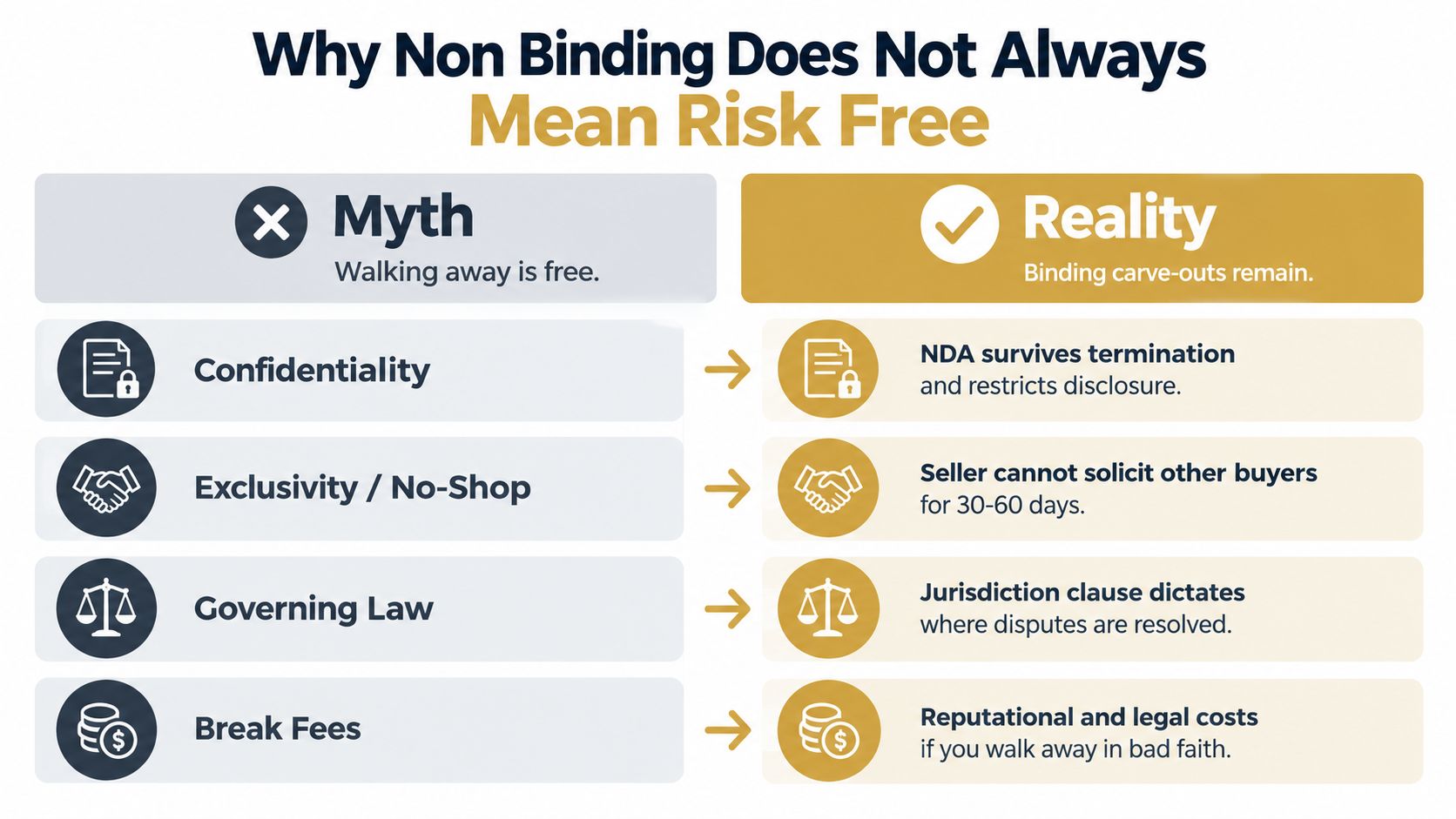
The phrase non-binding describes the document at a high level. It doesn't automatically erase every obligation inside it. A U.S. Securities and Exchange Commission filing for a non-binding letter of intent states that the LOI isn't binding except for specified sections, while also confirming that the parties must negotiate and sign a definitive agreement before closing. That is the correct mental model for SMB deals. The document can be mostly non-binding and still contain binding commitments.
Clauses that commonly survive
Confidentiality restricts how the buyer and seller use sensitive information. If Alex receives customer lists, pricing data, employee compensation records, and operational manuals, she can't assume that walking away frees her to share or exploit them.
Exclusivity and no-shop limit the seller's ability to seek, solicit, or negotiate competing proposals. The obligation needs clear dates, parties, and prohibited conduct. A vague promise to negotiate exclusively invites disagreement.
Expenses and reimbursement may require one party to pay specified costs if the process ends or if a defined event occurs. Never accept an expense provision you haven't quantified and reviewed.
Good-faith negotiation language requires careful drafting. A clause promising to negotiate or cooperate can create arguments about conduct, even though it shouldn't transform an indicative price into an obligation to close.
Governing law and dispute resolution determine which law applies and where disputes proceed. Those provisions can matter even when the transaction itself fails.
Courts may also examine the drafting, the parties' conduct, and side agreements to determine whether a particular obligation exists. The NZX public-company example illustrates how real-world proposals can call themselves non-binding while containing detailed conditions concerning diligence, financing, board approval, and adviser opinions. The label doesn't tell the whole story.
Red flag: Don't sign language that implies financing is closed, the price is final, or the parties have reached a complete agreement when your actual position is still conditional.
Look closely at definite exclusivity dates, breakup fees, expense reimbursement, financing representations, and any sentence stating that the parties “agree” to terms rather than merely “intend” to negotiate them. You may still walk away from the acquisition, but you shouldn't assume there can never be consequences for violating a binding carve-out or acting improperly.
Mapping the Deal Timeline Around the Offer
The NBO sits between preliminary interest and transaction commitment. Before it, the buyer may receive a teaser or confidential information memorandum, sign an NDA, review financial information, and attend a management presentation. After it, the parties may negotiate an LOI, establish exclusivity, conduct detailed diligence, draft a share or asset purchase agreement, close, and begin integration.
Each document answers a different question:
- NDA: Can the parties exchange confidential information under agreed restrictions?
- Teaser or CIM: Does the opportunity justify further review?
- Management presentation: Does the buyer believe the owners and operating model?
- NBO: What price and headline structure would move the buyer into the next stage?
- LOI: Which commercial terms and process protections will govern deeper negotiation?
- SPA: What legally binding representations, warranties, covenants, conditions, and remedies apply?
- Closing: Have the parties satisfied the definitive agreement and transferred the business?
Some smaller deals move quickly and use the NBO as the operative negotiation document. The parties may move from an accepted indicative offer directly into diligence and purchase agreement drafting. A more traditional process uses the NBO to narrow the field, then signs a separate LOI containing binding exclusivity and process terms.
The distinction matters because document weight should match transaction complexity. A buyer shouldn't turn a preliminary expression of interest into a miniature purchase agreement, but shouldn't leave critical assumptions unstated either.
NBO compared with other deal documents
| Document | Typical timing | Binding effect | Main signal |
|---|---|---|---|
| NBO | After initial information review | Commercial terms usually non-binding, selected clauses may bind | Buyer's indicative price and structure |
| Binding offer | Later stage, after material negotiation | Creates a stronger obligation, subject to stated conditions | Buyer is prepared to commit under defined terms |
| LOI | After the parties align on principal economics | Often partly binding, especially confidentiality and exclusivity | Parties intend to negotiate toward a definitive agreement |
| SPA | Final negotiation stage before closing | Binding purchase contract | Legal rights, obligations, remedies, and closing mechanics |
In auction processes, a seller may skip a formal NBO and ask buyers to submit a binding bid or an LOI. If that happens, don't copy a generic NBO template and assume the process has the same protections. Read the seller's instructions and identify exactly what commitment the process requires.
Strategic Uses for SMB Buyers and Sellers
A non-binding offer gives both sides information without forcing the entire transaction to close. That makes it valuable, but only if each party uses it deliberately.
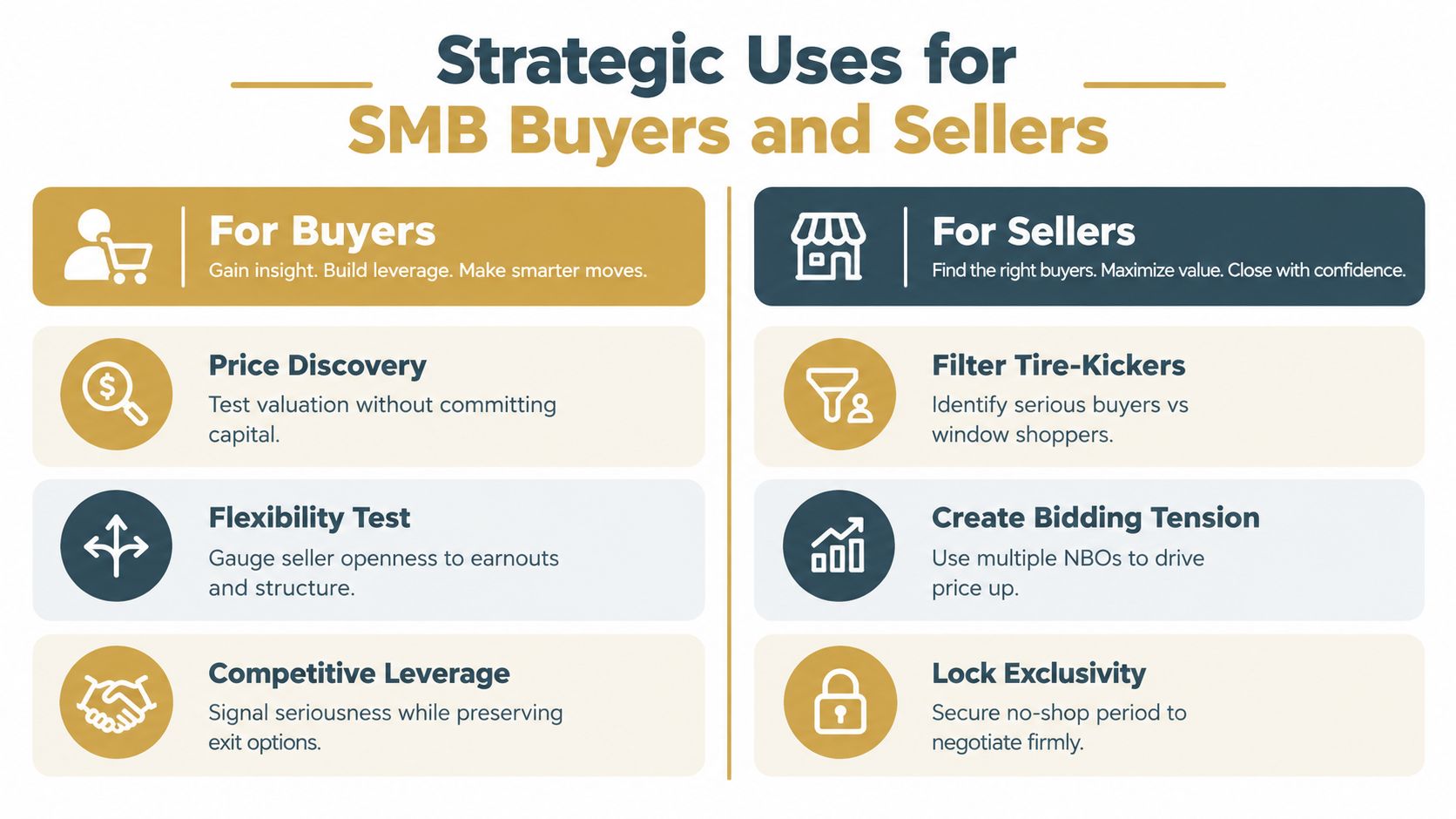
For Alex, the NBO tests whether the HVAC owner values certainty, price, speed, or post-closing involvement. She can propose a seller note and learn whether the owner is comfortable sharing repayment risk. She can include an earnout concept and discover whether the seller believes future performance depends on relationships Alex hasn't yet assessed.
How buyers should use the document
Start price discovery. A first-time buyer can put a credible number on the table without committing to close before diligence. That gives the seller something concrete to accept, reject, or counter.
Test structure. Don't negotiate only on price. Offer a clear combination of cash, seller financing, earnout, or holdback when the economics justify it. A seller who rejects the structure may still accept the price, or may reveal that certainty of funds matters more than headline value.
Trade exclusivity for process discipline. If the seller wants a serious proposal, ask for a defined no-shop period in return. Your request should be tied to specific access, diligence cooperation, and a realistic negotiation plan. The seller shouldn't give up alternatives indefinitely while you decide whether you're interested.
Signal credibility. Explain the status of your financing accurately. “Financing discussions are underway” is different from “funds are committed.” Misstating the position weakens trust and can create legal exposure.
How sellers should respond
A seller can use NBOs to filter out buyers who offer vague enthusiasm but won't identify price, structure, funding, or timing. Multiple credible proposals can also expose differences that matter more than the top figure, such as closing certainty, management treatment, and the amount of consideration deferred after closing.
The seller should compare proposals on a normalized basis. A higher price paid partly through an uncertain earnout may not be stronger than a lower price with more reliable consideration. A buyer requesting a long exclusivity period without providing proof of funds may be asking the seller to give up negotiating power too cheaply.
The strongest NBO is not the most aggressive one. It's the one that makes the next decision easier.
If the seller receives two attractive proposals, revised NBOs can keep both buyers engaged while diligence proceeds, but the seller must honor any binding no-shop commitment already signed. Buyers should assume that every requested protection has a price, and sellers should charge for exclusivity through stronger economics, stronger evidence of funding, or both.
A Sample Non Binding Offer Template You Can Adapt
Alex's letter should be short, commercially clear, and explicit about what remains subject to negotiation. The following sample is designed for an acquisition with a proposed purchase price of $1.5 million and a $300,000 seller note. It's a starting point, not a substitute for legal review.

Subject: Indicative proposal to acquire [Target Company Name]
Dear [Seller Name],
Introduction
[Buyer Entity] is pleased to submit this non-binding indicative proposal regarding the potential acquisition of [Target Company Name]. This proposal reflects our current understanding of the business and is subject to satisfactory due diligence, financing, internal approval, negotiation and execution of definitive transaction documents, and satisfaction of customary closing conditions.Why it matters: This paragraph tells the seller that you're serious while reserving the right to investigate and negotiate.
Indicative consideration
We propose total consideration of $1.5 million, subject to confirmation of the agreed transaction perimeter, normalized working capital, debt and debt-like items, and other customary purchase price adjustments. The proposed consideration would consist of:
- Cash at closing: $[amount], subject to final financing arrangements.
- Seller note: $300,000, with principal terms, including interest, maturity, repayment, security, and subordination, to be agreed in definitive documents.
- Earnout or holdback: [Insert amount or “none proposed”], subject to mutually acceptable performance measures and documentation.
Why it matters: Don't leave “$1.5 million” undefined. State what the amount assumes and identify terms that remain open.
Financing
Our financing plan is [committed / substantially arranged / in progress]. We'll provide reasonable evidence of funding capacity upon request, subject to confidentiality and the requirements of our financing partners.
Why it matters: Use the accurate description. Never call financing committed if you're still seeking approval.
Diligence and access
The proposal is subject to satisfactory financial, tax, legal, commercial, operational, employment, insurance, customer, supplier, equipment, and environmental diligence. The seller will provide reasonable access to records, management, facilities, advisers, and other information reasonably required to evaluate the transaction.
Why it matters: Connect your conditions to the actual risks in the business. A generic diligence sentence won't protect you from every unknown.
Binding provisions
The parties agree that the following provisions are intended to be binding upon acceptance of this proposal:
- Confidentiality and permitted use of information.
- Exclusivity and no-shop restrictions from [start date] through [end date].
- Access and cooperation obligations during diligence.
- Governing law and dispute resolution.
- [Expense allocation or reimbursement, if applicable].
All other provisions, including price, structure, financing, diligence conclusions, and the obligation to complete the transaction, are non-binding and subject to definitive agreements.
Why it matters: This is the most important drafting block. Separate the binding carve-outs instead of leaving the seller to infer them.
Next steps and expiration
If these terms are acceptable, the parties will work in good faith toward definitive transaction documents. This proposal expires at [time] on [date], unless extended in writing by both parties.
Sincerely,
[Name]
[Title]
[Buyer Entity]
[Signature]
A requested exclusivity period should be long enough to justify the buyer's diligence effort but short enough to avoid trapping the seller. The exact period depends on financing, access, business complexity, and the seller's alternatives. Whatever period you request, define its start, end, prohibited conduct, and termination rights.
Best Practices Before You Send Your NBO
Before Alex sends the HVAC proposal, she should stop treating the document as an email with a price attached. It's a negotiation map. Every sentence tells the seller how much certainty Alex has, how much risk she expects the owner to carry, and how much control she wants over the next stage.
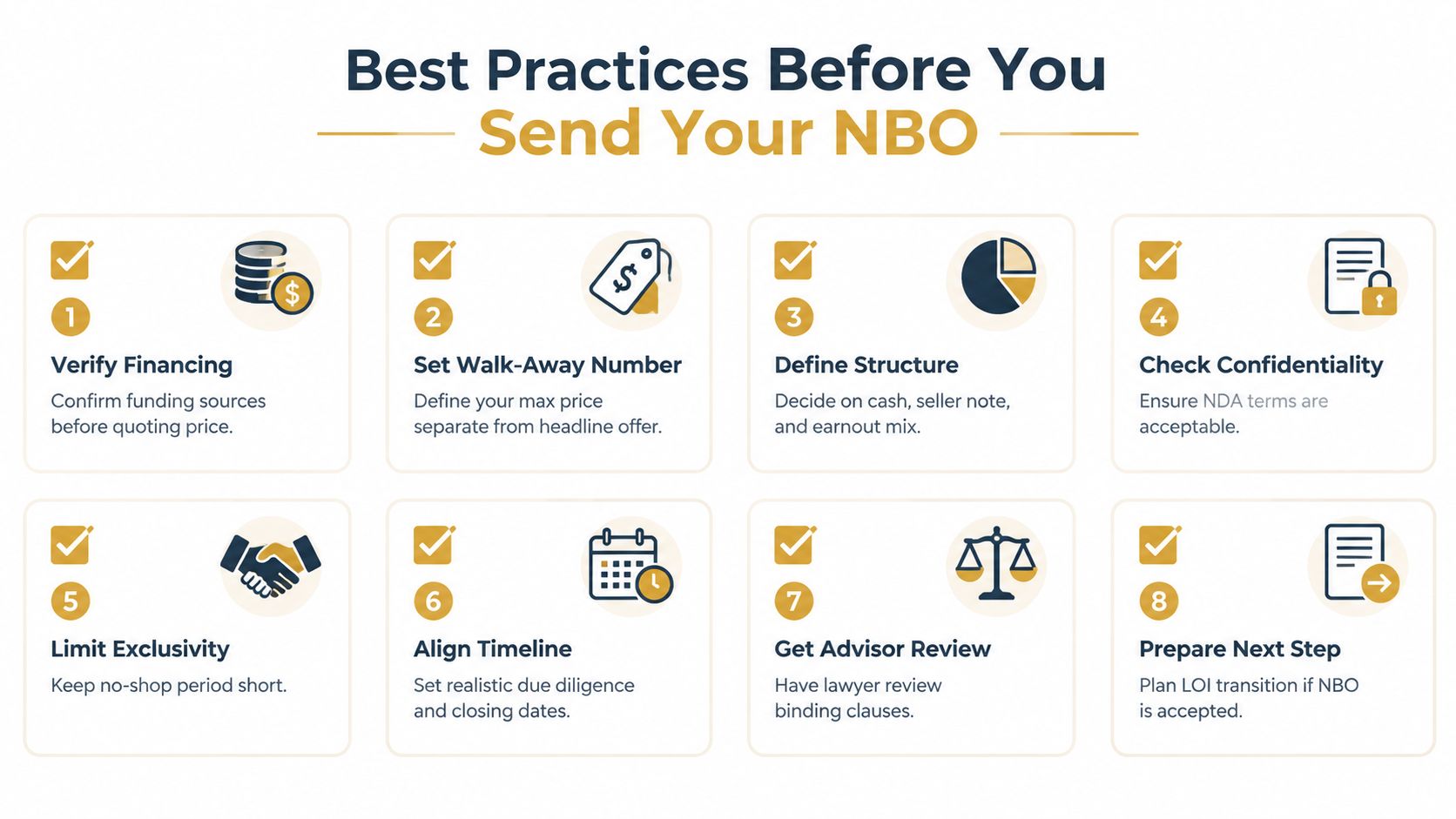
Use this checklist before signing or sending:
- Verify financing: Confirm the actual status of debt, equity, seller financing, and approval requirements before describing your funds.
- Set a walk-away number: Decide your maximum acceptable price separately from the headline offer. Don't let a seller counter move that ceiling.
- Define the structure: Decide how much cash you can deploy and whether a seller note, earnout, or holdback is commercially necessary.
- Check confidentiality: Review the NDA and confirm how information may be used, stored, shared, and returned if talks end.
- Limit exclusivity: Request only the no-shop period you can justify with a clear diligence and documentation schedule.
- Align the timeline: Set realistic targets for access, diligence, financing, definitive documents, and closing. Don't promise speed you can't deliver.
- Get advisor review: Have counsel identify every clause intended to bind, especially exclusivity, expenses, governing law, dispute resolution, and financing representations.
- Prepare the next step: Decide whether acceptance leads to a separate LOI, direct SPA drafting, or another negotiated document.
Alex's final proposal should state the $1.5 million price, explain the $300,000 seller note, describe financing, and identify the requested exclusivity terms without implying that closing is guaranteed. She should expect a counter. A counter isn't a failed offer, it's evidence about the seller's priorities and a chance to trade value rather than raise price.
If you're preparing a real acquisition and want practical guidance on offer design, diligence, financing, and negotiation, Dealmaker Wealth Society provides courses, templates, coaching, and a private peer community for acquisition entrepreneurs working through those decisions. Visit Dealmaker Wealth Society to explore the training and deal support available before you send your next non-binding offer.

From the Dealmaker Blog











A Creative Business Buying Fable
