Post Merger Integration Consulting: What It Covers
Post Merger Integration Consulting: What It Covers
83% of high-risk integrations fail to meet one or more of their success criteria, and those deals carry higher risk across organizational structure, people and project execution at the same time, according to Deloitte's post-merger integration study. That figure isn't about bad deals. It's about deals that closed, got announced, and then lost value someone had already paid for.
Post merger integration consulting is the discipline that sits between a signed purchase agreement and the cash flow you underwrote. It matters most to buyers who don't have a transformation department waiting at headquarters: searchers, independent sponsors, family offices and owner-operators buying a business with twelve employees and two accounting systems.
Table of Contents
- What Post-Merger Integration Consulting Covers
- The Workstreams Integration consultants Run
- How a 100-Day Integration Plan Is Built
- What Integration Consulting Looks Like in Practice
- Common Integration Mistakes and How to Spot a Capable Adviser
- Decide Whether You Need a Full Mandate or a Playbook
What Post-Merger Integration Consulting Covers
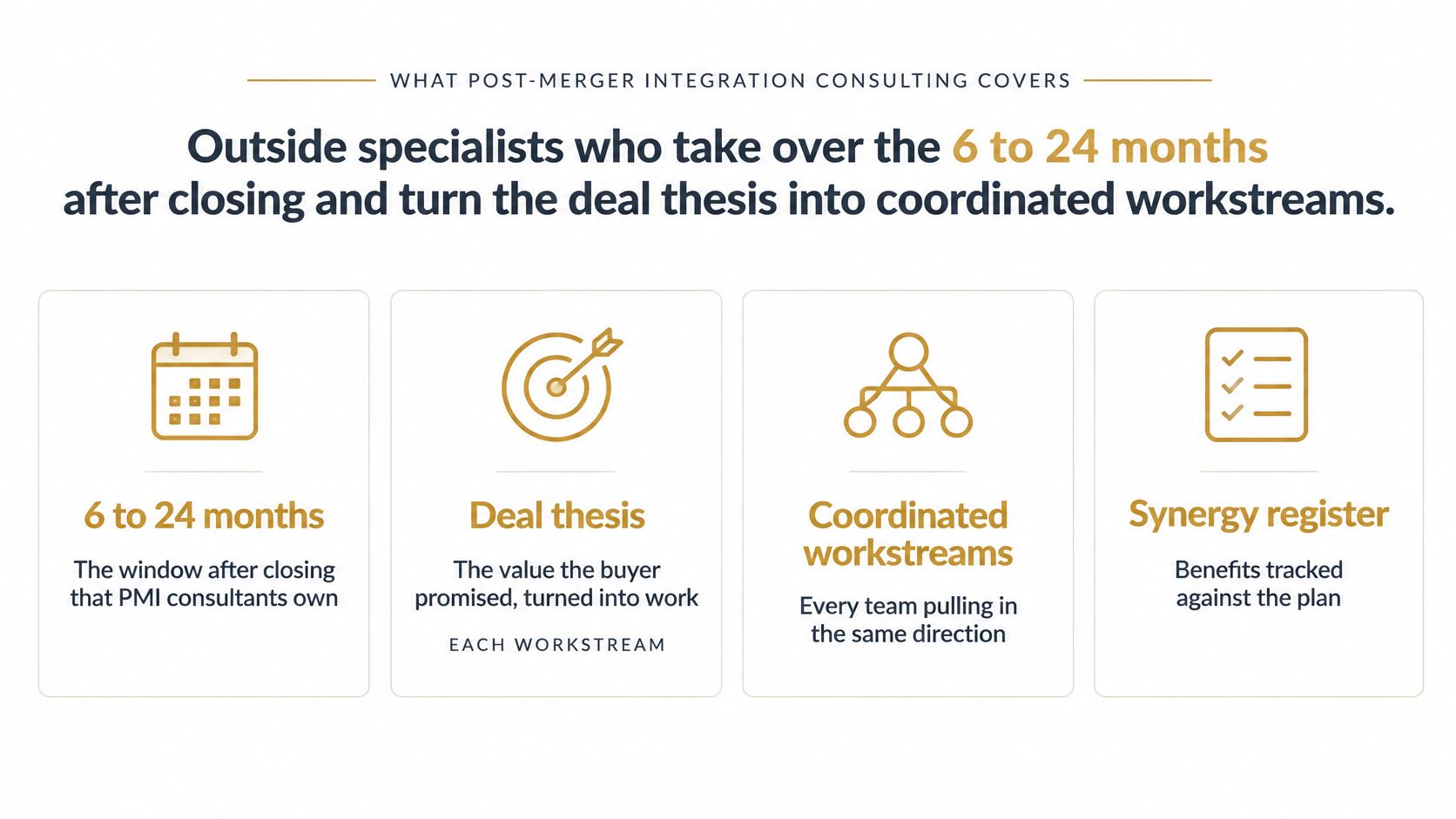
Post merger integration consulting means outside specialists who take ownership of the 6 to 24 months after closing and convert the deal thesis into coordinated workstreams, each with a named owner, a milestone date and a way to measure success. It is not a report, and it is not a project manager with a Gantt chart.
Think of a renovation. You chose the house and set the price. Someone has to sequence the trades, keep the family living in the house while the walls come down, and stop the electrician before the plasterboard closes over the wiring. Get the order wrong and you don't lose the house. You lose eighteen months of use and a great deal of money.
The sequencing question is where the value lives. Deloitte's analysis with the University of Münster examined more than 45,000 data points from post-merger transactions across major industries worldwide. It classified 35% of integrations as relatively low-risk transactions, which the study calls "Mikado" integrations, and about three-quarters of those met the study's success criteria. The high-risk group performed nothing like that: those transactions carried higher risk across at least three dimensions at once, organizational structure, people and project execution.
The practical test: a deal can hit its financial model and still destroy value if decision rights, incentives or delivery governance stay misaligned.
That is the case for treating PMI as a control discipline rather than administrative support after closing. Outcomes depend on coordinated decisions about operating model, accountability, workforce alignment, systems and delivery governance, and those decisions collide with each other when nobody owns the sequence. When you interview providers, judge them on workstream coverage and on how they would handle your specific constraints, not on the size of the market they operate in.
The Workstreams Integration consultants Run
A capable PMI consultant runs eight workstreams, and each one should have a named owner, a first-30-day output and a measure that tells you whether it is working. If a provider cannot map their offer onto these eight, you are buying a slide deck.
| Workstream | Core deliverable | Success measure |
|---|---|---|
| Synergy and value tracking | Synergy register with quantified baseline, owner, timing and measurement method | Realized run-rate savings versus baseline |
| Operating model and organization design | Decision-rights map and leadership appointments | Clear accountability and fewer escalated decisions |
| People and retention | Critical-role retention list and incentive alignment | Retention of non-executive talent and critical roles |
| Finance and reporting | Standardized KPI dictionary and consolidated reporting | One consistent definition of revenue, margin, churn and working capital |
| IT, data and AI | Dependency plan, cutover readiness and a data-permissions register | Cutover readiness and a model-performance baseline where AI is involved |
| Customers and revenue continuity | Top-30 customer contact plan and service-level safeguards | Customer service levels and churn held to plan |
| Legal and compliance | Contract, consent and data-transfer register | Consents and filings completed before consolidation |
| Integration governance (PMO) | Weekly dashboard with escalation thresholds | Milestone completion and issue resolution speed |
The table is the easy part. What keeps it honest is that the workstreams are interdependent, and the failures hide in the seams between them. Research examining more than 300 potential PMI risk factors identified 35 statistically significant factors, which clustered into four categories: synergy, structure, people and project risk, as summarized by the IMAA Institute. The consequence is uncomfortable. A deal can meet its financial model and still destroy value if decision rights, incentives, employee capability or implementation governance stay misaligned.
Two workstreams deserve extra attention because they are where owner-buyers get caught.
Finance and reporting. If the target sells on Amazon, the finance workstream starts with fees, returns and ad spend rather than the P&L summary, because that is where cash leaks fastest in a newly acquired brand. Learning fix margin leaks on Amazon is often the first place a buyer finds money they did not know was leaving the business.
People and retention. Integration plans die here. The change management side of business integrations is the part most owner-buyers underestimate, because the technical migration is visible and the morale problem isn't.
Small-business rule: with limited staff, fund cash visibility, payroll, compliance, customer continuity and key-person retention first. A full systems overhaul can wait a year.
How a 100-Day Integration Plan Is Built
A 100-day plan is not a list of everything you would like to change. It is the order in which you are allowed to change things.
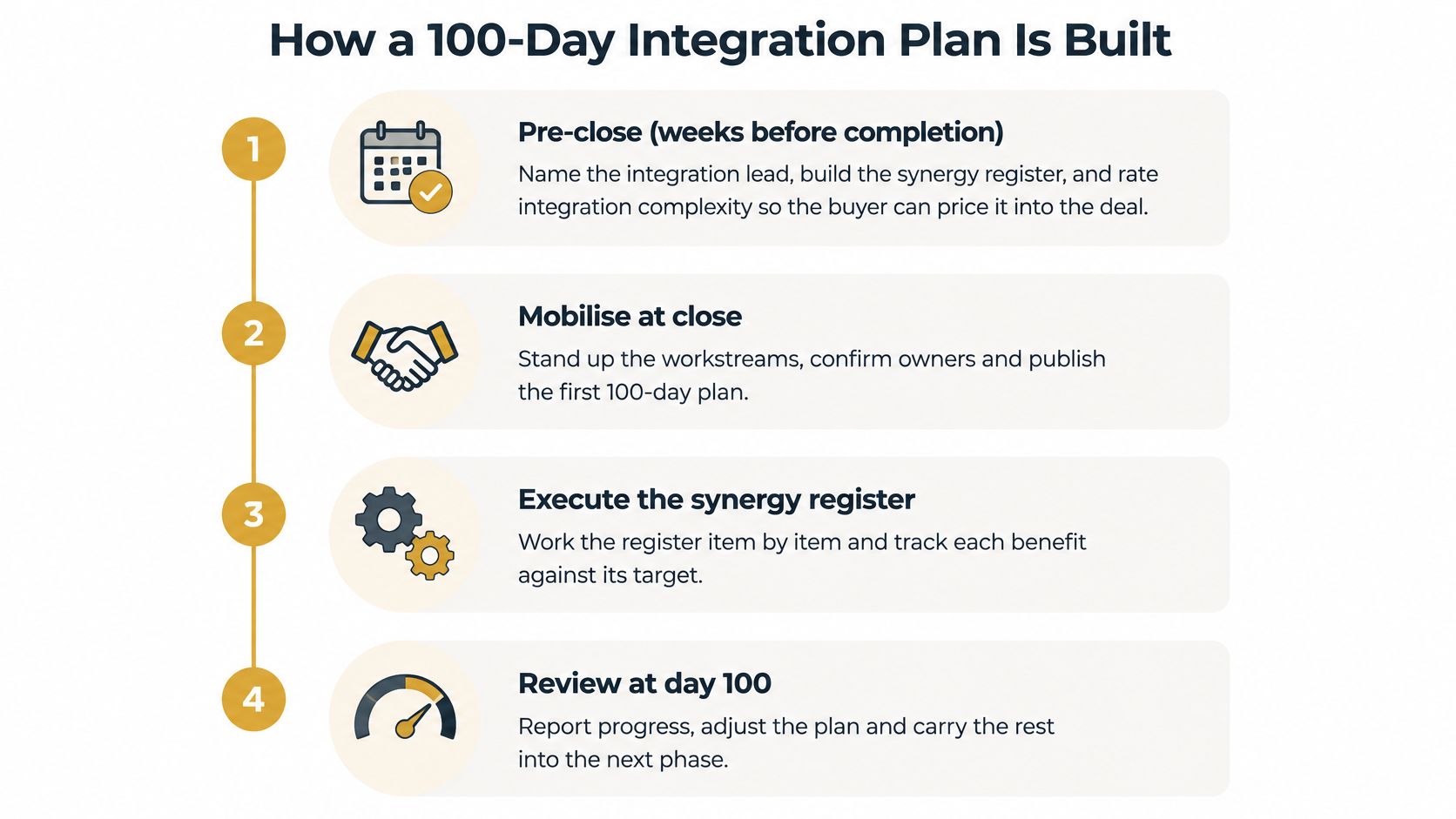
- Before completion. Name the integration lead, build the synergy register with a baseline and an owner for every benefit, and rate integration complexity so the buyer can price that effort into the offer rather than discovering it later.
- Days 1 to 30. Publish leadership appointments and decision rights in one announcement. Confirm payroll and banking continuity. Lock the top-30 customer contact plan and write down the names of the critical roles you cannot afford to lose.
- Days 31 to 60. Standardize the KPI dictionary, start finance and reporting consolidation, and phase policy alignment by dependency readiness rather than by enthusiasm.
- Days 61 to 100. Plan ERP or system cutovers, formalize retention and incentive decisions, and hold the first synergy realization review against the register you built before closing.
Run the plan on a weekly cadence of leading indicators: critical-role retention, systems cutover readiness, process adoption, customer service levels and realized run-rate savings. Waiting for quarterly EBITDA to tell you whether integration is working is like checking the scoreboard after the season ends. A written integration planning process beats memory once the first month gets busy.
The harder judgement is speed. Prolonged ambiguity raises employee anxiety, delays decisions and lets duplicate processes and conflicting customer commitments persist, which is why academic and practitioner research identifies integration strategy, team composition, communication, execution speed and measurement consistency as major determinants of post-acquisition outcomes, as set out in this review of integration success factors. Excessive speed without sequencing does the opposite damage: it overloads staff and triggers avoidable operational failures. Integration speed is a risk variable, not a target.
Two remedies: set escalation thresholds at the governance board so problems surface in days, and judge the program on a single value-creation scorecard covering financial outcomes, operational continuity, people stability and milestone completion.
No universal benchmark timeframe or single KPI settles the question of whether an integration succeeded. The scorecard is the answer, and it should be the same one the board sees every month.
What Integration Consulting Looks Like in Practice

A $2M-EBITDA eCommerce brand bought with seller financing, seller staying twelve months. Here the integration lead's first job is protecting the seller relationship, not replacing it, because the seller still holds the customer relationships and the supplier terms. The KPI dictionary gets phased in before any platform migration, and critical-role retention outranks cost cuts for the first two quarters. Buyers who lead with a cost program in month one usually lose the two people who knew how the warehouse ran.
An owner-dependent services business where one customer is over 25% of revenue. Concentration at that level is a risk factor to be priced into the offer, and above 40% it should change the deal structure. The decision-rights map names the buyer's new account owner from day one, and the 30-day plan puts a customer interview under NDA at the top of the list, with the target's top five to ten customers asked how long they have bought, what share of spend sits there, when the contract renews, what would make them leave and who else they considered.
An AI-enabled target. Training-data ownership, model outputs, cross-border permissions and vendor dependencies have to be settled before any consolidation, and legal analysis from Squire Patton Boggs on AI in M&A transactions treats IP ownership, data privacy, cybersecurity and post-completion operating arrangements as central deal issues rather than specialist afterthoughts. That analysis also reports Deloitte GenAI research finding fragmented data to be the most-cited technology friction point in transactions. The contrarian conclusion is worth holding onto: integrating every data asset immediately can raise risk rather than accelerate synergies. A staged architecture with data quarantine, documented permissions, human validation and model-performance baselines usually beats a rush to one platform.
Progress across all three gets judged on the same performance metrics that define acquisition success, not on how busy the integration team looks.
For roll-up strategies, the payoff compounds. A repeatable integration playbook is what makes the second, third and fourth bolt-on cheaper than the first, because the workstreams, templates, retention lists and KPI definitions already exist and only the names change.
Common Integration Mistakes and How to Spot a Capable Adviser
A Dublin Technological University review of M&A integration research cites Harding and Rovit's 2007 finding that 60% of organizations had no specific integration plan before the merger, and 38% still lacked one after completion, with poor integration accounting for roughly one-third of M&A failures. Writing that plan after closing is the expensive version of the same gap. For a buyer with no dedicated integration office, the miss is usually sequence and decision rights, not a missing slide deck.
The same failures keep showing up. The ERP becomes the project, while customers, incentives and who may decide what are treated as side issues. In the first cash squeeze, the integration budget is the line that gets cut, even though it is the spend protecting the price already paid. A synergy without a baseline and a named owner is a hope with a number attached. Customers feel process changes before the buyer sees the churn, because the buyer's systems were protected first. Then the seller's last day arrives and authority has not moved. Access and decision rights should transfer on a calendar, not on goodwill.
I would test any candidate on whether they run integration as a sequence of decisions rather than one programme that has to absorb every function. On a smaller deal, doing less, and doing it in a set order, can beat trying to fold in every system and team. That is a hypothesis to test against this deal's constraints, not a rule copied from a corporate integration office.
Ask these questions before you hire:
- How do you handle critical-role retention in the first thirty days?
- Who owns the synergy register, and how is each line measured?
- What is your communication cadence with frontline staff, not just executives?
- Have you run integration under this deal's constraint, whether thin management bandwidth, owner dependence, an earn-out or seller note, or regulated and AI-related data?
- What do you sequence first, and what do you deliberately leave alone until decision rights are clear?
A full PMI firm stays through execution. An adviser who writes the plan and leaves before it runs is selling a document, often at a similar price. If you will run the work yourself, a mentor or peer community can supply the same discipline, and choosing between those options deserves the same scrutiny you would apply to how to select team building vendors: check scope, deliverables and what happens when something goes wrong.
Ask about fees in the same conversation. A monthly retainer, a fixed fee for a 100-day sprint, or a fee partly tied to synergy milestones create different incentives. Confirm which applies, what sits outside scope, and who pays for external legal or data-security work.
The cheapest protection is still earlier than the adviser. Bring the integration question into due diligence, while you can still walk away or reprice.
Decide Whether You Need a Full Mandate or a Playbook
Whether selective integration beats full integration on a smaller deal is a hypothesis worth testing, not a settled rule. What is settled is that integration effort has to match integration complexity, and that most PMI guidance assumes a large corporate buyer with a dedicated integration office, a change team and a technology budget. Independent searchers, family offices and owner-operators have none of those.
Score your deal against this checklist before you decide how much support to buy.
- Hire a full mandate when the two entities share customers, systems or staff; either side has more than 20 employees; the seller leaves within twelve months and key-person risk is concentrated; an earn-out or seller note keeps the seller inside the business; or the data is regulated, cross-border or AI-enabled with unclear training-data ownership.
- Run a minimum viable playbook when a tuck-in keeps its brand and systems for a year; the seller stays operational and you only need to monitor cash; or the business has fewer than ten staff and no shared systems.
| Criterion | Full PMI mandate | Minimum viable playbook |
|---|---|---|
| Typical deal | Overlapping customers, systems or staff; 20+ employees | Tuck-in keeping brand and systems; under 10 staff |
| First priority | Synergy register, operating model, governance board | Cash visibility, payroll, compliance, customer continuity |
| Seller role | Seller exits within 12 months; key-person risk | Seller stays operational; earn-out or note tied to performance |
| Data and technology | Regulated, cross-border or AI-enabled data and systems | No shared systems; consolidate later |
| Reporting | Standardized KPI dictionary and weekly dashboard | Simple monthly cash and customer report |
| Cost and bandwidth | Dedicated integration lead or external consultant | Owner-led with a checklist and templates |
The retention evidence points the same way. WTW's 2025 M&A Barometer identifies retention of non-executive talent as the leading integration-success metric, cited by 50% of respondents, while culture alignment remains the top challenge for 74% of non-U.S. and 54% of U.S. companies. Neither of those problems is solved by a bigger systems budget, and both are solved faster when someone owns them by name.
Three things should exist before you sign:
- A scored checklist. Run your deal through the criteria above and write down the answer. Ambiguity here becomes a cost overrun later.
- One page of integration intent. Name the integration lead, the top three value risks, and the first thirty-day priorities. One page, not a deck.
- A price for the effort. Fold the integration cost into the offer. A deal that only works if integration is free does not work.
Then make one of three choices: hire a consultant, build the playbook in-house, or walk away from a deal whose integration you cannot fund. The third option is a legitimate outcome, not a failure.
The closing test: if you cannot say who owns the customer, the payroll and the synergy number on day one, you are not ready to close.
Integration is the part of the deal where the price you paid meets the operating reality you bought, and it's where Dealmaker Wealth Society spends a lot of its teaching time. Our specialty coaches cover post-acquisition transition and integration alongside capital raising, financial due diligence and M&A legals, and members can book a coaching call to review a specific deal before signing rather than after. If you want the playbooks, templates and a room full of people who have run this sequence before, visit Dealmaker Wealth Society and start with the integration question while the deal is still negotiable.

From the Dealmaker Blog












A Creative Business Buying Fable