What Is Normalized EBITDA? How Buyers Calculate It
What Is Normalized EBITDA? How Buyers Calculate It

Normalized EBITDA is reported EBITDA adjusted to remove non-recurring, non-operating and owner-specific items so it shows sustainable earnings.
The popular advice is to add back unusual expenses and multiply the result by a valuation multiple. That skips the hardest question: which adjustments would a buyer actually accept? A seller's largest advertised earnings figure isn't necessarily the best basis for your offer.
If you're asking what is normalized EBITDA, think of it as an estimate to investigate, not a certified answer. You're trying to establish what the business can earn under your ownership, including the costs you'll need to replace.
Table of Contents
- What Normalized EBITDA Means in Plain Terms
- Common Adjustments and Which Way They Move Earnings
- How to Build a Normalized EBITDA Bridge
- How Normalized EBITDA Changes the Purchase Price
- Seller, Buyer and Lender Versions of EBITDA
- Add-backs That Fail Buyer and Lender Review
- Confirm Your Normalized EBITDA Before You Make an Offer
What Normalized EBITDA Means in Plain Terms
EBITDA means earnings before interest, taxes, depreciation and amortization. It starts with net income, then adds back financing costs, income taxes and the accounting expenses that allocate the cost of tangible and intangible assets over time.
Normalization goes further. It separates the business's ongoing performance from expenses and gains that distort the picture a buyer needs.
Think of a home inspector assessing a property after a storm. A completed, isolated storm repair tells a different story from a roof that leaks whenever it rains. Likewise, a settled lawsuit may justify an adjustment, while recurring legal trouble may represent an ongoing cost.
Your starting point is the income statement, not the seller's marketing summary.

The calculation and its limits
A useful working formula is:
Normalized EBITDA = reported EBITDA + legitimate non-recurring charges − non-recurring gains
Owner-related adjustments also matter. For an illustrative calculation alongside the SEC's guidance on non-GAAP financial measures, reported EBITDA of $1.0 million, plus a $100,000 one-time legal settlement and $75,000 of excess owner compensation, produces $1.175 million, provided both adjustments are documented and unlikely to recur.
The compensation adjustment removes only the excess above a supportable replacement salary. It doesn't assume the next owner can operate without management.
EBITDA is a non-GAAP measure, meaning it isn't defined by generally accepted accounting principles. The SEC guidance requires EBITDA presented as a performance measure to be reconciled to net income. That accounting connection matters because normalization shouldn't become an excuse to abandon the financial statements.
Practical rule: Treat every adjustment as a claim requiring proof, not an automatic increase in earnings.
The arithmetic is straightforward. Deciding whether an expense belongs in that arithmetic requires judgment, documents and a realistic view of future operations.
Common Adjustments and Which Way They Move Earnings
Use this checklist to distinguish potential adjustments from ordinary operating expenses. The amount column gives an illustrative treatment rather than suggesting that every business deserves the same adjustment.
Add-backs increase normalized EBITDA by removing qualifying expenses. Deductions reduce it by removing unusual gains or recognizing costs that the seller's accounts understate.
Common EBITDA adjustments with direction, example and evidence
| Adjustment | Direction | Illustrative amount | Evidence to keep |
|---|---|---|---|
| One-time restructuring or severance | Add back | Documented severance attributable to a permanently closed location | Termination agreements and ledger detail showing no repeat |
| Litigation settlement | Add back | Documented settlement expense unlikely to recur | Settlement documents and legal correspondence |
| Transaction fees | Add back | Qualifying deal-specific fees recorded as expenses | Invoices and engagement letters |
| Asset-sale gain | Deduct | Recorded gain, not total sale proceeds | Sale records and fixed-asset register |
| Owner pay above market | Add back | Actual compensation less supported market replacement cost | Payroll records and a market salary survey |
| Owner pay below market | Deduct | Market replacement cost less recorded compensation | Replacement cost quote |
| Personal expenses run through the business | Add back | Verified personal portion included in operating expenses | Bank statements and general ledger coding |
| Related-party rent off market | Adjust to market, usually a deduction when rent is below market | Difference between recorded rent and supported market rent | Lease agreement and independent rent appraisal |
Two distinctions that prevent inflated earnings
A recurring cost isn't a one-time item just because its description changes. Repeated reorganizations may indicate that restructuring is part of how the company operates. Ask what operational change makes the latest expense different.
A below-market cost isn't a credit to the buyer. If the owner works for less than you'd pay a replacement manager, your earnings estimate needs to absorb that shortfall.
Owner compensation deserves particular care because tax treatment and acquisition underwriting answer different questions. Allied Tax Advisors' explanation of reasonable compensation for S-corp owners offers useful context, but your acquisition analysis must still establish the duties, hours and skills you'll need to replace.
The evidence column is what separates a defensible adjustment from a seller's wish. An invoice establishes that a cost occurred; it doesn't establish that the business can avoid it after closing.
Before relying on any add-back, sort the expense into a category, establish its accounting treatment and identify the document that supports your proposed change.
How to Build a Normalized EBITDA Bridge
An EBITDA bridge is a schedule connecting reported earnings to your normalized estimate. Build it in a spreadsheet, with a separate row for each adjustment and a reference to the underlying document.
This process illustration shows the broad path from reported results to a supportable conclusion.
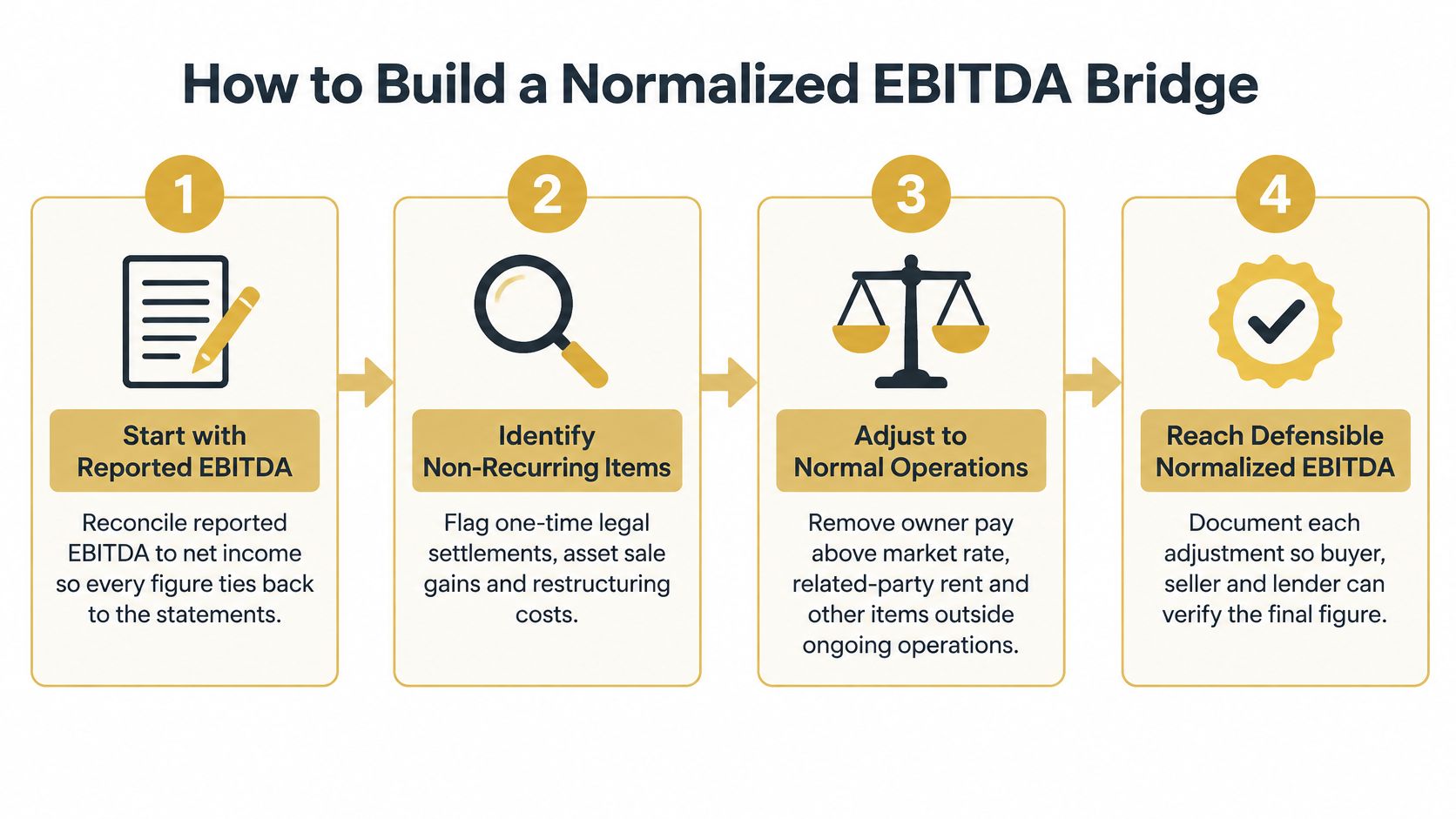
Auxo Capital Advisors' normalized EBITDA and quality-of-earnings guide emphasizes traceability, a causal link to future earnings and avoiding double counting. A quality-of-earnings review, often shortened to QoE, tests the reliability and sustainability of the earnings you're buying.
Build the schedule in a deliberate sequence
Reconcile the starting figure. Connect reported EBITDA to net income and the financial statements for the same reporting period. Don't combine earnings from one period with adjustments from another.
Record candidate adjustments before accepting them. Enter the amount, proposed direction and explanation for each item. Keep seller requests visible even when you haven't accepted them, so disputed items don't disappear into an unexplained total.
Trace each entry to its source. Match the adjustment to the general ledger, the detailed record of transactions, and relevant invoices, payroll records, bank statements or tax returns. A spreadsheet description without that trail is a major diligence weakness.
Test the future operating effect. Ask what changes after closing and why that change affects sustainable earnings. For a consulting expense, establish whether the project is complete or whether someone must keep performing the work.
Check for overlapping adjustments. Compare payroll, restructuring and owner-expense entries to make sure the same expense hasn't appeared under different labels. Also check whether the starting EBITDA already excludes the item.
Assign confidence and show the conclusion. Mark adjustments as supported, unresolved or rejected, with a short explanation. Keep unproven future savings separate from documented historical corrections.
A finished bridge should be readable without a verbal explanation from the seller. Name the supporting file beside every accepted line, identify the reviewer and record unresolved questions.
For a simple practice schedule, start with reported EBITDA, add a documented consulting expense from a completed project and deduct a non-recurring delivery-van sale gain. Tie the consulting line to its invoice and ledger entry, and the gain to the sale record and asset accounting.
Use this video as a companion explanation while preparing your schedule.
How Normalized EBITDA Changes the Purchase Price
Enterprise value is the indicated value of the operating business before the transaction's debt, cash and other purchase-price adjustments. In an EBITDA-based valuation:
Enterprise value = normalized EBITDA × valuation multiple
A valuation multiple expresses value as a multiple of earnings. It isn't a universal rate for every business, and choosing it requires a separate assessment of the company and the deal.
The relationship between the earnings base and indicated value is illustrated below.
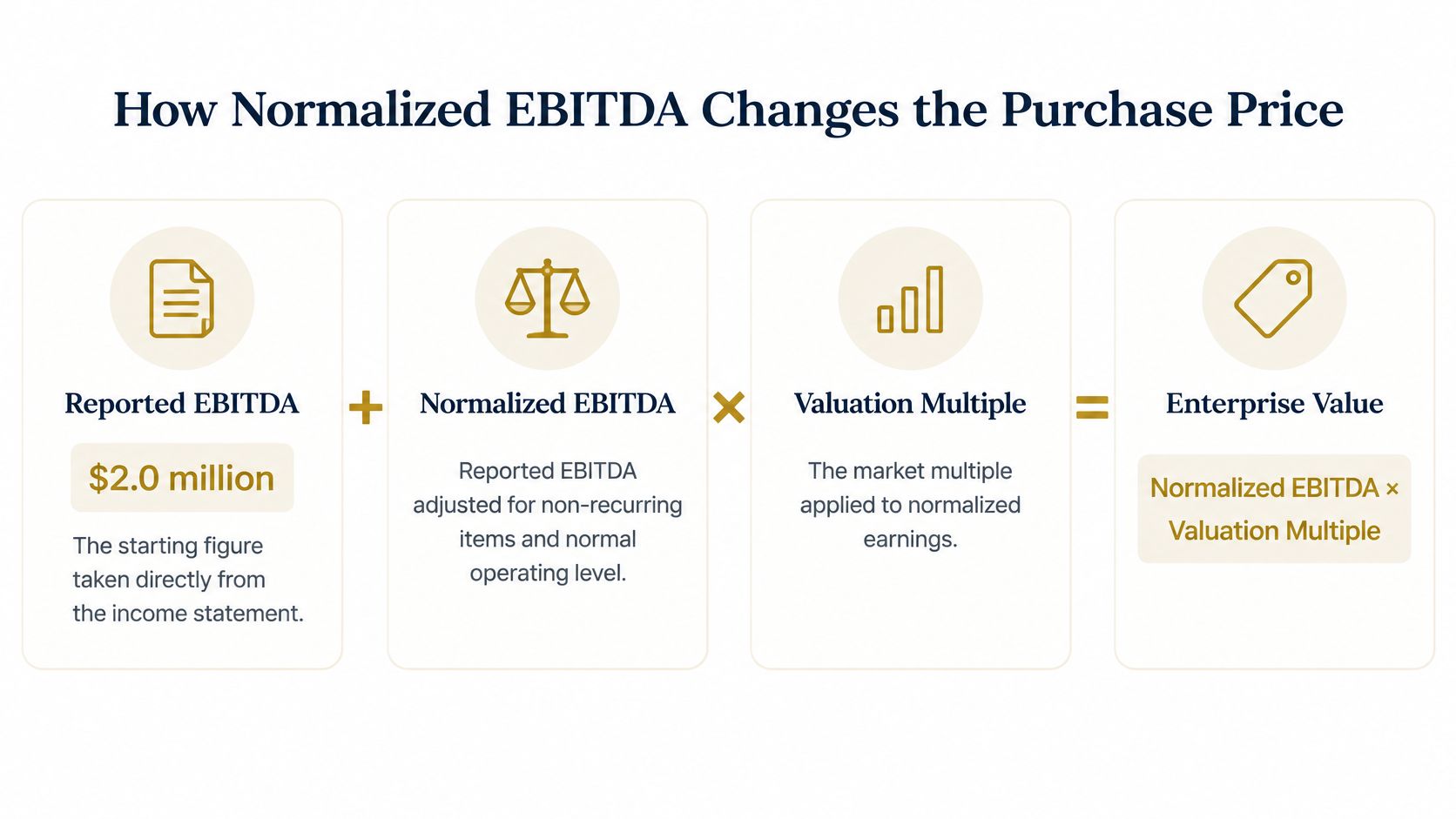
In the IB Interview Questions normalized EBITDA valuation guide, $2.0 million of reported EBITDA, a $0.3 million expense add-back and a $0.1 million gain deduction produce $2.2 million of normalized EBITDA and $11.0 million of enterprise value at 5.0x, rather than $10.0 million.
The table shows the arithmetic behind that example, including the intermediate values.
Worked example: from reported EBITDA to enterprise value at 5.0x
| Step | Earnings effect | Normalized EBITDA | Enterprise value at 5.0x |
|---|---|---|---|
| Reported EBITDA | Starting point | $2,000,000 | $10,000,000 |
| One-time expense add-back | +$300,000 | $2,300,000 | $11,500,000 |
| Non-recurring gain deduction | −$100,000 | $2,200,000 | $11,000,000 |
| Sensitivity per $100,000 of accepted EBITDA | ±$100,000 | ±$100,000 | ±$500,000 |
Negotiate the earnings base before debating the multiple
The expense add-back raises indicated value because the buyer accepts that the cost won't continue. The gain deduction reverses part of that increase because selling an asset isn't evidence of repeatable operating earnings.
For negotiations, the sensitivity row makes a small-looking accounting disagreement concrete. You're not merely debating whether an expense deserves a label. You're deciding how much purchase price rests on that assumption.
Unsupported adjustments can also make a buyer question the reliability of the remaining schedule. That can affect both the accepted earnings base and the multiple the buyer is willing to apply.
Use our guide to understanding valuation multiples in deals to evaluate that separate pricing decision. In your model, show every adjustment's earnings effect and value effect, and keep replacement costs and financing assumptions visible rather than burying them in the total.
Seller, Buyer and Lender Versions of EBITDA
Four versions of EBITDA compared
| Figure | Who prepares it | What it includes | How it is used |
|---|---|---|---|
| Reported EBITDA | Accountant, from the financial statements | Standard EBITDA calculation before normalization | Baseline for reconciling other figures |
| Seller-adjusted EBITDA | Seller or seller's advisor | Seller-proposed adjustments to reported earnings | Supports the listing and asking price |
| Buyer-underwritten EBITDA | Buyer and diligence team | Accepted adjustments, necessary deductions and replacement costs | Supports the offer and acquisition analysis |
| Lender EBITDA | Lender's analyst | Adjustments permitted by the applicable lending definition | Supports debt-capacity and covenant analysis |
Identical financial statements can produce different conclusions because the parties are answering different questions. The seller wants to demonstrate earning potential; the buyer needs an operating budget; the lender needs an acceptable basis for repayment analysis.
Investing.com's explanation of normalized EBITDA describes normalization as a negotiated estimate rather than a single accounting-standard result. Owner compensation, personal expenses, related-party rent, litigation and stock-based compensation can all receive different treatment.
Comparing the schedules side by side makes those disagreements easier to identify.

Why the largest figure may be the least useful
An advertised total can include assumptions that don't fit your ownership plan. A seller might remove management compensation because you intend to work in the business, while your investment model needs to include a hired manager.
That doesn't make either spreadsheet automatically dishonest. It makes the assumptions essential.
The useful earnings figure is the one that matches the business you'll operate, not the one that makes the asking price look cheapest.
Keep reported, seller-adjusted and buyer-underwritten earnings visible, with confidence assessments beside the adjustments. Add the lender's version when financing discussions establish its requirements.
Normalization must also remove favorable distortions. Non-recurring gains, above-market related-party pricing and costs that will rise after closing can make historical earnings look stronger than the business you'll inherit.
Ask the seller for the bridge behind the headline number. Then identify which differences are factual disputes, which are missing documents and which reflect genuinely different operating plans.
Add-backs That Fail Buyer and Lender Review
The easiest mistake is accepting a one-time expense that keeps appearing. Different consultants, projects or invoice descriptions don't prove that the underlying need has disappeared.
A seller may have completed a particular consulting engagement while still requiring outside help to run the company. Your question isn't whether that invoice will return. It's whether the cost of performing the work will return.
Red flags worth investigating
- Repeated project costs. Compare consulting and restructuring accounts across reporting periods. Ask what changed operationally to eliminate the need.
- Personal vehicles recorded as fleet expense. Request business-use records before treating the entire expense as personal. A vehicle used for deliveries doesn't become unnecessary because the owner also drives it home.
- Owner pay without a market comparison. Identify the owner's actual responsibilities and the cost of replacing them. A preferred salary figure isn't evidence.
- Rent that changes during negotiations. Obtain the proposed post-closing lease and compare it with the historical arrangement. Don't underwrite occupancy costs from an informal promise.
- Explanations that shift between drafts. Preserve earlier schedules and request a written explanation for changes. A revised description should clarify the facts, not replace missing support.
Our explanation of how acquisition add-backs work provides additional context for separating legitimate adjustments from optimistic presentation.
When an accepted valuation adjustment won't support debt
A loan covenant is a requirement in the lending agreement. Its EBITDA definition may permit fewer adjustments than your purchase-price model, so a lender can accept your valuation logic without financing against the same earnings amount.
Underwriting discipline: Keep an adjustment out of your base case until you can trace it to evidence and explain why the cost won't return.
If a material adjustment fails, recalculate the offer and financing requirement. You may need a lower price, more equity or a negotiated holdback, meaning purchase consideration retained subject to agreed conditions.
Don't treat any of those changes as a substitute for understanding the disputed expense.
Confirm Your Normalized EBITDA Before You Make an Offer
Don't submit an offer based on an unconfirmed normalized EBITDA headline. Establish a defensible preliminary underwriting figure first, while identifying what further diligence must resolve.
- Collect and reconcile historical records. Request financial statements and tax returns covering multiple reporting periods. Explain differences rather than assuming the documents should match without adjustment.
- Complete your evidence schedule. Give each proposed adjustment a confidence rating and exclude unsupported items from the base case.
- Separate your figure from the seller's. Treat the advertised earnings as a claim to test, not an automatic starting entitlement to value.
- Confirm the financing definition. Ask the lender which adjustments it permits and model the resulting debt capacity separately.
- Translate uncertainty into offer terms. Show the value effect of disputed earnings and identify how much additional equity or seller financing your structure would require.
Connect the financial assumptions to the operational due-diligence factors behind the business. A staffing or lease assumption needs operational support, not just spreadsheet approval.
At Dealmaker Wealth Society, we recommend acquiring only businesses that have weathered economic recessions, generate $1 million in gross revenue and have a proven track record of steady profits. Revenue is a screening criterion, not a substitute for verified earnings.
Build your bridge this week, request the seller's supporting schedule and take both into diligence before putting an earnings-dependent price into a letter of intent.
Dealmaker Wealth Society offers acquisition training, live coaching and a private peer community to help buyers evaluate businesses and structure deals. Visit Dealmaker Wealth Society to explore support for turning your EBITDA bridge into a disciplined valuation, financing plan and offer.

From the Dealmaker Blog














A Creative Business Buying Fable