Tuck-In vs Bolt-On Acquisition: Which Fits Your Deal?
Tuck-In vs Bolt-On Acquisition: Which Fits Your Deal?
Most of the advice on this subject starts with size. Small targets get called tuck-ins, larger ones get called bolt-ons, and the payoff is supposed to be the lower multiple you pay for the smaller business. That framing collapses the first time you sit in an integration meeting and realize nobody has decided whether the target's order system, brand or leadership team is supposed to survive the closing.
Size tells you how much you're writing on the cheque. It tells you nothing about the work that follows.
The classification that changes outcomes is built from a single question. What must still work the way it did before closing? Answer that and the label follows. Get it backwards, and you'll pay a tuck-in price for a business whose value walks out the door with the founder, or you'll budget a full rebrand for a company you should have absorbed in ninety days.
That one answer moves three numbers a buyer cares about. It changes what you can defend in the purchase price, which synergies belong in committed EBITDA, and how long the integration timetable runs before the platform's own customers feel the disruption.
Table of Contents
- Tuck-In vs Bolt-On at a Glance
- Why the Labels Blur and What Decides the Category
- Integration Depth and the Work It Creates
- Why a Bolt-On Can Lower the Blended Entry Multiple
- Synergy Realization and Integration Cost Reserves
- Which Approach Fits Which Deal
- Confirm the Category Before You Make an Offer
Tuck-In vs Bolt-On at a Glance
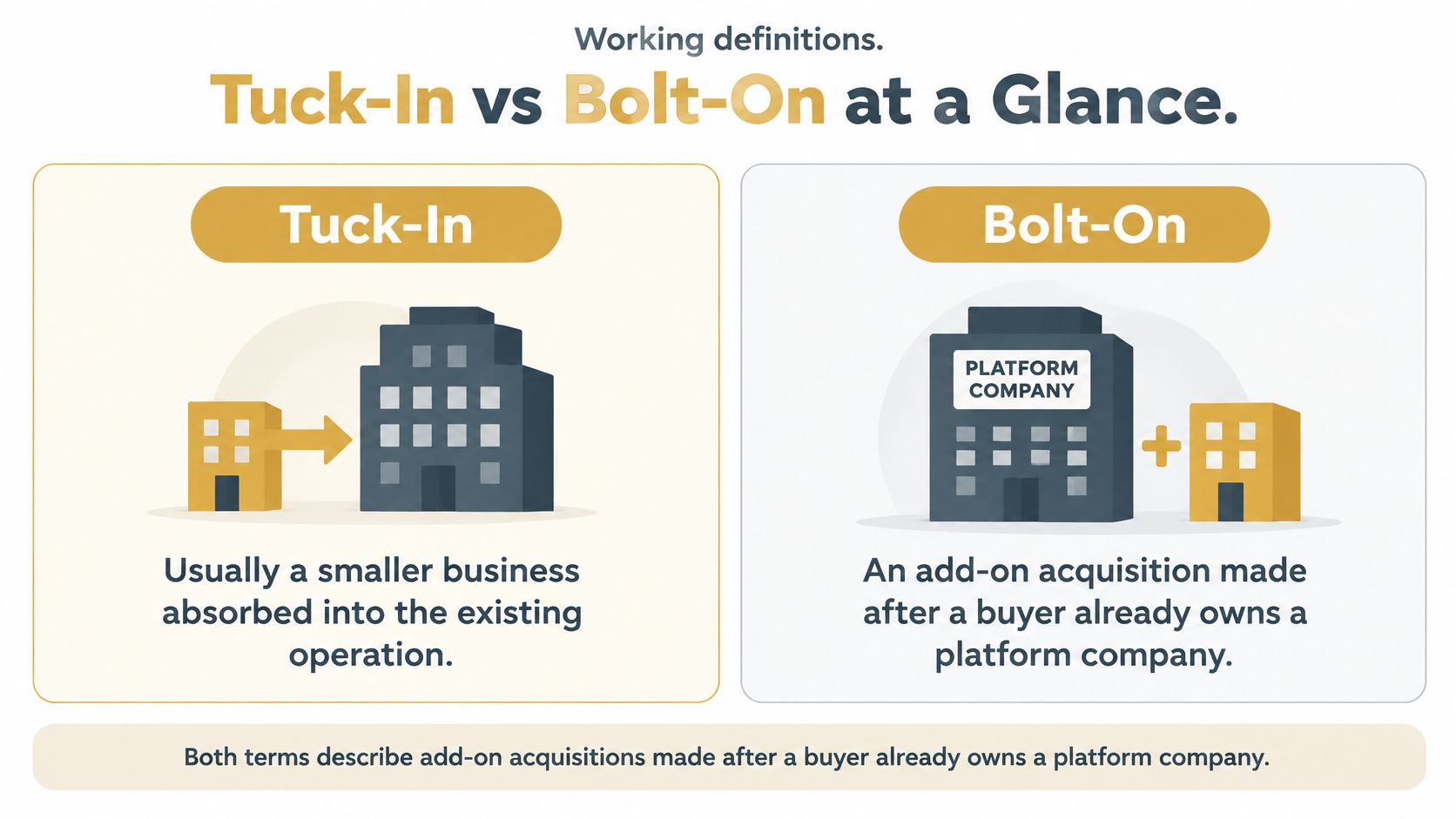
A tuck-in is a smaller business absorbed into an operation the buyer already owns. The cheque is for customers, staff, technology, a region, or a capability. Systems, brand, and processes are typically replaced by the platform's.
A bolt-on is a complementary company added to a platform. It can be small or substantial. It often keeps some combination of brand, local leadership, geography, or operating autonomy, while shared finance, procurement, or technology moves onto the platform.
Both are add-on acquisitions made after a platform company exists. The distinction is strategic rather than a standardized definition. Add-on transactions are usually judged against the platform's infrastructure, systems, management team, and distribution network rather than as stand-alone investments, as OpsFi's analysis of buy-and-build add-on acquisitions explains. Two buyers can file the same target under different headings, and neither has to be wrong about the business.
Read the rows as a pricing and work plan.
| Criterion | Tuck-in | Bolt-on |
|---|---|---|
| Typical target | Smaller business absorbed into an existing unit | Complementary company, small or substantial, added to the platform |
| Post-close integration | Folded into existing systems, processes and teams | Keeps brand, local leadership, geography, or operating autonomy; selected shared functions move to the platform |
| Main purpose | Customers, staff, technology, geography or capability | Expand platform scale inside a buy-and-build program |
| Operating model after close | Usually replaced by the platform's model | Often preserved in part |
| Key diligence focus | Transferable assets and integration cost | Standalone earnings and what must survive closing |
A tuck-in price holds only if customers, contracts, and data transfer, and if the synergy case is mostly cost takeout on systems the platform already runs. The integration clock is short. The target's own operating model is not part of what was bought.
A bolt-on price has to cover earnings that continue without the platform rewriting the business on day one. Synergy is narrower, usually shared finance, procurement, or technology, and the timetable runs longer because brand, geography, or leadership still have to perform. Banks, private-equity firms, and corporate acquirers still tag near-identical deals differently in documents and databases. Fund the row you can evidence, not the word on the teaser.
Why the Labels Blur and What Decides the Category
The label doesn't settle the deal. Two buyers can call the same target a tuck-in and a bolt-on, and both can defend it, because the terms describe intent and post-close operating model rather than a legal category. The Corporate Finance Institute's guide to bolt-on acquisitions makes the split explicit, noting that Investopedia treats the two as near-synonyms while other explanations separate them by what happens after closing, with a tuck-in absorbed into an existing division and a bolt-on retaining its brand, management or operating autonomy.
Replace the label with a question. Which assets must still work the way they did before closing? If the buyer mainly needs customers, employees, intellectual property or geography moved onto existing infrastructure, the deal behaves like a tuck-in regardless of what the teaser called it. If value depends on the target's local brand, relationships, management team or independent operating rhythm, it behaves like a bolt-on.
That call then drives four things a buyer has to fund.
- Diligence priorities. A tuck-in needs proof that customers, contracts and data transfer cleanly. A bolt-on needs proof that the earnings survive without the platform's help.
- Purchase price allocation. Value sitting in transferable assets gets priced differently from value sitting in a founder's relationships or a local name.
- Retention incentives. If people must stay, part of the price belongs in their pockets, not just the seller's.
- Systems migration timing. Absorbing finance and HR in month one is fine when nothing depends on the old stack. It isn't when the target's billing logic is the product.
Staged deals break the binary entirely. A transaction can open as a bolt-on, hold its brand for a year, then move finance and HR onto the platform and finish life as a tuck-in. Another keeps the brand while fully integrating everything behind it.
The practical tool is a deal-design matrix that maps each asset to one of three choices: absorb, keep or stage.
- Customers. Absorb when they buy through your channel and your sales team can serve them. Stage when contracts need consent letters before they can move.
- Brand. Keep when local recognition drives the purchase decision. Absorb when the name adds nothing your platform doesn't already have.
- Staff. Absorb the back office. Keep customer-facing teams whose relationships carry the revenue.
- Intellectual property. Absorb almost always, since ownership is the point.
- Systems. Stage the migration in waves so the revenue line survives the cutover.
- Leadership. Keep when the value depends on the operator staying. Absorb when the platform already has the manager.
Working rule: an asset-by-asset plan beats a single label every time, because it tells each workstream owner what they're protecting.
Integration Depth and the Work It Creates
Integration depth is the technical difference between the two deal types. A tuck-in moves onto the platform's business unit, systems stack and operating processes. A bolt-on may keep a distinct brand, geography, product line or leadership team while still leaning on shared capabilities. What changes in practice is the sequence of work, and it looks roughly the same on paper whether the target is a two-person agency or a regional operator.
- Decide what absorbs and what stays separate, function by function, because a vague answer here turns into a contested budget line in month three.
- Assign one owner per workstream and record a baseline before anything changes, so you can prove later whether the process improved or just moved.
- Set a 100-day plan for quick actions and a 12-month roadmap for system migrations, which keeps early wins visible while the slower work continues.
- Review monthly against that plan rather than the original deal model, because the model was built to win approval and the plan was built to run the business.
Where the target runs older ERP, order management or billing software, legacy integration patterns for B2B are worth reading before you commit to a cutover date, since the sequencing matters more than the tooling.
The common slip isn't a failed migration. It's a migration nobody measured. Teams move the data, switch off the old system and move on, without checking whether customers stayed, staff stayed or revenue held through the change. A tuck-in that loses a fifth of the target's accounts during the transition has given back most of what the lower entry price bought.
Keeping a bolt-on's leadership or brand creates a different obligation. Group reporting only stays comparable if you build a bridge: the same chart of accounts, the same revenue definitions, the same monthly close calendar, mapped back to the local structure so the local team still recognizes its own numbers. Skip that bridge and you spend the first year reconciling instead of managing.
Before signing, answer one question in writing: which functions must stay separate to protect the value you're buying? Our guide to determining post-acquisition integration needs walks through how to make that call before the wire goes out.
Integration cost is not the price of the migration. It's the price of the revenue you fail to protect while the migration runs.
Why a Bolt-On Can Lower the Blended Entry Multiple
The economics of an add-on are easy to state and easy to misread. A platform bought at 5.5x EBITDA on $5.0 million of EBITDA costs $27.5 million. A bolt-on producing the same $5.0 million of EBITDA at 3.5x costs $17.5 million. Together, the buyer owns $10.0 million of EBITDA for $45.0 million, which implies a blended entry multiple of 4.5x, a full turn below the platform multiple, according to CapitalPad's private-equity roll-up statistics.
| EBITDA | Multiple | Price | |
|---|---|---|---|
| Platform | $5.0M | 5.5x | $27.5M |
| Bolt-on | $5.0M | 3.5x | $17.5M |
| Combined | $10.0M | 4.5x | $45.0M |
Read the caveat next to the math. The same benchmark reports a 31.6% average deal IRR for historical buy-and-build investments against 23.1% for standalone buyouts, and 35.5% for deals with one or two add-ons against 19.9% for deals with more than two. These are observational comparisons, not proof that bolt-ons caused the premium.
That last pair is the part buyers skip. More add-ons correlating with lower returns doesn't mean add-ons destroy value. It's consistent with integration load, finite management bandwidth and buyers overpaying on the third and fourth deal once the playbook feels routine. Whatever the cause, the pattern argues for fewer, better-integrated targets rather than a queue of small ones.
The mechanism behind the multiple compression isn't just a cheaper purchase price. Shared finance, technology, sales, procurement, facilities and management convert the target's stand-alone cost base into group-level EBITDA. The target's accounting team becomes a shared function. Its software licences consolidate. Its purchasing runs through your contracts. Those savings are what make the pro forma earnings base larger than the sum of two stand-alone businesses.
Underwrite the deal in four separate lines so nobody blends them by accident: target stand-alone EBITDA, validated run-rate synergies, one-time integration costs, and the multiple applied to the pro forma earnings base. If you want the mechanics of how buyers and sellers settle on that final multiple, our explainer on understanding valuation multiples in deals covers the negotiation side.
The rule that keeps this honest is simple. A bolt-on's price advantage only counts once shared infrastructure can absorb the target. If the acquired business needs its own finance lead, its own procurement and its own sales operations to keep running, you paid 3.5x for a stand-alone company and financed the integration yourself.
Synergy Realization and Integration Cost Reserves
Price the offer on what you can defend after closing, not on the synergy slide used to support a higher number. A synthesis of post-merger research reports that cost synergies typically realize 70 to 85% of announced value, financial synergies 70 to 80%, and revenue synergies only 25 to 35%, according to PMIStack's post-merger integration statistics.
| Synergy type | Typical realization | Treatment in underwriting |
|---|---|---|
| Cost synergies | 70-85% of announced value | Committed EBITDA with a named owner and baseline |
| Revenue synergies | 25-35% of announced value | Probability-weighted upside, not committed EBITDA |
| Financial synergies | 70-80% of announced value | Modeled with timing and owner assigned |
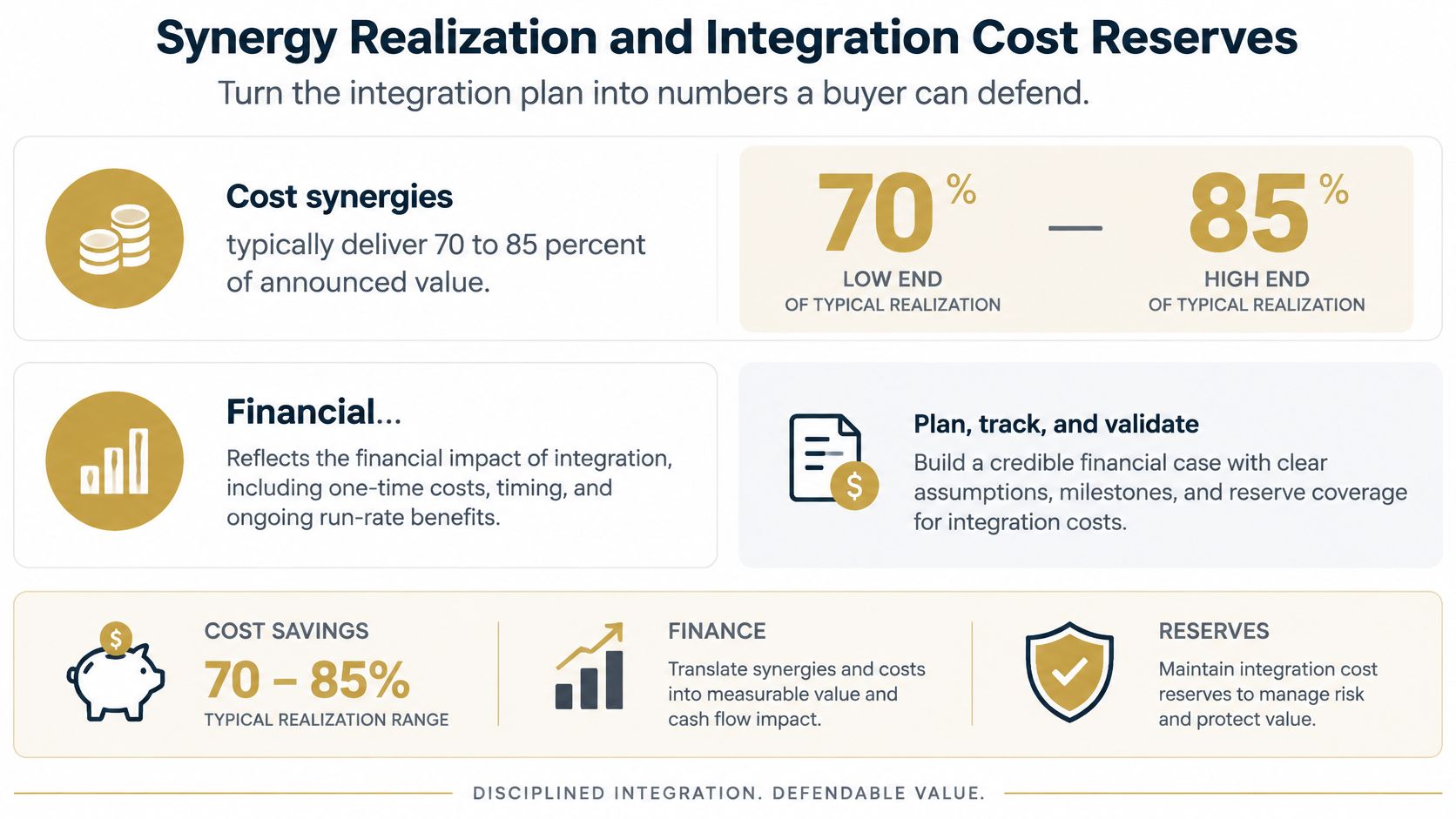
What must still be standing after the wire decides which of those rates you may use. In a tuck-in, customers, vendor contracts and systems have to move onto the existing platform. Vendor consolidation, duplicate back-office removal, facility rationalization and technology migration can be assigned to a named owner against a baseline, so they belong in committed EBITDA at 70 to 85%. Cross-selling and market expansion stay in a probability-weighted upside line, at 25 to 35% of the projection.
A bolt-on reverses the test. The brand, the local team and the accounts that buy because of who runs the place have to survive. Cost takeout that depends on absorbing that overhead does not clear the bar for committed EBITDA, because cutting it removes the asset you paid for. Financial synergies, where the capital structure changes, can still be modeled at 70 to 80%, with timing and an owner. Revenue bets remain at 25 to 35%.
Hold a reserve for the work of getting there before any synergy is booked. A tuck-in that must migrate systems, contracts and volume needs a heavier one-time reserve than a bolt-on whose plan is a reporting bridge and a retention program. That cash leaves whether the synergy arrives or not, which is what breaks the claim that a small deal can be absorbed.
Haircut, then price. Commit $0.70 to $0.85 of each announced dollar of cost synergy. Commit $0.25 to $0.35 of each announced dollar of revenue synergy. Our breakdown of evaluating potential acquisition synergies separates those controllable cost actions from the revenue bets, so the multiple lands on earnings you can stand behind.
Build the file in a spreadsheet so a change in realization rate moves the price in front of you. A spreadsheet guide for startup founders is only a general cost-benefit layout. The acquisition file still needs its own tabs for stand-alone earnings, synergies by owner, one-time costs, and the pro forma result after the haircut and the reserve.
Underwriting standard: commit cost synergies at 70 to 85%, price revenue synergies at 25 to 35%, and hold an integration reserve sized to what must survive closing, on top of both.
Which Approach Fits Which Deal
Classification follows the assets that must survive closing, not the size of the cheque. That single choice sets the price, the synergy case, and the integration clock.
A brand owner buys a competitor. An eCommerce operator acquires a rival whose customers, warehouse, and supplier contracts must move onto the existing platform. The customer list and the volume both transfer. This is a tuck-in. The value case lives or dies on migrating volume without losing rankings or accounts, so the offer should be written against a cutover schedule, not a brand plan. Synergies are cost and volume actions with owners and dates. If the migration slips, the price was wrong.
A regional services company buys a local name. A services platform acquires a local operator with a recognized brand, its own team, and accounts that buy because of who runs the place. The local identity and the people behind it are the assets that have to stay. That is a bolt-on. Fold the name into the platform and you pay for overhead while the relationships leave. The reporting bridge matters more than the systems migration, and the purchase price has to carry the cost of keeping that local team in place.
A platform runs a buy-and-build program. A buyer adds several small targets to lower procurement costs and share back-office functions. Each of those is a tuck-in, priced on the cost actions it enables, with a short integration window. The same program might acquire a larger regional player to enter a new geography. That deal behaves as a bolt-on because local management and the customer base stay. Same program, two classifications, two synergy cases, two integration budgets.
A staged acquisition. The buyer keeps the brand for the first year, then moves finance and HR onto the platform at the twelve-month mark, leaving sales and service local. Neither label fits cleanly, and forcing one misprices the deal. The timetable does the work: year-one synergies are limited to what can be taken without touching the brand, and the larger cost actions wait until month twelve.
Some targets split across both labels. Customers may transfer readily while the brand and local leadership must survive to keep them. The structure has to match that split: absorb account management, keep the brand, retain the founder on an earnout, and move finance only after the relationships are secure. Price the early period as a bolt-on and the later migration as a tuck-in, or the blended multiple will assume savings the first year cannot deliver. Where the target's value sits in recurring IT services and the growth plan depends on security capability, a cloud and cybersecurity growth guide is context for offerings the combined platform might sell. It does not classify the deal. Retained brand, retained leadership, and the staged timetable do.
Dealmaker Wealth Society works with buyers on this kind of structuring. Its focus is roll-ups and bolt-ons, buy-outs funded with debt, consulting for equity, and larger exits. Across those deals the pattern is consistent.
The category follows the asset you must keep, not the size of the cheque.
Confirm the Category Before You Make an Offer
Run this before the offer goes out, not after the letter of intent is signed.
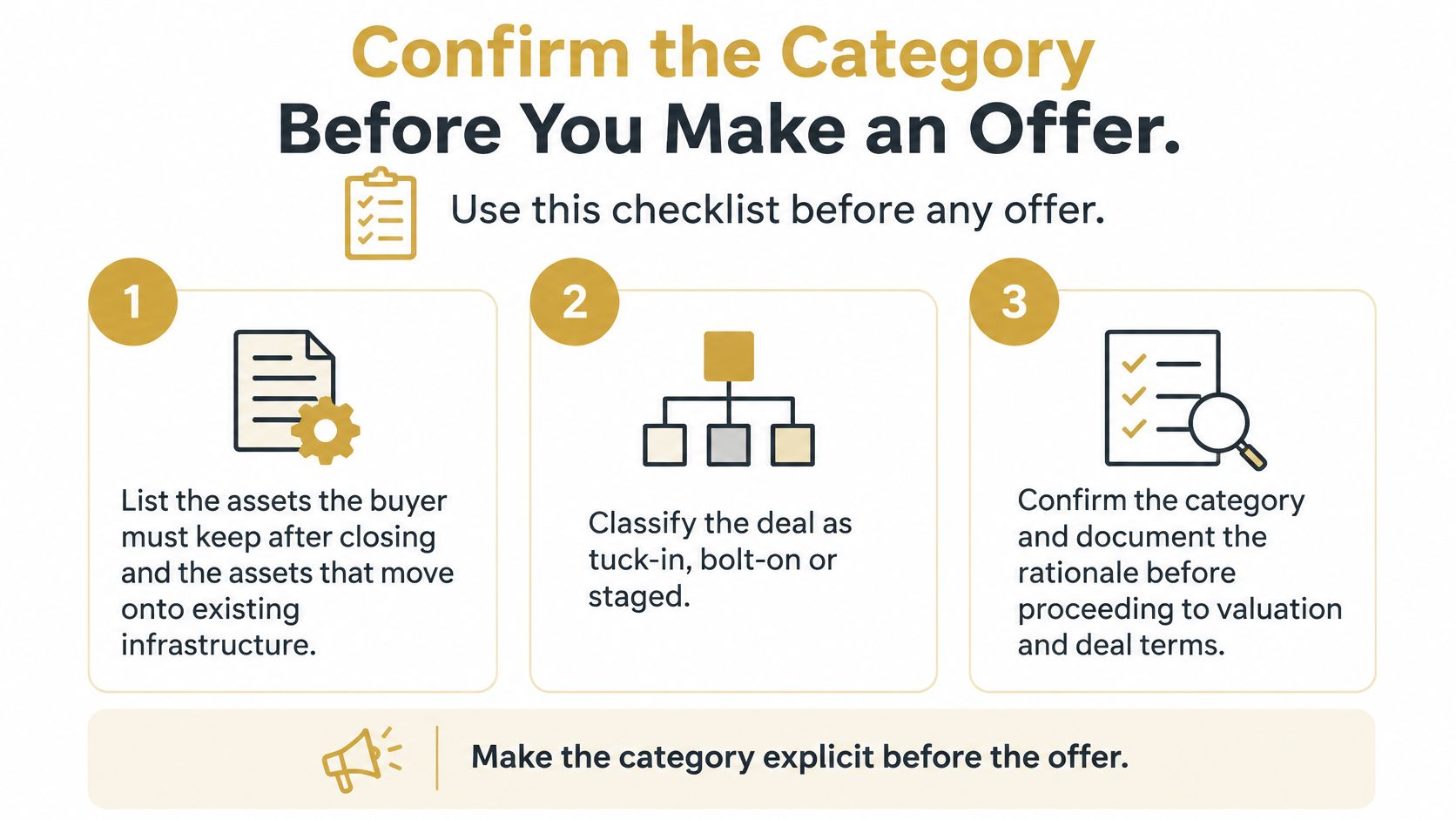
- List the assets that must survive closing and the assets that move onto your infrastructure. Two columns, every asset named.
- Classify the deal as tuck-in, bolt-on or staged from that list, using the asset rule rather than the target's revenue.
- Haircut the announced synergies at the realization rates, commit the cost actions with named owners, and push revenue synergies into a probability-weighted line.
- Add the sector integration-cost reserve you derived from the benchmark study, even when the target looks simple.
- Re-test the blended entry multiple after the haircut and the reserve, using the four-line underwriting split.
- Pull the 100-day and 12-month plans into the signing timetable with owners and dates attached, so integration starts on day one instead of after the handover lunch.
One more check belongs on the list, and it's the one that catches deals before the wire. Dealmaker Academy teaches a four-part customer verification process: a customer interview process, a concentration analysis, a contract review, and a retention risk assessment. Run all four on the target whose revenue you're counting on, because the accounts you assume will transfer are the same accounts that decide whether the classification was right. If you want a second read on a live deal, you can book a coaching call to review it with the team.
Then do the work this week. Take the one target you're evaluating, write its classification at the top of a page, list the assets that must survive closing beneath it, and test the price against the blended multiple once the synergies are haircut and the reserve is in. If the numbers still work with those assumptions in place, you have a deal worth pursuing. If they only work at full synergy, you have a price problem dressed up as a strategy.
Dealmaker Wealth Society teaches acquisition entrepreneurs how to classify a deal, price it against what must survive closing, and run the integration that follows, through on-demand modules, live coaching and a private peer network. If you're working through a tuck-in or bolt-on of your own, the community and the coaching team can pressure-test your classification and your blended multiple before you commit. Visit Dealmaker Wealth Society to see the training pathways and book a conversation about the deal in front of you.

From the Dealmaker Blog












A Creative Business Buying Fable