What Is SDE in Business Valuation? Formula and Examples
What Is SDE in Business Valuation? Formula and Examples
Seller's discretionary earnings is the total annual financial benefit one working owner can take from a small business, calculated as net profit plus owner compensation and other add-backs. It's a starting figure for pricing a company, not a forecast of your post-close paycheck.
So here's the question most explanations skip: if the seller stops showing up on Monday, how much of that advertised earnings figure survives? You either step into the owner's seat and do the work yourself, or you pay someone else to do it. SDE only answers the first version of that question. Understanding what is SDE in business valuation means learning both the arithmetic and the operating reality sitting underneath it.
Table of Contents
- Seller's Discretionary Earnings in Plain Terms
- How to Calculate SDE Step by Step
- Turning SDE Into a Business Value
- SDE Versus EBITDA and When Each Fits
- Checking Add-Backs Before You Trust SDE
- Confirm Your SDE Before Making an Offer
Seller's Discretionary Earnings in Plain Terms
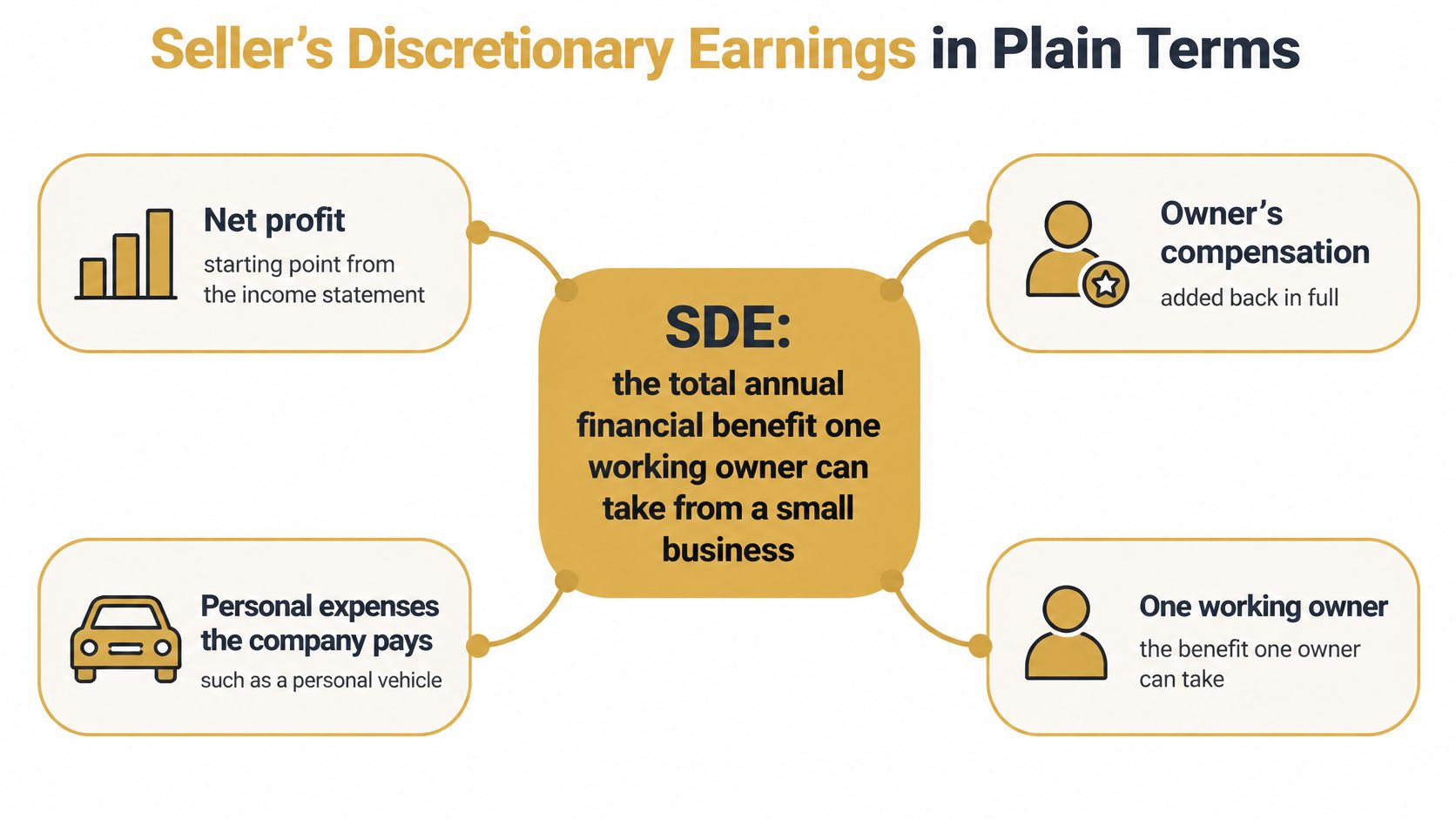
Morgan & Westfield's definition and examples of seller's discretionary earnings describe SDE as a cash-flow measure designed primarily for small, owner-operated businesses, representing the total annual financial benefit available to one working owner rather than accounting profit alone. The calculation starts with net profit and adds back the owner's salary, personal or discretionary expenses paid by the company, interest, taxes, depreciation, amortization and certain nonrecurring costs.
Think of it as what an owner would take home by staying on as the operator, not what the accountant prints at the bottom of the income statement. Two shops with identical economics can report wildly different profit because one owner takes a salary while the other runs a personal vehicle, a family phone plan and a ski trip through the company. Normalizing removes those choices so a buyer can compare the two on the same footing.
The concept map below shows the four pieces that make up the measure.
The example we'll carry through
Say a service company reports $180,000 of net profit, pays the owner $70,000 in salary, runs $20,000 of personal expenses through the books and records $10,000 of depreciation. Normalized SDE comes to approximately $280,000, before anyone checks whether each adjustment is defensible.
That last clause does the heavy lifting. SDE works when there's one working owner and the buyer intends to be that owner. It breaks down when the company needs a professional management team or several full-time owners, because no single buyer can absorb all those roles for free.
How to Calculate SDE Step by Step
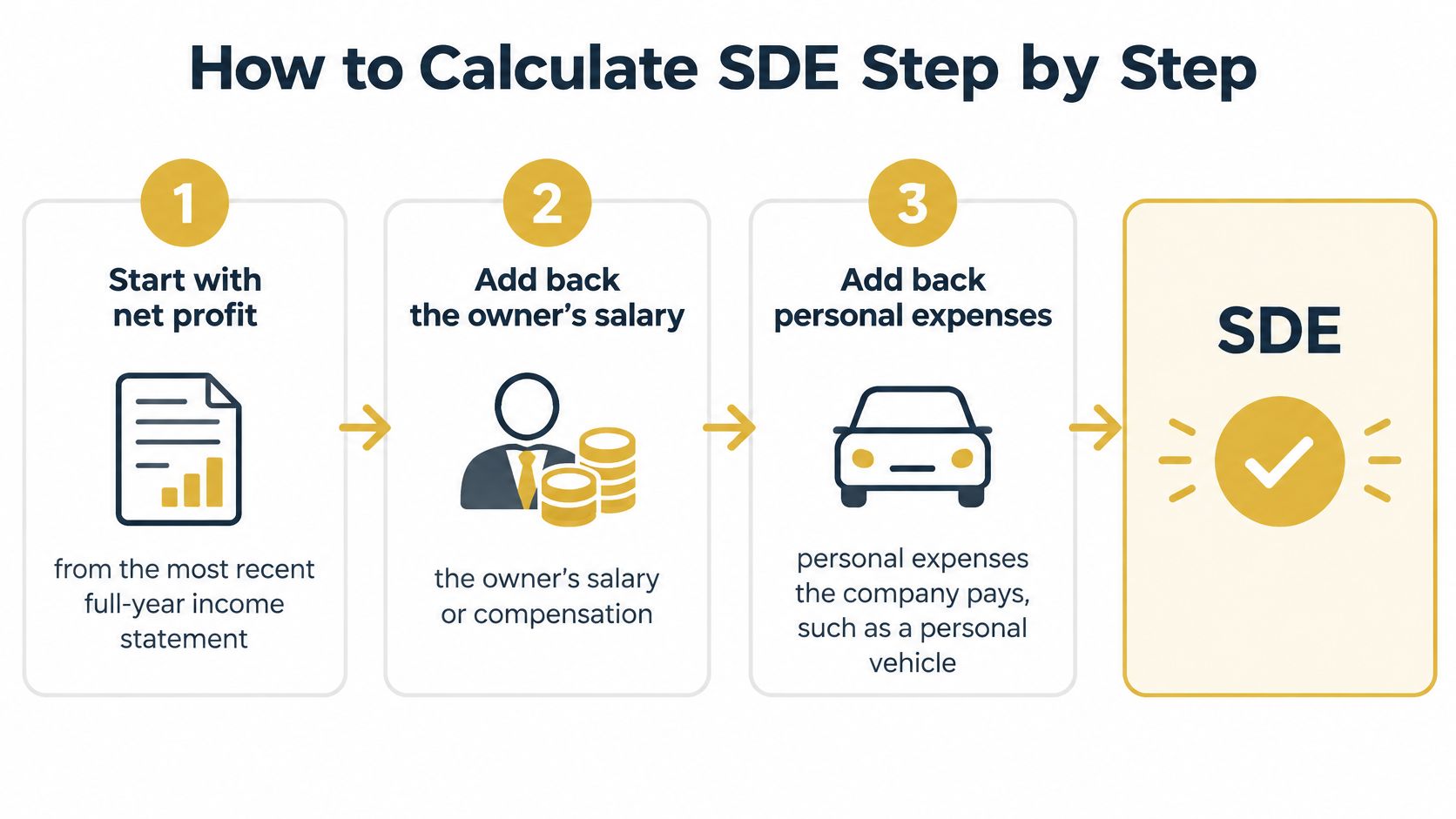
Build SDE in a fixed order, keeping a running total and a document for each adjustment. The calculation is a paper trail: every dollar added back should lead to an expense you can identify and explain.
- Start with net profit from the most recent full-year income statement, then reconcile it to the tax return. Investigate differences before treating either figure as your starting point.
- Add back one owner's compensation, including salary, bonus and payroll taxes already deducted from profit. The calculation assumes a single working owner, so keep any replacement staffing needs separate.
- Add back personal expenses the company pays. A privately used vehicle, family phone lines and travel without a business purpose qualify. A truck technicians use for jobs remains a business expense.
- Add back interest, taxes, depreciation and amortization. Interest and income taxes reflect financing and tax circumstances; depreciation and amortization are non-cash charges. Only add amounts already deducted in arriving at your starting profit.
- Add back documented nonrecurring costs, such as a one-time legal settlement or office move. Match each adjustment to an invoice and check prior years for similar charges.
- Verify every line against tax returns, bank statements and payroll records. An unsupported adjustment remains a seller's claim, not a confirmed addition to earnings.
The graphic summarizes the first three steps. Our example then adds depreciation to complete the calculation.
Two slips that cost buyers real money
Adding back owner salary does not make the owner's work disappear. If the seller is the lead estimator and you cannot perform that role, replacement pay reduces what you can keep. Record that cost separately rather than treating the full SDE as available income.
Recurring expenses need equal care. An annual spring marketing campaign remains an operating cost even if the seller describes each campaign as a separate, one-time project.
Use the walkthrough alongside the running total below.
Worked SDE calculation from net profit
| Line item | Amount (USD) | Running total (USD) |
|---|---|---|
| Net profit | $180,000 | $180,000 |
| Owner salary add-back | +$70,000 | $250,000 |
| Personal expenses add-back | +$20,000 | $270,000 |
| Depreciation add-back | +$10,000 | $280,000 |
| Normalized SDE | $280,000 | $280,000 |
The example reaches $280,000 only if each adjustment holds up. The salary add-back captures the owner's compensation, but a buyer who hires a replacement cannot keep all of it.
Finish with a supporting schedule that names the source document beside every add-back. A lender or accountant should be able to retrace the calculation, while you can distinguish the stated SDE from the earnings available after replacing the owner's work.
Turning SDE Into a Business Value
A buyer does not pay for SDE itself. A buyer pays for the portion of those earnings they can keep once the seller walks out the door, and the multiple is where that judgment gets priced. The formula is short: estimated value = SDE × a market-derived multiple. Transaction data summarized from approximately 9,500 closed U.S. small-business sales puts the all-industry average near 2.5× SDE, with many businesses selling between roughly 2.0× and 3.5×, according to the SDE multiples by industry benchmarks. The same benchmarks show the multiple generally rising with scale, from about 2.0× for businesses under $500,000 in value to 2.8× for the $500,000 to $1 million band and 3.1× for $1 million to $2 million.
Apply those tiers to a company producing $250,000 of verified SDE and you can see how much the multiple alone moves the answer.
Benchmark SDE multiples and implied values by deal size
| Deal size | Typical SDE multiple | Example SDE (USD) | Implied value (USD) |
|---|---|---|---|
| Under $500,000 | about 2.0x | $250,000 | about $500,000 |
| $500,000 to $1 million | about 2.8x | $250,000 | about $700,000 |
| $1 million to $2 million | about 3.1x | $250,000 | about $775,000 |
| All industries average | about 2.5x | $250,000 | about $625,000 |
The spread in that table is over a quarter of a million dollars on identical earnings. That gap is the market pricing one question: how much of this income survives the change of ownership?
Why identical earnings support different prices
The multiple is a risk judgment expressed as a number. SDE assumes one working owner, so every buyer is asking what happens to the cash flow when that owner leaves. Buyers weigh growth, recurring revenue, customer concentration, owner dependence, competitive position, the quality of the records and how easily the deal can be financed. A company with service contracts, a broad customer base and a documented operations manual earns the top of its band, because a new owner can step in and keep most of the earnings. A company where one client supplies most of the revenue and the owner holds every relationship earns the bottom, if it sells at all, because the buyer is purchasing income that may leave with the seller.
Closed-sale data tells you what buyers actually paid. Asking prices tell you what sellers hoped for, and those are different datasets.
Two practical consequences follow. Raising sustainable SDE increases value at any given multiple, so cleaning up pricing, cutting genuine waste and adding recurring revenue pays twice. Reducing owner dependence and building systems can also lift the multiple itself, which is why a well-documented business often outsells a slightly more profitable but chaotic one. A buyer who must hire a manager to replace the seller, or who expects key customers to follow the seller out the door, will not keep the full SDE figure, and the offer will reflect that shortfall. If you want to go deeper on how buyers argue about the multiplier, our guide to understanding valuation multiples in deals walks through that negotiation.
Treat every figure in that table as a benchmark rather than an appraisal of your specific target. The bands tell you where negotiations start. Where they end depends on how much of the earnings a buyer believes they will still own twelve months after closing.
SDE Versus EBITDA and When Each Fits
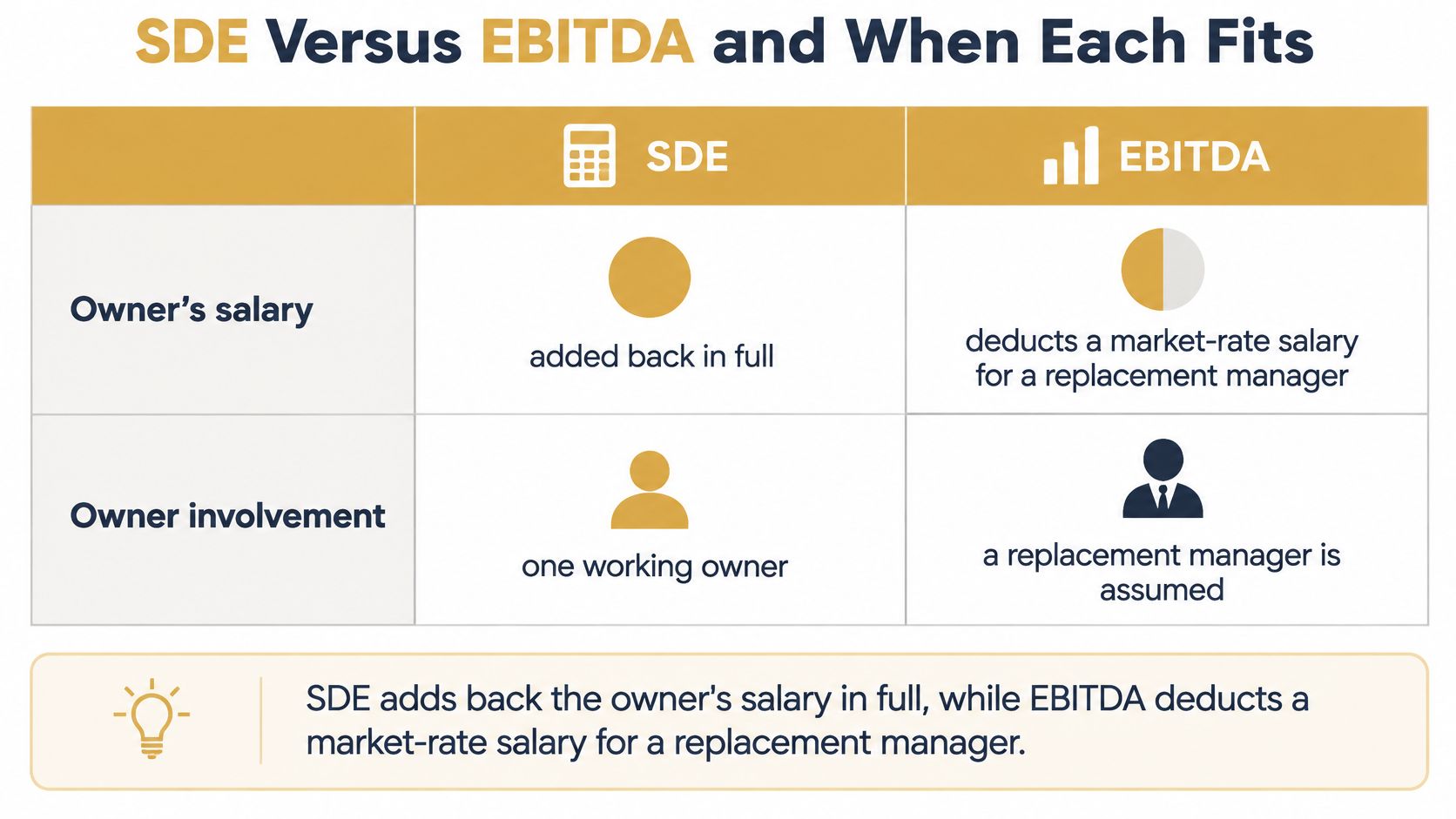
One accounting choice separates the two metrics. SDE adds the owner's compensation back in full. EBITDA leaves a market-rate salary in place for whoever performs that operating role, so it assumes the business pays for management whether the owner shows up or not.
The ARX Brokers business valuation guide reports SDE multiples around 2.0x for transactions below $500,000 and 3.5x to 4.1x EBITDA for $2 million to $5 million deals in 2025, with the middle bands shifting gradually from one metric toward the other.
SDE and EBITDA compared on the criteria that decide which to use
| Factor | SDE | EBITDA |
|---|---|---|
| Owner salary | Added back in full | Deducted at a market-rate replacement wage |
| Typical company | Owner-operated, usually under $1 million | Growing firms with management teams |
| Owner role | One working owner who will run the business | Owner may not be the operator |
| Reported multiple range | About 2.0x to 3.0x for deals under $1 million | About 3.5x to 4.1x for $2 million to $5 million deals |
Where SDE stops being decision-useful
Size is a proxy, not the rule. The key test is management depth. A company with several managers, institutional processes and two active owners needs market compensation for every working executive, which is EBITDA territory regardless of how small the revenue line looks. A single-owner plumbing operation where the buyer intends to run the schedule and the books is worth one owner's total economic benefit.
This produces an insight that cuts against the usual sales pitch: a higher SDE figure can signal greater owner dependence rather than superior quality. Every dollar added back because the owner did the work personally is a dollar of labor the buyer must replace or perform.
So pair the earnings number with the operating facts that determine whether it's transferable:
- Owner reliance: list the tasks only the seller performs, from estimating to key account calls.
- Customer concentration and recurring revenue: identify how much income is contracted versus re-won each year.
- Working capital and replacement management: price the inventory, receivables and salaries the business needs on day one.
If the business would fail without the owner, SDE is measuring the owner, not the company.
Checking Add-Backs Before You Trust SDE
An SDE figure is only as reliable as the adjustments underneath it. Guidance on the dreaded add-backs in business valuation separates legitimate normalization from speculative adjustments and notes that lenders recheck add-backs against tax returns, bank activity, payroll, invoices and operating needs, with observed industry multiples ranging from below 1.5x to above 6x. That spread is a warning: a multiple without an operating-reality bridge is incomplete.
Build three columns instead of one number.
Reported, lender-accepted and buyer-adjusted
Reported SDE is the seller's version, the figure on the listing. Lender-accepted SDE is what survives documentation review, and it's usually smaller because unsupported lines get struck. Buyer-adjusted cash flow is what remains after you fund a manager to replace the owner and restore recurring costs that were removed as discretionary.
Run the arithmetic on a scenario. Say a business clears diligence at $250,000 of SDE and the seller asks $625,000, which is 2.5x. If you don't intend to run it full time and must pay a competent manager $60,000 (an illustrative assumption, not a market quote), you keep about $190,000. The same price is now roughly 3.3x the cash flow you retain, and your debt service comes out of that smaller pool.
Which adjustments survive scrutiny
- Usually accepted: a documented one-time legal settlement, a personal car used only privately, payroll for a relative who does no work.
- Usually rejected: removing the cost of an owner who does all estimating, sales or technical work, cutting key staff pay from the figures, or calling an annual campaign nonrecurring.
- Always required: the source document. Match each line to tax returns, bank statements, payroll records and invoices, and write a verdict of accepted, adjusted or rejected beside it.
Customer revenue deserves the same treatment as expenses. The customer verification process taught at Dealmaker Academy has four parts: a customer interview process, a concentration analysis, a contract review and a retention risk assessment. It's the same process our founder runs before putting real money into an acquisition, and it tells you whether the earnings you're buying will still be there next year. For the broader debate on which adjustments buyers should accept, read our piece on what add-backs actually are.
Confirm Your SDE Before Making an Offer
Work through this sequence before you sign anything, and write the output down where a lender can see it.
- Rebuild SDE from source records. Use the last full year of tax returns and bank statements rather than the seller's spreadsheet, and reconcile the two.
- Sort every add-back into three columns: reported, lender-accepted and buyer-adjusted. Anything you can't document moves out of the middle column.
- Subtract the cost of any role the owner currently fills. Price a real hire at a real wage, including payroll taxes, even if you plan to do the job yourself for a while.
- Restore recurring costs removed as discretionary. Vehicles, software renewals, annual marketing and equipment replacement cycles belong in the operating budget.
- Apply the multiple range for the deal size to the adjusted figure, not the reported one. That's the price you can defend in a negotiation.
- Confirm the result with a lender and an accountant before you commit capital. Two independent reviews catch what your own enthusiasm misses.
Our guide to analyzing seller financial statements covers the document requests that make step one possible, including the general ledger access most first-time buyers forget to ask for.
Dealmaker Wealth Society has specialty coaches for capital raising, operations, financial due diligence, M&A legals and contracts, post-acquisition growth, post-acquisition transition and integration, and deal origination, so you can put your recast figures in front of someone who reviews deals for a living. We're a training company, not an investment adviser, and we don't provide personalized financial advice or act as a financial advisor. Your accountant and lender sign off on your specific deal.
Walk away from this process with three things: one defensible earnings number, the multiple range behind it, and a clear list of the costs you still have to fund after closing.
Rebuilding SDE line by line is exactly the kind of work our financial due diligence coaches review with students on live deals, alongside training in creative deal structuring, capital raising and post-acquisition growth. If you're screening your first acquisition and want a second set of eyes on the seller's add-backs before you write an offer, visit Dealmaker Wealth Society to explore the coaching and training we offer.

From the Dealmaker Blog












A Creative Business Buying Fable