Risks of Acquisitions and How to Mitigate Them
Risks of Acquisitions and How to Mitigate Them

The commonly cited 70% to 90% of acquisitions fail to achieve their intended value, as summarized in recent independent SMB acquisition coverage on the four risks that decide an acquisition. That statistic is usually used to criticize post-close integration. The more useful interpretation is harsher: many deals are already structurally fragile when the buyer signs.
Integration can expose the damage, but target selection, valuation, financing, and diligence often create it. Buyers miss the interaction between an overstated cash flow forecast, a concentrated customer base, a founder-dependent sales process, and debt sized against synergies that haven't arrived. Each issue may look manageable in isolation. Together, they can turn a reasonable operating problem into a liquidity crisis.
The practical question isn't “What are the risks of acquisitions?” It's, which risks should stop, reprice, or reshape the deal before close?
Table of Contents
- Why Most Acquisitions Fail Before Integration Even Starts
- The Four Risks That Predict Deal Failure
- How Debt Structure Changes Default Risk
- Technology and Data Integration Risks That Destroy Cash Flow
- Mitigation Tactics for Each Deal Phase
- When Risks Compound in a Single Deal
- Building Risk Management Into Your Deal Structure
Why Most Acquisitions Fail Before Integration Even Starts
The conventional M&A story starts after closing. The buyer announces a Day One plan, appoints an integration leader, schedules leadership meetings, and then discovers that the target's systems, incentives, and operating habits don't fit the acquirer's model. Culture clashes and poor execution matter, but blaming them exclusively lets the underwriting team off the hook.
Academic work on post-acquisition integration identifies failure to realize expected synergies as a major contributor to acquisition failure. It also identifies knowledge-sharing breakdowns as a serious cause of missed synergy effects in research on post-acquisition integration. That finding changes the operator's job before signing. The buyer must establish which knowledge creates revenue, how that knowledge transfers, and what happens if the people who hold it leave.
Pre-close risk accumulation
Most diligence processes separate financial, legal, commercial, and operational workstreams. That organization is efficient for specialists, but dangerous for decision-makers. A finance team may approve normalized EBITDA, a commercial team may accept the customer pipeline, and an operations team may flag founder dependence without anyone combining the implications.
Suppose the forecast assumes the founder remains active, two major customers renew, and a billing migration produces savings quickly. Those assumptions aren't independent. Founder departure can weaken renewals, weaker renewals can reduce cash flow, and lower cash flow can make debt service and integration spending collide. The buyer needs one integrated risk register, not several clean reports that never meet.
The M&A process from a founder's perspective is useful context because sellers and buyers experience the same transaction through different incentives. A founder may focus on certainty, confidentiality, and legacy, while the buyer needs verifiable transferability and downside protection.
| Root Cause Category | Phase Where Risk Originates | Phase Where Failure Becomes Visible | Typical Time to Surface |
|---|---|---|---|
| Inflated cash-flow assumptions | Target selection and valuation | Debt service and operating review | After close, when actual conversion diverges |
| Customer concentration | Commercial diligence | Renewal and pricing cycle | When a major account changes behavior |
| Owner dependency | Management assessment | Handover and client transition | When the founder reduces involvement |
| Integration design gaps | Pre-close planning | Systems and process migration | During early execution |
| Weak knowledge transfer | Deal planning and retention design | Cross-functional operating work | As teams attempt to combine workflows |
Signing removes bargaining power. Before close, the buyer can lower the price, add conditions, require a transition commitment, or walk away. After close, the same buyer owns the problem and must fund the fix. That's why integration planning best practices belong in the underwriting conversation, not in a folder opened after the announcement.
The Four Risks That Predict Deal Failure
Recent independent coverage on SMB acquisitions highlights four risks that buyers often review separately and then experience together: overstated cash flow, customer concentration, owner dependency, and debt. Legal and tax liabilities deserve their own diligence, but these four risks are especially useful because they connect valuation, revenue durability, management continuity, and solvency.
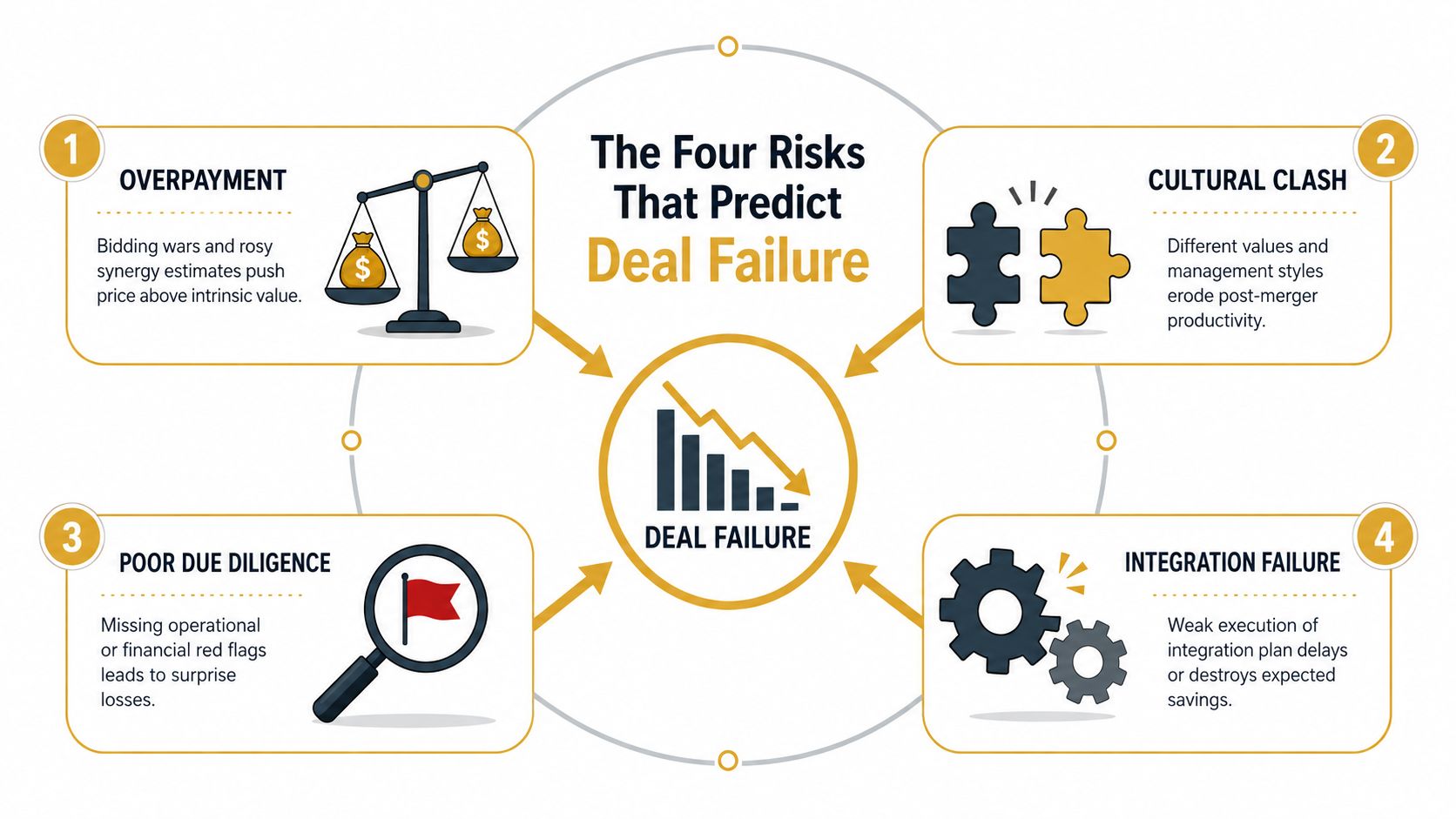
Overpayment removes the margin for error
A competitive process encourages buyers to defend a price with optimistic synergy assumptions. The problem isn't only paying a high multiple. It's paying a price that requires every assumption to work, then financing the transaction as though the upside were already proven.
After close, that pressure often produces aggressive cost reduction. The buyer cuts staff, marketing, or service capacity to protect returns, and those cuts can weaken the very customer relationships that supported the original model. A safer approach separates standalone earnings from unproven synergies and makes the price bear the uncertainty through contingent consideration.
Customer concentration turns one account into a capital event
Trailing revenue can conceal fragile revenue quality. A customer may be large but lightly contracted, tied to one relationship, or preparing to rebid the work. Validate revenue at the account level, review renewal behavior, inspect gross margin by customer, and speak with customers where the transaction process permits it.
When a concentrated account weakens after close, the buyer rarely responds calmly. Management may discount pricing, accelerate sales hiring, or draw on reserves while still paying acquisition debt. The revenue loss then becomes a margin and liquidity problem.
Owner dependency makes the asset less transferable
In many SMBs, the founder is the salesperson, escalation point, recruiter, and keeper of undocumented operating knowledge. An employment agreement helps, but it doesn't automatically transfer trust or judgment. Buyers need a transition map that names relationships, decisions, workflows, and training responsibilities.
Hidden liabilities arrive when attention is elsewhere
Incomplete legal, tax, employment, licensing, or compliance diligence can create obligations that weren't included in the purchase model. Asset-light businesses are particularly exposed when informal practices have replaced documented controls. Representations, warranties, indemnities, and escrow can allocate some of this risk, but contractual protection doesn't replace investigation.
The buyer should force each diligence finding into one of three decisions: reprice the deal, restructure the consideration, or accept the risk knowingly. Leaving it as a footnote is not a decision.
How Debt Structure Changes Default Risk
Debt changes how quickly an ordinary operating setback becomes a solvency problem. A target with steady cash generation may absorb a temporary customer delay when scheduled payments are modest. The same business becomes fragile when debt service consumes most available cash, even if revenue operations have not changed.
Research on acquisition financing indicates that changes to capital structure at closing can increase distress risk. The same study links narrow credit spreads before closing with higher post-buyout default probabilities assigned by banks. Buyers should stress-test the financing package alongside the purchase price, because an acceptable valuation can still fail under an impractical repayment schedule.
Build the downside case around cash, not optimism
Start with standalone cash flow, then model revenue pressure, weaker collections, delayed savings, integration costs, and refinancing constraints. The purpose is to identify which combination of ordinary setbacks leaves the company unable to meet its obligations.
Review these questions before committing:
- Debt service capacity: Can the business meet scheduled payments without relying on unproven synergies?
- Covenant headroom: How much operating deterioration triggers a breach, and what remedies does the lender receive?
- Refinancing exposure: What happens if credit conditions worsen before the next maturity?
- Cash reserves: Will the buyer retain enough liquidity for customer losses, retention payments, system work, and working-capital volatility?
- Payment timing: Do amortization demands arrive before the business can realistically deliver planned improvements?
A seller note or earn-out can reduce cash paid at closing, while creating competing incentives. The seller may prioritize short-term revenue recognition, but the buyer needs durable margin and customer retention. Define measurement rules, operating control, dispute procedures, and subordination clearly.
Faster financing can also be more expensive. Resources on hard money business acquisition loans explain the speed and structure of that option, but speed does not make a weak target safer. The financing must fit the business's cash conversion and ability to withstand a downside case.
Preserve optionality by sizing debt against current standalone performance, retaining liquidity for post-close surprises, and negotiating covenant flexibility during the early transition. The comparison of equity and debt financing for acquisitions helps frame the trade-offs among control, dilution, repayment pressure, and financial resilience.
Technology and Data Integration Risks That Destroy Cash Flow
Technology diligence is often treated as an IT checklist. That misses the economic issue. Fragmented systems create deferred operating expense, and the bill arrives when the buyer tries to combine reporting, billing, customer management, and controls.
An incompatible ERP can force teams to reconcile transactions manually. Shadow spreadsheets can hold pricing logic or customer history that no system owner understands. Orphaned software subscriptions can continue charging after the acquisition because nobody has established ownership. These problems affect working capital, reporting accuracy, overhead, and management time.
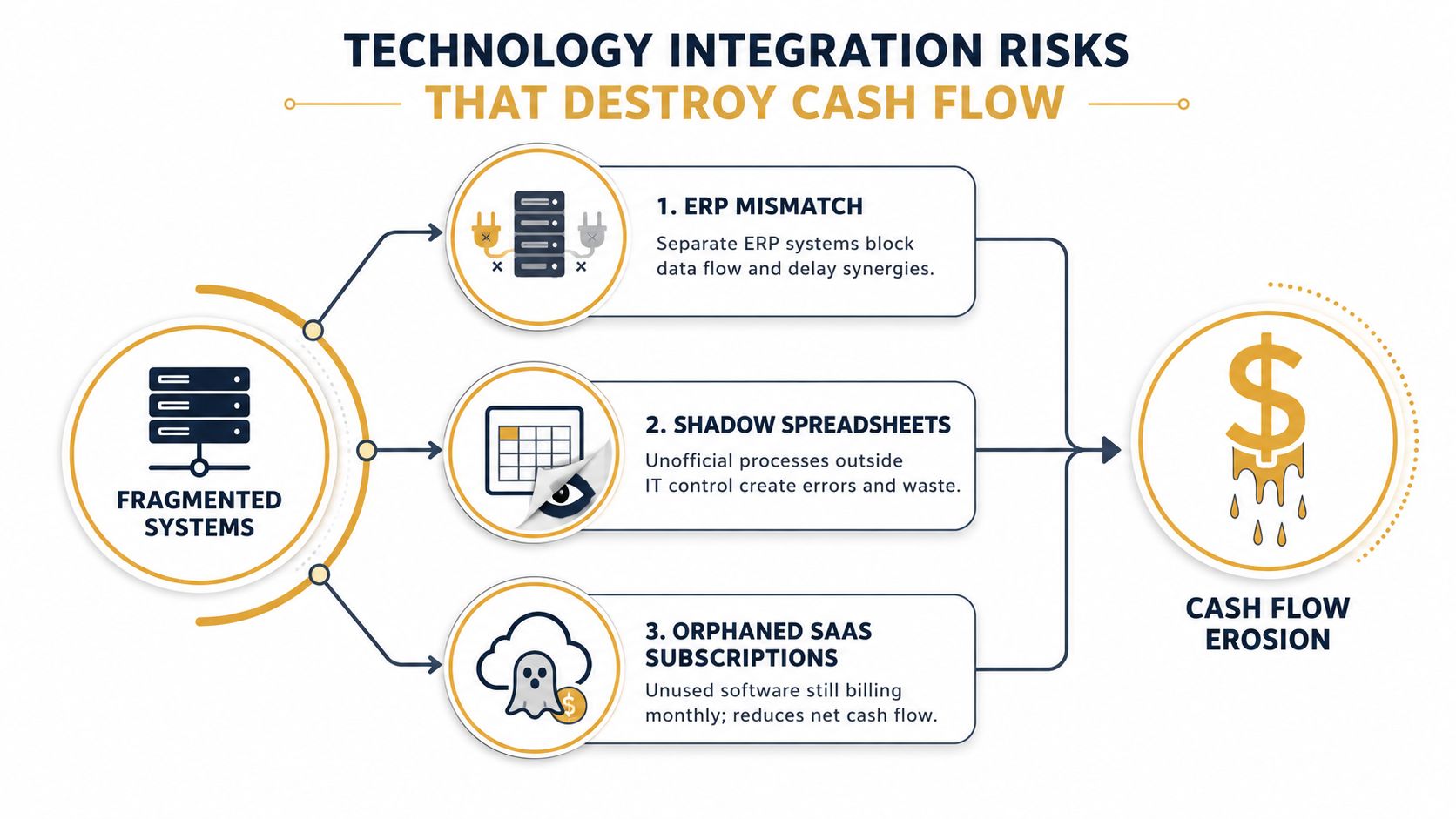
Trace each system defect to an economic consequence
The buyer should map technology findings to financial statements rather than accepting a technical risk rating.
| Technology or data issue | Operating consequence | Financial line at risk |
|---|---|---|
| ERP mismatch | Manual consolidation and delayed close | Administrative expense and management capacity |
| Billing inconsistency | Invoice errors and collection disputes | Revenue quality and accounts receivable |
| CRM incompatibility | Lost activity history and weak handoffs | Pipeline conversion and customer retention |
| Shadow spreadsheets | Duplicate data entry and uncontrolled logic | Labor cost and reporting reliability |
| Unowned SaaS accounts | Continued use or unnecessary billing | Operating expense |
The right question isn't whether the system can eventually be replaced. It's whether the company can operate safely while replacement occurs. SMB buyers often inherit founder-built workflows with limited documentation and no internal IT bench. A migration that looks affordable on paper can consume leadership attention, interrupt billing, and delay integration benefits.
Sequence migration instead of chasing a clean slate
Stabilize billing, payroll, customer service, and financial reporting first. Freeze unnecessary system changes, assign owners to critical data, and reconcile the two businesses using defined control reports before moving records. Keep a clear rollback plan for every migration that can interrupt revenue collection.
The technology integration challenges in mergers offer a useful planning reference for buyers building that workstream. Technology should support the operating model, not dictate a rushed transformation schedule. If the acquired business can keep serving customers and producing reliable cash data, the buyer has time to improve the architecture without turning technical debt into an operating emergency.
Mitigation Tactics for Each Deal Phase
Risk mitigation changes as the transaction advances. Before a letter of intent, the buyer decides whether further time and expense are justified. Between LOI and close, diligence and contract terms determine how downside is allocated. After close, the focus shifts to protecting cash and maintaining operating continuity.
Before the LOI
Run a targeted screening sprint before commissioning every diligence workstream. Request customer revenue by account, renewal and churn history, owner involvement by process, normalized cash conversion, outstanding debt, and a preliminary technology inventory.
The objective is to identify deal-breakers early, before commissioning every diligence workstream. If one customer generates a material share of revenue, obtain direct validation before making an offer. If the owner controls sales and delivery, reflect transition risk in the initial structure. If cash flow cannot support the proposed financing, integration plans will not correct the mismatch.
Between LOI and close
Diligence findings should change the purchase agreement, rather than merely populate a report. Use specific representations and warranties covering revenue recognition, tax compliance, employee obligations, intellectual property, customer contracts, data rights, and system ownership. Consider escrow or holdbacks for risks that are identifiable but not fully quantified.
Founder employment or consulting terms should define the actual knowledge-transfer work: customer introductions, documentation, process training, and decision handoffs. Earn-outs require objective definitions and protections against disputes over post-close operating decisions. Maintain a written list of risks requiring a price change, structural protection, or termination.
Debt capacity deserves its own review. Model lower revenue, slower collections, margin pressure, and delayed synergies before financing is final. Covenant headroom can disappear quickly when a concentrated customer relationship weakens at the same time that integration costs rise.
The first 100 days
Post-close priorities should be cash stabilization, customer continuity, and control visibility. Establish an integration management office with named owners, a weekly issue log, and separate KPIs for retention, system harmonization, knowledge transfer, and synergy capture.
| Deal Phase | Mitigation Tactic | Risk Addressed |
|---|---|---|
| Pre-LOI | Account-level revenue and renewal review | Customer concentration |
| Pre-LOI | Founder dependency map | Key-person risk |
| LOI to close | Targeted representations and escrow | Undisclosed liabilities |
| LOI to close | Downside debt model and covenant review, including lower-revenue and slower-collection cases | Default risk |
| LOI to close | Founder transition agreement | Knowledge loss |
| First 100 days | Cash-control dashboard | Liquidity leakage |
| First 100 days | Staged system migration | Technology disruption |
| First 100 days | Retention and customer-contact plan | Revenue and talent loss |
Do not migrate every system at once. Protect the revenue engine first, then remove duplication in a sequence the operating team can absorb. Keep rollback procedures for changes that could interrupt billing, reporting, or customer service. That sequencing preserves room to address the risks identified before close without turning the first integration decisions into a cash-flow crisis.
When Risks Compound in a Single Deal
A lower-middle-market buyer acquires a services business with $12 million in revenue after winning a competitive process with aggressive synergy assumptions. The buyer has also underestimated customer concentration and assumed the founder's sales relationships will transfer naturally. Those assumptions create a narrow margin for error before the first integration decision is made.
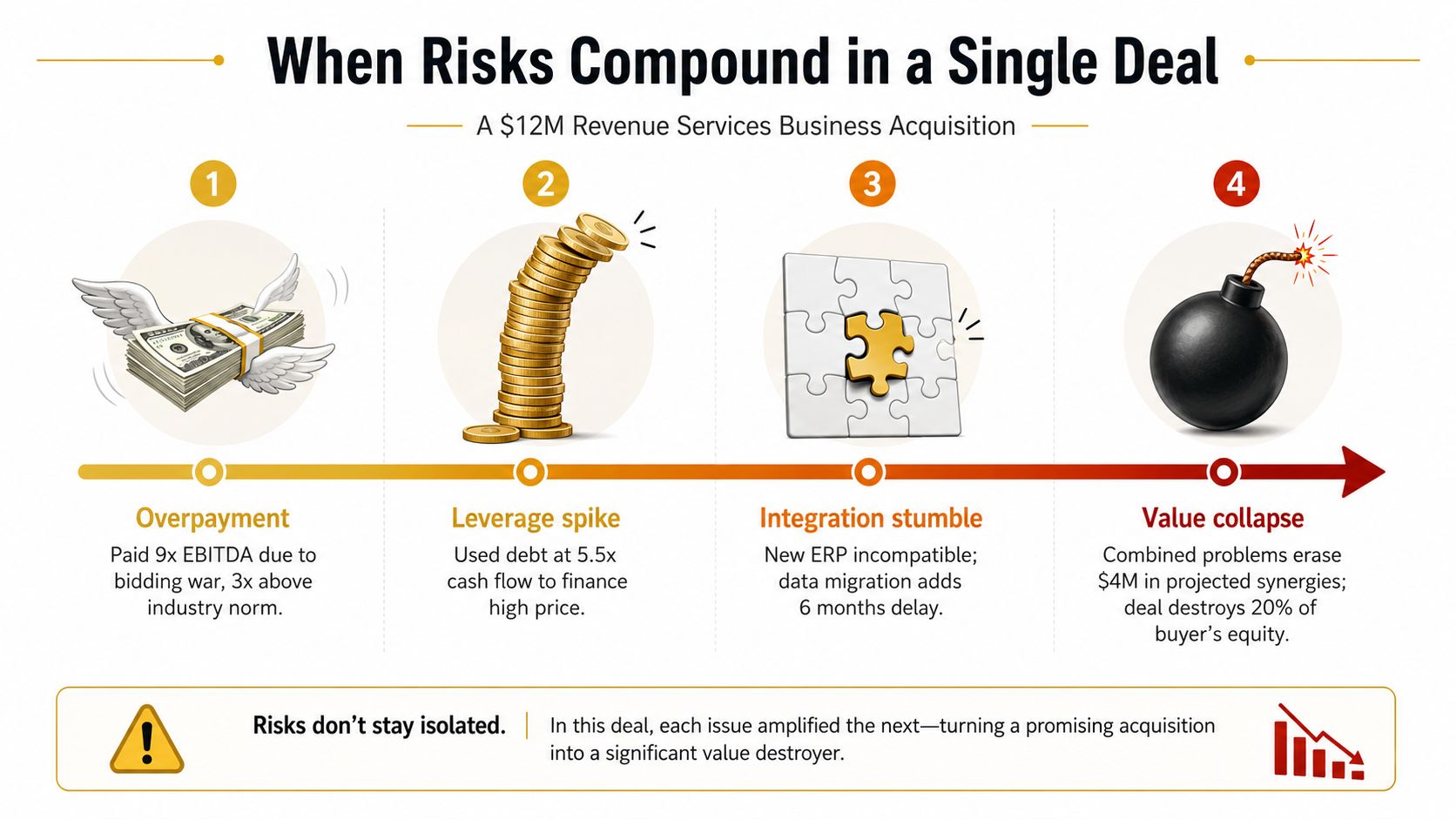
Revenue weakens first. A major customer becomes uncertain during the transition because the founder no longer owns the relationship. The buyer responds with discounts and additional account coverage, preserving part of the account while reducing margin and consuming management time.
Financing pressure follows. Debt payments were sized around the original forecast, so weaker revenue leaves less cash for retention, hiring, and integration. Key employees question the new operating model. Meanwhile, the founder remains the only person who understands several critical processes, turning dependency into a retention and continuity problem.
Technology friction then converts operating strain into reporting risk. The acquired billing system does not meet the buyer's reporting requirements, and the ERP migration takes longer than planned. Teams run parallel processes, reports arrive late, and leaders cannot separate a genuine sales decline from a data problem. The combined effect is predictable: less cash, less management capacity, and less time to correct the original assumptions.
Three points where the buyer could have intervened
First, the buyer could have changed the structure. A lower upfront payment, seller note, earn-out, or holdback would have kept more uncertainty with the seller and reduced the value paid before performance was demonstrated.
Second, the buyer could have validated customers before signing. Direct renewal evidence, relationship mapping, and account-level margin review would have shown how much revenue depended on the founder and what retention effort would cost.
Third, the buyer could have delayed the ERP migration. A controlled reporting bridge and protected billing process would have preserved cash visibility while the team documented data and workflow dependencies.
Overpayment, concentration, dependency, borrowing, and system friction compound because each risk erodes the margin the buyer needs to absorb the others.
Building Risk Management Into Your Deal Structure
Due diligence identifies risk. Deal structure determines who carries it, when it is paid for, and what happens if the assumption fails. Once a buyer closes an overvalued or poorly protected transaction, negotiation options shrink and cash becomes the main buffer.
Use structural protections against the risks that can fail before close and intensify afterward:
- Earn-outs: Tie contingent consideration to durable revenue, retention, or gross-profit outcomes when future performance depends on the seller's relationships. Define accounting rules, decision rights, and operating control before signing.
- Seller notes: Keep the seller economically connected to continuity and repayment. Document subordination, default rights, reporting access, and conditions for payment.
- Escrow and holdbacks: Reserve consideration for identifiable liability exposure, tax issues, indemnity claims, or unresolved diligence findings. Match the amount and release terms to the specific risk.
- Representations and warranties insurance: Assess whether insurance can transfer specified transactional risks. Review exclusions, retention, policy limits, and claims procedures before relying on it.
- Transition agreements: Turn informal founder knowledge into scheduled introductions, documentation, training, and handover milestones. Assign owners and deadlines so continuity does not depend on goodwill.
Technical debt deserves treatment similar to financial debt because both consume future capacity. The Faberwork LLC technical debt insights offer context for treating unmanaged systems as a risk-control issue rather than a purely technical inconvenience.
Walking away is a mitigation tactic. Set a kill list before deal momentum builds, covering unacceptable customer dependence, unsupported cash flow, inadequate financing headroom, unresolved liabilities, and owner responsibilities that cannot transfer. A repeatable underwriting framework lets buyers compare targets consistently instead of allowing enthusiasm for one opportunity to reset their standards.
Dealmaker Wealth Society offers acquisition education, deal-structuring training, due-diligence playbooks, capital-raising guidance, and community feedback. Visit Dealmaker Wealth Society to review support for assessing targets, negotiating protection, and planning the first phase of ownership.

From the Dealmaker Blog












A Creative Business Buying Fable