
SBA Loan for Buying an Existing Business: The Full Guide
SBA Loan for Buying an Existing Business: The Full Guide
A business-acquisition SBA loan has a risk profile that many buyers never see. Independent analysis of SBA loan-level data covering FY2020 through FY2025 found that change-of-ownership loans had a 0.71% charge-off or default rate, compared with about 1.43% for startups and about 1.99% for businesses two years old or younger. The acquisition category also reached about $8.29 billion across roughly 7,003 deals in FY2025, representing about 22% of all 7(a) approvals by dollars. (Lendesca analysis of SBA loan data)
That doesn't mean every established business is a safe credit. It means lenders can underwrite an operating history, verified cash flow, customers, employees, and assets instead of relying mainly on a forecast. The core challenge is proving that the earnings will remain available after the seller exits, the debt is added, and the buyer takes control.
Table of Contents
- What an SBA Acquisition Loan Is
- Who Qualifies for an SBA Loan to Buy a Business
- Choosing the Right SBA Program for Your Acquisition
- Building an SBA-Ready Acquisition File
- Walking the Acquisition Deal From LOI to Funding
- Why the 10% Down Number Can Be Misleading
- Pre-Application Checklist and Common SBA Acquisition Questions
What an SBA Acquisition Loan Is
An SBA 7(a) loan is the primary federal financing option for buying an existing small business in the United States. The U.S. Small Business Administration's 7(a) program permits proceeds to acquire an existing business or a partial ownership interest, with a standard maximum loan size of up to $5 million. Approved proceeds may also cover working capital, equipment, and eligible real estate tied to the transaction.
The SBA does not usually lend directly to the buyer. A participating bank originates the loan, underwrites the buyer and target company, and receives an SBA guarantee on an eligible portion of the credit. That guarantee can reduce the bank's exposure, but it does not replace credit analysis. The lender still tests the buyer's experience, the company's cash flow, the valuation, collateral, transaction documents, and the repayment plan against both its own policy and SBA requirements.
How a change of ownership works
A typical acquisition file follows this economic sequence:
- The buyer and seller agree on a purchase price and deal terms.
- The lender verifies the target's historical financial performance and the buyer's ability to operate it.
- The SBA 7(a) proceeds fund approved acquisition uses, usually paying the seller at closing.
- The buyer takes control through an asset purchase, stock purchase, or purchase of an ownership interest.
- Any permitted acquisition debt or approved working-capital need is included in the final structure.
The lender treats a change-of-ownership transaction differently from startup financing. The target may provide tax returns, financial statements, payroll records, customer information, and operating history. The underwriting question remains whether those earnings will continue after the seller leaves, new debt is added, and the buyer assumes control.
A guarantee fee may be added to the loan balance. Fee estimates typically range from 2.0% to 3.5% of the guaranteed portion, varying by loan size and structure, per current SBA guidance. Non-real-estate acquisition debt generally has a maximum maturity of 10 years. A transaction that includes eligible real estate may qualify for a maturity of up to 25 years.
SBA acquisition loan at a glance
| Feature | Detail |
|---|---|
| Primary program | SBA 7(a) |
| Permitted purpose | Existing-business acquisition, partial ownership purchase, working capital, equipment, and eligible real estate |
| Standard maximum loan size | Up to $5 million, per the SBA 7(a) program |
| Funding source | Participating bank or other approved lender |
| SBA role | Guarantee support for an eligible portion of the lender's loan |
| Typical acquisition maturity | Up to 10 years for non-real-estate acquisition debt |
| Real-estate maturity | Up to 25 years when eligible real estate is included |
| Buyer's core obligation | Demonstrate repayment capacity and contribute acceptable equity |
The practical takeaway is that an SBA loan for buying an existing business is a cash-flow underwriting exercise, not just purchase-price financing. Before submitting an offer, the buyer should understand what cash remains after normalized operating expenses, owner compensation, taxes, working capital needs, and scheduled debt service. That analysis gives the lender a usable repayment case and exposes deal terms that the business may not support.
Who Qualifies for an SBA Loan to Buy a Business
Eligibility starts with the buyer, but approval depends on the buyer and the target fitting together. A strong personal profile won't rescue a weak business, and an attractive business won't compensate for an operator who can't explain how the transition will work.
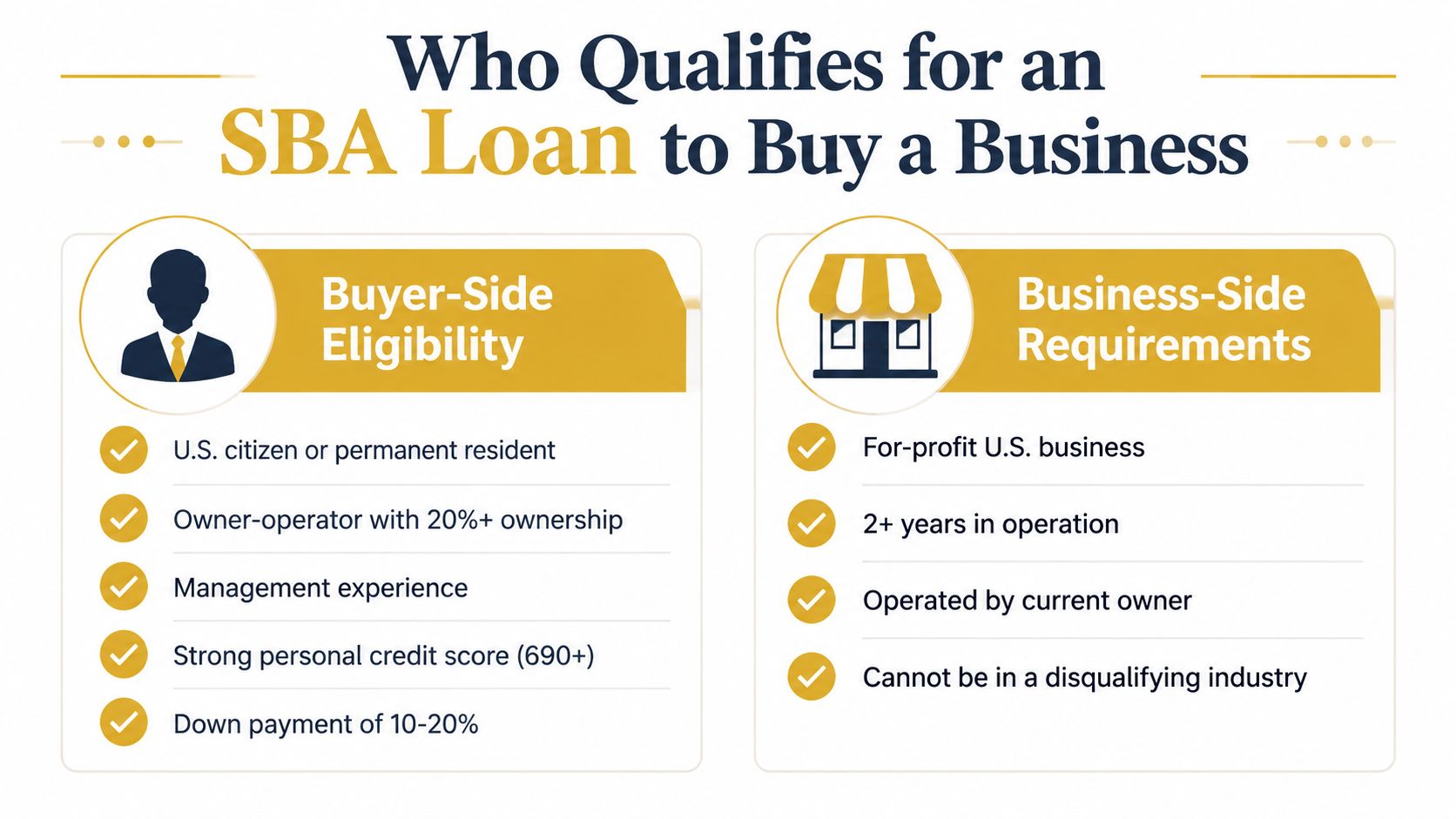
Buyer-side screening
Start with a candid self-assessment before signing a binding purchase agreement. The lender will typically examine:
- Residency and ownership: The buyer generally needs to be a U.S. citizen or permanent resident and must have meaningful ownership and operating responsibility.
- Management background: Experience running people, budgets, sales, operations, or a closely related business helps the lender believe the transition plan.
- Credit history: A clean, explainable credit profile is more valuable than a score viewed in isolation. Recent delinquencies, unresolved tax issues, or unexplained obligations can delay or kill a file.
- Equity injection: Plan to contribute at least 10% of the project cost from verifiable funds that meet the lender's equity rules. The cash must be documented, traceable, and available for closing.
- Personal liquidity: The lender wants to see that you can handle closing costs and early operating needs without immediately draining every personal reserve.
Ownership percentages can create additional lender questions. A buyer who owns a meaningful stake but won't run the company may face a different review than an owner-operator. Each participating lender can also apply overlays beyond the basic program requirements.
Business-side screening
The target generally needs to be a for-profit U.S. small business that meets the SBA size standard for its industry and NAICS classification. Size eligibility can depend on employee count or revenue, so don't rely on a general rule. Confirm the target's classification with the lender early.
The business should have operating history that allows the lender to review tax returns, monthly financial statements, debt, customer relationships, leases, licenses, and working-capital patterns. The lender will also examine whether the purchase agreement transfers the assets and contracts needed to keep generating revenue.
Use of proceeds must remain within approved purposes. A buyer can't use the SBA facility to fund unrelated personal expenses, an unapproved distribution, or debt that the lender hasn't reviewed. Existing debt, leases, seller obligations, and franchise arrangements must appear in the file, not surface during final documentation.
Franchise resales can qualify when the franchise system appears on the SBA's recognized franchise listing and the transaction satisfies the lender's underwriting requirements. The brand name alone doesn't make a franchise acquisition financeable. The lender still needs support for unit-level cash flow, transfer rights, required remodels, royalties, and the buyer's operating plan.
Choosing the Right SBA Program for Your Acquisition
The program choice should follow the asset mix and the deal's timing, not the buyer's attachment to a headline down payment. The SBA 7(a) program usually offers the broadest acquisition flexibility because it can combine the business purchase with working capital, equipment, and eligible real estate in one structure.
The SBA 504 program is more specialized. It fits transactions where owner-occupied commercial real estate or heavy equipment represents the central financing need. A certified development company and a senior lender share the structure, and the program can provide a long fixed-rate second piece. It's less useful when the buyer mainly needs to purchase goodwill, customer relationships, or operating cash flow.
A conventional bank loan may close faster for a financially strong buyer and a clean target. The trade-off is usually a larger cash contribution, shorter repayment structure, more refinancing risk, and a lender that has no SBA guarantee to absorb part of the exposure. The cheapest quoted rate isn't automatically the best financing if the payment schedule leaves the business exposed during a soft quarter.
For a broader framework on evaluating acquisition debt, review these criteria for business purchase loans.
Compare the financing choices
| Factor | SBA 7(a) | SBA 504 | Conventional bank |
|---|---|---|---|
| Best fit | Goodwill-heavy acquisitions with flexible use of proceeds | Owner-occupied real estate and heavy equipment | Strong borrower, strong cash flow, and a tight timeline |
| Buyer injection | Commonly structured around 10%, subject to lender and transaction requirements | Often structured around 10%, with project-specific requirements | Frequently higher than SBA structures |
| Maximum business-acquisition maturity | Up to 10 years for non-real-estate debt | Real-estate-focused structure with a longer fixed-rate component | Often shorter, with possible balloon or refinance exposure |
| Real-estate treatment | Can include eligible real estate, potentially up to 25 years | Purpose-built for eligible owner-occupied real estate | Depends on the bank and collateral |
| Use-of-proceeds flexibility | High for acquisition, working capital, equipment, and eligible real estate | Narrower and asset-focused | Varies by lender |
| Closing speed | Moderate, with SBA packaging and lender underwriting | Moderate to slower when project layers are complex | Can be faster when documentation is clean |
| Guarantee support | SBA guarantee can expand lender appetite | Split structure involving senior lender and CDC | No SBA backstop |
| Main weakness | Documentation, valuation, and SBA compliance can create delays | Poor fit for goodwill-led purchases | Higher equity burden and shorter debt life |
A practical decision rule works well. Choose 7(a) when flexibility and cash-flow-based financing matter most. Consider 504 when real estate drives the project. Explore conventional financing when you have strong liquidity, a seasoned operation, and a timeline that makes SBA packaging impractical.
Building an SBA-Ready Acquisition File
A lender-ready package is a workflow, not a digital junk drawer. Build it before you submit an offer, because the quality of the pre-LOI file affects both your credibility with the seller and your negotiating power.
Start with the buyer packet
Prepare the personal file first:
- Personal tax returns: Provide three years with every schedule and attachment, not just the first pages.
- Income documentation: Include two years of W-2s, K-1s, or other evidence supporting your stated income and ownership interests.
- Personal financial statement: Complete SBA Form 413 accurately, including contingent liabilities and pledged assets.
- Professional resume: Connect your management, industry, hiring, sales, finance, and operational experience to the target.
- Credit explanations: Prepare a written explanation for material credit events, including documentation that resolves the issue.
The buyer's resume should answer the lender's central question: why can this person run this particular business? A generic executive biography is weaker than a concise operating plan showing how you'll manage employees, preserve customer relationships, monitor margins, and replace the seller's responsibilities.
Build the change-of-ownership packet
The target file needs more than annual tax returns. Request:
- Monthly profit and loss statements: Obtain 24 months of monthly results and reconcile them to filed tax returns.
- Balance sheets: Track cash, receivables, inventory, payables, debt, and unusual liabilities.
- AR aging: Test whether reported revenue has turned into collectible cash.
- AP detail: Identify overdue suppliers, informal payment arrangements, and obligations omitted from headline debt.
- Add-back schedule: Tie every proposed adjustment to invoices, contracts, payroll records, or another verifiable document.
- Customer concentration: Identify dependence on any single customer or account and model what happens if that relationship changes.
- Supplier concentration: Review pricing power, exclusivity, transferability, and replacement options.
- Lease assignment: Secure landlord consent and confirm renewal rights, rent, deposits, and personal guarantees.
- Post-close projection: Produce a 12-month forecast that includes debt service, realistic payroll, taxes, maintenance, working capital, and transition costs.
Use a structured financial due diligence checklist for acquiring a business to keep the review tied to decisions rather than document collection.
Finish the SBA forms and reconciliation
The lender will also expect SBA-specific forms, including Form 1919 for the applicant, Form 1920 for the operating business, and Form 159 for the 7(a) guaranty-fee disclosure. Names and forms alone won't make the file credible. Every figure in the application should reconcile to the purchase agreement, financial statements, tax returns, sources-and-uses schedule, and projections.
Practical rule: If an add-back can't survive a skeptical question from an underwriter, don't use it to justify the purchase price.
Walking the Acquisition Deal From LOI to Funding
Consider a representative acquisition with a $2.4 million purchase price and a negotiated valuation of $2.65 million, structured with 90% SBA 7(a) financing. The numbers describe the scenario only. The important lesson is how preparation controls the clock.
At week zero, the buyer assembles the personal financial statement, tax returns, resume, target financials, preliminary sources and uses, and a lender-ready explanation of the transition plan. That package supports a credible LOI because the buyer can show financing evidence instead of making an unsupported promise to close.

During weeks one through three, the LOI is executed and the buyer begins full diligence. That means reviewing seller disclosures, tax returns, monthly financials, contracts, employees, leases, litigation, licenses, and working capital. A third-party quality of earnings report can test whether reported earnings match the cash flow the lender will underwrite. The buyer should also obtain an indication from a lender experienced in 7(a) change-of-ownership files.
Weeks four through six are where many attractive deals become difficult. The bank verifies tax filings through IRS Form 4506-C, reviews the business valuation against the negotiated price, and completes environmental work when real estate is involved. The lender also structures any seller note and standby equity so the injection complies with program and credit requirements.
Weeks seven through nine involve final SBA packaging and submission to the National Guaranty Purchase Center. A typical SBA review may take 5 to 15 business days, but the total timeline depends on lender workload, SBA volume, document quality, and outstanding conditions. Once the approval letter and loan authorization arrive, a clean closing can sometimes be organized inside a five-business-day window.
A useful legal reference for the diligence stage is this guide to M&A due diligence, especially when the purchase agreement must address representations, indemnities, exclusions, and closing conditions. Buyers should also approach negotiating business purchase agreements as a financing exercise, not just a price discussion.
The recurring bottlenecks are predictable: a quality of earnings review takes longer than scoped, AR aging contains disputed invoices, the landlord delays lease assignment, or the SBA experiences a review backlog. Put responsibility and deadlines for each item into the LOI and purchase agreement.
Why the 10% Down Number Can Be Misleading
The 10% equity injection is a useful starting point, but it isn't a complete capitalization plan. A lender cares less about whether you can technically fund the injection than whether the acquired company can pay its new debt while preserving enough cash to operate.
For a straight acquisition, current lender guidance commonly centers on debt service coverage expectations around 1.25x, while some business-expansion acquisitions may be evaluated around 1.15x. These thresholds are not a universal approval promise. A lender can require more cushion when margins are thin, the customer base is concentrated, the seller performs critical work, or the forecast depends on aggressive growth. (Loan Readiness guidance)
The headline injection also ignores practical uses of cash. Seller financing, standby requirements, closing costs, and a working-capital peg can increase the amount of capital you need available even when the SBA loan covers most of the purchase price.
What the capital stack really contains
| Component | Headline view | What a file actually shows |
|---|---|---|
| Buyer equity | 10% down | Verified funds, acceptable source, and enough liquidity remaining after closing |
| Seller note | Optional financing | Detailed principal, interest, amortization, subordination, and standby treatment |
| Working capital | Included if requested | A defensible peg based on receivables, inventory, payables, seasonality, and operating needs |
| Add-backs | Reduces adjusted expenses | Only defensible when supported by invoices, contracts, payroll records, and recurring-pattern analysis |
| Debt service | Loan payment after closing | Tested against normalized cash flow, taxes, maintenance, replacement payroll, and downside cases |
| Closing costs | Often omitted from the headline | Legal, valuation, diligence, lender, insurance, lease, and other transaction expenses |
The add-back schedule is often where a file lives or dies. Personal expenses run through the company, one-time legal settlements, and related-party rent may be legitimate adjustments, but the buyer must prove them. If the seller can't produce evidence, the underwriter may remove the adjustment and reduce normalized earnings.
Run the year-one survival test
A useful downside test reduces revenue by 15% and compresses margins by 200 basis points. Those assumptions are a stress exercise, not a forecast or market statistic. Apply them to the target's normalized operating model, then subtract the new debt service and any replacement cost for work previously performed by the seller.
A business with verified recurring cash flow, modest customer concentration, adequate working capital, and a conservative purchase price may remain serviceable under that case. A business that only qualifies because of unsupported add-backs, optimistic growth, or a fragile working-capital assumption can become one bad quarter from a covenant problem.
Performance data reinforces the distinction between financeability and invulnerability. For FY2018 to FY2019 change-of-ownership cohorts, one public dataset reported a 6.88% charge-off rate by count and 3.60% by dollars, compared with 9.83% by count and 3.84% by dollars for other 7(a) loans. (CTA Acquisitions analysis)
The practitioner's conclusion is direct: DSCR quality and add-back hygiene matter more than the headline down-payment percentage.
Pre-Application Checklist and Common SBA Acquisition Questions
Before requesting a term sheet, turn the transaction into a lender-readable file. The buyer who assembles the file first, not the one who negotiates hardest, usually closes the deal.
Pre-application checklist
- Size the injection: Document the source of funds, confirm how the lender treats gifts or borrowed funds, and preserve liquidity for post-close operations.
- Define seller financing: Put interest, maturity, payment terms, subordination, and standby conditions in writing before underwriting begins.
- Confirm ownership and operations: Make sure the buyer's resume supports the proposed role and that the ownership arrangement matches the operating plan.
- Reconcile the target: Tie tax returns, monthly P&Ls, bank activity, AR, AP, inventory, debt, and add-backs together. Missing connections between these records often create acquisition delays.
- Protect the LOI: Make financing, diligence, valuation, lease assignment, and landlord consent explicit conditions before the deposit becomes difficult to recover.
- Check franchise eligibility: Verify the brand's SBA franchise listing before spending heavily on diligence.
- Plan working capital: Include the cash requirement in sources and uses. A purchase price that works only when the buyer has no operating cushion is not a complete funding plan.
Questions that commonly stall a deal
How long does an SBA 7(a) acquisition take? A clean transaction can fit a 60 to 90 day planning window, but lender underwriting, SBA review, valuation, landlord consent, and missing records can extend it. Request a written document list and assign an owner to every condition. The LOI should also leave enough time for these reviews before closing obligations become binding.
Does existing business debt or an EIDL automatically disqualify the buyer? No. For an acquisition, the lender needs a complete debt schedule, payment history, payoff or assumption terms, and evidence that the purchased business can service every obligation after closing. The debt must appear in the file, not emerge during final underwriting.
How much earnest money should go into escrow before the LOI? Do not choose an amount by habit. Make the deposit refundable or creditable under clearly defined financing and diligence conditions, then have counsel review the language before funds move.
What happens if the seller carries paper? The note can help bridge the capital stack, but it must be disclosed and structured around lender requirements. A seller note that demands payments too early can weaken DSCR rather than strengthen the transaction.
Can a franchise resale qualify? Yes, when the franchise is eligible under SBA requirements and the lender approves the buyer, unit economics, transfer terms, and operating plan.
Dealmaker Wealth Society provides acquisition education, lender-preparation frameworks, due-diligence checklists, negotiation training, and community feedback for buyers structuring small-business purchases. If you're preparing an SBA loan for buying an existing business, visit Dealmaker Wealth Society to review its acquisition training and deal-support resources before submitting your LOI.

From the Dealmaker Blog









A Creative Business Buying Fable
