Strategy for Acquisition: A Practical Buyer’s Playbook
Strategy for Acquisition: A Practical Buyer’s Playbook
The acquisition world loves to talk about price, multiple, and closing. The more useful number is what happens after the wire clears, because customer acquisition cost and customer lifetime value are what tell you whether growth is profitable, not just busy. First Page Sage's 2026 benchmark puts average CAC at $942 for organic acquisition and $1,907 for paid acquisition, with a 2.2% visitor-to-lead conversion rate and 69% shopping cart abandonment in HubSpot's acquisition analytics reference, which is a blunt reminder that a winning strategy for acquisition has to be built around funnel efficiency and post-close execution, not instinct.
A lot of first-time buyers learn this the hard way. They source a business, negotiate aggressively, win the deal, then discover that the integration plan is one page and the “synergies” are just a line item in the seller's deck. The buyer thinks they bought a company, but what they really bought was a sequence of unresolved assumptions.
Table of Contents
- The Moment Most Acquisition Plans Break
- What a Real Acquisition Strategy Covers
- Pressure-Testing Your Deal Thesis Before You Source
- Building a Repeatable Sourcing Engine
- The Due Diligence Questions Most Buyers Skip
- From Signing to Value Capture in the First 100 Days
- Your Acquisition Strategy Playbook in One Page
The Moment Most Acquisition Plans Break
The failure usually shows up two weeks after closing, when the buyer is finally out of celebration mode and into the weekly operating rhythm. The seller is gone, the team is asking for decisions, and the spreadsheets that looked tidy during diligence no longer match what's happening in the business. That's when the buyer realizes the plan was really a hope list, not a control system.
The buyer who negotiated well and still lost margin
A typical first-time buyer does several things right. They avoid overpaying, they push hard on reps and warranties, and they get comfortable telling themselves the downside is “manageable.” Then the work starts. Customer handoffs are messy, the bookkeeper has a different view of cash than the seller did, and the ops team spends its time compensating for the gap between the target's actual process and the one described in diligence.
Practical rule: If the plan doesn't say who owns stabilization in week one, it isn't a plan.
That failure mode is common because people treat acquisition as a transaction instead of an operating system. A transaction ends at signing or close. An operating system starts before sourcing, shapes what you look for, and keeps running after integration decisions are made. The strategy for acquisition that matters is the one that can survive contact with a real team, real customers, and real cash flow.
The strongest clue that a plan is thin is usually structural, not financial. If the buyer can explain the valuation but can't explain how work will move on day one, the plan is underbuilt. If the buyer can name every seller objection but hasn't mapped the post-close milestones, the plan is underbuilt. The purchase may still work, but the odds are being carried by luck rather than design.
One founder I've watched at the closing table sourced well, negotiated hard, and got the deal over the line. The trouble wasn't the deal. It was that the post-close integration plan lived in a single page nobody revisited after signing. The company didn't fail dramatically. It just leaked margin through confusion, delay, and duplicated work until the original thesis looked far less certain.
A better mindset is simple. The acquisition strategy is the thing that tells you what would have to be true for the deal to work, what could break it, and what will be measured after close to prove value is real.
What a Real Acquisition Strategy Covers
A acquisition strategy is a working document that has to survive the full deal cycle, from search to integration to stabilization. Defense acquisition guidance describes it as an integrated plan for the business, technical, product-support, security, and supportability approaches used to manage risk and meet objectives across the full life cycle DAU acquisition strategy guidance. That logic maps cleanly to small-business buyouts because the buyer is managing more than price. The buyer is managing sequence, ownership, and the points where a good thesis can still fail.
The five control points a buyer should be able to defend
The cleanest way to judge the plan is to break it into five gates.
- Target sourcing. Decide what kind of company fits the thesis before the inbox fills up.
- Diligence. Test whether the thesis survives the facts, not the seller narrative.
- Financing. Make sure the capital structure supports the operating plan.
- Integration. Define how people, systems, and customers will be absorbed.
- Stabilization. Set the first post-close milestones and the owners responsible for them.
FAR Part 7 requires acquisition planning to document the statement of need, feasible alternatives, technical and contractual history, risk reduction actions, and milestones such as solicitation, negotiations, and award. The DAU acquisition strategy guidance captures that planning frame DAU acquisition strategy guidance. That structure is useful for SMB buyers because it forces clarity before commitment. You are not just saying, “We want to buy a business.” You are documenting why this one, why now, and what has to happen next for the deal to create value.
A disciplined buyer should be able to answer five written questions before they review a single opportunity:
- What need are we solving? Growth, capability, market entry, or replacement of a key dependency.
- What alternatives were rejected? Build, partner, license, or acquire.
- What risks are being reduced? Operational, financial, technical, or integration risk.
- What milestones must be hit? LOI, diligence completion, financing, close, and stabilization.
- What would cause us to stop? A failed assumption, a broken integration path, or a financing gap.
The best acquisition plans read like decision documents, not aspiration documents.
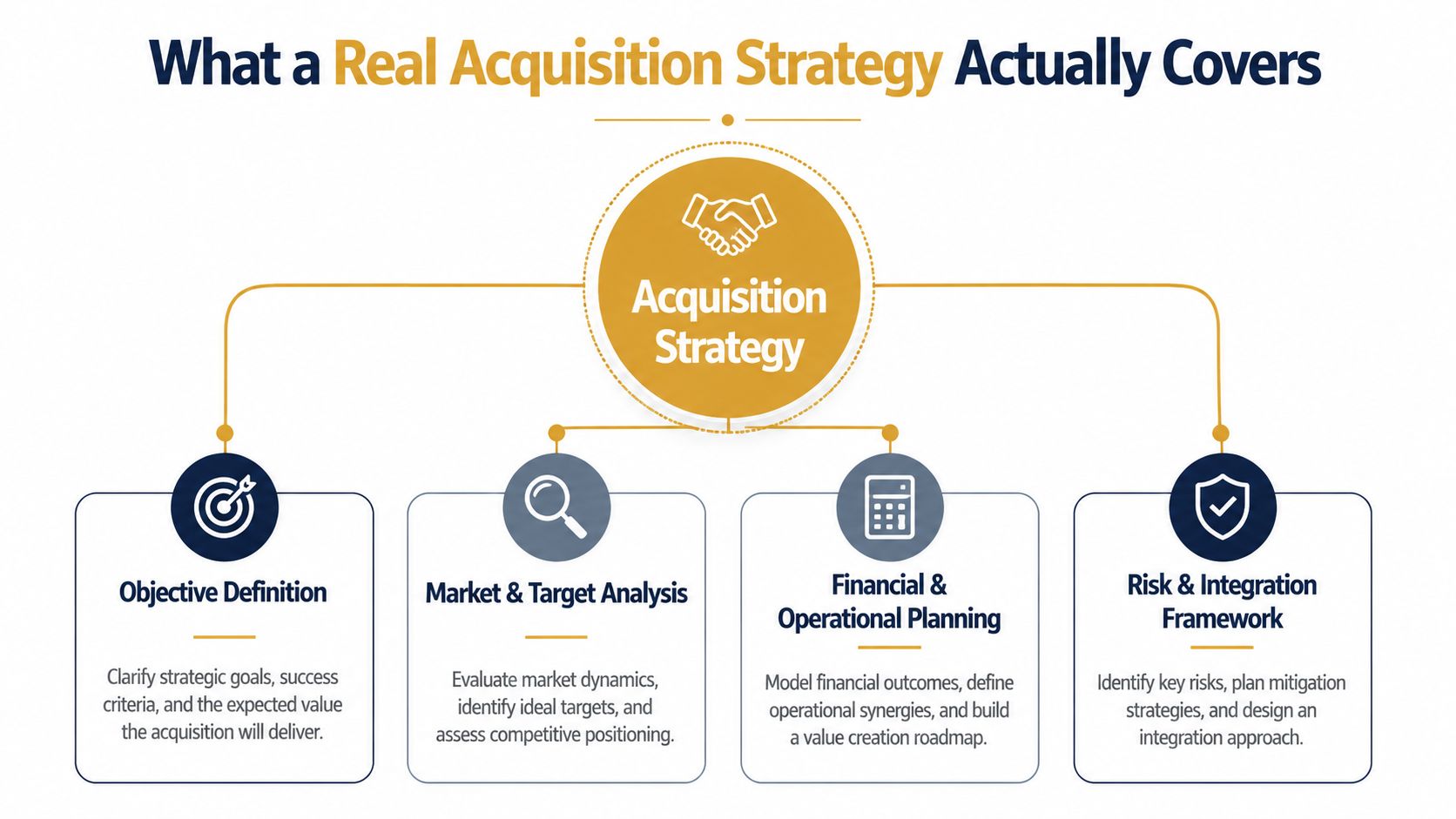
The practical payoff is control. When the plan is built this way, you can tell whether a deal fits your capital, your team, and your operating capacity before the excitement of a good opportunity narrows your judgment. A useful place to pressure-test those screens is a business acquisition criteria evaluation framework, because criteria that look neat on paper often break when they meet real sellers, real timing, and real constraints.
Pressure-Testing Your Deal Thesis Before You Source
A thesis that can't be broken in writing will usually be broken in practice. The useful version of a thesis is a falsifiable hypothesis with named value-creation levers. If you can't state what specifically creates the return, you're not investing with discipline, you're guessing.
Make the thesis describe the leverage, not the story
Each deal thesis should identify which lever is supposed to create value and what category that lever belongs to. In small-business acquisitions, most levers fall into three buckets, operational integration, financing assumption, or technology transfer. That matters because each bucket fails in a different way.
- Operational integration breaks when customer handoffs, staffing, or process ownership are unclear.
- Financing assumptions break when debt service, working capital, or seller rollover expectations are wrong.
- Technology transfer breaks when the acquirer overestimates how easily the capability can be absorbed.
The Institute for Manufacturing at Cambridge lays out four technical steps for technology acquisitions, identify attractive technologies or partners, assess and select the most promising opportunities, negotiate terms, and then transfer the technology into the acquirer's organization Cambridge technology acquisitions report. It also highlights three questions that matter more than most buyers admit, why the capability is being acquired, who it's being acquired from, and how mature the technology is Cambridge technology acquisitions report. Those questions are useful beyond tech-heavy deals because they force the buyer to name the asset and the transfer risk.
Stress-test the thesis before the broker call
A good pressure test is simple. Write the thesis as if you're trying to disprove it, then list the assumptions that must hold true for the deal to work. Next to each assumption, identify what evidence would make you walk away.
For example, if the return depends on post-close cross-selling, then the buyer needs evidence that customers buy more than one thing, not just that the seller says they will. If the return depends on replacing the owner, then the buyer needs evidence that the owner is the bottleneck and that the team can operate without constant intervention. If the return depends on migrating a capability, then maturity and absorbability matter more than headline revenue.
That's where a lot of weak sourcing starts to show up. Buyers scan for “good businesses” instead of “good fits for a specific thesis.” The thesis should tell you what kind of targets to ignore. If you need fast integration, a complex family-run operation may be the wrong fit. If you need reliable retention, a business with heavy owner dependence is a warning sign, not a feature.
The cleanest discipline I've seen is to force every thesis into one page, then share it with anyone who has to live with the deal after closing. If the thesis doesn't survive that test, it's not ready.
Use a structured evaluation template like business acquisition criteria evaluation to keep the thesis tied to actual decision points rather than vibes.
Building a Repeatable Sourcing Engine
Treat sourcing like networking, which is too loose. A repeatable sourcing engine starts with a target profile, then uses data to separate real opportunities from noise. The goal is not volume for its own sake. The goal is a steady flow of targets that fit a specific thesis.
The four steps that turn sourcing into a channel
First, define the target profile narrowly. “Any profitable business” is not a profile. A better profile includes owner age range if relevant, customer type, geography, service complexity, and the operational characteristics the buyer can absorb.
Second, screen using segmentation and behavioral data. That can mean looking at customer concentration, founder dependence, review patterns, hiring signals, or whether the company's website and outreach language suggest a real fit with your thesis. Broad assumptions don't source deals. Specific filters do.
Third, choose outreach channels based on the target type, not on what feels active. Conferences, brokers, direct outreach, referrals, and advisors each behave differently. The best channel for a local service business is usually not the best channel for a niche SaaS company.
Fourth, qualify on thesis fit before you spend time on a call. The call is expensive. So is your attention. Don't let a founder's responsiveness seduce you into believing the company fits your criteria.
| Channel | Best For | Signal Strength |
|---|---|---|
| Direct outreach | Off-market local service businesses | Strong when owner motivation is visible and the message is thesis-specific |
| Advisors and brokers | On-market companies with organized process | Strong when the target is already accustomed to buyer conversations |
| Founder referrals | Niche B2B businesses and owner-led firms | Strong when trust matters and the buyer's reputation travels |
| Conferences and industry events | Sector-focused targets with specialist knowledge | Moderate, because access is real but fit still has to be screened |
| Content-led inbound | Buyers building a visible brand in a narrow niche | Strong over time when the target market already pays attention |
Most guides stop at “use multiple channels.” That's too vague to be useful. The question is which channel produces the highest-quality off-market opportunities for your thesis and how consistently it does that across different target types. The acquisition motive research from NYU Stern underscores that motives vary, which means sourcing has to be aligned to the actual strategic logic, not a generic mandate NYU Stern acquisition motives. For a buyer, that's the difference between a busy pipeline and a useful one.
If you want a process that is closer to a machine than a habit, the deal origination machine framework is worth studying. It's one of the few practical resources that treats sourcing as a system of inputs, filters, and outputs instead of a contact list.
Busy sourcing feels productive. A qualified pipeline is productive.
The discipline is to score channels by how many thesis-fit opportunities they produce, not by how many conversations they generate. Retire channels that look active but don't convert into credible opportunities.
The Due Diligence Questions Most Buyers Skip
A buyer can have a clean quality-of-earnings report and still close on a business that is hard to absorb. The diligence mistake that hurts most is failing to test whether the company can handle the change the buyer plans to make. Cambridge's technology acquisition guidance is useful because it forces three questions that map directly to small-business reality, why is the capability being acquired, who is it being acquired from, and how mature is it Cambridge technology acquisitions report.
The three questions that expose hidden risk
Start with why the capability is being acquired. In a small-business deal, that may sound like, “We're buying distribution,” or “We're buying a team,” or “We're buying a process the buyer cannot build quickly.” If the answer is vague, the rest of diligence usually is too.
Then ask who it's being acquired from. If the seller is the operator, the salesperson, or the rainmaker, the business may be more fragile than the financials suggest. Owner dependency belongs in diligence even when it does not show up as a line item.
Finally, ask how mature the capability is. A business can be valuable and still be difficult to absorb. If the systems, team habits, or customer expectations are immature, the buyer can inherit complexity faster than they can integrate it.
The internal diligence work that gets skipped most often is the operational side. A buyer can model revenue and debt service all day and still miss that the team cannot function without one specific person, or that the process breaks when volume rises, or that the customer promise is delivered by improvisation rather than repeatable systems. That is why operational diligence needs a scorecard, not a paragraph.
Use the operational due diligence factors checklist as a working tool, then add questions about culture, customer concentration, system fragility, and replacement capacity. Those are the places where the thesis either survives or fails.
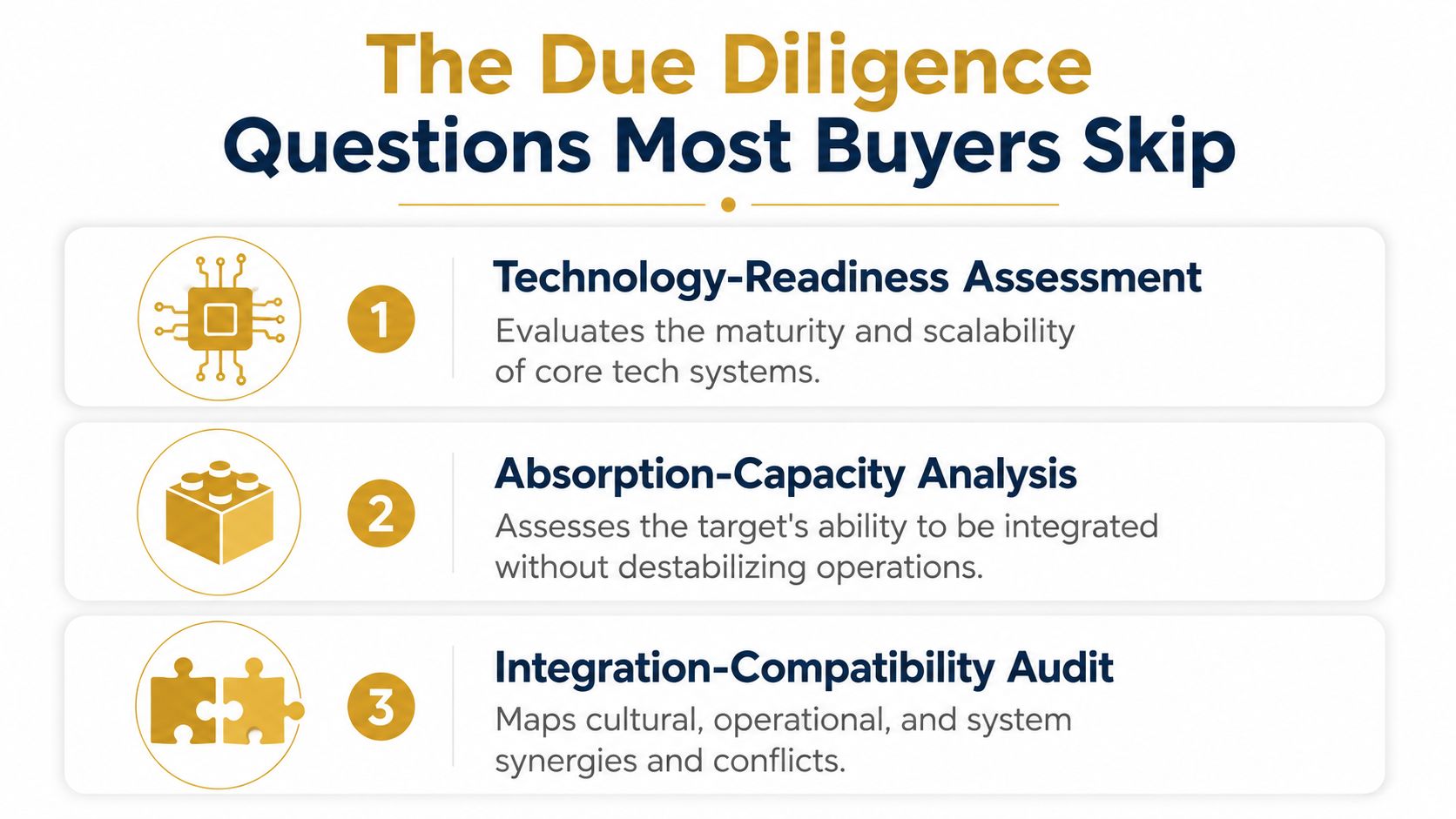
The rule is simple. If diligence only confirms the seller's narrative, it is not diligence. It is marketing review. A real buyer uses diligence to decide whether the target can be integrated without destabilizing the business they already own.
A practical learning resource like the embedded video below can help teams sharpen their diligence lens before they enter live negotiations.
From Signing to Value Capture in the First 100 Days
A representative eCommerce roll-up shows how the strategy for acquisition becomes real after close. The buyer had a sensible thesis, add adjacent brands, centralize back-office work, and stabilize the customer experience fast. The first instinct was to chase synergies, but the better move was to slow the business down enough to avoid breaking it.
Week one decides more than most people admit
The first two decisions matter most. One is whether to preserve the existing customer-facing workflow or switch quickly to the acquirer's systems. The other is whether to keep the seller involved long enough to transfer tacit knowledge or move them out fast to avoid confusion. Those choices shape nearly everything that follows.
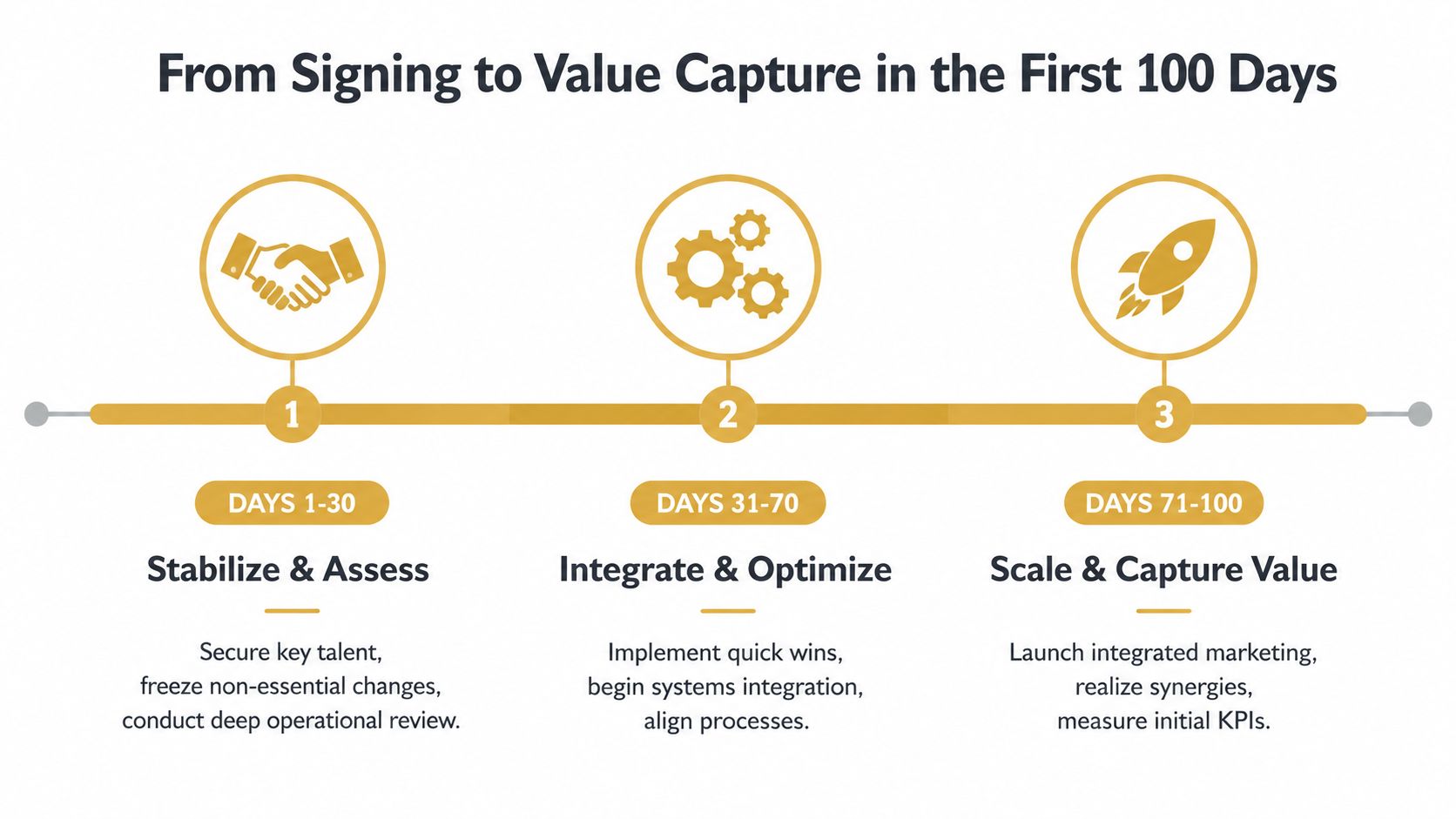
The first 30 days are about cash preservation, customer retention, and team retention. If those three are stable, the buyer has room to work. If any one of them slips, the integration plan starts consuming time that should have gone to value capture.
From there, the cadence becomes weekly and specific. Someone owns inventory visibility, someone owns customer communication, someone owns the financial close, and someone owns the systems migration. When no one owns a workstream, the seller's old habits tend to survive by default.
What good looks like by day 100
By the end of the first 100 days, the buyer should know whether value capture is real, not theoretical. That means the core process is running without daily rescue work, customers are staying through the transition, and the team knows who makes decisions. If those signals aren't present, the strategy hasn't failed in theory. It has failed in execution.
The strongest post-close operators I've seen don't obsess over making every change at once. They protect the business first, then change the parts that matter most, and only then widen the integration effort. That sequence keeps the deal from bleeding out while everyone argues about upside.
Your Acquisition Strategy Playbook in One Page
The biggest strategic failures in small-business acquisitions are easy to name once you've seen enough of them. Buyers treat sourcing as a numbers game, confuse diligence with finance-only review, overestimate integration speed, ignore absorption capacity, underwrite financing too optimistically, skip a real 100-day plan, and let the thesis drift after the LOI. Each one destroys value.
The pre-launch checklist
Before you evaluate a deal, make sure these are written and defendable:
- Thesis clarity. You can state exactly why this acquisition creates value.
- Channel scorecard. You know which sourcing channels fit the target profile and which ones are noise.
- Diligence scorecard. You've tested operational, cultural, and integration risk, not just financial statements.
- Financing structure. The capital stack supports the operating plan, not just the closing date.
- 100-day owner. One person owns stabilization, integration, and follow-through.
If you want a clean way to organize that work into a presentation or board-ready memo, consulting deck templates can help structure the thinking without turning it into fluff. The point isn't prettier slides. The point is forcing the logic into a format other people can challenge.
The single metric to watch from day one is whether the business is capturing the value your thesis promised. If the early operating rhythm isn't producing that result, the issue is usually in the strategy, not the spreadsheet.
Dealmaker Wealth Society teaches buyers how to source, evaluate, finance, and integrate acquisitions with real-world deal structure and post-close execution in mind. If you want frameworks that fit this exact work, visit Dealmaker Wealth Society and use the training, templates, and community to pressure-test your next deal before you sign.

From the Dealmaker Blog









A Creative Business Buying Fable