What Is Post-Merger Integration: SMB Guide
What Is Post-Merger Integration: SMB Guide
Most acquisition advice tells you to integrate everything quickly. That sounds disciplined, but for a small business it can be reckless. Replacing the target's software, brand, reporting habits, customer routines, and leadership structure at once may create administrative consistency while destroying the speed, trust, and local knowledge that made the business valuable.
So, what is post-merger integration? It's the structured process of combining two organizations after a merger or acquisition so the new enterprise can achieve its strategic, operational, financial, and cultural objectives. In an SMB acquisition, that doesn't mean forcing every activity into the buyer's template. It means deciding what needs immediate control, what should change later, and what should remain distinct.
Table of Contents
- Redefining Post-Merger Integration for Small Business Buyers
- The Four Phases of a Successful Acquisition Rollout
- Deciding What to Standardize and What to Protect
- Managing the Human Element Beyond Corporate Culture
- Tracking Value with a Weekly Integration Dashboard
- Real-World Execution in an SMB Roll-Up Scenario
- Turning Integration into Long-Term Value Creation
Redefining Post-Merger Integration for Small Business Buyers
A corporate PMI program often treats integration as a race toward one operating model. An acquisition entrepreneur should treat it as a sequencing problem. The right question isn't, “How quickly can I make this business look like mine?” It's, “Which changes protect cash, customers, and compliance, and which changes could damage the value I just bought?”
Post-merger integration typically covers governance, leadership, employee communication, organizational design, systems and data migration, finance and reporting, customer and supplier continuity, talent retention, and synergy delivery. The legal transaction may be complete, but the economic transaction is still being tested through everyday decisions. Customers decide whether to stay, employees decide whether to remain, and managers reveal whether the new ownership can execute.
Practical rule: Integrate control before you integrate activity.
That distinction matters. You may need immediate visibility into bank accounts, payroll, cash disbursements, financial reporting, compliance obligations, and customer concentration. You may not need to replace the target's scheduling tool, sales script, service workflow, or local brand during the first week. In fact, changing those systems before understanding how the business really works can create service failures and employee resistance.
Why full integration can destroy value
The target's productive strengths may be invisible on a balance sheet. A founder may know which customers need a personal call, which technician can solve unusual jobs, or which informal handoff prevents delays. A local brand may carry trust that a parent-company identity can't reproduce. A niche workflow may look inefficient to an outside buyer while protecting margins or retention.
Integration costs are also frequently understated when buyers measure transaction size but ignore the degree of operational change. Reported integration-cost estimates can be understated by 30% to 50% when operational disruption isn't properly accounted for, as discussed in this analysis of the technology blind spot in traditional due diligence.
That's why a buyer should classify every major capability into three groups:
- Integrate now: Cash controls, financial reporting, legal obligations, payroll ownership, cybersecurity access, and decision rights.
- Preserve temporarily: Customer-facing systems, service routines, local marketing, and founder-developed processes that still perform.
- Leave autonomous: Differentiating capabilities with low compliance risk and strong customer or employee attachment.
A practical post-acquisition integration needs framework helps buyers assess that boundary before closing. For staffing gaps, specialist support such as Lathire can also help an acquisition team add operational capacity without immediately redesigning the entire target organization.
The Daimler-Benz and Chrysler combination illustrates why legal combination isn't the same as effective integration. IMD describes the 1998 transaction as the first transatlantic merger and, at the time, the largest industrial merger ever completed. The case involved cross-cultural management, organizational implementation, global strategy, and change management. The companies formally combined, but cultural and structural problems persisted, and they ultimately separated in 2009. The lesson for a small buyer is direct: integration must translate deal logic into accountable workstreams, milestones, and choices about what to standardize and what to preserve. IMD's DaimlerChrysler case provides the broader historical context.
The Four Phases of a Successful Acquisition Rollout
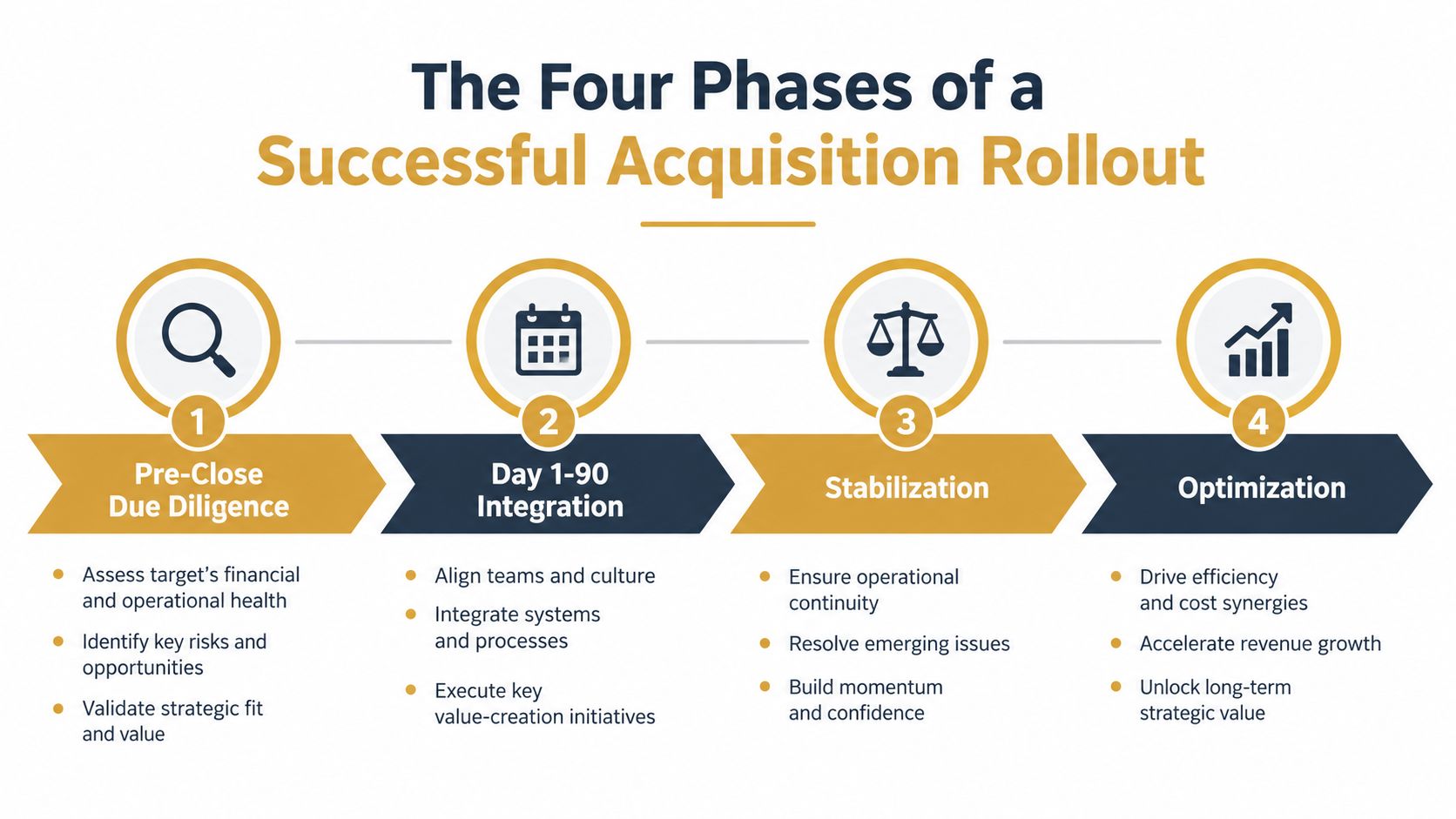
Integration doesn't begin when the wire transfer lands. It begins during diligence, when the buyer tests whether the deal thesis can be translated into executable work. A buyer who waits until closing to ask who owns payroll, which customers need reassurance, or how systems depend on one another is already operating behind the business.
Pre-close planning
Start with the investment thesis. Convert broad statements such as “reduce overhead” or “cross-sell the customer base” into initiatives with a baseline, accountable owner, target outcome, timing, implementation cost, and risk.
Then create short workstream charters for finance, people, customers, operations, technology, legal, and commercial execution. Each charter should state what the team owns, what it doesn't own, which decisions require approval, and which dependencies could block progress. A dependency map might show that payroll migration depends on employee data quality, which depends on HR records, which depends on access to the seller's systems.
Empirical PMI research using more than 45,000 transaction data points identified four major risk categories, synergy, structure, people, and project execution. The research also found that weak synergy definition creates measurement risk and poor governance delays benefits, supporting the need for workstream charters and Day One controls before close.
Day One execution
Day One isn't the day to redesign the company. It's the day to establish confidence and control.
Confirm who can approve payments, who owns employee questions, who communicates with key customers, and who handles urgent operational failures. Protect access to banking, accounting, payroll, insurance, contracts, customer records, and critical software. Make sure employees know who their manager is and how decisions will be made.
The strongest Day One plans preserve continuity while making the new ownership visible. Customers should experience reliable service, not an announcement-driven disruption.
The first 100 days
Use the initial sprint to stabilize the base business, validate assumptions, and deliver a small number of high-confidence improvements. Establish the combined-company baseline, then track procurement, shared services, pricing, staffing, working capital, and revenue opportunities against it.
Don't launch every project simultaneously. Sequence initiatives according to customer risk, regulatory exposure, system dependency, and expected value. A low-risk reporting improvement may belong early. A customer-facing software migration may belong later, after the team understands the target's workflow.
Long-term value realization
After stabilization, the integration lead should shift from crisis management to operating improvement. Review the original thesis, compare expected and realized benefits, and add opportunities discovered through customer conversations, employee knowledge, and newly combined data.
A small buyer doesn't need a large corporate Integration Management Office. One accountable integration lead, a weekly decision meeting, a shared action register, and clear executive sponsorship can provide enough structure if owners actually have authority to resolve issues.
Deciding What to Standardize and What to Protect
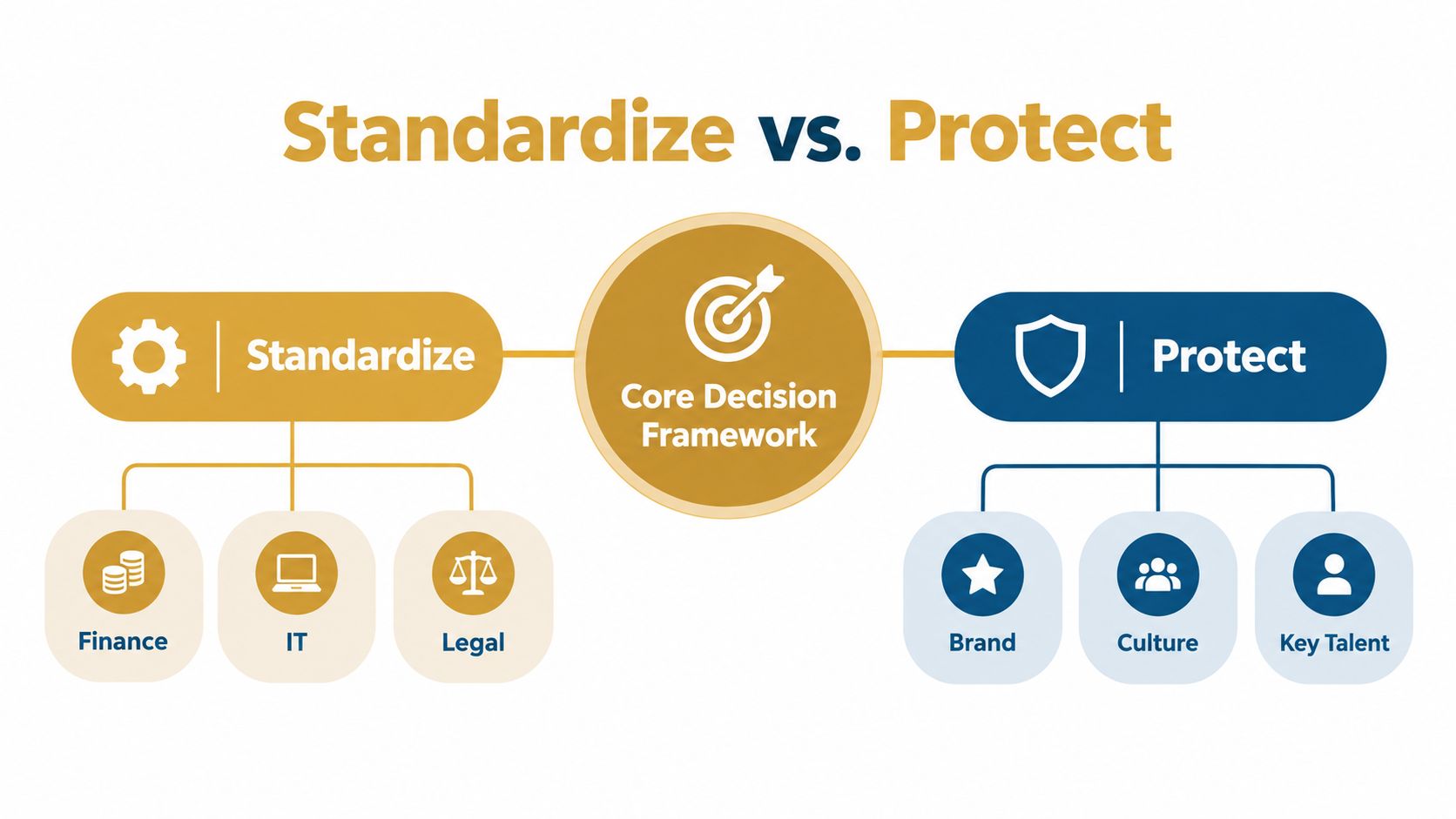
The most useful boundary in SMB integration is between control and activity. Control answers who can approve, measure, report, and escalate. Activity describes how employees serve customers and complete work. Buyers often confuse the two, then impose unnecessary process changes just because the parent company already has a preferred tool or workflow.
Begin with the value driver
Ask why you bought the business. If the thesis depends on back-office savings, standardize finance, procurement, reporting, and selected administrative functions. If it depends on local reputation or specialized service delivery, protect the customer-facing capabilities that create that advantage.
Then score each proposed change against four questions:
- Does it protect cash or compliance? If yes, it deserves early attention.
- Could it disrupt customers? If yes, test before migrating.
- Does the target perform this activity better? If yes, don't replace it automatically.
- Does another system depend on it? If yes, map the dependency first.
A decision matrix makes disagreements visible. Finance may want one accounting platform immediately. Operations may argue that the target's scheduling tool is essential to route jobs efficiently. The answer may be to consolidate reporting while leaving scheduling untouched until the buyer can compare outcomes rather than preferences.
Standardize the control layer
Day One standardization commonly includes bank authority, payment approvals, financial close procedures, payroll oversight, insurance, legal compliance, cybersecurity permissions, and management reporting. These controls give the buyer visibility and protect the enterprise without telling frontline employees how to perform every task.
Standardize definitions too. “Gross margin,” “active customer,” “completed job,” and “employee turnover” must mean the same thing across the portfolio. Otherwise, the buyer can create a unified dashboard that compares incompatible data.
Protect productive differences
Preserve a distinctive brand when it carries local trust. Preserve a founder-led sales motion when customers buy access to the founder's expertise. Preserve proprietary scheduling, quoting, or service routines when they produce a reliable customer experience and don't create unacceptable risk.
The buyer owns the outcome, not necessarily every method used to produce it.
Protection doesn't mean permanent exemption. Set review dates, document why autonomy exists, and define the evidence that would justify a later change. This approach gives the target room to keep performing while allowing the parent company to revisit technology, branding, or process choices with real operating data.
Managing the Human Element Beyond Corporate Culture
“Culture fit” is too vague to manage. In a small business, the human integration problem is more concrete: Who makes decisions? Who knows the customers? Who can solve an unusual problem? Who believes the new owner will keep promises? Employees answer those questions through behavior long before they answer a survey.
A few people may hold disproportionate institutional knowledge. A service manager may know the practical capacity of every technician. An administrator may understand which suppliers allow flexible terms. A salesperson may own relationships that never appear in the CRM. If those people leave, the buyer may lose operating continuity even when the financial systems remain intact.
Research summarized in independent M&A coverage reports identified cultural and working-style problems as major integration challenges, with 40% of respondents citing integration difficulties as a primary hurdle. The SEC-filed integration plan reflects a more operational view by focusing on decision-making, communication, expectations, measurement, and connectedness rather than treating culture as a slogan.
Watch behavior, not just sentiment
A weekly people review should track:
- Regretted attrition: Which valuable employees have left, or appear likely to leave?
- Absenteeism: Are attendance patterns changing in critical teams?
- Open critical roles: Which positions lack a dependable owner?
- Decision-cycle time: Are routine decisions taking longer because authority is unclear?
- Customer complaints: Are service failures appearing in the same areas where employees seem uncertain?
- Pulse feedback: Are employees receiving answers, or merely more announcements?
Communication volume isn't integration quality. Employees need a clear reporting line, honest answers about role changes, specific instructions for new processes, and evidence that managers follow through. A town hall followed by silence creates more distrust than a shorter meeting accompanied by visible decisions.
Buyers should also conduct stay conversations with key employees. Ask what customers depend on, which processes are fragile, what the new owner hasn't understood, and what would cause the employee to reconsider staying. The answers often reveal integration risks that financial reporting won't show.
For practical definitions of change-related terminology, buyers can browse change management terms. The operational response belongs in a written retention plan covering critical roles, customer handoffs, manager access, training, and escalation. A focused employee retention strategy after acquisition turns concern into assigned actions rather than vague reassurance.
Tracking Value with a Weekly Integration Dashboard
Synergy is not a line in the acquisition model. It becomes real only when an owner delivers an initiative, finance validates the result, and the operating team can sustain it without damaging revenue or service.
Build the dashboard around a standalone baseline for each business and a combined target state. Every initiative should identify its owner, benefit-recognition date, cash or P&L impact, implementation cost, and risk-adjusted status. If a buyer claims savings from consolidating vendors, the dashboard should show the prior spend, the new commercial terms, the effective date, and the verified financial result.
Core dashboard design
| Category | Key Metric | Why It Matters |
|---|---|---|
| People | Regretted attrition and employee turnover | Shows whether critical knowledge and capacity are leaving |
| Customers | Retention, complaints, and service levels | Detects disruption before revenue reporting catches it |
| Finance | Gross margin and working capital | Tests whether integration is improving economics without hiding cash pressure |
| Synergies | Realized savings and synergy run-rate | Converts deal assumptions into accountable operating results |
| Operations | Systems migration status and decision-cycle time | Reveals whether new controls are helping or slowing execution |
| Commercial | Pipeline, conversion activity, and cross-sell progress | Protects growth while back-office changes are underway |
Review the dashboard weekly with the integration lead and workstream owners. Keep the meeting focused on exceptions. A green status with no evidence isn't useful, and a red status without a decision owner is just documentation.
Protect commercial execution
Commercial integration deserves its own discipline. Salespeople need clear ownership of accounts, customer-facing teams need consistent answers, and the buyer must avoid changing pricing, branding, or service promises without understanding the revenue effect.
Research cited by McKinsey found that large mergers neglecting integrated commercial execution experienced an average seven-percentage-point decline in sales growth during the three years after closing. The finding comes from a different transaction scale, but the operating warning applies to SMB buyers: cost integration can't compensate for preventable customer loss. McKinsey's discussion of commercial integration and merger execution explains why revenue work needs explicit ownership.
A dashboard should therefore show customer and sales signals alongside expense initiatives. Buyers looking for a more detailed approach can use this post-acquisition performance measurement framework to connect operating activity to value creation.
Real-World Execution in an SMB Roll-Up Scenario
Consider a fictional but realistic roll-up transaction. An acquisition entrepreneur buys a profitable, founder-led field service company and adds it to a growing portfolio. The target has a strong local reputation, experienced technicians, a founder who still handles key relationships, and proprietary scheduling software that the parent company doesn't use.

The buyer's first instinct is to migrate everything into the portfolio's systems. That plan changes during diligence. The target's scheduling tool contains practical routing knowledge that isn't documented elsewhere, while the local brand drives trust with repeat customers. Replacing both immediately would make reporting cleaner for headquarters but would introduce operational risk where customers feel it most.
The buyer chooses a narrower integration boundary. Accounting moves to the holding company's platform, payroll and HR administration follow the parent's controls, bank authority and payment approvals are centralized, and weekly reporting uses the portfolio's standard definitions. The target keeps its scheduling software, local brand, service scripts, and frontline workflow.
What the first 90 days actually require
The integration lead creates a decision register and assigns owners. Finance owns the reporting migration. The target's operations manager owns scheduling continuity. The founder introduces the buyer to priority customers, then transitions relationship responsibility to named account owners rather than disappearing from the business without a handoff.
The buyer also avoids promising that every employee will retain the same role indefinitely. Instead, management explains which controls are changing, which customer processes are staying, how decisions will be escalated, and when the next review will occur. That clarity matters more than polished integration language.
After stabilization, the buyer compares the target's scheduling performance with the portfolio's existing approach. If the proprietary tool continues to support strong service levels, there's no reason to replace it for uniformity. If the parent's system later proves better for a specific function, the buyer can migrate one workflow at a time with testing and training.
The following video provides additional context for teams thinking through merger and acquisition execution:
The result isn't “full integration.” It's selective integration. The buyer captures back-office control and reporting consistency while protecting the target's customer relationships, operating knowledge, and entrepreneurial speed. That trade-off is often more valuable than a visually uniform organization.
Turning Integration into Long-Term Value Creation
The first 100 days matter, but PMI shouldn't become a project that ends when the checklist is complete. The acquired business will continue to reveal information after close. Employees identify overlooked bottlenecks, customers expose unmet needs, and combined data may show opportunities that weren't visible during negotiations.
The strongest buyers keep three habits in place:
- They revisit the deal thesis. Expected savings and revenue opportunities are tested against actual results, not defended because they appeared in the original model.
- They preserve useful autonomy. A target can share financial controls and governance while retaining a brand, workflow, or leadership practice that creates customer value.
- They keep decision rights explicit. Employees need to know which decisions belong locally, which belong to the parent, and how disagreements get resolved.
Integration agility is central to this approach. A McKinsey survey of 638 merger-management professionals found that, among the highest-performing respondents, more than 70% identified integration agility as a key success factor. The relevant capability is tailoring integration to the deal's rationale rather than applying an inflexible template, as described in McKinsey's research on merger integration.
For a first-time buyer, that means building a management system that can adapt. Use a baseline, owners, milestones, a benefits ledger, a weekly dashboard, and regular customer and employee feedback. Then change the plan when evidence shows that a presumed synergy threatens the very capability that generates revenue.
Post-merger integration succeeds when the new owner creates more control without unnecessary bureaucracy, more scale without customer distance, and more value without erasing the target's strengths. That's the standard to apply before closing, during stabilization, and throughout the life of the acquisition.
Dealmaker Wealth Society offers acquisition education, integration playbooks, templates, KPI dashboards, live coaching, and peer support for buyers building and scaling small businesses. Visit Dealmaker Wealth Society to pressure-test your post-close plan and get practical support for the next acquisition.

From the Dealmaker Blog









A Creative Business Buying Fable