
What Is a Good Deal: A Framework for Spotting Real Value
What Is a Good Deal: A Framework for Spotting Real Value

At 11 p.m., a buyer can stare at two acquisition summaries with nearly identical asking prices and still know they aren't remotely equivalent. One business may produce durable cash flow through recurring commercial contracts. The other may depend on a short-lived trend, paid traffic, or a seller whose personal effort holds the operation together. The sticker price starts the conversation, but it doesn't decide whether the deal creates wealth.
The practical answer to what is a good deal is a structure that converts reliable earnings into an attractive cash-on-cash return while leaving enough margin for operational mistakes, customer loss, financing pressure, and an imperfect first year. Price matters. So do the multiple paid, the cash required at closing, seller alignment, strategic fit, and the risks hiding behind reported earnings.
Table of Contents
- Why Two Deals at the Same Price Can Feel Nothing Alike
- The Core Building Blocks of Deal Quality
- The Five Lenses That Decide Whether a Deal Is Actually Good
- A Good Deal and a Bad Deal Compared Side by Side
- Your Deal-Screening Checklist Before You Sign an LOI
- Three Deal Myths That Quietly Cost Buyers Millions
- Putting the Framework to Work on Your Next Deal
Why Two Deals at the Same Price Can Feel Nothing Alike
The buyer sits at a kitchen counter with two printed summaries spread beside a cold cup of coffee. Both businesses are priced at roughly $1.4 million, so the first glance offers no obvious winner.
The HVAC services company has ten recurring commercial contracts, a recognizable service area, and technicians who handle most field work without the owner standing over them. Its growth story is modest, but the revenue arrives through relationships customers already renew. The e-commerce brand looks more exciting. Its recent sales rose quickly after a product went viral, yet much of the traffic came from a narrow channel and the seller still manages advertising, supplier negotiations, and product launches personally.
Within thirty seconds, the buyer notices what the asking price conceals:
- Cash-flow durability: The HVAC company has a visible operating base. The online brand may be asking the buyer to pay for momentum that hasn't yet become repeatable earnings.
- Transferability: A buyer can inherit contracts and operating routines more easily than a seller's audience, instincts, and informal supplier relationships.
- Financing pressure: The same purchase price can require very different equity contributions depending on the seller note, lender terms, working-capital needs, and closing conditions.
- Downside exposure: A customer departure may hurt the HVAC business. A platform policy change, inventory problem, or failed product launch could damage the e-commerce business much faster.
Gut feel isn't irrational in this situation. It's pattern recognition reacting to structure, financing, and risk before the buyer has fully expressed those concerns in a spreadsheet. The problem starts when intuition becomes the entire underwriting process.
Practical rule: A good deal is not the opportunity with the most exciting story. It's the opportunity whose cash flow, price, and structure still work after the story is removed.
Modern M&A valuation has moved toward standardized benchmarking rather than intuition alone. A review of U.S. public-deal advisor valuations found that enterprise-value multiples appeared in 60% of the sample, EBITDA had become the preferred value driver over EBIT and net income, and forward multiples were used 25% of the time. Advisors relied on trading-company comparables 66% of the time, compared with 34% for other transactions, which underscores why relative pricing matters when judging deal quality (the valuation study).
That framework applies to smaller acquisitions, even though the information is less polished. Two businesses at the same price can produce radically different outcomes because the buyer isn't purchasing revenue or a headline. The buyer is purchasing a stream of future cash flow, financed with a particular amount of personal capital and exposed to a particular set of risks.
The Core Building Blocks of Deal Quality
Before deciding whether an acquisition is attractive, translate the offer into four primitives. These measures give the deal a common language and prevent a seller's presentation from steering the analysis.

Earnings multiple
The earnings multiple tells you how much purchase price you're paying for a unit of normalized annual earnings. If a business produces $300,000 of SDE and sells for $900,000, the implied multiple is 3.0x SDE. Think of it as price per penny of dependable profit. The lower the multiple, the less you're paying for each dollar of earnings, but a low multiple often reflects customer concentration, declining sales, owner dependence, or weak records.
For smaller businesses, companies below about $1 million in EBITDA commonly trade around 3x to 5x EBITDA, while owner-operated businesses often trade around 2x to 4x SDE, according to small-business valuation guidance from Sofer Advisors. Those ranges are reference points, not automatic answers. You still need to normalize earnings and adjust for risk.
Cash-on-cash return
Cash-on-cash return divides first-year cash flow by the buyer's actual cash invested. This measure exposes why financing can change the verdict. A $900,000 acquisition requiring $600,000 of buyer cash can outperform a $700,000 all-cash acquisition if the first business generates materially more distributable cash relative to the capital deployed.
Use the cash at risk, not just the enterprise value. Include the down payment, fees, required working-capital reserve, and any immediate equipment or inventory spending. Then subtract debt service from realistic first-year cash flow before calculating the return.
Seller financing
With seller financing, the seller lends part of the purchase price instead of receiving every dollar at closing. That arrangement lowers the buyer's initial cash requirement and keeps the seller economically connected to the business's transition. It also gives the buyer a direct test of the seller's confidence in the reported earnings.
The note still creates an obligation. Review interest, amortization, maturity, prepayment rights, default provisions, and subordination to senior debt. A seller note helps only when the business can support the combined payment burden.
Earn-outs
An earn-out defers part of the price and makes payment contingent on post-close performance. It can bridge a valuation gap when the seller expects growth that the buyer isn't prepared to fund upfront.
Poorly drafted earn-outs create disputes over revenue recognition, expenses, customer ownership, and operational control. Tie the trigger to records both parties can verify, define the calculation precisely, and address what happens if the buyer changes pricing, staffing, or sales channels.
For a deeper review of the mechanics behind purchase-price analysis, see these business acquisition valuation criteria. These four building blocks feed the broader evaluation, where return, fit, risk, and structure can either reinforce the multiple or expose it as misleading.
The Five Lenses That Decide Whether a Deal Is Actually Good
Consider a hypothetical $1.3 million acquisition of a regional commercial cleaning company. The seller reports a 3.8x SDE multiple. That number is a starting point, not a verdict.
Lens one, multiple paid
A 3.8x SDE multiple sits within the broad range often seen for smaller owner-operated businesses, but the buyer must ask what the SDE contains. If the seller has added back personal expenses that a new owner will incur, the normalized earnings are overstated. If one customer generates a large share of revenue, the apparent bargain may carry a concentration discount for a reason.
A low multiple on unstable earnings can cost more than a higher multiple on durable earnings. The buyer should compare the business with relevant transactions, then adjust for customer retention, margins, growth quality, and owner dependence.
Lens two, cash-on-cash return
After accounting for seller financing and a working-capital reserve, suppose the buyer's first-year cash-on-cash return underwrites to 28%. That result is more informative than the 3.8x label because it connects operating cash flow to the buyer's actual capital at risk.
The model should use post-debt-service cash flow and realistic replacement costs. If the buyer must hire an operations manager immediately, that expense belongs in the calculation even if the seller's SDE add-backs make the business look more profitable.
Lens three, strategic fit
The cleaning company becomes more attractive if the buyer already has routes in the same geography, overlapping commercial customers, and a labor pool that can support additional crews. Route density can lower travel friction, while shared sales infrastructure may reduce the cost of serving new accounts.
Strategic fit isn't a vague feeling. Score the specific operating levers the buyer can pull after closing, such as scheduling, cross-selling, procurement, recruiting, or customer retention.
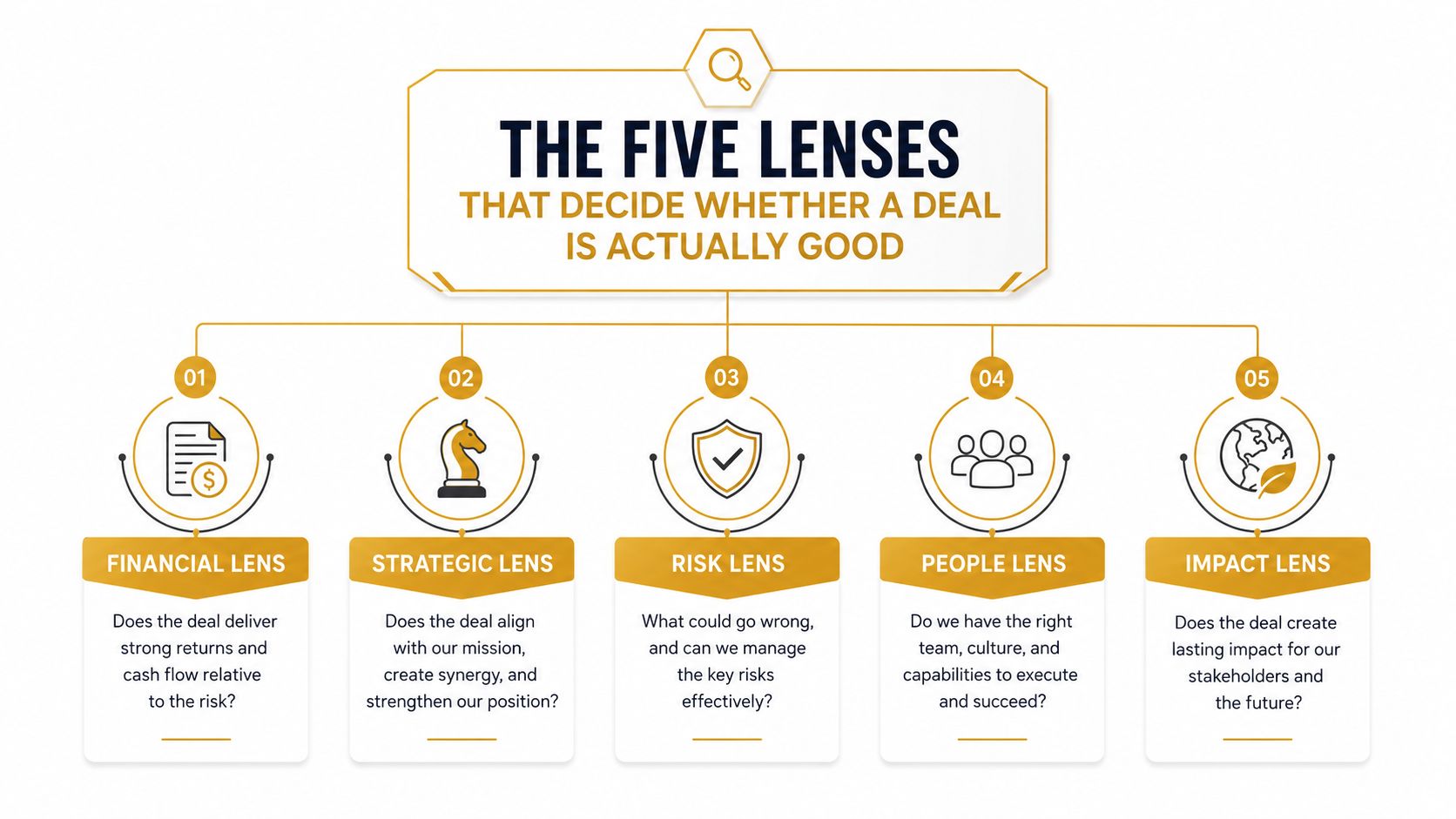
Lens four, risk profile
Customer concentration, dependence on a key supervisor, unresolved claims, and weak contract documentation can break the return calculation. A buyer should stress-test the model against customer loss, wage pressure, equipment replacement, and a slower transition.
The question isn't whether risk exists. Every operating business has risk. The question is whether the price and structure compensate the buyer for bearing it.
Lens five, structure
Review the seller note, earn-out triggers, transition obligations, non-compete language, and remedies if representations prove inaccurate. A seller note can improve the buyer's capital efficiency, but only if repayment terms leave the company enough liquidity to operate.
Change one lens and the verdict can flip. The same earnings may look attractive at one cash requirement and unacceptable at another, or sensible with a committed transition and dangerous without one.
A Good Deal and a Bad Deal Compared Side by Side
Two fictional HVAC service companies produce identical revenue of $1.2 million and identical SDE of $300,000. Their operating profiles look similar in a teaser, but the proposed transactions tell a different story.
| Metric | Strong Deal | Weak Deal |
|---|---|---|
| Purchase price | $900,000 | $1,350,000 |
| SDE | $300,000 | $300,000 |
| Implied SDE multiple | 3.0x | 4.5x |
| Seller financing | 40% at 6% | None |
| Recurring customer mix | 80% | 55% |
| Owner transition | 90 days | None |
| Customer retention assumption | 80% | Not supported |
| Buyer cash requirement | Lower, subject to reserves and costs | Entire purchase price plus reserves |
The strong deal wins the first lens immediately. Paying 3.0x SDE gives the buyer more earnings for each dollar of enterprise value than paying 4.5x for the same SDE. The difference isn't cosmetic. It represents 1.5 additional turns of multiple, which the weak deal must justify through superior growth, lower risk, or stronger strategic value.
The second lens is capital efficiency. Seller financing equal to 40% of the price at 6% reduces the strong deal's upfront equity requirement, although the note still creates debt service. The weak deal closes all-cash, so the buyer puts substantially more capital at risk before receiving the first post-close distribution.
| Evaluation lens | Strong Deal | Weak Deal |
|---|---|---|
| Multiple paid | Lower price per dollar of SDE | Higher price for identical SDE |
| Return potential | Seller note can lift cash-on-cash return | All-cash funding depresses capital efficiency |
| Strategic fit | Recurring relationships support planning | Lower recurring mix creates less visibility |
| Risk profile | Retention assumption and transition offer evidence to verify | No transition leaves owner dependence unresolved |
| Structure | Seller remains financially aligned | Buyer carries nearly all execution risk |
The strong deal's 80% customer retention assumption still needs evidence. Review renewal history, cancellations, service complaints, contract terms, and the customers responsible for the largest accounts. A 90-day owner transition also has value only if it includes documented introductions, ride-alongs, pricing handoffs, and training.
The weak deal can still work for an operator with exceptional HVAC expertise and a credible growth plan. But on the information available, the higher multiple and absence of seller financing push its cash-on-cash return from roughly 45% in the stronger structure to single digits in the weaker one, before considering additional operating risk. The variable that flipped the verdict wasn't revenue or SDE. It was the combination of the extra 1.5 turns and the missing seller financing, which forced the buyer to fund more risk with more cash.
Your Deal-Screening Checklist Before You Sign an LOI
A CIM can make every opportunity sound urgent. A screening checklist slows the process down long enough to separate a financeable business from an attractive narrative.
Multiple lens
- Normalize SDE or EBITDA: Rebuild earnings from tax returns, bank statements, payroll, and general-ledger detail. Add-backs need evidence and must reflect expenses a buyer can remove.
- Compare relevant businesses: Test the target multiple against category norms and comparable transactions, then adjust for transferability, customer quality, growth, and risk.
- Challenge the denominator: Ask whether the stated earnings include temporary revenue, unpaid owner labor, or expenses that will return after closing.
Return lens
- Underwrite first-year cash-on-cash return above 25%: Calculate using buyer cash deployed, working-capital reserves, financing costs, replacement management, and a realistic operating case. Don't use an upside forecast to justify the LOI.
- Run downside math: Reduce revenue or margin assumptions, increase necessary expenses, and determine whether debt service remains manageable.
- Separate cash flow from accounting profit: The buyer needs cash available after operating needs and required payments, not merely adjusted earnings on a presentation page.
Fit lens
- Identify one year-one operating lever: Look for route density, customer overlap, procurement savings, sales capacity, recruiting strength, or systems that the buyer can control.
- Name the owner of the lever: If nobody has the time, skill, or authority to execute it, it shouldn't support the valuation.
Risk lens
- Test customer concentration under 20%: Verify the threshold using customer-level revenue, contracts, renewal records, and churn history.
- Document key-person dependence: Identify who controls pricing, relationships, production, hiring, and vendor access.
- Define a transition period of 60 to 180 days: Put the seller's duties, availability, introductions, and training deliverables in writing.
Structure lens
- Seek a seller note of at least 20% of price: Evaluate the interest rate, maturity, amortization, collateral, and priority alongside senior financing.
- Make earn-outs measurable: Use verified financial statements and unambiguous triggers, with clear rules for operational changes.
- Protect post-close recourse: Review representations, warranties, indemnities, survival periods, and escrow arrangements with acquisition counsel.
For buyers comparing valuation documents, BOV vs appraisal differences explained offers useful context on how an opinion of value can differ from a formal appraisal. For the diligence work itself, use essential due diligence checklists for buyers to turn each screening question into a document request and verification task.

Three Deal Myths That Quietly Cost Buyers Millions
Myth one, a low headline price equals a good deal
A discounted price doesn't rescue a business whose revenue is falling and whose buyer has no credible stabilization plan. A low multiple can reflect deteriorating customer relationships, obsolete equipment, weak pricing, or a seller who has already exhausted the easiest growth opportunities.
The buyer should ask what must improve for the business to produce the projected cash flow. If the answer depends on a major turnaround, the acquisition is partly an operating project, not a simple purchase of existing earnings. Price the execution risk instead of treating the discount as protection.
Myth two, revenue is what matters
Revenue tells you the size of the commercial activity. It doesn't tell you how much cash reaches the owner.
| Business | Revenue | Margin | Illustrative earnings |
|---|---|---|---|
| Business A | $5 million | 3% | $150,000 |
| Business B | $1.5 million | 22% | $330,000 |
Business A has more than three times the revenue of Business B, yet Business B produces more illustrative earnings under these assumptions. The buyer financing Business A may inherit heavy labor, fulfillment, inventory, or service costs without receiving an adequate return on invested capital.
SDE, EBITDA, working-capital needs, and capital expenditure requirements should drive the cash-on-cash analysis. Revenue becomes valuable when the business converts it into dependable cash flow.
Myth three, a high multiple automatically kills the deal
A high multiple deserves scrutiny, but it isn't automatically irrational. A company with recurring revenue, strong customer retention, transferable systems, and low owner dependence can justify more confidence in future cash flow than a project-based agency with a lower multiple and a constantly resetting pipeline.
The buyer still needs to model multiple compression. If the exit market later values the company at a lower multiple, growth and debt repayment must compensate for that change. A higher entry multiple can work when the buyer purchases exceptional durability and has a realistic path to expand earnings, but it can't work on optimism alone.
A multiple is a price tag attached to a risk profile. Remove the risk profile and the multiple becomes almost meaningless.
Putting the Framework to Work on Your Next Deal
Use the framework as a sequence, not a democracy in which every factor gets an equal vote. Return and risk have veto power. Strategic fit and structure can improve a deal, but they can't justify cash flow that fails under reasonable pressure.
Start by screening the asking price against normalized earnings. Rebuild SDE or EBITDA, calculate the implied multiple, compare it with relevant market context, and remove add-backs that won't survive ownership transfer.
Then model cash-on-cash return under three scenarios:
- Base case: Current normalized earnings, realistic debt service, ordinary working-capital requirements, and no unproven growth.
- Upside case: Only improvements supported by a specific operating action, assigned owner, and credible timing.
- Downside case: Customer loss, margin pressure, replacement hiring, delayed transition, or an unexpected operating expense.
Next, stress-test concentration and owner dependence. A business can pass the base case and still fail if one customer departure or one employee resignation destroys the earnings stream. Document the exact event that causes the return to fall below your required threshold.
Score strategic fit on a 1-to-5 scale, using observable factors such as customer overlap, route density, sales capability, labor access, and systems compatibility. Keep the score separate from the financial model so enthusiasm doesn't inflate the return assumptions.
Finally, revisit structure after the numbers pencil out. A hypothetical HVAC company priced at 3.2x with 25% seller financing may clear the base case, but only if owner dependency falls from 80% to 40% after closing. That reduction must come from a transition plan, documented processes, customer introductions, and a named replacement for the seller's responsibilities. If it doesn't happen, the original return calculation is incomplete.

For a broader approach to sourcing and evaluating opportunities, review these frameworks for effective deal evaluation. Before requesting an LOI, run the full sequence. After diligence, run it again with verified financials, customer evidence, financing terms, and transition obligations. The first number is an asking price, not a conclusion.
Dealmaker Wealth Society provides acquisition training, diligence guidance, deal-structuring education, and peer support for buyers working through opportunities like these. Visit Dealmaker Wealth Society to explore the available programs and get a more disciplined process for deciding whether your next deal is genuinely worth pursuing.

From the Dealmaker Blog













A Creative Business Buying Fable
