What Is Seller Financing in a Business Acquisition?
What Is Seller Financing in a Business Acquisition?

Seller financing is a deferred portion of the purchase price that the seller carries as a note, often covering roughly 10% to 25% of the deal price. The buyer pays that amount over time instead of delivering the entire purchase price in cash at closing.
You may be looking at a profitable business, have a lender interested, and still face one stubborn problem: the financing package doesn't cover the seller's asking price. The seller may also hesitate to accept a lower valuation, while you may not want to put every available dollar into the acquisition. Seller financing can bridge that gap, but it isn't free money and it usually isn't a replacement for a bank.
The useful way to understand it is as a subordinated, gap-funding layer inside the acquisition's capital stack. A senior lender funds first, the buyer contributes equity, and the seller carries a note for part of the remaining price. The seller gets a contractual claim on future cash flow, while the buyer gets a path to closing that might otherwise be unavailable.
Table of Contents
- A Plain-English Definition of Seller Financing
- How Seller Financing Fits Inside the Deal Capital Stack
- Common Structures Used in SMB Acquisitions
- Typical Terms and Numbers in a Seller Note
- Seller Financing Inside SBA 7(a) Acquisition Deals
- Pros and Cons for Buyers and Sellers
- Legal, Tax, and Documentation Essentials
- When to Use Seller Financing in Your Deal Strategy
A Plain-English Definition of Seller Financing
Seller financing is a deferred portion of the purchase price that the seller carries back as a personal loan to the buyer. Instead of receiving every dollar at closing, the seller accepts a promissory note and receives scheduled payments of principal and interest.
Think of buying a car from a local dealer that doesn't use a bank for one particular transaction. You pay part of the price upfront, sign an agreement for the balance, and send monthly payments to the seller. In a business acquisition, the seller takes the role of the private creditor. The business and, in some cases, the buyer's other assets provide security for repayment.
Market guides describe seller notes in a range that commonly reaches 10% to 25% of the purchase price, with broader deal structures sometimes extending beyond that range. The precise amount depends on the buyer's equity, the senior lender's limits, the seller's confidence, and the business's ability to support debt service. A practical overview of seller financing structures and risks can help you see how those variables interact.

Suppose the agreed purchase price is $1.2 million and the seller carries $250,000. The buyer still needs to assemble the remaining $950,000 from equity, senior debt, or another approved source. The seller note doesn't reduce the price by itself. It changes when the seller receives part of the price and shifts repayment risk to the period after closing.
That distinction matters. The seller isn't giving the buyer a discount. The seller is accepting a promise to pay, often behind a bank's claim. The note's interest rate, maturity, collateral, payment schedule, default rights, and subordination agreement determine whether the arrangement protects both sides.
How Seller Financing Fits Inside the Deal Capital Stack
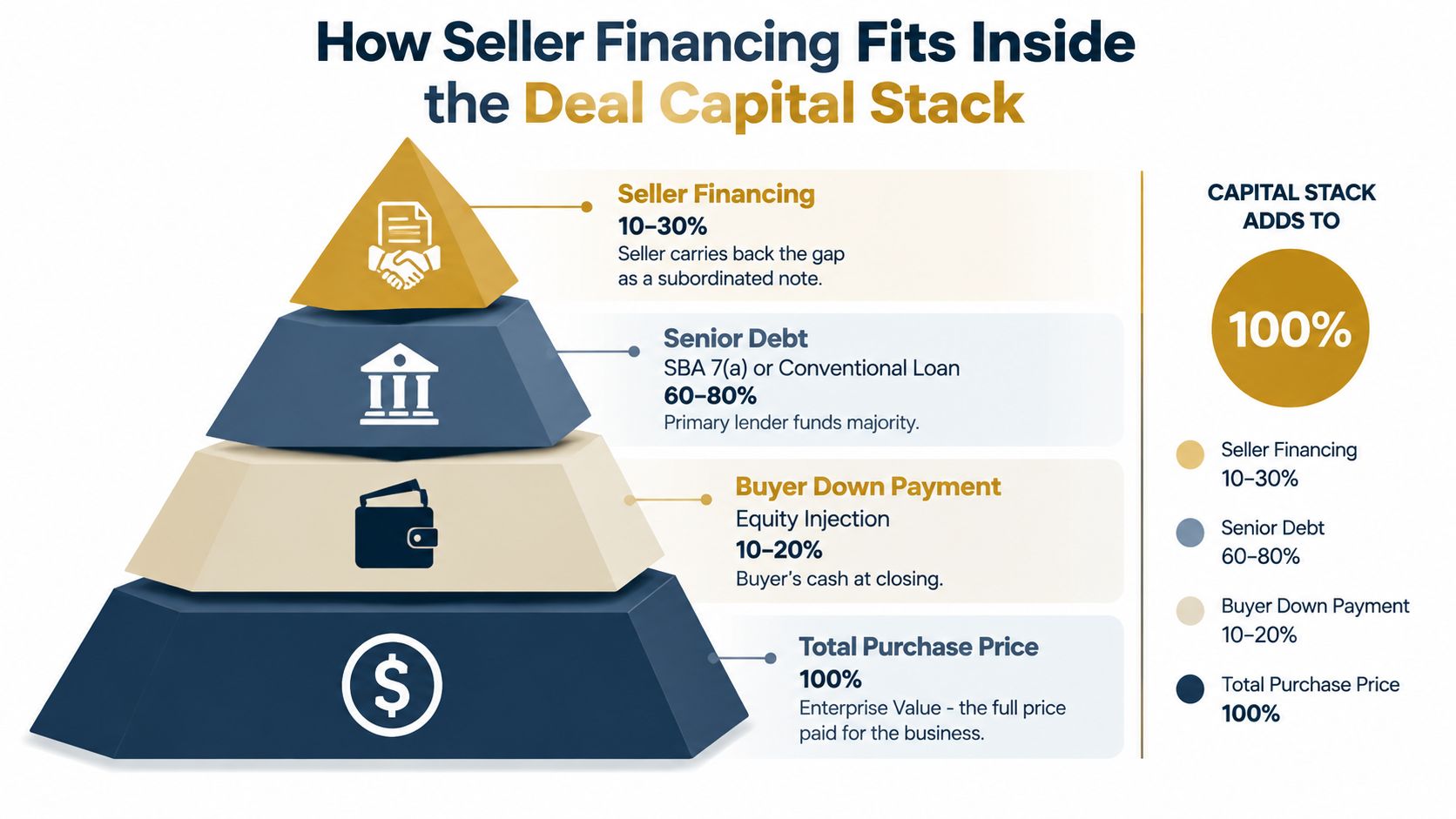
An acquisition capital stack answers one question: who supplies each dollar of the purchase price, and who gets paid first? In a small-business transaction, the stack usually contains four components.
- Total purchase price: This is the full amount paid for the business, including the agreed value of the operating company and any negotiated adjustments.
- Buyer equity: The buyer's cash contribution sits at risk from day one. It absorbs losses before debt holders do.
- Senior debt: A bank or other primary lender provides financing under its own underwriting standards. SBA 7(a) and conventional loans can occupy this senior position.
- Seller note: The seller defers part of the proceeds and accepts repayment over time, usually subject to senior lender rights.
The seller note is often a subordinated layer. In plain English, the seller agrees that the senior lender gets paid first if the business has limited cash or enters default. Subordination isn't determined by which creditor charges the higher interest rate. Seniority determines payment priority.
Practical rule: A seller note should be analyzed as credit risk, not as unpaid sale proceeds.
Consider a $2 million acquisition funded with 60% senior debt, 15% seller financing, and 25% buyer equity. The senior lender supplies $1.2 million, the seller carries $300,000, and the buyer contributes $500,000. The three funding sources add to the full purchase price, but they don't have equal rights.
If the seller note rises while the purchase price stays fixed, the buyer may need less cash at closing. However, the seller takes on more repayment exposure, and the company must support another debt obligation. If senior debt increases instead, the buyer may reduce its equity contribution, but the lender may impose tighter covenants, guarantees, or cash-flow requirements.
The stack also affects negotiations. A seller might accept a subordinated note because it preserves the headline price. A lender might accept it only if the note can't demand payment ahead of senior debt. Buyers comparing financing options for buying a company should examine the entire stack, not just the amount of cash required at closing.
A visual explanation of the stack can make payment priority easier to understand:
Common Structures Used in SMB Acquisitions
Seller financing doesn't describe one document or one payment pattern. Buyers and sellers use several structures, and each one allocates risk differently.
| Structure | How It Works | Best For | Key Risk |
|---|---|---|---|
| Straight promissory note | The seller lends a fixed amount under an agreed rate, payment schedule, and maturity date. | A transaction where both sides agree on value and want predictable payments. | The buyer must service the debt even if performance weakens, which can make closing more difficult. |
| Earnout | Part of the consideration becomes payable only if the business reaches defined performance milestones. | A valuation gap caused by uncertainty about future revenue, profit, retention, or growth. | Ambiguous milestones can create disputes over accounting, control, and whether the payment was earned. |
| Subordinated seller note | The seller accepts a deferred payment claim that formally ranks behind senior debt. | A deal that needs additional capital while preserving bank financing. | The seller has limited remedies and may wait behind the senior lender during a default. |
A straight promissory note works like a conventional private loan. The parties agree on the principal, interest, amortization, maturity, prepayment rights, and default provisions before closing. This structure gives the seller payment certainty and gives the buyer a known debt burden, but the lender may count the scheduled payments when testing whether the business can support the acquisition.
An earnout is different because the buyer doesn't owe the contingent amount unless the agreed conditions occur. That can resolve a disagreement over what the business is worth today versus what it might become after the buyer takes over. The purchase agreement must define the measurement period, accounting method, operational control, and dispute process with care.
A subordinated note is a priority arrangement as much as it is a payment arrangement. The seller may have collateral and a guarantee, yet still agree not to collect principal or enforce certain remedies until the senior lender's rights are satisfied.
Choose among these structures by asking three questions. How confident are both parties in the price? Does the seller want predictable income or continued participation in upside? What does the senior lender permit? A deal can use more than one structure, but combining a fixed note with an earnout requires especially clear definitions so the buyer isn't exposed to overlapping obligations.
Typical Terms and Numbers in a Seller Note
A seller note term sheet turns a broad promise into an enforceable repayment plan. Market guidance commonly places seller notes around 10% to 25% of purchase price, with terms often including 5-year to 7-year maturities and interest near 6% to 9% for the higher-risk seller position. The exact terms remain negotiable, but the seller's junior ranking generally requires compensation for added risk. These ranges are summarized in business acquisition financing guidance for 2026.
| Term | Typical Range | Notes |
|---|---|---|
| Note size | 10% to 25% of purchase price | The seller note commonly fills the gap left after senior debt and buyer equity. |
| Maturity | 5 to 7 years | The final balance may be due as a balloon unless the note fully amortizes. |
| Interest rate | 6% to 9% | The rate reflects the seller's subordinated credit position and negotiated protections. |
| Payment pattern | Monthly principal and interest, interest-only, or deferred payments | Senior lender rules and business cash flow often drive the structure. |
| Collateral | Business assets, UCC filing, guarantees, or equity pledge | The seller's rights may be limited by senior lender priority. |
For a concrete illustration, assume a $1.5 million acquisition includes a 15% seller note at 6% over five years. The note principal would be $225,000. The term sheet still needs to answer whether payments are fully amortizing, whether a balance remains due at maturity, whether the buyer can prepay without penalty, and what happens after a missed payment.
Collateral might include a security interest in the company's assets, a UCC filing, a pledge of ownership interests, and a personal guarantee. Those protections don't eliminate risk. A seller can hold a valid lien and still recover little if the business lacks value after a failed turnaround and the senior lender has priority.
The most negotiable levers are usually the payment start date, amortization, prepayment rights, default cure period, collateral, guarantee scope, and maturity. The most market-driven constraints often come from the senior lender, especially when the seller note is subordinated or intended to support an SBA structure.
Seller Financing Inside SBA 7(a) Acquisition Deals
SBA 7(a) transactions make one question especially important: does the seller note count toward the buyer's required equity injection? It can, but only when the note meets the applicable full-standby requirements for the entire SBA loan term. Under that arrangement, the seller doesn't receive principal or interest payments during the standby period, and the seller note remains behind the SBA lender.
Industry guidance describes the seller note as potentially covering up to half of the required equity injection when it is fully on standby for the required term. A buyer shouldn't treat that as automatic. The lender, SBA rules, documentation, and specific transaction facts control the result. SBA 7(a) down-payment guidance explains why standby status is a central structuring issue.
What full standby changes
Full standby generally means the seller can't collect scheduled principal or interest while the SBA loan remains subject to the standby arrangement. The note also needs to be subordinated properly, and provisions that let the seller accelerate repayment or enforce remedies may conflict with lender requirements.
A partially deferred note can still appear in the capital stack, but it generally won't satisfy the equity-injection test. It may instead behave like additional debt, adding payment pressure to the acquired company's cash flow. That difference can decide whether a buyer has enough qualifying equity to close.
How to negotiate the trade-off
The seller may resist full standby because it delays income and increases exposure. The buyer can address that concern through a stronger guarantee, clearer reporting rights, defined default notices, collateral subject to lender approval, or a later payment schedule that begins once standby ends.
Don't finalize the seller note in isolation. Have the SBA lender review the purchase agreement, promissory note, subordination agreement, and security documents before signing. A note that looks workable between buyer and seller can still fail the lender's requirements if its payment or remedy language conflicts with senior debt.
Pros and Cons for Buyers and Sellers
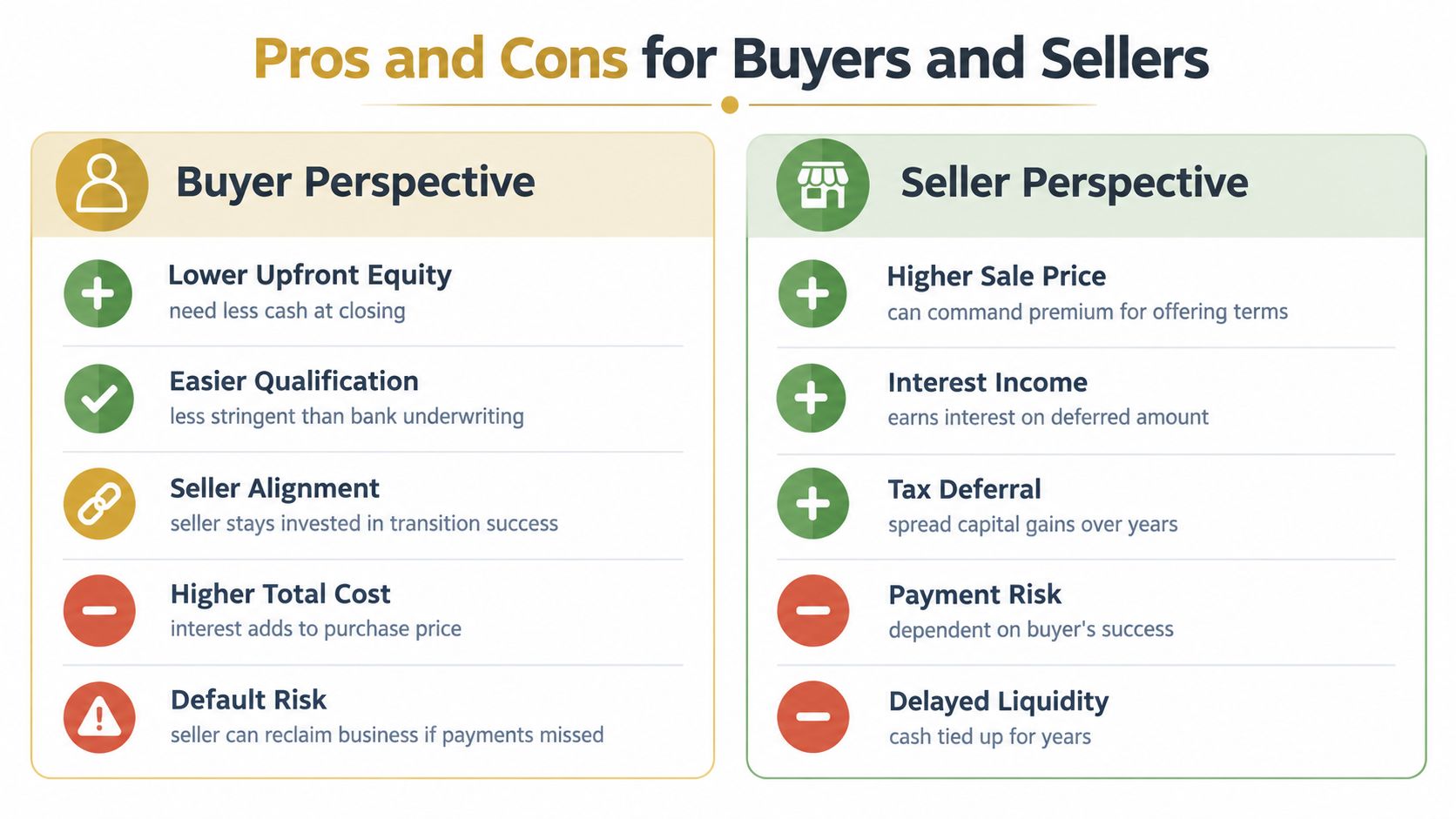
Seller financing can make a transaction possible, but the same feature that helps one party can expose the other. The buyer gets time to pay. The seller keeps a claim on the business and depends on the buyer's future performance.
The buyer's side
A buyer may use a seller note to reduce the cash needed at closing or to solve a lender shortfall. The seller's willingness to carry paper can also signal confidence in the business and create an incentive for a careful transition.
The costs are just as concrete. The buyer assumes another payment obligation, may sign a personal guarantee, and could face a balloon payment before the business has built enough equity to refinance. A note can also slow equity buildup because operating cash goes toward debt service rather than reinvestment.
The seller's side
A seller can widen the buyer pool, preserve the negotiated price, and earn interest on the deferred balance. Installment treatment may spread recognition of gain over the payment period, subject to tax rules and professional advice.
The seller also gives up immediate liquidity. If the buyer undercapitalizes the company, misses payments, or struggles with the transition, the seller may spend years managing a credit problem instead of enjoying a clean exit. Subordination makes that risk sharper because the senior lender receives priority.
The deal deserves a stress test before either party celebrates the headline price:
- Cash-flow resilience: Can the business cover senior debt and the seller note if operating performance deteriorates?
- Senior-debt strength: What collateral, covenants, guarantees, and remedies does the bank control?
- Downside response: What happens if the business underperforms by 20%, and is that scenario survivable without emergency capital?
For a closer look at payment protections, review these ways to strengthen seller financing payments. The objective isn't to eliminate risk. It's to make the risk visible, priced, and documented before closing.
Seller financing is valuable only when the surrounding business can support the promised payments.
Legal, Tax, and Documentation Essentials
A handshake may begin the conversation, but it can't carry the transaction. The seller note should be negotiated alongside the purchase agreement, not added as an informal side arrangement after the commercial terms are settled.
Documents that define the obligation
The promissory note states the principal, interest, payment dates, maturity, prepayment rights, and default consequences. The security agreement grants the seller rights in specified business assets, while a UCC-1 filing helps perfect those rights under applicable law. If the buyer uses a new acquisition entity, the seller may also request a personal guarantee or a pledge of the buyer's ownership interests.
A holdback or escrow can reserve part of the note balance for indemnity claims, working-capital adjustments, or liabilities discovered after closing. The parties should specify release conditions, notice requirements, and the process for resolving a disputed claim.
Tax and regulatory review
Interest is generally treated differently from principal for the seller, and installment-sale reporting can affect when gain is recognized. Imputed-interest rules under Internal Revenue Code Section 1274 may also affect how payments are characterized. A tax professional should review the allocation, interest rate, asset classes, and reporting obligations before the parties sign.
The legal environment varies by jurisdiction and transaction type. Seller financing may trigger licensing, disclosure, usury, or mortgage-origination rules when the arrangement involves real estate, repeated lending activity, or other regulated circumstances. A Michigan DIFS FAQ notes that some seller-financed residential mortgage activity can implicate the MLOLA, while SAFE Act treatment may differ for certain non-habitual owner-occupant transactions. Business acquisition counsel should determine whether those rules apply to the actual deal.
Use a structured financial due diligence checklist for founders to verify cash flow, debt obligations, working capital, tax records, and liabilities before relying on future business payments. Buyers can also review payment-plan structuring considerations for business acquisitions before drafting the final documents.
When to Use Seller Financing in Your Deal Strategy
Seller financing works best when it solves a specific capital or negotiation problem. It can support an acquisition when the senior lender won't fund the full price, the buyer wants to preserve operating cash, or the seller has enough confidence in the business to accept delayed proceeds.
Market coverage shows why the structure remains relevant. Independent and industry sources place the share of small-business sales involving some seller financing anywhere from about 40% to 90%, depending on source and deal size. One major market report found that 90% of buyers expected seller financing to form part of their acquisition strategy, while only 29% of owners planned to offer it, revealing a meaningful gap between buyer expectations and seller willingness. See the market discussion in seller financing research from Morgan & Westfield.
Early 2026 market survey data also placed the seller-carried portion of deal value around 10% to 16% in most segments, with the figure as low as 5% in the $5 million to $50 million range. Historical survey data cited in market coverage found owner financing in 48% of business sales in 2023, including 34% of transactions in the $5 million to $50 million bracket. Those figures don't establish a universal rule, but they do show that seller financing can be a normal negotiation point rather than an unusual rescue device. The underlying market discussion is available in seller financing data for small-business acquisitions.
A practical decision screen
Seller financing is more attractive when:
- The seller wants installment treatment: Delayed proceeds may fit the seller's tax and income objectives, subject to tax advice.
- The senior lender leaves a gap: A subordinated note can fill part of the unfunded purchase price.
- The business has understandable cash flow: The buyer can model debt service under weaker operating conditions.
- The seller believes in the transition: Continued exposure makes more sense when the seller trusts the buyer's operating plan.
- The valuation needs flexibility: An earnout or note can bridge a disagreement without forcing either side to accept an immediate concession.
It is usually weaker when the seller needs maximum cash at closing, wants no post-close relationship, or doubts the buyer's ability to operate the company. Buyers should also be cautious when the business already carries heavy senior debt or depends on optimistic projections.
Don't confuse seller financing with every possible tax-deferral strategy. A real estate investor evaluating a like-kind exchange can consult an overview of 1031 exchange tax strategy, but that framework isn't a substitute for structuring and documenting a business acquisition note.
Seller financing is a tool, not a verdict. Treat it as one layer alongside senior debt, SBA 7(a) financing, equity, and, where appropriate, an earnout. The right structure gives each party a clear return, a defined risk, and a workable response when the business doesn't perform exactly as planned.
Dealmaker Wealth Society provides acquisition education, deal-structuring training, mentorship, and peer support for buyers working through funding, negotiation, and post-close execution. Visit Dealmaker Wealth Society to explore practical resources for evaluating seller notes and building a capital stack that can support your next business acquisition.

From the Dealmaker Blog











A Creative Business Buying Fable