When Buying a Business What Is Cash Flow
When Buying a Business What Is Cash Flow

The median cash flow for sold U.S. small businesses was about $165,256 in Q1 2026, and the median cash flow multiple was 2.7x. That means buyers commonly valued businesses at roughly 2.7 times annual cash flow, not revenue.
When buying a business, cash flow is the money the operation can produce after normal operating needs are covered and before you decide how much debt, reinvestment, or owner compensation it can support. The figure in a seller's spreadsheet may be called cash flow, SDE, EBITDA, or adjusted profit, but none of those labels automatically tells you how much cash will remain after closing.
That distinction separates an attractive listing from a financeable acquisition. A business can show impressive revenue and still leave the new owner short of payroll, inventory funding, taxes, maintenance spending, or loan payments. The buyer's job is to turn the seller's headline number into a realistic estimate of post-close free cash flow.
Table of Contents
- Why Cash Flow Is the Number That Decides Your Deal
- Operating Cash Flow vs Free Cash Flow What Every Buyer Must Distinguish
- How to Calculate Free Cash Flow for an Acquisition
- Normalizing Seller Cash Flow Adjustments Buyers Should Make
- The Working Capital Trap That Kills Cash Flow Positive Deals
- EBITDA SDE and Free Cash Flow Which Metric Matters When
- How Cash Flow Determines Your Acquisition Valuation and Deal Terms
- Your Acquisition Cash Flow Verification Checklist
Why Cash Flow Is the Number That Decides Your Deal
A business can report strong revenue and still leave its owner short of payroll, inventory funding, taxes, maintenance spending, or loan payments. That is why buyers underwrite cash generation, not the seller's headline earnings figure.
In Q1 2026, sold U.S. small businesses had median cash flow of about $165,256 and a median cash flow multiple of 2.7x, according to BizBuySell's Q1 2026 Insight Report. The same report showed a median sale price of $350,000 and median revenue of $713,404. Revenue attracts attention, but it does not establish whether the acquisition can fund debt service, reinvestment, and the buyer's income.

Revenue attracts buyers, cash flow qualifies them
Revenue measures customer purchases. Cash flow measures what remains available after ordinary operating demands. A growing company may need more inventory, employees, equipment, or receivables funding before that growth produces usable cash.
Seller add-backs create another risk. Personal expenses, one-time repairs, owner benefits, and other adjustments may be valid for a specific owner, yet unavailable to the buyer after closing. A buyer who accepts every adjustment at face value can overstate both financing capacity and personal income.
Practical rule: Treat reported cash flow as a starting hypothesis, not spendable money.
The gap between accounting earnings and available cash is why cash-flow analysis became a standard part of financial reporting. U.S. reporting requirements adopted in the early 1990s, including SFAS 117 in 1993, required most organizations to provide a cash-flow statement for each reporting period. The statement offers a clearer view of operating liquidity than earnings alone. The historical context appears in Columbia Business School's cash-flow analysis material.
Before committing emotionally to a target, reconcile the seller's cash-flow figure to tax returns, bank statements, and general-ledger detail. Then test whether the result survives a replacement owner salary, required working capital, maintenance spending, cash taxes, and debt service. That post-close figure, not adjusted earnings on a listing, determines how much room the deal has.
Reviewing entity choice and payroll tips can clarify how compensation and business expenses affect reported results, but the acquisition still requires transaction-specific normalization. For a practical perspective on liquidity and deal resilience, see why cash is always king.
Operating Cash Flow vs Free Cash Flow What Every Buyer Must Distinguish
Operating cash flow measures cash produced by the business's ordinary activities. It reflects the operating cycle, including collections, supplier payments, payroll, and other recurring transactions. It doesn't yet answer the buyer's most important question: how much cash survives after the obligations required to own and operate the business?
Free cash flow is the amount left after the business pays for the resources necessary to keep functioning. For acquisition underwriting, that usually means starting with adjusted EBITDA or SDE and deducting a replacement owner salary, maintenance capital expenditures, cash taxes, and required working-capital investment. The exact presentation can vary, but the discipline is consistent: remove cash demands that the seller's headline metric may leave out.
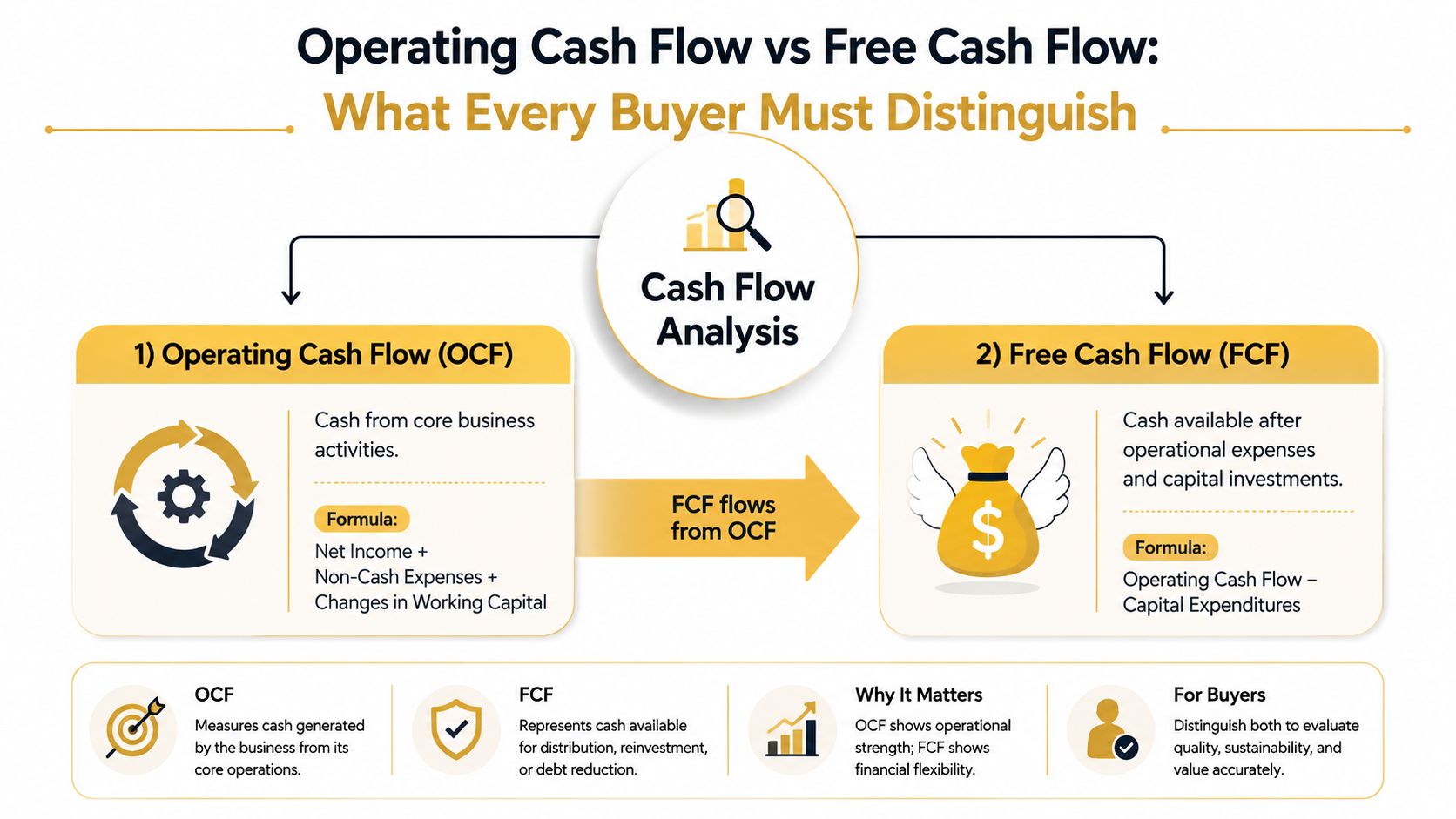
A simple way to see the gap
Think of operating cash flow as the body's heartbeat. It shows that the operating system is producing circulation. Free cash flow is the blood available to sustain the buyer, the lender, and the business after vital organs have taken what they need.
Suppose a target reports $200,000 in operating cash flow. The buyer then accounts for a replacement owner salary, maintenance spending, cash taxes, and working-capital needs. If those deductions total $132,000, only $68,000 remains as free cash flow. The difference isn't an accounting technicality. It changes the amount of debt the business can safely carry and the cash the buyer can take home.
| Metric | What it tells you | Main limitation |
|---|---|---|
| Operating cash flow | Whether core operations generate cash | It may exclude acquisition financing and required reinvestment |
| Adjusted EBITDA or SDE | A normalized earnings starting point | Add-backs may not reflect post-close cash needs |
| Free cash flow | Cash available after necessary deductions | It still requires stress testing for future risk |
Sellers often prefer operating cash flow or adjusted SDE because those measures can present the business in its strongest light. Buyers should use them to begin the analysis, then calculate the cash available after ownership changes. Business acquisition cash-flow guidance frames the practical underwriting process around adjusted EBITDA or SDE, followed by deductions for replacement compensation, maintenance capex, taxes, and working capital.
If you confuse operating cash flow with free cash flow, you may borrow against money the business never had available. That creates an underfunded acquisition from the first day of ownership.
How to Calculate Free Cash Flow for an Acquisition
A practical acquisition formula is:
Adjusted EBITDA or SDE
minus replacement owner salary
minus maintenance capital expenditures
minus cash taxes
minus required working-capital investment
equals estimated free cash flow
Start with the seller's adjusted EBITDA or SDE, but don't accept the adjustment schedule without testing each item. In a small-business purchase, SDE often represents the total economic benefit available to one owner-operator. That benefit still needs to be reduced if the buyer won't perform the same work personally or if the operation requires cash investment the seller has deferred.
Deduct the replacement owner salary
If the seller works full time in sales, operations, estimating, service delivery, or administration, replace that labor with a market-rate employee or manager. The seller's compensation may have been added back, but the work doesn't disappear when the ownership changes.
Use the role, workload, geography, and required skills to estimate the replacement cost. If the buyer plans to work in the business, model both versions: owner-operated and manager-run. The difference reveals how dependent the valuation is on the buyer accepting a job instead of purchasing an investment.
Account for maintenance capex and cash taxes
Maintenance capital expenditures keep existing capacity working. Replacing equipment, vehicles, technology, or essential fixtures isn't optional because the seller didn't incur the expense every year. Review historical spending, asset condition, and deferred replacement needs rather than relying on a smooth annual average.
Cash taxes also reduce the money available for debt service and distributions. Accounting income and cash taxes don't always move together, so the buyer should model the actual tax burden expected under the proposed ownership and financing structure.
Fund the operating cycle
Required working capital supports receivables, inventory, payroll timing, deposits, and ordinary fluctuations between paying suppliers and collecting customers. A growing business may need more operating capital even when its reported earnings are rising.
For example, assume a target has $240,000 of adjusted SDE. The buyer models a $70,000 replacement owner salary, $25,000 of maintenance capex, $40,000 of cash taxes, and $30,000 of working-capital investment. Estimated free cash flow is $75,000. That is the figure to compare with projected annual debt service, not the original SDE.
A lender's analysis will ultimately focus on repayment capacity, and the buyer should do the same before submitting an offer. Tools that support agentic analytics for finance may help organize financial information, but automated analysis can't decide whether an add-back or replacement role is economically realistic.
Normalizing Seller Cash Flow Adjustments Buyers Should Make
Normalization turns a seller's reported earnings into a sustainable operating baseline. The buyer removes expenses that won't recur, reverses personal or unusual items that don't belong in the business, and adds back costs only when the buyer can prove they aren't required after closing.
The process isn't about forcing the number downward. It's about separating genuine economic benefit from presentation tactics.
Adjustments that may be valid
A single extraordinary repair may be a legitimate add-back if the buyer verifies that it was unusual, fully completed, and not evidence of neglected maintenance. A personal vehicle expense may be removed if the buyer won't need that vehicle for operations. A non-recurring legal bill may also qualify if the underlying dispute has ended and no related liability remains.
For every proposed add-back, ask four questions:
- What happened? Obtain the invoice, contract, or supporting record.
- Why was it unusual? Compare it with prior periods and the nature of the business.
- Will the cost recur? Consider whether a new owner will face the same requirement.
- Who benefits? Separate a personal benefit from a business expense that supports operations.
An item that appears only once in a spreadsheet isn't automatically non-recurring. A business with aging equipment may show one large repair this year and another large replacement shortly after closing.
Adjustments that require skepticism
Above-market owner compensation is a common trap. If the seller pays themselves more than the market cost for the actual role, the excess may be a valid normalization adjustment. If the seller's compensation is below market because they perform essential work cheaply, adding all of it back inflates the buyer's expected cash flow.
The same logic applies to family payroll, personal travel, discretionary memberships, and “temporary” expenses. If the expense keeps the owner involved, maintains relationships, or performs an operating function, the buyer should assume it has economic value until proven otherwise.
Use this practical discussion of add-backs to sharpen your questions, then build an adjustment schedule with three columns: seller claim, buyer treatment, and supporting evidence. Any unresolved item should remain excluded from the buyer's base case until diligence proves otherwise.
The Working Capital Trap That Kills Cash Flow Positive Deals
A business can report positive cash flow and still fail after closing because cash arrives later than expenses fall due. Receivables, inventory, payroll timing, supplier terms, deposits, and transition costs can consume the cash that a seller's earnings summary appears to make available.
Working capital isn't a balance-sheet formality. At closing, it's the operating capital needed to keep the business running without an immediate cash injection from the buyer. Sellers and buyers should negotiate a specific working-capital target at the Letter of Intent stage, including what accounts count, how the target is calculated, and how a shortfall changes the purchase price.
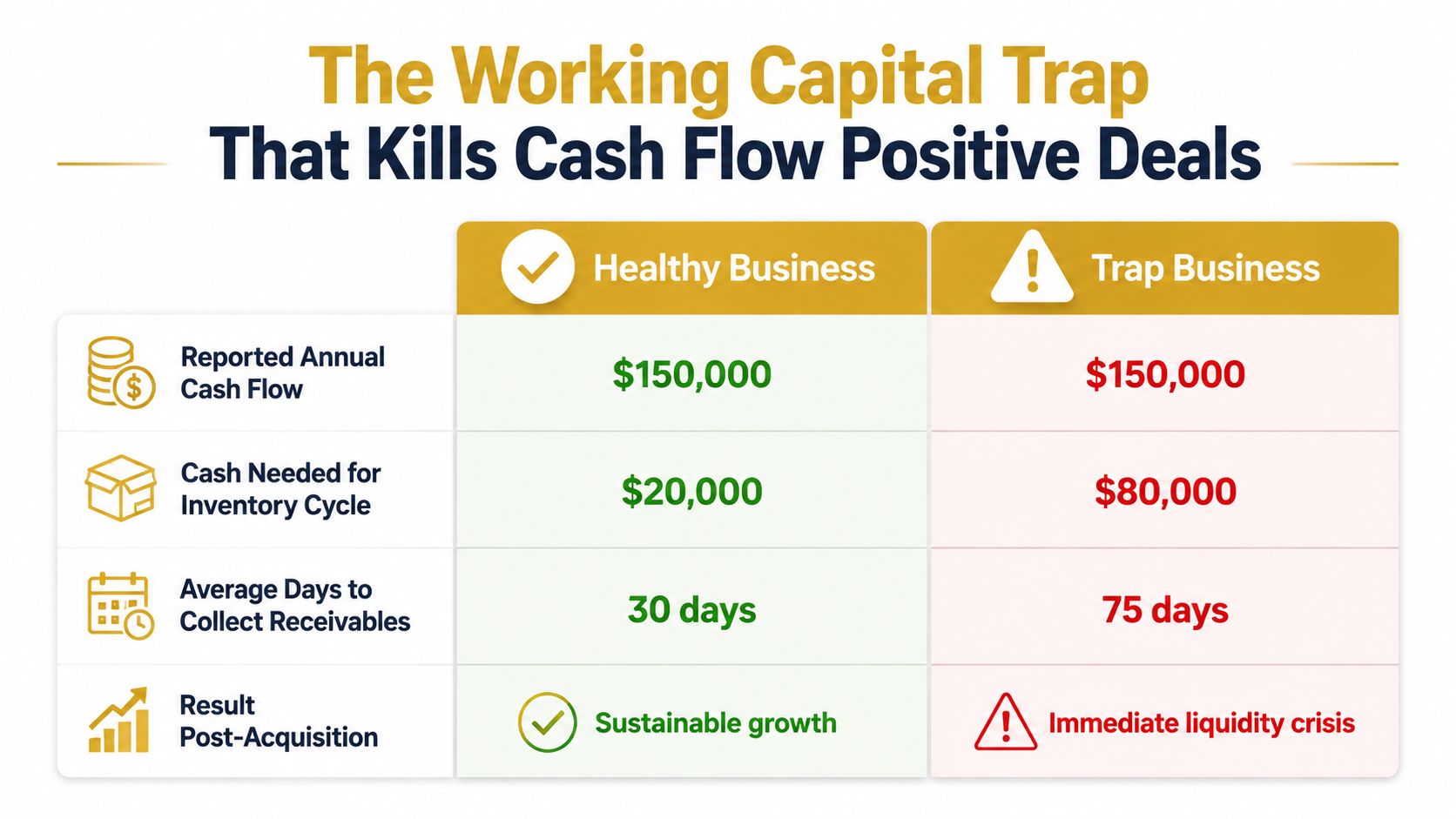
Why the same earnings can produce different outcomes
Two businesses can report the same annual cash flow and have radically different liquidity profiles. One may collect quickly and carry modest inventory. Another may wait much longer for customer payment while funding materials, wages, and subcontractors upfront.
That difference affects the buyer on day one. If the seller extracts cash, delays collections, reduces inventory, or pays liabilities before closing, the buyer may inherit the revenue engine without the operating fuel required to run it.
Strong cash flow is false comfort when growth capex or a long cash-conversion cycle consumes the cash before the owner can use it.
Acquisition-focused guidance recommends addressing working capital in the LOI rather than waiting for final closing documents. One source also notes that SBA lenders may allow 2% to 3% of loan proceeds to be set aside as reserves and advises buyers to budget $75,000 to $150,000 for acquisitions under $5 million in enterprise value. Those figures come from the PBS Brokers working-capital calculation worksheet, and they should be treated as planning guidance, not a universal lender commitment.
The buyer should request aging schedules, inventory detail, payroll timing, vendor terms, and historical working-capital patterns. Also model a slower collection period, an inventory build, and transition expenses. For a direct explanation of the issue, review what working capital means in an acquisition.
The iframe below provides another visual resource on the working-capital problem.
EBITDA SDE and Free Cash Flow Which Metric Matters When
Buyers often argue about whether EBITDA or SDE is the “right” cash-flow metric. The better question is which metric fits the ownership model, transaction size, and financing analysis.
| Metric | What it measures | Most useful when | Limitation |
|---|---|---|---|
| EBITDA | Earnings before interest, taxes, depreciation, and amortization | The business has professional management and limited owner dependence | It doesn't deduct owner replacement cost, taxes, capex, or working capital |
| SDE | The economic benefit available to one owner-operator after customary adjustments | A small business depends on one active owner | It can overstate value for a buyer who needs management |
| Free cash flow | Cash remaining after realistic operating and ownership deductions | Underwriting every acquisition | It depends on accurate assumptions and complete diligence |
EBITDA is useful for comparing operating performance across businesses and capital structures. It becomes less useful if the owner personally handles critical functions or if the buyer must immediately hire a replacement. A buyer evaluating EBITDA should understand how to evaluate your EBITDA in the context of the actual operating model, not just the seller's adjusted schedule.
SDE can be the most intuitive starting point for an owner-operator purchase because it captures salary, benefits, and other economic benefits that a single buyer may receive. It stops being a reliable proxy for spendable cash when the buyer wants passive ownership, plans a management layer, or faces substantial deferred investment.
A decision framework for buyers
Use SDE to screen a small owner-operated target. Use EBITDA to compare a more established company with management in place. Use free cash flow to decide whether the purchase price and financing structure can survive after closing.
None of these metrics captures every risk. Owner dependency, weak documentation, customer concentration, transition friction, and uncertain receivables can reduce the cash available to service debt. Verify the claimed figure against tax returns, bank statements, reconciliations, and customer-level evidence before allowing a multiple to set the price.
How Cash Flow Determines Your Acquisition Valuation and Deal Terms
Cash flow determines both what a business may be worth and what it can support after closing. Those questions overlap, but they require different tests. A seller may apply a multiple to adjusted SDE, while a lender examines whether free cash flow remains sufficient after debt service, replacement labor, taxes, maintenance spending, and working-capital needs.
Earlier Q1 2026 market data reported a 2.7x median cash-flow multiple for sold U.S. small businesses. Applying that reference multiple to $165,000 of normalized cash flow indicates a value of approximately $445,500. The figure is a market reference, not a guaranteed price. It only has meaning if the normalized cash flow reflects the buyer's post-close reality.
A headline cash-flow figure can include the seller's labor, recurring repairs, underfunded working capital, or unsupported personal add-backs. Paying a multiple on that figure means paying for cash the buyer may never receive. Since the valuation multiple magnifies the underlying earnings base, even a modest normalization error can materially change the offer.
Cash flow also sets the structure
Reliable free cash flow gives a lender greater confidence in repayment capacity and may support more conventional financing. Uneven or overstated cash flow can force a lower price, more buyer equity, seller financing, an earn-out, or an equity partner.
Each structure shifts a different risk. Seller financing keeps the seller financially connected to the outcome, but repayment terms still need to fit the business's actual cash generation. An earn-out ties part of the consideration to future performance, although the agreement must define revenue, profit, timing, control, and disputes precisely. An equity partnership reduces immediate debt pressure, but it creates governance, distribution, and exit questions.
The offer should be based on cash available under the buyer's ownership plan, not the seller's strongest historical year. Build the model around the owner's departure, required hiring, debt payments, maintenance investment, taxes, and the working capital needed to keep operations running. Then stress-test weaker sales, slower collections, and unexpected repairs.
The result is a defensible valuation and deal structure. Revenue growth and an attractive listing can support the story, but only surviving free cash flow can support the purchase.
Your Acquisition Cash Flow Verification Checklist
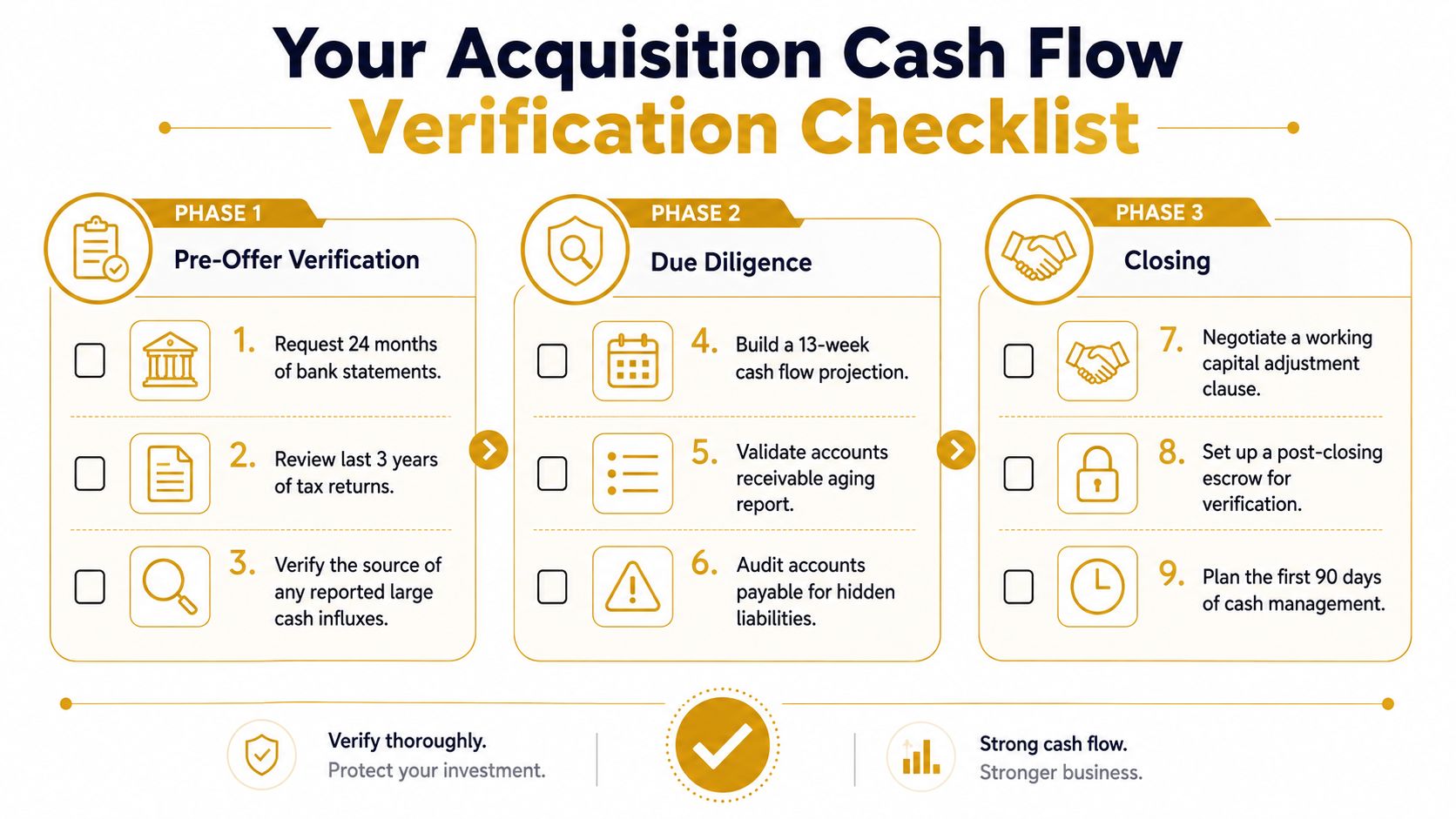
Cash-flow verification should happen in phases. Before making an offer, establish whether the seller's reported money movement exists. During diligence, test whether the earnings survive normalization. Before closing, protect the operating liquidity that the buyer needs to take control.
Pre-offer verification
- Reconcile bank activity: Compare reported cash generation with bank statements and investigate unexplained gaps, transfers, and unusual deposits.
- Review tax returns: Request the last three years of tax returns and reconcile revenue, owner compensation, taxable income, and claimed adjustments.
- Request a working-capital schedule: Ask for receivables, inventory, payables, payroll timing, and the proposed target needed to operate immediately after close.
- Trace large cash events: Verify the source of any unusual cash influx rather than treating it as ordinary operating performance.
Due-diligence deep dive
- Challenge every add-back: Require evidence for repairs, legal expenses, personal items, family payroll, and other adjustments.
- Price replacement labor: Model the market-rate salary for each essential function the seller currently performs.
- Estimate maintenance capex: Review historical spending, asset age, deferred replacements, and upcoming equipment needs.
- Model debt service: Run the proposed financing against the buyer's free-cash-flow calculation, then test weaker collections, lower sales, and higher operating costs.
- Validate receivables: Review aging reports and confirm that recorded receivables are collectible rather than stale balances.
- Audit payables: Search for unpaid vendors, accrued payroll, taxes, customer deposits, and commitments that could become post-close cash demands.
Closing and post-close stress testing
- Negotiate a working-capital adjustment: Define the target, included accounts, measurement method, and purchase-price adjustment before the purchase agreement is final.
- Plan owner transition costs: Budget for training, customer introductions, replacement hiring, and temporary duplicate labor.
- Prepare a twelve-month reserve plan: Decide how much liquidity the business needs if collections slow, inventory rises, or an important customer pauses orders.
- Protect verification rights: Use escrow or post-closing adjustment mechanisms where appropriate so unresolved financial claims have a defined remedy.
The central question isn't “Is this business cash-flow positive?” Ask instead: How much cash survives debt service, replacement labor, deferred capex, customer risk, owner departure, and the working-capital cycle? That is the number that belongs in your offer model.
Dealmaker Wealth Society provides acquisition training, due-diligence playbooks, negotiation guidance, and community support for people evaluating and structuring small-business purchases. If you want practical frameworks for testing cash flow, financing deals, and handling post-close execution, visit Dealmaker Wealth Society and explore the available programs.

From the Dealmaker Blog









A Creative Business Buying Fable