
Roll Up Acquisition Strategy Explained for Growth
Roll Up Acquisition Strategy Explained for Growth

You're running a profitable business in a fragmented market, but growth still depends on finding more customers one at a time. Nearby competitors have loyal clients, capable employees, and owners who may be ready for a transition. Buying one of those companies could add geographic reach or specialized capability faster than building it internally, but the challenge begins after closing. If your finance systems, customer relationships, and integration team can't absorb the next deal, every acquisition makes the platform harder to manage.
That's the practical tension behind a roll up acquisition strategy. The model can create a larger, more capable company through repeated acquisitions, but it isn't a shortcut around operating discipline. The strongest buyers treat each transaction as one part of a repeatable system, with clear limits on acquisition pace and careful attention to the relationships that protect revenue.
Table of Contents
- Introduction to Roll Up Growth in Fragmented Markets
- How a Roll Up Acquisition Strategy Works
- Finding and Screening the Right Add On Targets
- Financing Your Roll Up and Stacking Capital Wisely
- Integration Playbook That Turns Many Companies Into One
- Unit Economics Scale Effects and When to Pause Buying
- Real World Roll Up Examples and Your Next Steps
Introduction to Roll Up Growth in Fragmented Markets
A regional commercial landscaping market may contain dozens of capable operators. Each serves nearby towns with a modest fleet, loyal customers, and an owner who still manages sales or scheduling. No single company has enough route density to dominate, yet many face the same supplier, labor, and service challenges.
Building a new landscaping company from zero requires recruiting a team, winning contracts, buying equipment, and earning trust before revenue becomes predictable. A roll-up starts with an established operator, preserves the relationships that already generate value, and adds nearby businesses whose routes, capabilities, or customers strengthen the combined company.
The U.S. Federal Trade Commission's explanation of serial acquisitions describes this pattern as one firm consolidating a fragmented market through many relatively small acquisitions. The terms serial acquisition, roll-up, buy-and-build, and platform add-on can describe related activity. The cited industry analysis reports that global add-on deal volume rose from below 500 deals in 2003 to 5,769 deals in 2023, an increase of more than 1,000%. It also reports that 49% of 2023 add-on deals were the acquiring company's fourth or later acquisition, compared with 21% in 2003.
Those figures show adoption, not automatic success. A suitable market still needs repeatable demand, enough potential targets, transferable operations, and a platform team that can absorb change. The buyer must also pace deal flow against integration capacity, because closing transactions faster than the team can integrate them can weaken reporting, service consistency, and decision-making.
Customer relationships create a second constraint. A target may look attractive through its contracts and earnings, yet those results can depend heavily on the owner's personal trust with a few accounts. Before approving the next add-on, the buyer should examine who owns those relationships, how customers respond to a transition, and what operating support will keep them.
The acquisition is only the event. The operating system built around it determines whether the strategy compounds.
The model can fit a first-time acquisition entrepreneur, an established operator pursuing bolt-ons, or an investor building a platform with outside capital. A practical buy-then-build approach begins with an anchor business and sets a disciplined path for future purchases. The strategy therefore depends on more than sourcing and purchase multiples. It depends on integrating at a manageable pace while underwriting the customer relationships that support the next deal.
How a Roll Up Acquisition Strategy Works
A roll-up often begins with one business that can serve as the platform. It does not need to be the market's largest company. It does need dependable leadership, credible financial reporting, useful operating processes, and enough management capacity to support more activity.
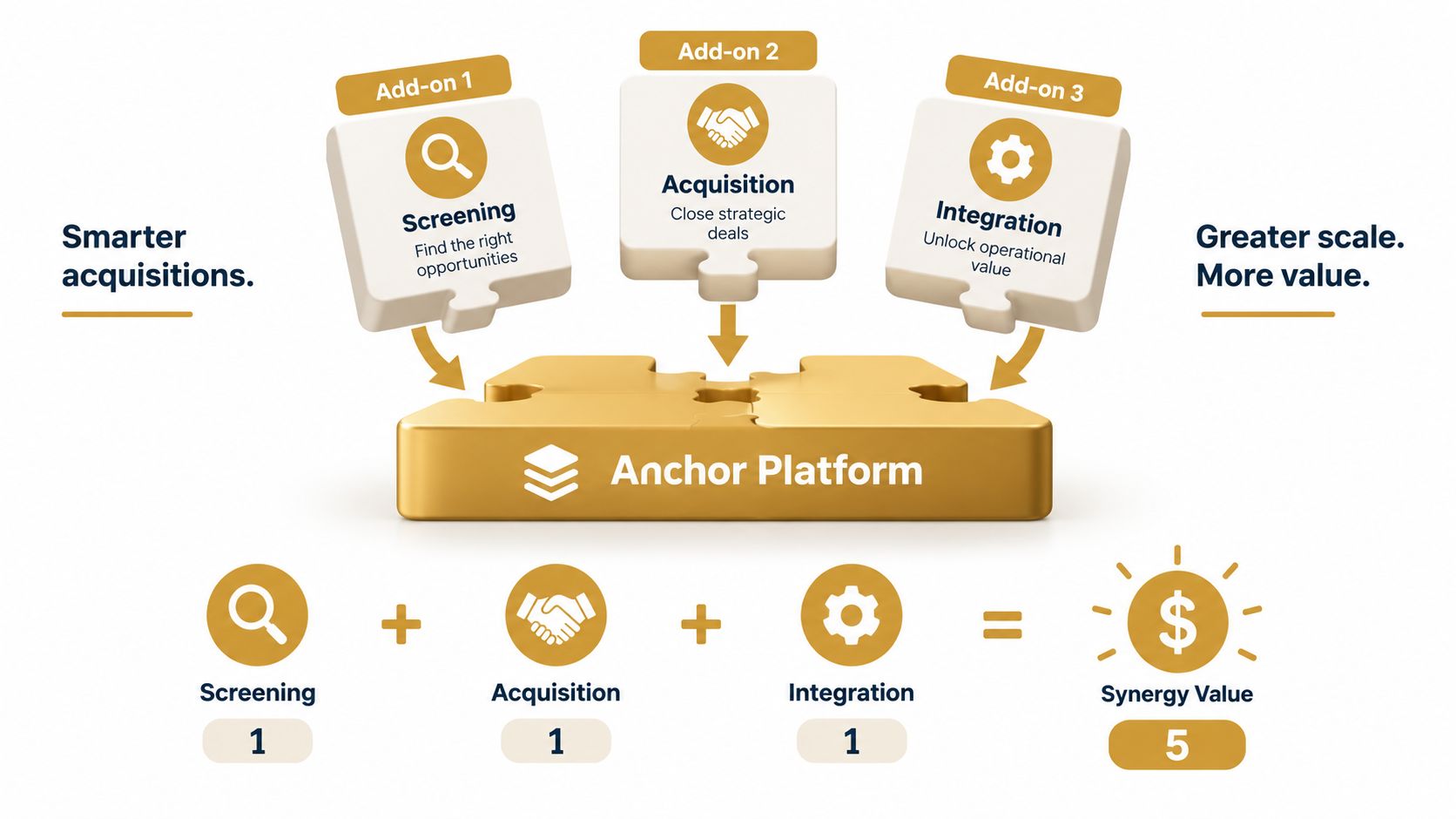
The buyer then adds smaller companies that solve a clear platform need. An add-on might provide another location, a complementary service, specialized employees, or customer access the platform could not reach efficiently. Each purchase should make the combined company more useful, denser, or easier to operate.
The OECD uses serial acquisition and industry roll-up to describe repeated acquisitions in the same or adjacent markets. Unlike a single merger, this model requires every transaction to be judged as part of an ongoing sequence. The OECD's report on serial acquisitions and industry roll-ups explains why platform fit matters alongside the target's standalone economics.
The platform creates the base
The platform works like a workshop. It provides shared tools, management routines, reporting standards, and decision-making structure. Add-ons bring new workbenches, customer relationships, or specialist skills. Productivity improves only when the buyer decides which capabilities to share and which should remain local.
One platform may retain an acquired brand and local manager while centralizing accounting and purchasing. Another may move every company toward one brand. The choice depends on customer expectations, employee retention, and where the acquisition's value comes from.
Add-ons create compounding scale
A single small acquisition may add revenue without changing the platform's economics. Several well-matched acquisitions can create geographic density, improve purchasing power, support cross-selling, and spread central costs across a wider base. These benefits come from the combination. Joining a larger company does not automatically improve every target.
Research summarized in a serial-acquirer analysis found that 23% of sampled M&A transactions were completed by serial acquirers making at least four acquisitions every three years. 84% of their deals were small, and 85% involved private companies. The research source is available through the University of Vaasa.
Pacing matters as much as selection. If deal flow exceeds the team's integration capacity, reporting can become inconsistent, service quality can slip, and managers can lose visibility into the combined business. Customer relationships deserve the same scrutiny. A target's earnings may rely on the owner's personal trust with a few accounts, so the buyer should test how those customers will respond to a transition before approving the next add-on.
Ask whether the next target strengthens pricing power, geographic coverage, product breadth, or operating capacity. A business that only adds revenue may consume management attention without improving the platform's long-term position.
For a structured review of transaction risks, buyers can use this 7-step M&A risk evaluation alongside financial, legal, operational, and customer diligence.
Finding and Screening the Right Add On Targets
A target can report attractive profits and still weaken the platform. The better test is whether the acquisition solves a defined operating problem without creating another one. For example, a business may add geographic density or a useful capability, yet depend on a founder whose customer relationships cannot be transferred.
Write the target profile before reviewing opportunities. Set the customer type, geography, service mix, leadership needs, and operating standards that support the platform thesis. This profile acts like a measuring template. It keeps an appealing seller story from replacing a clear acquisition strategy and helps the team compare opportunities consistently.

Screen for strategic fit before valuation
Use an early filter built around five questions:
- Industry structure: Does the market contain enough small competitors to support future add-ons? Fragmentation creates potential deal flow, but it does not guarantee good economics.
- Owner transition: Will the owner exit, delegate, or remain under a defined arrangement? A reluctant seller can leave the platform dependent on one person.
- Customer durability: Do customers stay because of the company's service process, or because they personally trust the founder? The answer shapes transition planning and relationship-risk underwriting.
- Financial quality: Are revenue recognition, margins, expenses, and working capital clear enough to underwrite? Inconsistent records should reduce confidence before they influence the price.
- Platform contribution: Does the target add density, capability, or customer access the platform can use? Revenue alone is not an investment thesis.
Customer concentration requires its own review. Some roll-up targets have 25% or more revenue concentration in their top customer, which can expose the wider platform if that relationship depends on the founder or is not protected during transition. The VX Group discusses customer concentration and relationship risk in roll-up targets.
Score the opportunity, not just the seller
A simple internal scorecard lets the team rate targets against the same criteria and record the evidence behind each rating. A strong margin profile should not conceal weak retention. An attractive location should not outweigh incompatible systems or an integration burden the team cannot handle.
Timing belongs in the screen as well. A target may fit the thesis but still require more management attention than the platform can absorb before the next add-on. Match expected deal flow to available integration capacity, including leaders, reporting processes, systems work, and customer communication.
Early red flags include missing customer contracts, unexplained margin changes, founder-controlled sales, poor employee documentation, and financial statements that cannot be reconciled to operating records. These issues do not always end a deal, but they should affect its structure, price, transition plan, or approval.
Find opportunities through direct owner outreach, industry advisers, brokers, professional associations, and supplier or lender relationships. The source matters less than applying the same screen and rejecting targets that fail to strengthen the platform.
Financing Your Roll Up and Stacking Capital Wisely
A roll-up can stall after a successful first purchase. The buyer may own a promising platform, yet have too little cash, borrowing room, or management capacity left to stabilize it and assess the next add-on. Capital planning therefore starts with the platform and the integration pace it can absorb, not the full acquisition wish list.
A capital stack may combine buyer equity, seller financing, senior or SBA-backed debt, and outside equity. Each source changes the balance among control, purchase speed, repayment pressure, and alignment. The suitable mix depends on cash flow quality, collateral, seller goals, and the buyer's tolerance for debt.
| Capital Source | Best Use Case | Trade Off to Consider |
|---|---|---|
| Buyer equity | Initial contribution and credibility with lenders or sellers | Preserves control but exposes personal capital |
| Seller financing | Targets where the seller wants ongoing economic alignment | Reduces upfront cash, but creates a continuing seller relationship |
| SBA or senior debt | Businesses with stable cash flow and supportable repayment capacity | Can lower equity needs, but adds fixed obligations and lender requirements |
| Equity partners | Larger platforms, specialist expertise, or broader acquisition capacity | Expands resources, but dilutes ownership and adds governance |
| Debt-supported structures | Repeatable acquisitions with predictable cash generation | Can accelerate buying, but leaves less room for underperformance |
Seller financing can suit an owner who trusts the transition plan but wants more than a single closing payment. It may connect part of the seller's economics to the quality of the handoff. The documents should define control, performance expectations, and remedies clearly.
Equity partners can provide more than cash. An operating partner may bring industry access, while a capital partner may provide follow-on funding. That support gives the buyer room to assess new opportunities without pulling money or leadership away from integration.
Customer relationships also belong in the financing model. A business whose revenue depends heavily on the departing owner may carry repayment risk even when historical cash flow looks adequate. Underwrite the transition, customer communication plan, and retention exposure before committing capital to the next add-on.
Reviewing business acquisition funding strategies can help buyers compare creative structures with conventional debt and equity. Whatever the mix, model downside cases before signing. The roll-up should withstand delayed integration, a lost customer, or a slower add-on pipeline without forcing a rushed sale.
Integration Playbook That Turns Many Companies Into One
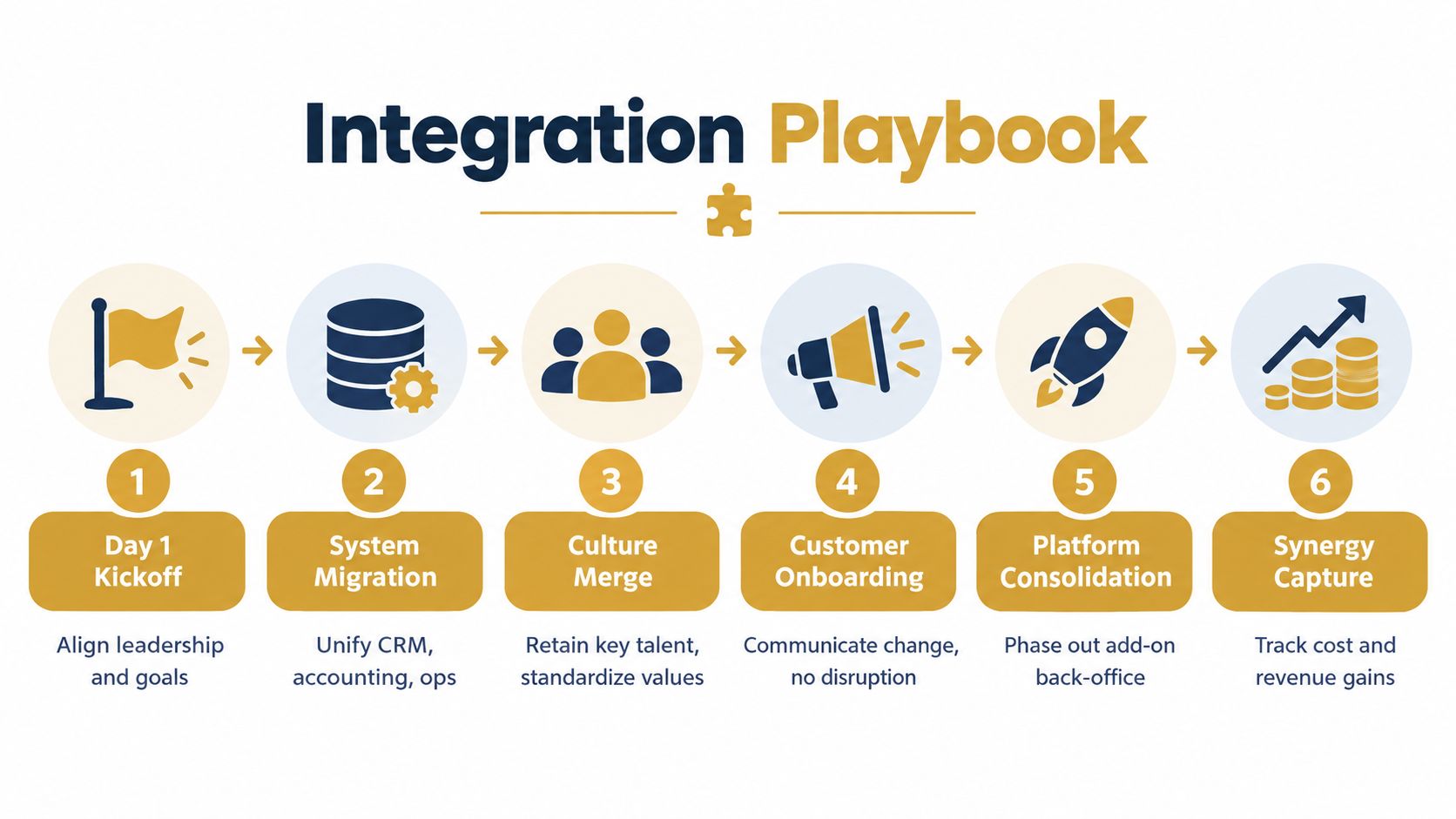
Integration starts before signing. A buyer needs a map of which systems, decisions, customer touchpoints, and responsibilities will change, alongside the areas that should remain local. Without that map, every add-on creates a new interpretation of how the platform should operate.
The platform and add-ons need different treatment. Research on roll-up execution describes a platform that stays relatively autonomous while add-ons receive more active integration for knowledge sharing, process alignment, and capability expansion. The University of Gothenburg research on platform and add-on integration supports staging the work instead of centralizing everything on the first day.
Standardize the control layer first
Start with finance and reporting. Leaders need a dependable view of cash, revenue, expenses, receivables, and operating performance. Align the chart of accounts, close process, approval rights, reporting calendar, and definitions of key measures before redesigning every local workflow.
Then improve systems that support customer and operational visibility. A shared CRM, accounting environment, or scheduling process can help, but migration needs a documented data plan. Poorly mapped customer records and inconsistent service histories can confuse staff and unsettle customers during the handoff.
Keep valuable local differences. Pricing knowledge, trusted account relationships, specialist methods, and community reputation may support retention. Removing them to create uniformity can weaken the acquired business.
Match integration work to team capacity
Integration debt builds when each acquisition leaves behind another set of systems, data definitions, reporting habits, and unresolved decisions. Deal flow should match the team's ability to close those open items. The Kadenwood Group's discussion of integration capacity explains why acquisitions can outpace the people responsible for combining them.
Before approving another add-on, count open integration initiatives, review finance close times, test whether customer data reconciles, and assign an accountable owner to every workstream. If leaders cannot explain what remains unfinished from the previous deal, another closing may add risk instead of value. This pacing discipline is one of the gaps that sourcing-focused roll-up plans often overlook.
Customer relationships require the same discipline. Before changing account ownership, identify customers tied closely to a founder or local team, prepare communication, and set retention checks for the transition. Underwriting that relationship risk before the next add-on protects the deal thesis from revenue that looks stable on paper but depends on personal trust.
People leaders managing headcount, reporting lines, and role changes can use this practical guide to org redesign for HR leaders. For post-close coordination, integration planning best practices can help translate the transaction thesis into assigned operating work.
Unit Economics Scale Effects and When to Pause Buying
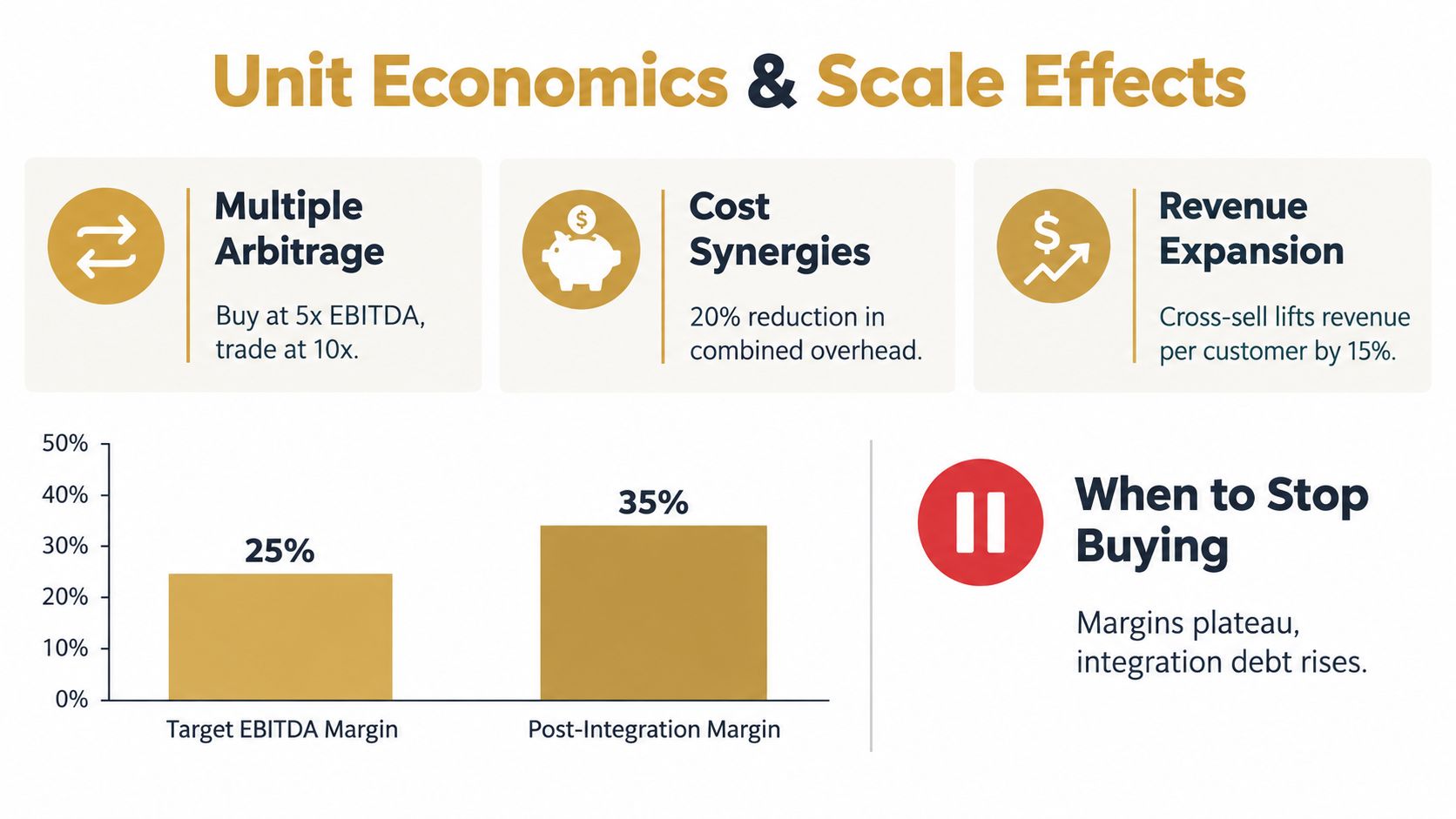
A roll-up creates value when the combined company operates better than the separate businesses. The improvement may come from buying at a price below the platform's eventual value, removing duplicated costs, or increasing revenue through broader capabilities and customer access. Each source needs a testable operating link. A lower purchase price alone does not prove that the platform is getting stronger.
Track every acquisition against its original thesis. Review integration costs, customer retention, employee turnover, working-capital needs, and management time alongside revenue and earnings. A deal can appear inexpensive while consuming the people and attention needed to make the next deal work.
Watch the relationship layer
Healthy historical financials can conceal revenue that depends on a founder or local account manager. Before signing, identify how much revenue is attached to those relationships and whether the business has a credible successor for each important account. Customer trust may be an operating asset, not a replaceable job function.
Ask who owns each major customer relationship, how customers may respond to an ownership change, and whether another employee can take over without weakening service. Put the response into the purchase agreement and the first operating plan. Joint introductions, scheduled account reviews, service-continuity commitments, and a defined seller handoff can turn a fragile transition into a managed one.
Set a pause rule
Deal pace should match the platform's ability to absorb change. A smaller corporate-development team may handle fewer add-ons than a platform with dedicated integration, finance, systems, and people resources. The right pace depends on transaction complexity, team experience, systems readiness, and customer risk. Treat any outside rule of thumb as a reference, not a quota.
Pause buying while reporting remains unreliable, earlier integrations are incomplete, key leaders are overloaded, or customer-retention signals weaken. Use the time to repair the operating system and confirm that unit economics are improving. Adding another target before those conditions improve can spread management attention thinner and make the existing platform less resilient.
The following video offers another way to connect acquisition activity with operating discipline:
Real World Roll Up Examples and Your Next Steps
Roll-ups appear in many forms. An eCommerce buyer may acquire several brands with complementary products, then coordinate inventory, advertising, analytics, and customer support. A professional-services platform may bring together firms with adjacent specialties while preserving the local trust that drives referrals. A regional service operator may acquire nearby competitors to create denser routes and share administrative resources.
The pattern changes by industry, but the decision questions stay consistent:
- Can the platform support another company? Review leadership bandwidth, reporting quality, systems, and open integration work.
- Does the target strengthen the thesis? Identify the specific capability, geography, customer access, or operating benefit the add-on contributes.
- Can customers transition safely? Map founder relationships, customer concentration, contracts, service dependencies, and communication responsibilities.
- Does the financing preserve flexibility? Test repayment obligations and equity commitments against slower growth and unexpected operating costs.
- Will the team measure the result? Assign owners and dates for integration milestones, customer retention, reporting, and synergy realization.
A buyer who can't answer these questions should slow the process before issuing another indication of interest. The goal isn't to accumulate companies. It's to build a platform that can absorb acquisitions without losing customers, people, or financial control.
Dealmaker Wealth Society offers acquisition education, mentorship, deal feedback, financing training, and playbooks covering sourcing, diligence, negotiation, and post-acquisition integration. Those resources can support an acquisition entrepreneur or operator who wants a structured way to evaluate the first platform and plan later bolt-ons.
Visit Dealmaker Wealth Society to explore training and community support for sourcing, structuring, financing, and integrating small-business acquisitions. Use the platform's checklists and mentorship resources to pressure-test your next target's integration capacity and customer relationship risk before you commit to another add-on.

From the Dealmaker Blog













A Creative Business Buying Fable
