Buy vs Build: Which Path Creates Value Faster
Buy vs Build: Which Path Creates Value Faster
Companies that complete more than five deals a year grow at twice the rate of firms that pursue M&A selectively, and they spend 38% less on each acquisition, based on a 10-year analysis of 1,000 companies in McKinsey's review of acquisition programs. That gap reframes buy vs build. Buying is not a shortcut you finish at signing. It is a bet that you can run someone else's customers, staff, and systems well enough to earn back the premium.
A purchase hands you cash flow on day one and a set of problems you did not design. A startup keeps control and burns months before demand is proven. The cost most comparisons skip is what happens after close: duplicated payroll, parallel software, and the hours required to make two companies behave like one.
Table of Contents
- Buy vs Build at a Glance
- Where the Money Goes Before and After Close
- Timelines From Close and From First Revenue
- Where Acquisition Returns Actually Come From
- Risk Profiles Compared Side by Side
- Integration Work the Buy Path Hides
- Sourcing and Screening Acquisition Targets
- Choose Buy or Build for Your Situation
Buy vs Build at a Glance
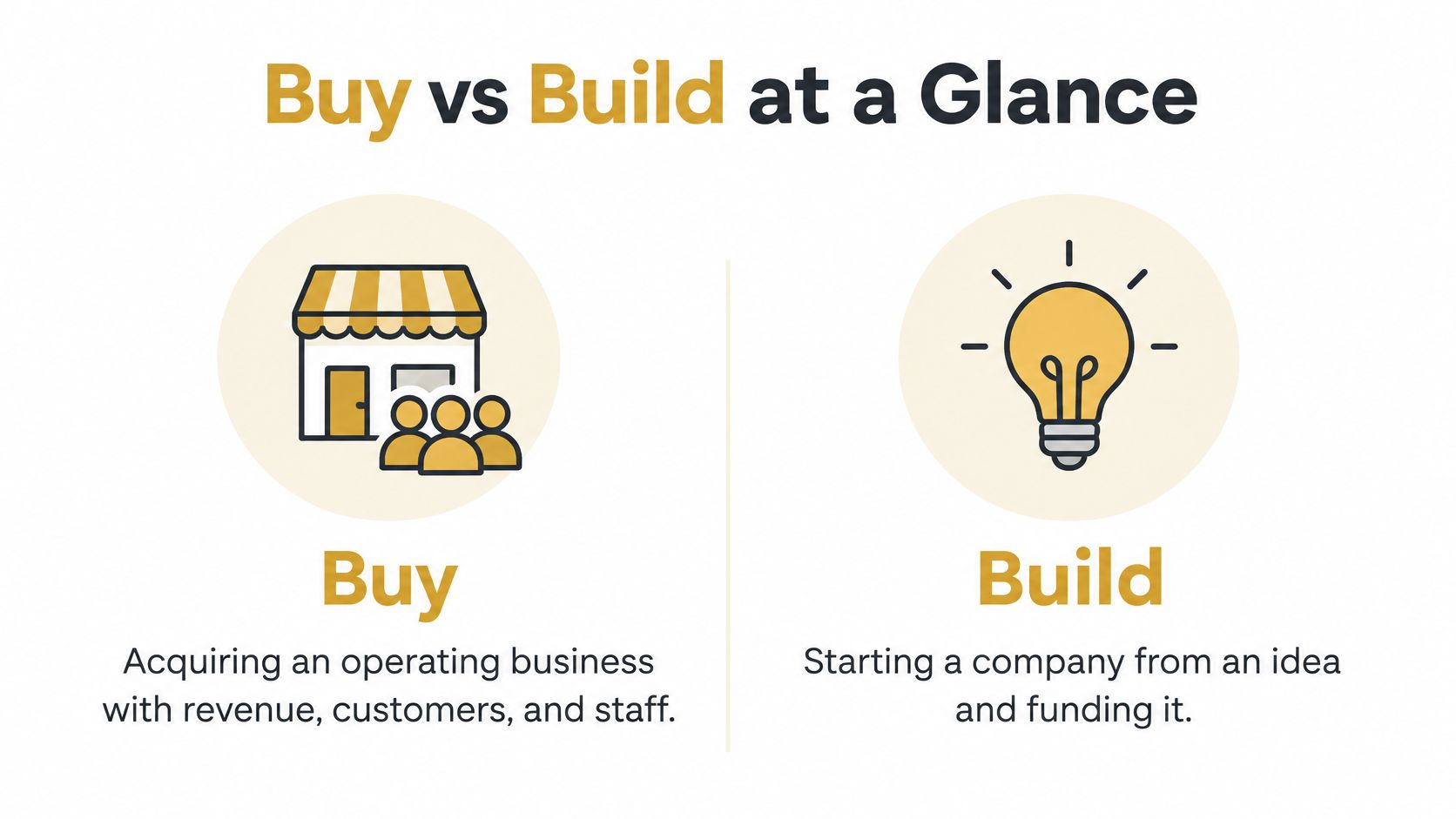
Buying means acquiring an operating business that already has revenue, customers, and staff. Building means starting a company from an idea and funding it until revenue arrives.
| Criterion | Buy an existing business | Build from scratch |
|---|---|---|
| Time to first cash flow | From the close date | Often 12 to 18 months or more before break-even, per the worked example |
| Upfront capital | Purchase price plus fees, often sized as a multiple of annual earnings | Launch spend, hiring and runway before revenue |
| Customer base | Inherited on day one, with churn risk to test | Built one buyer at a time |
| Biggest risk | Hidden liabilities, customer concentration, integration load | Demand never materializes and cash runs out first |
| Ways to reduce risk | Diligence, earn-outs, seller transition support | Pilot customers, staged spending, stop-loss thresholds |
| Reversibility | Hard to unwind cleanly after signing | Easier to pivot or stop before large spend |
Every row is a range. Sector, deal size, and local demand move the numbers, so the table is a starting frame, not a verdict. A services firm with recurring contracts will not look like a seasonal retailer, and a small bolt-on will not look like a platform deal.
Buying trades speed and proven cash flow for a purchase premium and inherited problems. Building trades certainty and control for time and unproven demand. Cash timing, capital at risk, failure modes, and the work after close each get a harder test below, and the last section matches a path to a situation.
Where the Money Goes Before and After Close
Capital does not stop at the headline price. On a buy, you fund the purchase price, transaction fees, working capital left in the company at close, and debt service that starts immediately. A business that already earns steady profit can cover part of its own financing from the first month. On a build, you fund the launch budget, hiring before revenue, marketing to find the first customers, and a runway that has to last until break-even.
Say a target earns $400,000 a year and you pay three times earnings, so the price is $1.2 million. A 20 percent cash down payment is $240,000, before legal counsel, a quality-of-earnings review, and the cash you must leave on the balance sheet. If earnings hold, that $400,000 can service debt while you learn the book. A startup that needs eighteen months of payroll and marketing at $40,000 a month puts $720,000 at risk before it breaks even, and none of that spend has produced a customer yet.
Cash at risk on two clocks
List every cash need, then place it on a 12-month view and a 36-month view.
- Buy, first year: down payment, fees, working-capital true-up, and debt service, offset by the earnings the company already produces.
- Buy, year three: the premium is either earned back through cash flow or it is still sitting in the price you paid.
- Build, first year: payroll, tools, and marketing with little or no offset, because revenue is still a forecast.
- Build, year three: if the model works, early losses can be behind you and you own the customer relationships outright. If it does not, the staged spend is the loss.
The gap in cash at risk narrows once you count earnings the acquired business already produces. It widens again if those earnings slip in the first year, because debt service does not wait. A low multiple is not a bargain when earnings are falling. Build costs are easier to cap, because you can stop hiring or cut marketing at a milestone. Acquisition cash is harder to call back after you wire it.
Model both paths in a simple cash calendar before you negotiate. Our guide to evaluating business acquisition costs walks through the line items buyers miss between the offer and the first debt payment.
Timelines From Close and From First Revenue
Put both paths on one calendar before you compare costs. Buying starts with sourcing and diligence, often several months from first outreach to a signed purchase agreement. Cash flow from the acquired base starts at close, minus the integration work that follows. Building starts with idea tests and pilot customers, then a ramp. The cash example above puts break-even at roughly eighteen months of payroll and marketing.
| Phase | Buy an existing business | Build from scratch |
|---|---|---|
| Sourcing and diligence | Several months from outreach to signing, set by the deal process | Idea validation and pilot customers, often 3 to 6 months |
| Cash flow starts | At close, from the acquired base | After first paying customers, often 12 to 18 months to break-even |
| Integration or ramp window | Parallel operations for the better part of a year after close | Ramp to break-even, with systems designed around the model |
| Checkpoints | Month 3 cash check, month 6 system decisions, month 12 integration review | Month 3 pilot check, month 6 stop-loss review, month 12 revenue ramp review |
Buy timelines slip in the months after you own the company, not in the weeks you spend negotiating. Deal memos often assume a clean handoff. Payroll, software, and customer routines rarely move that fast, so plan the longer window rather than the story in the teaser.
Use three checkpoints on each path. At month three, a buyer checks whether cash still covers debt after any customer loss, and a founder checks whether pilots are paying. At month six, the buyer decides which systems stay and which go, and the founder applies a stop-loss if the ramp is behind plan. At month twelve, one path reviews whether integration is finished, and the other reviews whether revenue can carry the team. Treat every range here as an assumption you replace with your own deal file and your own market.
Where Acquisition Returns Actually Come From
The purchase price alone creates no return. You pay for the existing business, and any premium remains a cost until operating improvements earn it back. Returns can come from pricing, cross-selling, procurement, margin improvement, or faster organic growth. A higher resale multiple on the same unchanged business is not an operating return.

The price is what you paid. The return is the operating change you can name before you sign.
Two sources you should split before an offer
Standalone cash flow must justify the price without synergies. If the business cannot support its debt and a reasonable return on invested equity, it fails the first test.
Synergies belong in a separate model, with conservative assumptions. Calculate the deal with partial credit for them and with none. Cross-selling and shared overhead may look straightforward in a spreadsheet, but they can take time to realize, particularly while the acquired team adapts to a new sales approach. The purchase still needs to work in the low case.
A Bain analysis of 44 private-equity buy-and-build deals completed between 2010 and 2019 found average MOIC of 1.4x for deals driven mainly by multiple arbitrage, compared with 2.2x for deals with a clear strategic rationale, including faster organic growth or genuine margin improvement. The 0.8x difference underscores the value of an operating thesis beyond the purchase price.
Repeated acquisitions can also produce returns when they follow a consistent strategy. Bain's research on programmatic acquirers, defined as companies completing at least two small or medium acquisitions a year around one strategic theme, found about 2 percentage points more annual excess total shareholder return than among peers. A single large acquisition does not, by itself, establish the same pattern.
Building creates value through a different route. Returns depend on gaining and retaining paying customers, rather than buying an established customer base. A startup avoids a takeover premium, but it also begins without existing revenue to support the business.
Before making an offer, state the operating change that will generate the return the price assumes. If you cannot identify that change, the investment case depends on a higher future multiple rather than business improvement.
A short video explains how buyers separate purchase price from operating work.
Risk Profiles Compared Side by Side
The two paths fail in different places. Sorting by risk type shows which problems you can price and which ones you should walk away from.
Liabilities you inherit versus demand you have not proven
A buyer can inherit undisclosed debt, tax exposure, pending claims, aging equipment, and sales that depend on the owner personally. Those items sit in the data room if you look, and in the first ninety days if you do not. A founder carries demand risk instead. The market may never show up, the ramp may run slower than the model, the team may churn, and the product may need a pivot while cash is already spent.
Concentration versus spending ahead of proof
When one or two customers supply a large share of revenue, the buyer inherits that fragility on day one. Before closing, ask how long those customers have worked with the business, what share of their spend goes there, when renewals fall, what would make them leave, and who else they considered. A vague answer on any of those is a price cut or a pass, not a footnote.
The matching build risk is spending before proof. A launch can exhaust the runway while the offer is still being tested with friendly prospects. Staged spend is the control. A fixed launch budget with no stop rule is how a test becomes a loss.
Controls that actually change the outcome
- Buy side: diligence on debt, tax, and contracts, plus escrow, an earn-out tied to retained revenue, and paid seller support through the first renewal cycle.
- Build side: pilot customers who pay, spending released only after a milestone, and a stop-loss you write down before you hire.
Liabilities you can measure belong in the price, the escrow, or the earn-out. Owner-dependent revenue you cannot transfer, and demand you have never seen a stranger pay for, are risks to avoid rather than discount. A cheaper price does not fix a book that leaves when the seller does.
Integration Work the Buy Path Hides
The acquisition is not finished when ownership transfers. Integration usually runs longer than the deal narrative, and the cost of two systems in parallel shows up in payroll and software while you are still introducing yourself to customers.

A 2025 M&A success survey reported that 75% of integrations required at least seven months and 27% exceeded 12 months. An independent AlixPartners survey in the same discussion named insufficient dedicated resources as the leading implementation risk, ahead of weak communication and limited leadership engagement. Buying a profitable company can cut commercial startup risk and still raise operating complexity.
Sort every acquired capability into one of four buckets: preserve locally, standardize immediately, connect through shared data, or replace later. Accounting codes and safety rules usually standardize now. A local service ritual that customers notice should stay put until you understand it. Customer records can be connected before the tools that hold them are replaced.
- List every system, process, data source, and team in the target. Skipping this list is how a second payroll vendor survives for a year.
- Classify each item into one of the four buckets and name an owner. Unowned work defaults to the seller's old habit.
- Estimate integration cost by workstream, including the months of duplicated payroll or software. That duplicate run-rate is part of the price even though it never appears in the LOI.
- Protect customer continuity by naming the accounts that must see no change in service for the first ninety days. Revenue you disturb in that window is hard to win back.
- Set a month-six checkpoint for what gets replaced. Waiting for a perfect systems plan delays the decisions that save money.
Practical guidance on integrating operations after an acquisition is worth reading before you promise a full systems cutover in the first quarter. For a smaller buyer without an integration office, our note on determining post-acquisition integration needs is a workable starting map.
Treat leadership capacity as a number. Count the hours you can give integration each week before you commit to a second deal. If that number is already full, the next target waits.
Sourcing and Screening Acquisition Targets
A buy path only exists if a target fits a thesis you wrote before you started calling. Searching without that sentence produces a pile of broker books and no decision rule.
- Write the thesis in one sentence: the capability, customer segment, or region the purchase must add. If the sentence needs a comma splice of unrelated ideas, you do not have a thesis yet.
- Build a list of 20 to 30 businesses through brokers, direct owner outreach, industry associations, and lender introductions. A short list is a hope. A list this size gives you room to say no.
- Screen out any target that lacks a steady profit history across prior downturns, a meaningful revenue base, or a customer concentration you cannot accept.
- Rank what remains by operating levers you can credibly pull after close, such as pricing, cross-selling, procurement, or margin work. A pretty multiple with no lever is a hold, not a buy.
- Request the financials and customer data for the standalone cash flow test before you pay advisors or write an offer. Advisory fees on a target that fails that test are a self-inflicted cost.
Our checklist for identifying viable acquisition opportunities keeps that screen in one place so the list does not drift toward whatever is listed this week. A build needs its own sourcing step too. Test the thesis with prospective customers, and confirm you can reach them again, before you fund a full launch.
Choose Buy or Build for Your Situation
Buy when proven cash flow and inherited customers matter more than the premium. Build when the differentiator has to stay in-house, or when no target fits the thesis. Speed favors buying, because customers, staff, distribution, and technology arrive on day one. Building fits when an acquired team is locked into practices you would have to unwind, though recruiting for a new model takes time you must fund.
Buy software, accounting, and back-office tools unless they are the edge. Build only where customer insight or a proprietary process creates that edge. Menlo Ventures reported in late 2025 that 76% of enterprise AI solutions were purchased rather than built internally, up from near parity 18 months earlier, and that 47% of AI deals reached production. A tool purchase is not the same as owning the people, data rights, and workflows behind it. A business with ordinary software can still be a good buy if the customers and the data are the asset.
Building is more reversible. You can stop spend at each milestone. An acquisition is hard to unwind after signing.
| Your situation | Lean toward | Why |
|---|---|---|
| First-time owner who needs cash flow soon | Buy | Proven revenue lowers launch risk |
| Owner adding a capability or region quickly | Buy | Speed and inherited customers outweigh the premium |
| New concept with no proven demand | Build | No existing target fits the thesis |
| Operator with limited capital | Build, or a small bolt-on | Lower upfront cash and staged spending |
| Serial acquirer with a repeatable process | Buy, in sequence | Repetition compounds returns |
| Core product that is the differentiator | Build | The proprietary advantage stays in-house |
We recommend a profitable target only when it has weathered prior downturns, generates $1 million in gross revenue, and shows a steady profit history. Before you choose, answer three questions. Is the capability already for sale? Would the advantage come from something you control? How quickly do buyers in this market punish a wait?
Before you sign, confirm standalone cash flow covers the price, run Dealmaker Academy's customer verification (interview, concentration analysis, contract review, and retention risk assessment), read change-of-control clauses, and name the integration owner and budget. If you lack a full commercial team for the first year, how fractional revenue leaders help is a practical way to cover sales leadership without a permanent hire on day one. Match your row, write the thesis in one sentence, and test it against that checklist. You can also book a coaching call to review a specific deal before the offer goes out.
Dealmaker Wealth Society teaches acquisition entrepreneurs how to buy, build, and scale a small business, including creative deal structure and the work that starts after close. If you are weighing a first purchase against a startup, the 10-Day Business Buying Launch is the starting curriculum our dealmakers use. Visit Dealmaker Wealth Society to see the training and book time on a live deal.

From the Dealmaker Blog







A Creative Business Buying Fable