Partner Buyout Agreement Template: Clauses and Process
Partner Buyout Agreement Template: Clauses and Process
Your partner just said they want out. The books are messy, the operating agreement is thin, and nobody wrote down what the interest is worth if earnings swing or if one of you holds the records. A partner buyout agreement template is the paper that should already be waiting for this moment. It says who can force a sale, how the number gets built when earnings move, and how the check is paid so the partner who controls the records cannot rewrite the formula after the fact.
Most downloaded forms fail in the same three places. The formula looks objective until the partner who runs the books picks the measurement date. The note looks affordable until the seller's pay comes off the cash flow the buyer still needs to run the company. The tax line says capital gain until receivables and inventory turn part of the price into ordinary income.
A Regions summary of Nationwide research notes that far fewer small-business owners have a succession plan than mid-market owners. I would not wait for a fight to fill the blanks. Treat any form as a first draft, then have counsel and a tax adviser mark it against capital accounts before anyone signs.
Table of Contents
- Clause Checklist for a Partner Buyout Agreement
- Triggering Events That Activate a Buyout
- Valuation Methods and Dispute-Proof Pricing
- Funding Structures for an Installment Buyout
- Tax and Entity Choices That Change the Buyout
- Representations, Indemnities and Non-Compete Terms
- Step-by-Step Buyout Process from Offer to Closing
- Confirm the Agreement Before You Sign
Clause Checklist for a Partner Buyout Agreement
Fill the skeleton in the order a drafter works. The agreement has to match ownership and capital-account records, not a guessed price. The Law Office of Bryan Fagan succession planning notes are a useful check when buy-sell language has to sit next to a real operating agreement.
- Parties: [legal name], [entity type], [ownership percentage per operating agreement].
- Triggers: [retirement / death / disability / divorce / default / voluntary sale / deadlock].
- Valuation: measurement date [], enterprise value method [], adjustments for cash, debt, working capital and contingent liabilities [], appraiser [], tie-breaker [__].
- Price and payment: cash at closing [], note principal [], interest rate [], term [], prepayment rights [], default remedy [].
- Transfer and approval rights: right of first refusal [], consent threshold [].
- Tax allocation: entity redemption or cross-purchase [], pre-closing tax owner [].
- Protections: representations [], cap [], basket [], survival [].
- Non-compete: scope [], geography [], duration [__].
- Lender and guarantees: lender consent [], guarantee release date [].
- Disputes: appraisal cost split [], timetable []. Signatures and spousal consent [__].
Fill each bracket from the records, then compare the draft with this table. It is a first-draft skeleton. Counsel and a tax adviser still have to review the final text.
| Clause | What to specify | Common gap |
|---|---|---|
| Parties and ownership | Legal names, entity type, ownership percentages matching capital accounts | Percentages that differ from the operating agreement |
| Triggering events | Retirement, death, disability, divorce, default, voluntary sale | Divorce or default triggers left out |
| Valuation date and method | Measurement date, enterprise value formula, balance-sheet adjustments | Undefined date lets value drift |
| Purchase price and payment | Cash at closing, note principal, interest rate, term, prepayment rights | Payment schedule with no default remedy |
| Transfer and approval rights | Right of first refusal, consent thresholds, transfer limits | Third-party sale allowed or blocked by accident |
| Tax allocation | Entity redemption or cross-purchase, allocation of pre-closing tax | Pre-closing tax liability left unassigned |
| Representations and warranties | Ownership, authority, undisclosed liabilities, taxes, litigation | Representations with no survival period |
| Indemnification | Caps, baskets, survival periods, claim procedure | Caps that also apply to fraud |
| Non-compete and non-solicit | Scope, geography, duration | Scope too broad to enforce |
| Lender and guarantee terms | Lender consent, release or replacement of personal guarantees | Departing partner guarantee never released |
| Dispute resolution | Appraiser selection, tie-breaker, appraisal cost split, timetable | No tie-breaker, so the dispute stalls |
Triggering Events That Activate a Buyout
A partnership can exist, and it can create tax and ownership consequences, even when nobody signed anything. The IRS Statistics of Income partnership statistics page sits on a definition the IRS uses across its guidance: two or more individuals or entities conduct a trade or business, contribute money, property, labor, or expertise, and share profits and losses. Spouses who run a business together and share profits and losses may be treated as partners whether or not they signed a partnership agreement. That is why a written buyout framework matters. It should name every event that ends a partner's role, then give each event a process and a clock.
Retirement needs a written notice period and a short election window so the remaining owners cannot stall the start date. Death needs a rule on whether the estate must sell or may require a buyout, plus how insurance proceeds hit the price and when the first payment is due. Disability needs a medical definition and a waiting period, often 90 or 180 consecutive days, so a short illness does not force a sale.
Events people leave blank
Divorce needs transfer limits and a valuation date for any spouse's claimed interest. Without that date, a family-court fight can freeze the company while the books keep moving. Default needs a cure period, then acceleration if the breach is not fixed. A voluntary third-party sale needs a right of first refusal with a matching timeline, usually 30 days to match price and terms. Deadlock needs a voting threshold and a process, either a shotgun offer or an appraisal-based buyout.
Practical rule: If a trigger has no notice period, no valuation date, and no buyer, it is a slogan, not a clause.
List every trigger in your own agreement. Confirm that each one names who acts, what document starts the clock, and when the price must be paid. A template is a starting governance document. The signed version should line up ownership percentages, capital accounts, profit-and-loss splits, and tax treatment with how the partners share the business.
Valuation Methods and Dispute-Proof Pricing
A fixed purchase price is not a valuation mechanism. Both sides, and a stranger reading the file later, have to be able to rebuild the number from the same records. Put the measurement meeting on the calendar before you argue about multiples. The photo below is the working session that clause is meant to force.

Fields the formula has to name
IRS Publication 541 states that, in a partner's retirement or death, an arm's-length agreement generally establishes the value of the partner's interest. A calculation based only on net assets must still be adjusted to include the partner's share of partnership liabilities in both value and basis. The template should therefore require a current balance sheet, a debt schedule, a capital-account reconciliation, and a written formula that turns enterprise value into equity value.
Draft these fields in the clause, not in a side email:
- Valuation date: the measurement date, not "closing" left undefined.
- Enterprise value method: book value, an earnings multiple, discounted cash flow, or an appraisal, written as a formula.
- Balance-sheet bridge: cash, debt, working capital, contingent liabilities, and partner loans.
- Discounts: any minority or control discount, stated as a percent or as "none."
- Who buys: a purchase by the remaining partners, a redemption by the entity, or a mix. The legal seller, the tax reporting, and the liability release all change with that choice.
Rules that stay fair when one partner holds the books
"Fair market value" sounds clean and then stalls. A formula that looks objective turns unfair when earnings are volatile or one partner controls the information. Normalize owner compensation to a market salary before you apply a multiple. State whether partner loans and capital-account balances are added or netted. Say how customer concentration and key-person risk are handled, as a discount, as an earnout, or as neither. Give the appraiser written instructions, a record list, a cost split, and a tie-breaker if the two appraisers disagree. A short walk-through of how small-business methods differ is in this comparison of valuation techniques.
Say the enterprise value is $1,000,000, debt is $300,000, and cash is $50,000. Equity value is $1,000,000 minus $300,000 plus $50,000, or $750,000. A departing partner's 40 percent share is $300,000 before any agreed minority discount. The agreement then states whether partner loans and capital balances are added or netted, and it freezes every figure as of the measurement date so both sides and the appraiser get the same result.
The clip below shows why a number nobody can rebuild becomes the fight.
| Method | How it prices the interest | Where it breaks down |
|---|---|---|
| Book value | Net assets from the balance sheet | Ignores goodwill and earnings |
| Earnings multiple | Normalized earnings multiplied by an agreed multiple | Volatile earnings and owner pay adjustments |
| Discounted cash flow | Projected cash flows discounted to present value | Sensitive to forecast assumptions |
| Independent appraisal | Appraiser sets fair value | Costly and slow; depends on the instructions given |
| Agreed formula with tie-breaker | Fixed method plus a named tie-breaker | Needs pre-agreed financial records to work |
I would pair a fixed formula with the records the agreement requires and a named tie-breaker. Representations on ownership, authority, undisclosed liabilities, taxes, litigation, intellectual property, and continuing duties belong in the same document, with indemnification caps, baskets, survival periods, and a claim procedure. Those lines are what a lender and a later dispute use.
Funding Structures for an Installment Buyout
The payment section is where affordability and closing risk get written down. State the cash at closing, any seller-note principal, the interest rate, the amortization period, the maturity date, the payment frequency, subordination, security, prepayment rights, default remedies, and any condition tied to lender approval. A schedule that names the price and skips the default remedy is a promise, not a note.
What a lender will ask to see
FNB's partner buyout lending page identifies SBA 7(a) financing as a source for partner buyouts and lists the file lenders usually want: business tax returns, personal financial information for significant post-closing owners, the existing operating or partnership agreement, a proposed buyout agreement, and valuation support. Some SBA-related guidance also describes enhanced scrutiny where financing exceeds 90% of the purchase price, including the purchasing owner's prior active participation, continuity of ownership, and the business's debt-to-worth ratio. Treat those points as lender-program variables. Confirm them against the current SBA SOP and that lender's policy. They are not universal rules.
Build four protections into the draft before you shop the loan:
- Financing and valuation contingencies so a failed appraisal or a declined loan does not leave a broken contract.
- A closing condition that the departing partner's personal guarantees are released or replaced.
- A distribution covenant that blocks dividends and new debt which would impair debt service.
- A cash-flow model showing operating cash flow covers debt service after the departing partner's compensation and duties are removed.
Seller financing moves business risk onto the person who is leaving. If repayment depends on future cash flow, that person needs reporting rights, collateral, and a brake on distributions. Security that is too tight can also make the company unbankable. More payment-plan patterns are in this note on structuring payment plans for business acquisitions.
| Structure | How it works | Seller risk | Buyer risk |
|---|---|---|---|
| Cash at closing | Full price paid at closing | Low | High cash requirement at closing |
| Seller note | Remaining balance repaid over a fixed term | Repayment depends on future business cash flow | Covenants restrict distributions and new debt |
| SBA 7(a) loan with seller note | Bank loan plus seller carry, subject to lender terms | Subordinated payments and possible delay | Enhanced lender scrutiny when financing exceeds 90 percent |
| Earnout-linked installments | Payments tied to post-closing results | Payment depends on performance | Disputes over how metrics are measured |
Add a short post-closing management plan. Name who calls customers, who signs checks, and for how many weeks. A model that still assumes the seller's labor will not survive the first missed payment.
Tax and Entity Choices That Change the Buyout
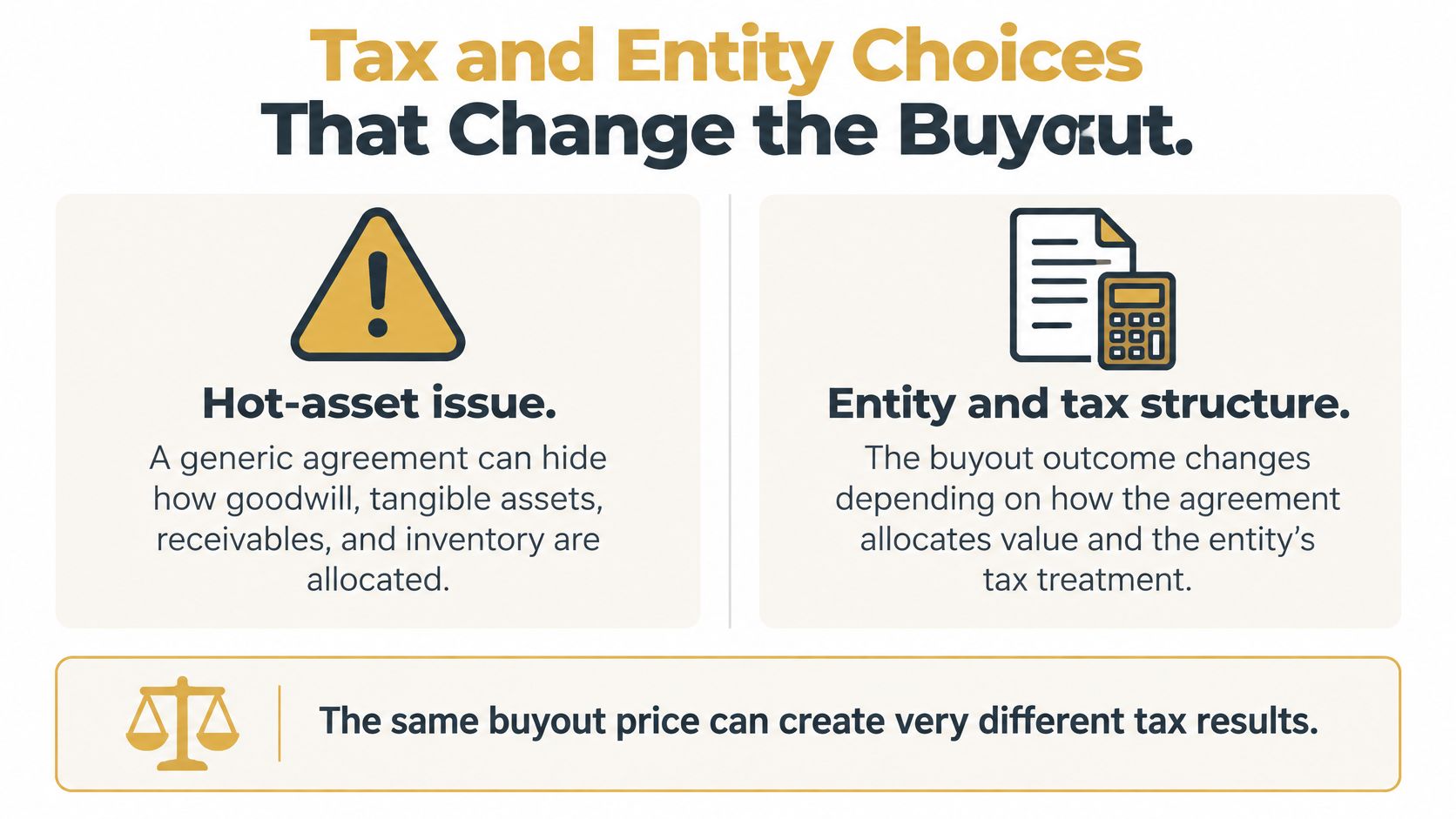
The surprise is usually the hot-asset slice, not the headline price. A generic agreement can state a number and a schedule and never show how value is split among goodwill, tangible assets, receivables, inventory, and a noncompete. Payments tied to unrealized receivables, inventory, or certain depreciated assets can be ordinary income rather than capital gain. A partnership buyout agreement form discussion of those assets notes that a deal involving them may trigger IRS Form 8308 reporting. Have the tax adviser confirm that before you lock the structure.
Redemption or cross-purchase
In an entity redemption, the partnership buys the departing interest. In a cross-purchase, the remaining partners buy it in their own names. The buyer, the basis, and the reporting package all change. A wider look at how deal shape moves tax is in this review of tax implications of business acquisitions.
| Feature | Entity redemption | Cross-purchase |
|---|---|---|
| Buyer | The entity | The remaining partners personally |
| Buyers' basis | Remaining partners' basis changes through the redemption rules | Buyers take a cost basis in the interest they purchase |
| Reporting | Partnership-level reporting, confirm with tax adviser | Individual purchase reporting, confirm with tax adviser |
| Hot-asset reporting | Form 8308 may apply | Form 8308 may apply |
After you pick a column, the agreement still has to assign pre-closing tax liabilities, define profit-and-loss allocation between signing and closing, and state what security, personal guarantee, default remedy, or acceleration right the seller gets.
The same dollar of price can be capital gain for one partner and ordinary income for the other. The allocation schedule is the tax return.
Aggressive collateral and tight covenants can also make the company impossible to finance or to run. A tax adviser should sign off on the entity choice and the hot-asset split before anyone signs the buyout.
Representations, Indemnities and Non-Compete Terms
Owners often assume the price clause is the protection. It is not. After closing, the only recourse is what the seller promised, how long those promises live, and what happens if they were wrong. A representation with no survival period expires the day you need it.
The departing partner should represent ownership, authority to sell, no undisclosed liabilities, tax compliance, pending litigation, intellectual property sitting in the company rather than in a personal name, and any continuing duties. Indemnity then needs four numbers, not a paragraph of comfort language. Set a cap, a basket (the threshold before claims count), a survival period for each representation, and a claim procedure with a notice deadline. Fraud and tax liabilities often sit outside the cap. Negotiate that carve-out. Do not assume a template already did it. A cap that also covers fraud is the gap that leaves the buyer paying for a lie.
Restrictions you can actually enforce
A non-compete and a non-solicit have to name the business activity, the geography, and the duration, and they should be tied to the value being paid. A nationwide ban on "any competing business" for five years is the clause a court is most likely to cut down. Match the geography to where the customers are.
On an installment deal, flip the lens. The seller needs reporting rights and a block on distributions or new debt that would weaken repayment. Run three checks on every protective clause. Who does it protect? Are the limits written as numbers? Does the survival period last at least as long as the payment schedule? If any answer is no, the clause will not help after closing.
Step-by-Step Buyout Process from Offer to Closing
Run the buyout as a sequence. Skipping a record early is what makes the closing week difficult. The flow below is the short version. The notes under it are where deals often slip.
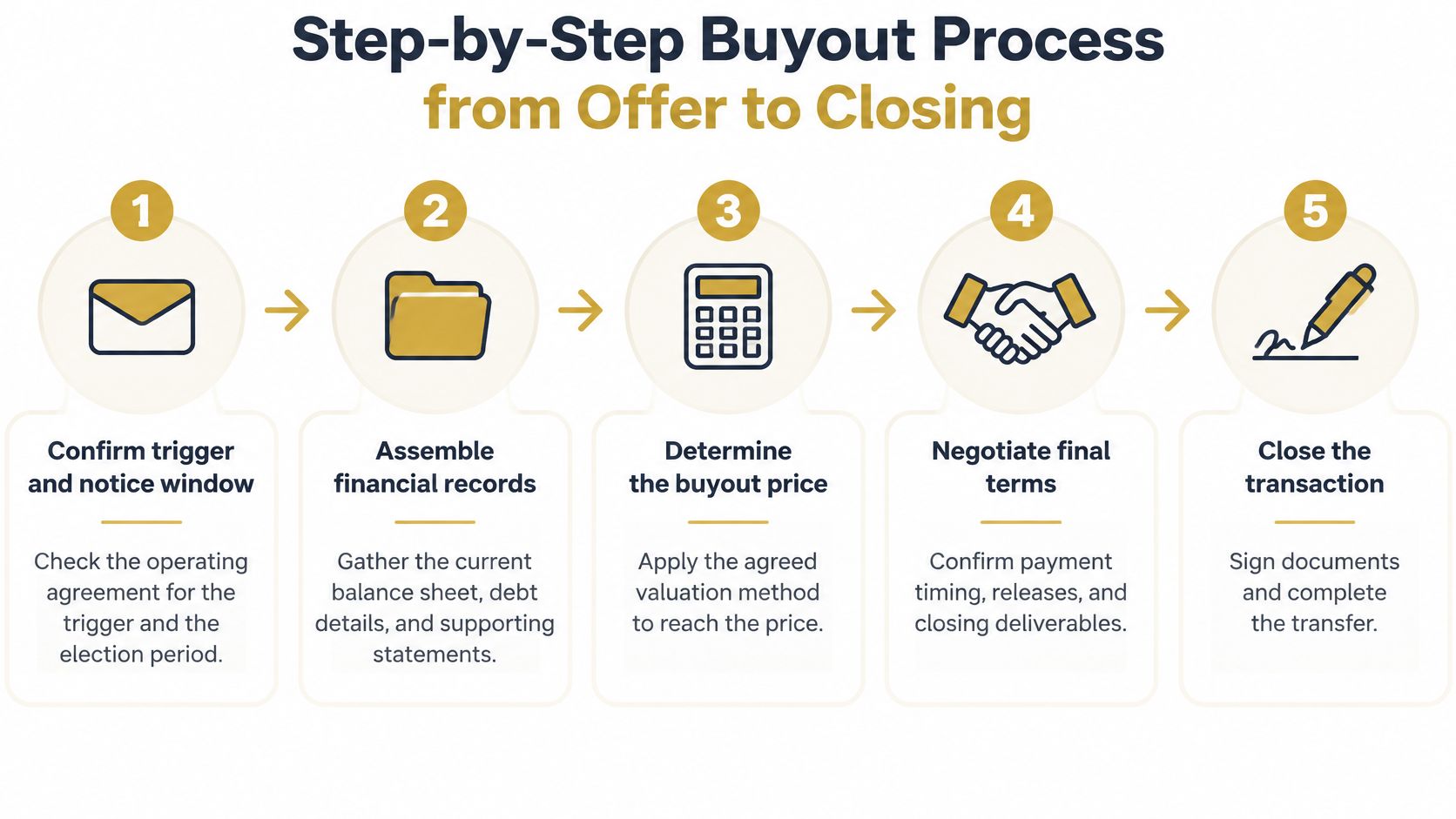
- Confirm the trigger. Read the operating agreement for the event, the notice, and the election window. The common slip is starting talks before the notice is sent, so the clock never starts.
- Assemble the records. Pull a current balance sheet, a debt schedule, a capital-account reconciliation, and three years of tax returns. A stale balance sheet is the slip that moves the price after everyone thought it was done.
- Lock the formula. Agree the valuation date and method, and name the appraiser and the tie-breaker in the same email. Leaving the tie-breaker for "later" is how the appraisal stalls.
- Exchange a written offer. Cover price, payment terms, and security in one document. A verbal number with "paperwork to follow" is the slip.
- Model the cash flow. Show debt service after the departing partner's pay and duties are removed. If the model only works with that pay still in the business, the note is too large.
- Build the lender package. If you are financing, send valuation support and the proposed agreement with the returns. A package that omits the draft buyout agreement gets sent back.
- Negotiate the protections. Trade representations, indemnities, and covenants against the note terms. Signing "standard reps" without a survival period is the slip.
- Confirm the tax path. A tax adviser should sign off on redemption versus cross-purchase and any hot-asset reporting. Guessing the character of the gain is the expensive slip.
- Collect consents. Any material contract without an assignment clause needs a customer consent letter before the deal closes. Waiting until the closing table is how a key contract blocks the transfer.
- Close and clean up. Release or replace guarantees, file the required tax forms, and write the transition plan. The guarantee left in the seller's name is the slip that follows people for years.
Our specialty coaches cover M&A contracts and financial due diligence when a live file needs a second set of eyes on steps 6 through 10. Do not close on a guarantee release that is "to be obtained."
Confirm the Agreement Before You Sign
Before you sign, read the draft against the operating agreement and the capital accounts, line by line. The trigger, the valuation formula, the payment schedule, the guarantee release, the tax allocation, the indemnity caps, and the dispute tie-breaker all have to appear in writing. Every lender condition should be a closing contingency, not a hope in a term sheet. Attach any spousal consent the entity or state law requires.
Ask counsel and a tax adviser to review the hot-asset split and the entity choice before the signature page goes out. Then do the practical work this week. Build the draft from the clause checklist, drop in the balance sheet, the debt schedule, and the capital-account reconciliation, and compare every line with the table.
If you are new to buying a business, the 10-Day Business Buying Launch is the first step we point people to, and our top dealmakers started there. You can also book a coaching call to review a specific deal. All of these terms still have to be confirmed with qualified legal and tax professionals. A template does not replace that review.
You have three choices. Sign, renegotiate the open blanks, or delay until the records are complete. Put a date on the calendar this week for that call, and do not let the file sit unsigned while the numbers keep moving.
Dealmaker Wealth Society teaches acquisition entrepreneurs how to structure ownership changes, valuation, and funding on small-business deals, including the partner buyouts this template is built for. If you want the training, the coaching, and the peer network behind that work, visit Dealmaker Wealth Society and start with the path that matches where you are in the deal.

From the Dealmaker Blog











A Creative Business Buying Fable