
Buying a Business Letter of Intent: A Complete Guide
Buying a Business Letter of Intent: A Complete Guide
A signed letter of intent is associated with a 78% closing rate, compared with 12% for verbal agreements, according to SMB Investor Network's deal glossary. That gap changes how a buyer should view the document. A buying business letter of intent isn't a polite handshake before the “real” agreement. It's the document that determines whether you get protected access to the business, preserve room to renegotiate, and control the path to a definitive purchase agreement.
The LOI also creates exposure. Its economic terms are usually non-binding, but provisions covering confidentiality, exclusivity, expenses, and governing law can bind both sides before diligence is complete. A poorly drafted document can leave you committed to a process without the access, financing protections, or walk-away rights needed to make a sound acquisition decision.
Table of Contents
- Why the LOI Is the Most Influential Document in Your Deal
- What a Business Letter of Intent Actually Is
- Every Clause a Buying LOI Should Cover
- Binding vs Non-Binding Language and Why It Matters
- Exclusivity, Confidentiality, and Diligence Access
- Price, Structure, and Contingencies in the LOI
- Annotated Sample LOI for Buying a Small Business
- Common Pitfalls When Buying a Business Letter of Intent
- Step-by-Step Process From Draft to Signed LOI
- LOI Checklist and Quick Reference for Buyers
Why the LOI Is the Most Influential Document in Your Deal
A signed LOI is associated with a 78% close rate, compared with 12% for verbal agreements, according to SMB Investor Network. That difference reflects the LOI's practical role. It turns an informal conversation into a transaction with stated expectations, deadlines, and responsibilities.
The document also changes the seller's behavior. After signing, a seller may pause discussions with other buyers, provide more detailed records, make management available, and spend time negotiating the definitive agreement. The buyer should receive something in return: a defined diligence period, access to the people and information needed for review, and a credible route to closing.
The LOI sets the negotiation perimeter
Price is only one term. A buying LOI should also address the proposed purchase structure, payment mechanics, exclusivity, diligence access, financing assumptions, required consents, and the target closing process. Those provisions show which points the parties have aligned on and which remain subject to verification or definitive documentation.
“Subject to satisfactory diligence” offers little protection by itself. Specify the records you need, management access, financing conditions, deadlines, and termination rights. These details determine whether the buyer can test the business properly and leave if the facts do not support the proposed economics.
Practical rule: Sign an LOI only when you can identify every provision that binds you, every term reserved for the definitive agreement, and each discovery that would justify walking away or revising the price.
The LOI should also frame the post-LOI re-trade. Diligence may produce a 5% to 15% reduction from the initial LOI price, as reported by SMB Investor Network. That range is not a reason to submit an inflated or unserious offer. It is a reason to state the assumptions behind the headline price and tie payment to verified financial and operating information.
A well-drafted LOI therefore preserves room for a fair adjustment without making the negotiation arbitrary. The buyer gains protection through specific access rights, measurable assumptions, and a clear distinction between agreed commercial terms and matters still subject to confirmation.
What a Business Letter of Intent Actually Is
A letter of intent, or LOI, is a written outline of the principal terms for a proposed acquisition. It sits between an informal offer and the definitive purchase agreement. The buyer uses it to state the proposed price, transaction structure, payment terms, diligence conditions, and process expectations before counsel drafts the full contract.
Most acquisition LOIs are hybrid documents. The parties generally don't become obligated to close merely because they signed the document, but selected provisions can create immediate obligations. Confidentiality, exclusivity, expense allocation, and governing law commonly receive binding treatment, while the purchase price, representations, indemnities, and closing mechanics remain subject to a definitive agreement.
How the documents differ
A verbal offer communicates interest but leaves too much open to interpretation. An LOI records the commercial framework and creates a basis for diligence. A term sheet is often shorter and commonly used to summarize financing or investment terms, while an acquisition LOI addresses the buyer, seller, target business, transaction structure, and rules governing the negotiation.
The definitive purchase agreement is different in kind, not just length. It contains the enforceable transfer obligations, representations and warranties, covenants, conditions to closing, indemnification provisions, remedies, and schedules needed to complete the transaction.
A useful LOI should answer three questions:
- What are the parties trying to accomplish? Identify the target, the assets or ownership interests being acquired, and the proposed structure.
- What must happen before closing? Describe diligence, financing, third-party approvals, and other conditions.
- What applies immediately? Mark the binding provisions clearly so neither side confuses a negotiation framework with a purchase contract.
The LOI's job is to prevent the parties from spending heavily on legal drafting and diligence before they agree on the commercial basics. It should create alignment without pretending that the buyer has already verified the seller's information.
Every Clause a Buying LOI Should Cover
A strong LOI is concise, but it isn't vague. Each clause should either define the transaction, protect the diligence process, or allocate a risk that would otherwise surface later in the purchase agreement.
The commercial and procedural core
Start with the full legal names of the buyer, seller, and target. Identify whether the buyer proposes an asset purchase, equity purchase, or another structure. Then state the aggregate purchase price and explain what that amount includes. If the price depends on debt, cash, working capital, inventory, or other adjustments, define those concepts early.
Payment terms deserve equal precision. Identify cash at closing, seller financing, earn-outs, escrow, holdbacks, or rollover equity. An earn-out should include the broad measurement concept, reporting access, operational protections, and dispute process that will later be documented in detail.
The LOI should also state which liabilities the buyer will assume and which remain with the seller. In a small business, this can include leases, customer deposits, payroll obligations, gift cards, taxes, equipment debt, and pending claims.
Access, timing, and approvals
The diligence clause should cover books and records, tax information, contracts, employee data, intellectual property, litigation, regulatory materials, leases, customer concentration, and key-person dependencies. It should also give the buyer access to appropriate employees and advisors, subject to confidentiality and operational safeguards.
Include the proposed closing timeline, the outside date, financing assumptions, landlord or lender consents, key customer approvals, and any required regulatory permissions. Employee and customer transition expectations belong in the LOI when continuity depends on the seller's cooperation.
| Clause | Commercial purpose | Typical buyer position | Typical seller position |
|---|---|---|---|
| Parties and target | Establishes who is negotiating and what is being sold | Precise legal identification | Avoids ambiguity but may keep affiliates outside the transaction |
| Price and structure | Defines the proposed economics | Price subject to verification and adjustments | Seeks a clear headline number and limited retrade |
| Payment terms | Allocates immediate and deferred consideration | Protects cash flow and performance risk | Prefers cash certainty and enforceable deferred payments |
| Liabilities | Determines what transfers | Assumes only identified obligations | Seeks broader assumption of operating liabilities |
| Exclusivity | Protects the buyer's diligence investment | Defined period, no-shop, clear breach consequences | Short period with narrow restrictions |
| Diligence access | Makes verification possible | Broad records and management access | Controlled access to protect employees and customers |
| Financing and approvals | Preserves conditions to closing | Express financing and consent conditions | Wants fewer conditions and greater certainty |
| Binding language | Allocates legal enforceability | Only process protections binding | May seek stronger commitment on price and timing |
| Expenses | Allocates transaction costs | Each party pays its own costs unless agreed otherwise | May request reimbursement if buyer abandons the deal |
| Governing law | Provides a legal framework | Familiar and commercially practical jurisdiction | Often prefers its home jurisdiction |
The clauses buyers most often concede too early are exclusivity scope, diligence access, working-capital definitions, and financing conditions. Those concessions can look minor during price negotiations but become decisive when the records don't match the initial story.
Binding vs Non-Binding Language and Why It Matters
The phrase “non-binding LOI” doesn't make every sentence non-binding. Courts may examine the document's wording, completeness, and the parties' later conduct to determine whether they created an enforceable agreement. Guidance from Holland & Knight on letters of intent in business transactions highlights the practical risk. An LOI can include non-binding economic terms while creating binding obligations around confidentiality and exclusivity, and transaction costs can range from $10,000 to $100,000 or more, depending on complexity.
Separate the two categories explicitly
A buyer's LOI should identify the binding provisions in a dedicated section. It should then state that all remaining provisions express current intent only and don't obligate either party to execute a purchase agreement or close the transaction.
Language such as “the parties intend to be legally bound” creates risk when it appears near a document that contains a complete price, asset description, closing date, and detailed obligations. By contrast, a clear provision stating that no obligation to consummate the acquisition exists, except for listed clauses, better reflects the usual commercial purpose of an LOI.
Don't rely on a footer or a single sentence at the end. Mark each section as binding or non-binding, especially where the document includes access covenants, expense reimbursement, employee restrictions, or seller operating promises.
| Clause | Usually binding? | Buyer-side risk |
|---|---|---|
| Confidentiality | Yes | Limits how the buyer can use diligence information |
| Exclusivity and no-shop | Yes | Can prevent the buyer from pursuing alternatives while committed |
| Expense allocation | Often | May create reimbursement obligations after termination |
| Governing law | Yes | Determines the legal framework for disputes |
| Purchase price | Usually no | May still influence the later negotiation |
| Transaction structure | Usually no | Can become an expectation if drafted too definitively |
| Diligence conditions | Usually no, unless access is promised | Weak wording can limit practical verification |
| Definitive agreement | No commitment to close | Poor drafting may suggest otherwise |
A seller can also be trapped by the same split. If exclusivity is binding, the seller cannot treat the LOI as entirely optional while shopping the business to another buyer. The safest drafting makes the parties litigate neither intent nor semantics. It tells them exactly what applies now and what waits for the definitive agreement.
Exclusivity, Confidentiality, and Diligence Access
Once the LOI is signed, the buyer's practical advantage comes from three connected protections: exclusivity, confidentiality, and access. Remove any one of them and the diligence process becomes less reliable.
Exclusivity must close the obvious loopholes
The exclusivity clause should prohibit the seller, its owners, representatives, brokers, affiliates, and controlled entities from soliciting, encouraging, discussing, or accepting competing proposals. It should address unsolicited offers as well as actively sourced offers. Otherwise, a seller can claim that a competing buyer approached without solicitation and continue the auction.
The period should be long enough to complete financial, legal, operational, and financing work, but not so long that the buyer receives protection without creating momentum. Add automatic termination, extension rights tied to seller delays, and a clear consequence for breach. The seller should also agree not to use the buyer's proposal to improve another bidder's terms.
Confidentiality must protect both sides
A mutual confidentiality provision protects the seller's employees, customers, and vendors from premature disclosure while protecting the buyer's analyses, financing plans, and negotiation position. Address permitted disclosures to lawyers, accountants, lenders, investors, and other advisors, along with return-or-destroy obligations if the deal ends.
The buyer should check whether an existing NDA already governs the information. If it does, the LOI should state which document controls in the event of conflict. Residual-knowledge language deserves attention because broad carve-outs can weaken the seller's protection and create disputes over what the buyer may retain.
For a practical diligence framework, buyers can use the Jumpstart Partners due diligence guide alongside a financial due diligence checklist. The LOI should translate that work into express access rights rather than promising “reasonable access.”
Access and expiration mechanics
Specify the data-room materials, books, contracts, leases, customer information, employee interviews, site visits, and management meetings the seller must facilitate. Set response expectations and identify what happens if the seller delays. The LOI should terminate automatically at expiration unless the parties sign an extension, and an extension should preserve exclusivity rather than return the business to market.
Price, Structure, and Contingencies in the LOI
A buyer is not just recording a price. The LOI should set an economic framework that can survive diligence, financing, and the final purchase agreement.
Define what the headline number means
A price without a bridge is incomplete. State whether the figure represents enterprise value, equity value, or consideration for identified assets. Clarify the treatment of debt, cash, working capital, inventory, transaction expenses, and assumed liabilities. Two parties can accept the same headline number while expecting different amounts to change hands at closing.
Set out the adjustment process in the LOI. If working capital will be normalized, identify how the target will be calculated and how disputes will be resolved. If inventory is included, specify whether it will be valued at cost, market value, or another agreed basis. These details often determine the final economics more than the opening price.
Match the structure to the risk
Cash at closing gives the seller certainty and leaves the buyer with a clean payment obligation, but it places the purchase risk at closing. Seller financing defers part of the payment and can keep the seller engaged during collection and transition. An earn-out ties part of the consideration to post-closing performance, while rollover equity preserves the seller's participation and introduces governance, dilution, and future-exit issues.
Earn-outs require precise definitions. The LOI should identify the measurement period, performance metrics, accounting rules, buyer operating authority, reporting rights, and treatment of extraordinary events. Buyers considering this structure should review this guide to earn-outs in business transactions before accepting broad performance language.
Preserve the exit routes
The contingency package should address satisfactory diligence, required financing, third-party consents, accurate seller representations, ordinary-course operation, and the absence of a material adverse change. Give the buyer a termination right that works in practice. “Satisfactory to buyer” may provide flexibility, but the parties can also agree on an objective materiality standard or list specific findings that permit termination.
The LOI should preserve a realistic period for repricing after diligence. The original price is often based on seller information, while diligence may reveal customer concentration, deferred maintenance, working-capital shortfalls, contract restrictions, or earnings adjustments. The buyer needs room to revise price or structure before signing definitive documents, rather than treating the initial figure as an unchangeable promise.
| LOI term | What it locks in | Buyer's diligence advantage |
|---|---|---|
| Headline price | Initial valuation framework | Requires adjustment definitions |
| Cash at close | Immediate payment concept | Limits protection after payment |
| Seller note | Deferred payment structure | Supports remedies and alignment |
| Earn-out | Contingent consideration | Requires measurable, controllable metrics |
| Working-capital target | Closing adjustment mechanism | Protects against underfunded operations |
| Financing contingency | Debt or capital condition | Preserves a walk-away right |
| Diligence condition | Verification requirement | Supports termination or price revision |
| Third-party approvals | Consent requirement | Prevents closing without transferable rights |
Annotated Sample LOI for Buying a Small Business
The following sample illustrates how I would frame a proposed acquisition of a service business for $1.8 million. The dollar amount is an example for drafting practice, not a market statistic. The important feature is the separation between non-binding commercial terms and binding process protections.
Opening and economics
Parties and transaction, non-binding: Buyer proposes to acquire substantially all operating assets of the target service business from Seller, excluding cash and excluded liabilities. The proposed purchase price is $1.8 million, subject to the adjustments and conditions described below.
This identifies the asset deal and prevents the buyer from accidentally assuming every liability. The buyer should define excluded liabilities in the definitive agreement, including taxes, owner obligations, and pre-closing claims.
Payment structure, non-binding: The consideration will consist of cash at closing, a seller-financed note, and an earn-out tied to agreed performance measures. The parties will negotiate final note terms, security, earn-out definitions, reporting rights, and dispute procedures in the purchase agreement.
The negotiation whitespace is substantial. The buyer should not accept an earn-out until it can control or at least measure the relevant performance.
Exclusivity and diligence
Exclusivity, binding: From signature through the agreed expiration date, Seller will not solicit, encourage, negotiate, or accept another proposal concerning the target, directly or through representatives or affiliates.
Use actual calendar dates in the signed version. A defined start and end date is better than “for a reasonable period.” Add a seller cooperation covenant requiring prompt delivery of records and access to identified personnel.
Diligence access, non-binding framework with binding cooperation covenant: Buyer may review financial, tax, legal, operational, employee, customer, vendor, lease, and intellectual-property information and may meet with designated managers, subject to confidentiality and reasonable operating safeguards.
The buyer should tighten this clause by identifying the data-room contents, response process, site access, and consequences of material delay. The seller will likely push back on customer data, employee contact, and information that could disrupt operations.
Financing and closing
Financing condition, non-binding: Buyer's obligation to close will be subject to obtaining financing on terms acceptable to Buyer and completing diligence to Buyer's satisfaction.
A seller may request a firm financing deadline or evidence of lender progress. The buyer should resist language that converts a financing assumption into an unconditional obligation.
Closing timeline, non-binding: The parties will work toward a closing after completion of diligence, financing, required consents, and execution of the definitive purchase agreement, with an outside date stated in that agreement.
The outside date belongs in the LOI if timing matters. The buyer should also require the seller to operate in the ordinary course, preserve key relationships, and cooperate with landlord, lender, and customer consents.
Confidentiality, binding: Existing confidentiality obligations remain in effect, and the parties will use transaction information only for evaluating and completing the proposed acquisition.
The seller may request indemnification triggers, a break fee, or a broader no-solicit. The buyer should evaluate each request separately rather than accepting a package that makes the LOI too binding.
Common Pitfalls When Buying a Business Letter of Intent
The most expensive LOI mistakes usually look harmless when the document is being negotiated. They become expensive after the buyer has spent time, money, and credibility on a process that the LOI failed to protect.
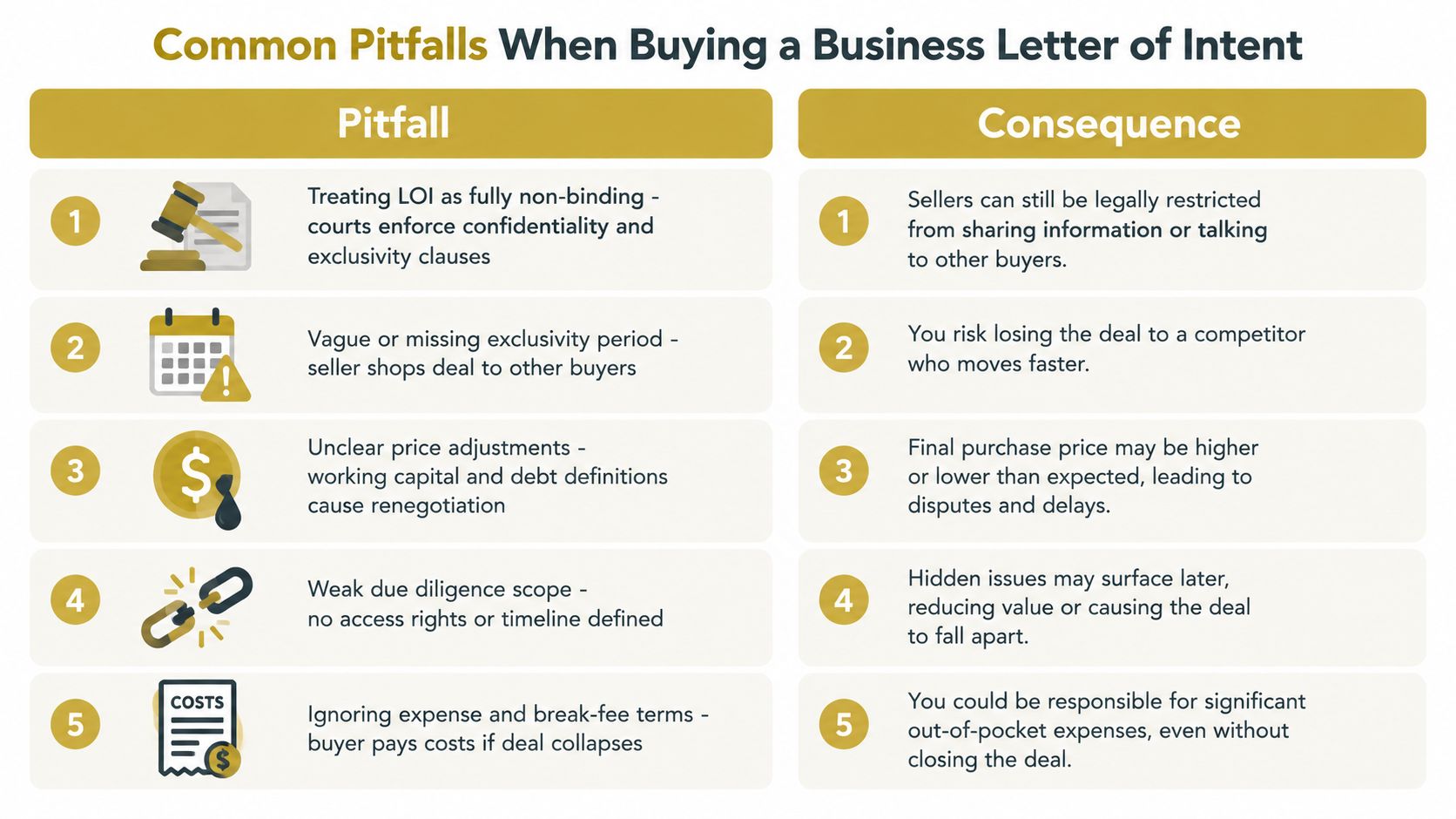
The recurring errors
- Treating the entire LOI as non-binding: Confidentiality, exclusivity, expense reimbursement, and governing-law provisions may still create enforceable obligations.
- Using a precise price without assumptions: A fixed headline figure can make a later adjustment look like bad faith, even when diligence identifies missing earnings or working-capital support.
- Accepting exclusivity without access rights: The seller may be barred from shopping the business while still controlling the information needed to complete diligence.
- Waiving financing protection to look serious: The buyer can become responsible for closing despite a lender declining the transaction or changing its terms.
- Ignoring working-capital normalization: The buyer may inherit a business that requires an immediate cash injection because the seller delivered less operating capital than expected.
- Leaving the seller's operating obligations undefined: The seller can make major decisions, lose key employees, or alter customer relationships before closing.
- Skipping employee and customer restrictions: The seller may solicit staff, customers, or vendors after the transaction unless the definitive agreement addresses those risks.
- Accepting vague earn-out language: A performance payment can become impossible to calculate or operationally achieve when the buyer controls post-closing decisions.
A useful sanity check: Read the LOI as though the deal fails tomorrow. Identify every clause that still binds you, every cost you may owe, every piece of information you may be unable to use, and every remedy you lack.
The buyer should also ask whether the LOI preserves a price revision when the seller's records contradict the initial materials. A diligence condition without a practical termination right is a slogan. A no-shop clause without a consequence is an invitation to test the buyer's resolve.
Step-by-Step Process From Draft to Signed LOI
A signed LOI should be the result of a controlled process, not an informal exchange of intentions. The buyer reviews the teaser, signs or confirms the NDA, tests the available financial information, and sets an initial valuation range. Early discussions should also address structure, seller financing, earn-out concepts, exclusivity, and the conditions that would justify proceeding.
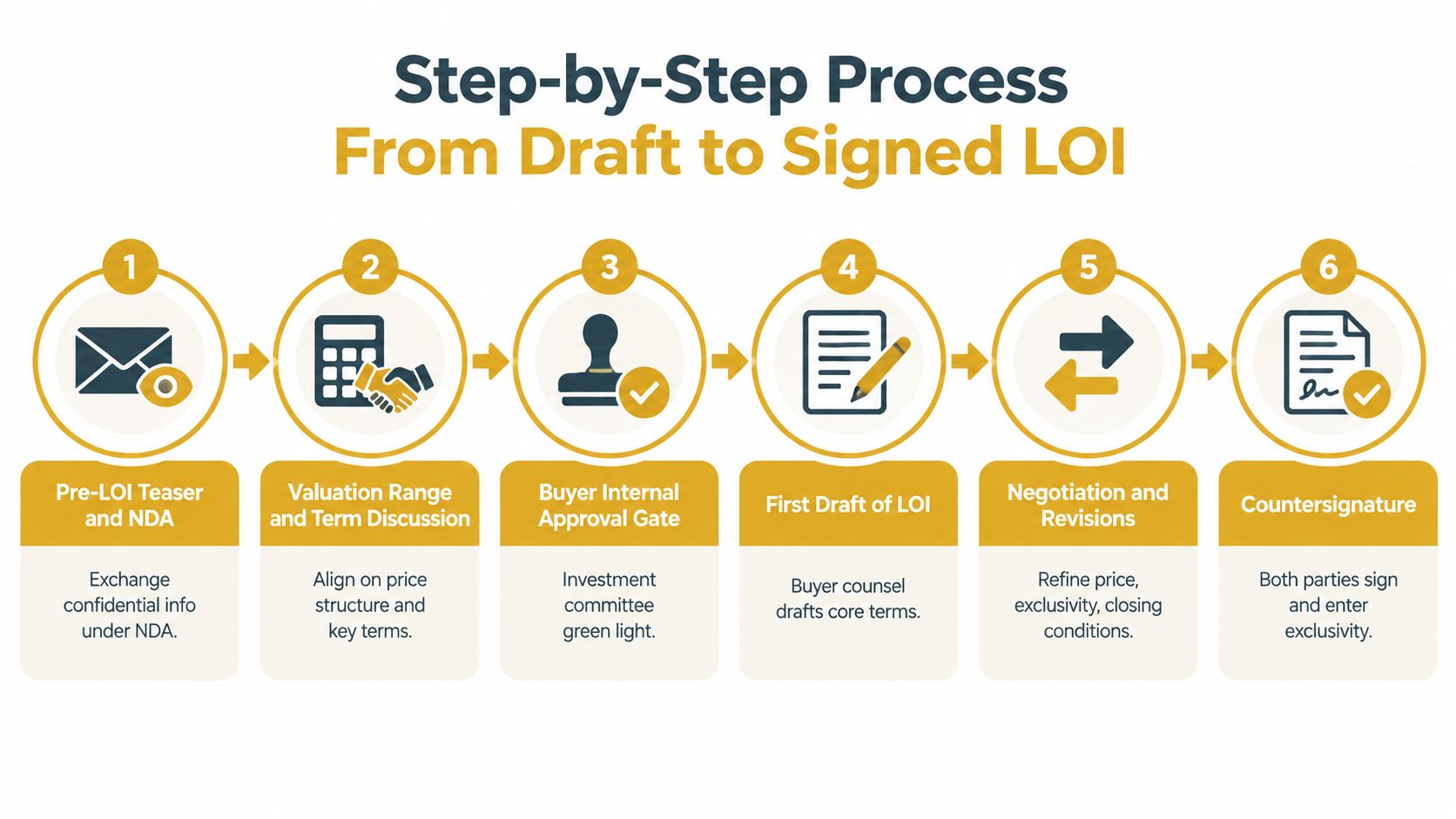
The workflow that keeps momentum
- Screen the opportunity: Confirm the target, owner's objectives, available financial information, and obvious deal constraints.
- Approve the proposal internally: Set the maximum price, structure, financing assumptions, and protections required before drafting.
- Anchor the first draft: A buyer-prepared draft can define diligence conditions, the binding provisions, and the non-binding provisions instead of adopting the seller's preferred language.
- Exchange markups: Counsel and advisors should resolve price mechanics, exclusivity scope, information access, approvals, and expense terms.
- Hold a focused redline call: Settle commercial disagreements on the call, then record each decision in the document.
- Sign and launch diligence: The countersignature should start the data-room timetable, management access, lender work, consent process, and purchase agreement drafting.
A small-business LOI may take 7 to 14 days to negotiate. The period from signing the LOI to closing is often 45 to 120 days, but that range is planning guidance rather than a commitment. Seller delays, financing complexity, required consents, and diligence findings can change the schedule quickly.
The signed LOI also creates the practical window for a price re-trade. If verified financials, customer concentration, tax records, or asset condition differ from the seller's initial materials, the buyer needs a defined route to revise the price or exit. That protection works only when the LOI connects diligence findings to a termination right or revised economics.
An experienced transaction attorney should handle legal drafting and enforceability questions. A trained legal assistant can organize the data room, track redlines, manage signature versions, and maintain the diligence request list. Buyers seeking that administrative support can review Hire Legal assistants, which complements rather than replaces legal counsel.
The purchase agreement should follow verified financials, agreed debt and working-capital treatment, a workable financing plan, identified third-party consents, and a diligence report the buyer can accept or price appropriately. For the next drafting stage, buyers can review guidance on negotiating business purchase agreements.
LOI Checklist and Quick Reference for Buyers
Before sending or signing a buying business letter of intent, review the document as a control system. It should protect the information flow, preserve the buyer's ability to investigate, and prevent the seller from creating a competing process while the buyer funds diligence.
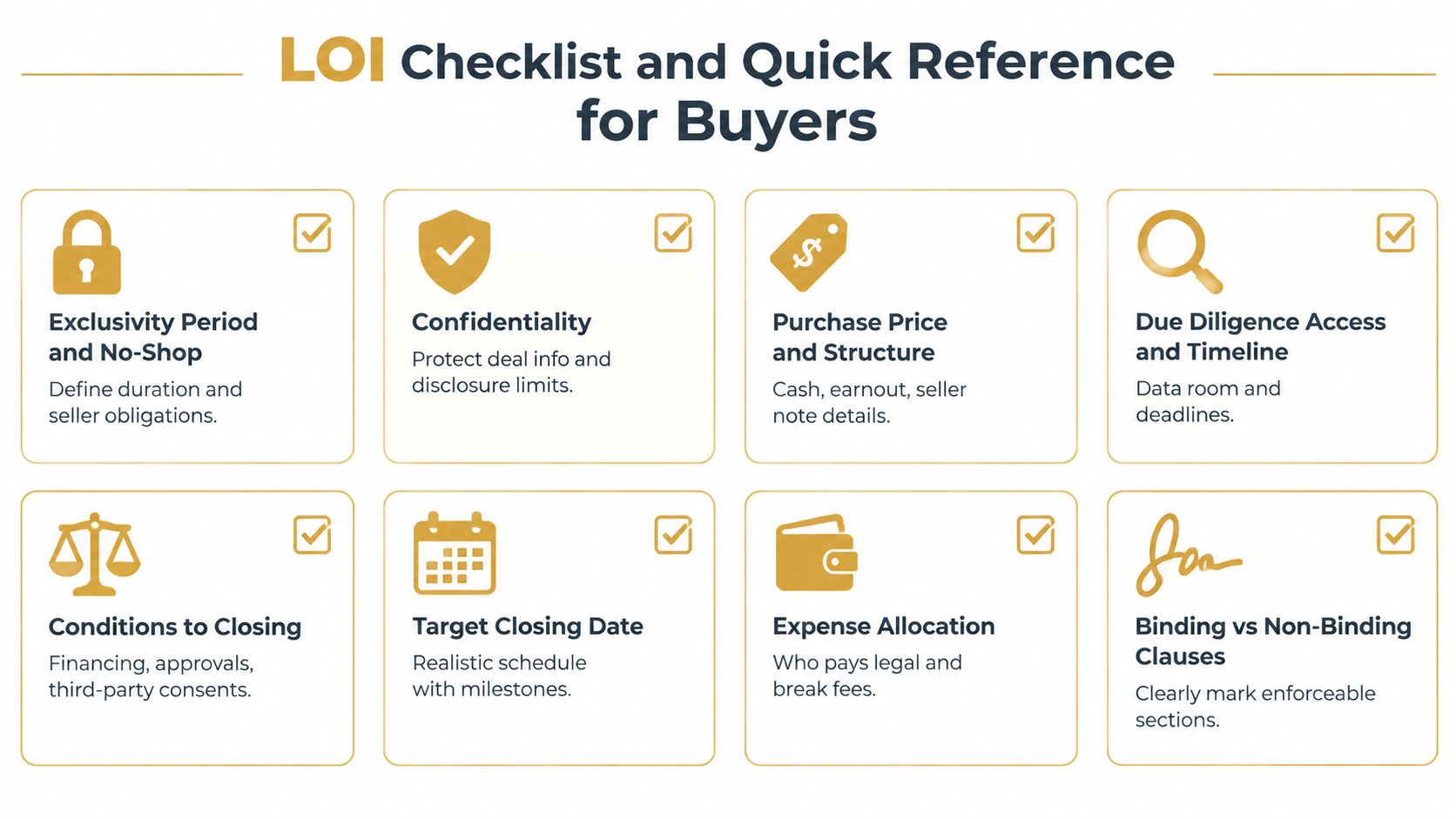
Commercial terms
- Parties and target: Use complete legal names and identify the assets, equity, or business interests being acquired.
- Price and structure: State the headline amount, asset or equity structure, cash at close, seller note, earn-out, rollover, and adjustment concepts.
- Liabilities: List assumed and excluded liabilities, including debt, taxes, deposits, claims, and operating obligations.
- Closing conditions: Include diligence satisfaction, financing, third-party consents, ordinary-course operation, and required approvals.
Process protections
- Exclusivity and no-shop: Define the period, covered parties, prohibited conduct, unsolicited offers, termination, and breach consequences.
- Confidentiality: Address transaction information, permitted disclosures, advisors, return or destruction, and any existing NDA.
- Diligence access: Name the records, data-room materials, employees, facilities, customers, vendors, and response expectations.
- Timeline: Set milestones, an outside date, extension triggers, and the effect of seller delay.
Legal clarity
- Binding split: Mark confidentiality, exclusivity, expenses, governing law, and other enforceable terms expressly.
- Walk-away rights: Confirm that unresolved diligence, financing, consent, or material business issues can stop the transaction.
- Expense allocation: State who pays legal, accounting, lender, diligence, and any break-fee costs.
- Definitive agreement: Make clear that the acquisition closes only after execution of the final purchase agreement.
Use this checklist before counsel reviews the draft, then ask counsel to test the language against your transaction structure and jurisdiction. For structured training, acquisition checklists, negotiation practice, and peer support around active deals, Dealmaker Wealth Society offers education and community resources for buyers working through sourcing, diligence, financing, and LOI negotiations. Visit the platform before your next offer so you can enter the LOI stage with a defined price framework, protected diligence process, and a clear understanding of what you're agreeing to sign.

From the Dealmaker Blog











A Creative Business Buying Fable
