
How to Buy a Business First Time Buyer Roadmap
How to Buy a Business First Time Buyer Roadmap

You've found a business that looks promising. The seller says it's profitable, the broker's summary is polished, and the asking price seems close to what you can finance. Then the practical questions arrive: How much cash do you need? Can the business repay the debt? What happens if the owner leaves? Will customers and employees stay after the handover?
Learning how to buy a business means answering those questions in the right order. The work isn't just finding a listing. It's building a pipeline, underwriting cash flow, structuring risk between buyer, seller, and lender, verifying the facts, and leading the business through its first transition. The purchase agreement gets signed once. The operating decisions that follow determine whether the acquisition creates the outcome you wanted.
Table of Contents
- Why Buying an Existing Business Beats Starting From Scratch
- Finding and Screening Businesses Worth Buying
- Valuing the Business and Structuring Your Offer
- Due Diligence and Negotiation That Protect Your Deal
- Closing the Purchase and Nailing the First 100 Days
- Your Next Move Toward Ownership
Why Buying an Existing Business Beats Starting From Scratch
A first-time buyer often begins with a simple comparison. Starting from scratch offers control and a clean slate, but it also requires building demand, hiring a team, creating processes, and proving that customers will pay. Buying an existing business offers less freedom on day one, yet it may come with revenue, customer relationships, employees, suppliers, operating history, and systems that already function.
That distinction changes the risk you're taking. You aren't paying only for equipment or a brand name. You're buying a working economic engine, then accepting responsibility for maintaining and improving it. The benefits of buying an established business become most valuable when the buyer understands what must be preserved before attempting growth.

Acquisition is usually a financing exercise
Most first-time buyers aren't purchasing with all cash. One industry source reports that nearly 95% of bank loans used to acquire a small business are SBA loans, and describes a common structure combining approximately 10% buyer equity, 5% to 15% seller financing, and 75% to 85% bank debt (small-business acquisition financing data). The SBA generally guarantees a substantial portion of a lender's exposure rather than lending directly, which can make a transaction workable when conventional underwriting would be difficult.
That structure creates leverage, but leverage isn't free money. Debt service reduces flexibility, seller notes create an ongoing relationship, and the buyer's equity is exposed if performance deteriorates. The right question isn't, “Can I borrow enough?” It's, “Can this business support the obligations while I protect customers, employees, and working capital?”
Buyers who close behave differently
Browsers collect listings. Buyers define criteria, speak with owners, reject weak opportunities quickly, and keep moving when a deal fails. A realistic acquisition path includes sourcing, preliminary screening, lender conversations, an indication of interest or letter of intent, diligence, negotiation, closing, and integration. The process can take patience because financing, landlord approvals, documentation, and seller decisions all affect the timetable.
A useful mindset is to treat each opportunity as an underwriting question rather than an emotional opportunity. You don't need the perfect business. You need a business whose cash flow, people, customer base, and operating requirements fit your capital, skills, and leadership capacity.
Finding and Screening Businesses Worth Buying
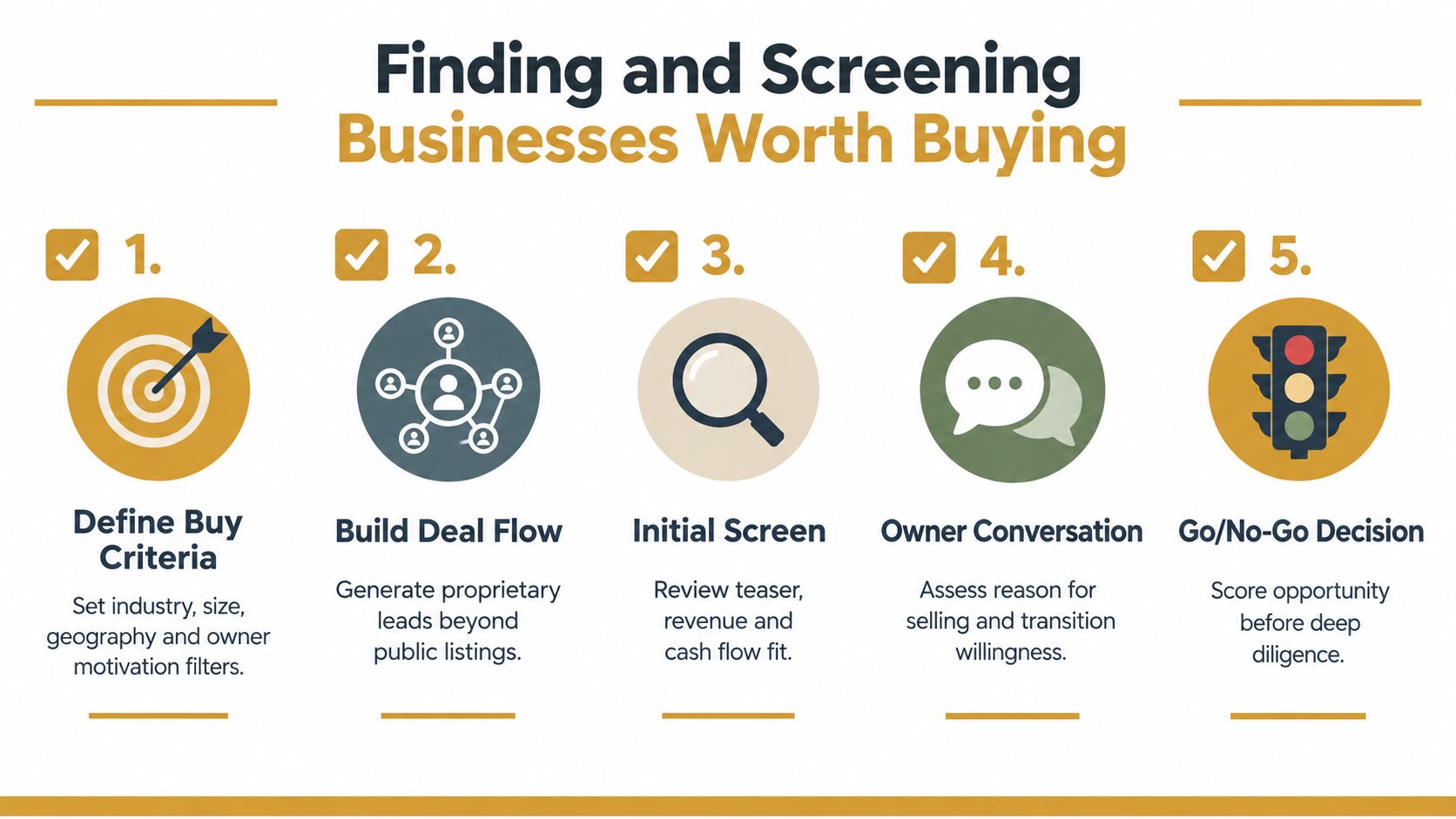
Start with a written buy box before you open a marketplace. Define the industries you understand, the geography you can operate in, the size of business you can finance, and the role you want to play after closing. Add filters for owner motivation, customer type, recurring or repeat demand, licensing requirements, and whether the seller is willing to support a transition.
Your criteria should be narrow enough to guide decisions but flexible enough to surface unconventional opportunities. A buyer with strong sales experience may accept a business with weak marketing but reject one dependent on technical knowledge they can't replace. A local operator may prefer a company with a physical presence, while an executive seeking flexibility may prioritize a management team and documented processes.
Build deal flow beyond public listings
Public marketplaces are useful for learning what's available, but they're only one channel. Build relationships with business brokers, commercial lenders, accountants, attorneys, franchise professionals, suppliers, and local business owners. Direct outreach can also uncover owners who haven't formally listed the company but are open to a confidential conversation.
Keep a simple pipeline in Airtable, Notion, or a spreadsheet. Record the source, industry, location, asking price, stated cash flow, owner's reason for selling, next action, and rejection reason. A rejection log is valuable because it shows which filters are protecting you and which may be too restrictive.
For buyers exploring franchise-related opportunities, a specialized directory such as the directory entry for Johnny Franchise can provide another starting point for understanding the people and businesses active in that space. Treat directories as networking resources, not as substitutes for financial verification.
Screen for business quality before valuation
A teaser rarely gives you enough information to make a final decision. It can tell you whether the opportunity deserves a conversation. Ask for a basic financial summary, understand how the owner defines cash flow, and compare the business model with your buy box.
Use an initial scorecard with categories such as:
- Financial fit: Does the reported cash flow appear sufficient for debt service, owner compensation, taxes, reinvestment, and working capital?
- Owner dependency: Does the owner sell, estimate, schedule, approve, or personally control relationships that the business needs?
- Customer concentration: Would losing one major account materially change the company's economics?
- Operational resilience: Are employees, vendors, procedures, and systems documented well enough for continuity?
- Growth practicality: Can you identify credible improvements without relying on heroic assumptions?
The point is consistency. A scorecard doesn't replace judgment, but it prevents a charismatic seller or attractive brand from dominating your analysis. For a more formal approach, use the frameworks for effective deal evaluation to turn early screening into a repeatable process.
Valuing the Business and Structuring Your Offer
Price should follow verified earning power, not the seller's preferred number. Begin by understanding EBITDA, then normalize it. Remove expenses that won't continue, challenge add-backs that benefit the seller personally, account for replacement management, and separate genuine operating costs from discretionary spending.
Working capital deserves equal attention. A seller may present a business with strong earnings while allowing inventory, receivables, or payables to drift below the level needed for normal operations. Define a working-capital target and specify how the closing adjustment will work. If the business needs cash to operate on the first day, that requirement belongs in the purchase economics, not in an afterthought.
The market gives buyers a reason to negotiate with evidence. Closed-deal reporting indicates that acquisitions in Q2 2025 sold 10.5% below asking prices, described as the widest gap in three years (closed-deal pricing report). That doesn't mean every buyer should demand the same discount. It means asking price is an opening position, and your offer should reflect quality of earnings, risk, financing constraints, and the terms you're willing to provide.
Use structure to share risk
A common acquisition structure uses roughly 10% buyer equity, 5% to 15% seller financing, and 75% to 85% bank debt (SMB acquisition financing benchmarks). The exact terms depend on lender requirements, business quality, collateral, cash flow, and negotiation. Seller financing can reduce the buyer's upfront cash requirement and keep the seller economically connected to a successful transition.
Earnouts can bridge a disagreement about future performance, but they often create disputes when the measurement rules are vague. If you use one, define the metric, accounting treatment, reporting access, decision rights, and what happens if the buyer changes the business. An equity rollover may align the seller with future growth, but it also means the buyer may not have complete control over the outcome.
| Funding Source | Typical Share | Best For | Trade Off |
|---|---|---|---|
| Buyer equity | About 10% | Demonstrating commitment and funding the equity injection | Uses personal or investor capital and absorbs first-loss risk |
| Seller financing | 5% to 15% | Bridging valuation gaps and supporting transition alignment | Creates repayment obligations and a continuing seller relationship |
| Bank debt | 75% to 85% | Financing the majority of the purchase price | Requires underwriting, debt service, and lender controls |
Structure for risk sharing, not just price. A lower headline price can still produce a fragile deal if the buyer must fund too much cash, inherit excessive working-capital needs, or assume unprotected operational risk.
Your offer should state the conditions that matter, including financing, diligence, lease consent, inventory treatment, training, non-compete provisions, and access to records. The business valuation methods guide can help you compare approaches, but the final price still has to make sense against the company's verified cash generation and transition risk.
Due Diligence and Negotiation That Protect Your Deal
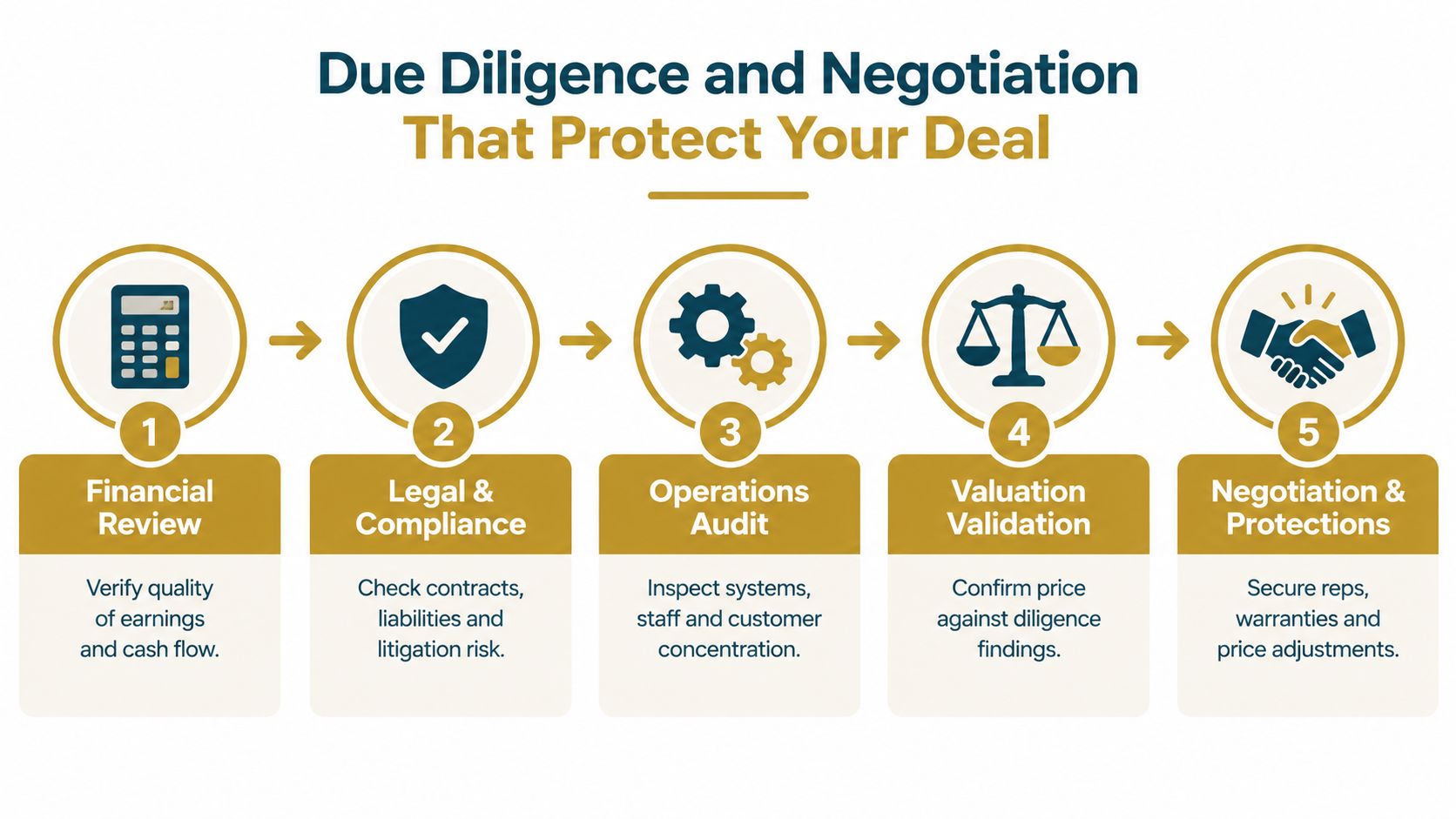
Diligence is where a promising story becomes an investable business, or falls apart. Start with the financial statements, tax returns, bank activity, general ledger, accounts receivable, accounts payable, payroll, inventory, and capital expenditure history. Reconcile reported EBITDA to the underlying records and identify every adjustment that affects sustainable cash flow.
Then test the business outside the spreadsheet. Review contracts, leases, licenses, insurance, claims, litigation, intellectual property, employment arrangements, customer agreements, supplier dependence, and regulatory exposure. Speak with key employees where appropriate, inspect the operating workflow, and determine which responsibilities still sit entirely with the seller.
Run a disciplined diligence sprint
Neutral market guidance places professional diligence for a $500K to $25M target at about $25,000 to $75,000, with four to six weeks of active work (small-business due diligence guidance). The complete transaction can stretch to roughly 170 days once SBA underwriting and landlord consent are included, so buyers should plan their personal finances and communication strategy around a process longer than the initial excitement suggests.
Assign an owner to each workstream and maintain a live request list:
- Quality of earnings: Verify revenue recognition, margins, add-backs, payroll, taxes, and cash conversion.
- Working capital: Establish a normalized target and identify seasonal or unusual balances.
- Legal and commercial: Review agreements, liabilities, customer concentration, suppliers, leases, and compliance.
- People and HR: Confirm compensation, benefits, key-person risk, employment documentation, and retention concerns.
- Operations: Map systems, approvals, fulfillment, technology, vendor relationships, and owner-dependent tasks.
A buyer shouldn't wait until the end to interpret findings. If a major customer can terminate after a change of control, that issue affects price and closing conditions immediately. If the owner personally controls sales, build a transition plan and consider retaining the seller through a defined support period.
Negotiate the protection, not the drama
Negotiation works best when each request connects to a documented risk. A weak add-back may justify a price reduction, a seller note, a holdback, or stronger representations and warranties. An uncertain lease may require landlord consent as a closing condition. Unreliable inventory records may call for a count and a purchase-price adjustment.
Use the purchase agreement to define what the buyer receives, what the seller promises, and what happens when facts differ from the disclosure schedule. Avoid turning every issue into a fight over pride. Sellers often care about certainty, legacy, employees, and timing as much as the last change in price.
Review the diligence findings with your attorney, accountant, lender, and insurance advisers. The goal isn't to eliminate every risk. It's to identify the risks you can operate, insure, price, or contract around before you commit capital.
Closing the Purchase and Nailing the First 100 Days
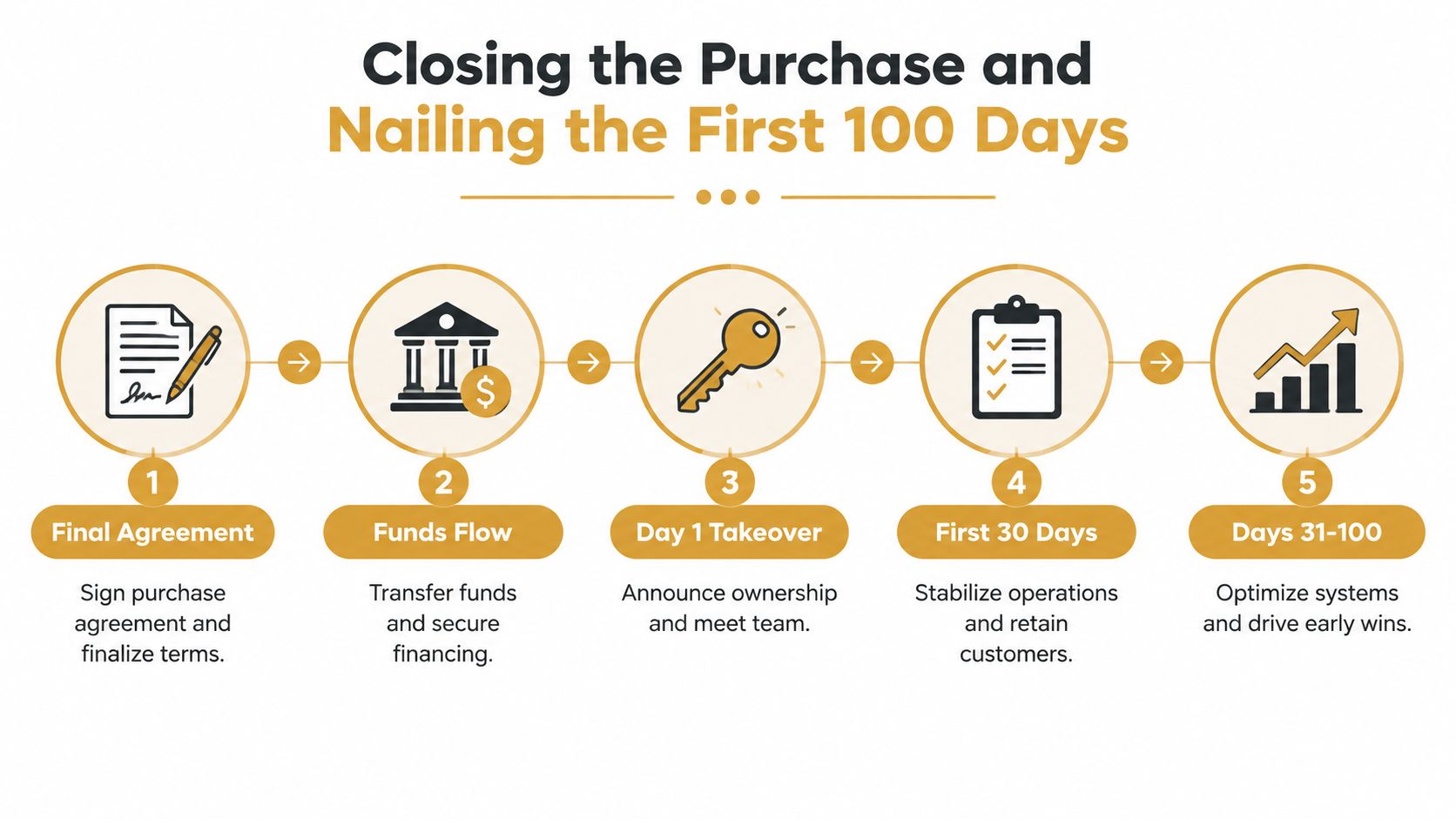
Closing is a controlled funds-and-documents process, not a ceremonial finish line. Before signing, confirm the final purchase agreement, disclosure schedules, lender conditions, insurance, lease consent, inventory treatment, employee communications, transition services, and funds flow. Your closing checklist should show who owns each item and what evidence confirms completion.
The transition agreement deserves careful attention. Specify the seller's availability, customer introductions, employee meetings, vendor handoffs, system access, passwords, training materials, and unresolved projects. Vague promises such as “reasonable assistance” create uncertainty exactly when the buyer needs clarity.
Stabilize before you optimize
On day one, employees need to know who is responsible, what will remain unchanged, and how decisions will be made. Customers need continuity, not a dramatic announcement about every future improvement. Meet the people who keep delivery, billing, sales, scheduling, and customer service moving.
Use the first 100 days to protect the base:
- Cash control: Review collections, payments, payroll, inventory purchases, and near-term obligations.
- People retention: Speak directly with key employees, understand their concerns, and clarify reporting lines.
- Customer continuity: Contact important customers with a practical message focused on service and support.
- Process mapping: Document how work moves through the business before replacing systems.
- Operating rhythm: Establish regular meetings, a short list of leading indicators, and a clear issue log.
Don't launch a major technology overhaul just because the inherited system feels dated. First determine whether the system is causing measurable problems, whether employees depend on workarounds, and whether a change could interrupt service. An operating system should make accountability clearer, not create a second business for the new owner to manage.
Integration capacity determines the outcome
Post-close execution is a major source of acquisition risk. Coverage of KPMG's 2025 integration survey reported that 83% of M&A deals failed to boost shareholder returns, while poor integration execution has been linked to about 27% of M&A failures (M&A integration statistics). Those figures concern M&A broadly, but the operating lesson applies directly to smaller acquisitions: buying a sound company doesn't protect a buyer who mishandles people, customers, systems, or decision-making after closing.
Ask yourself what you can personally lead. If you're taking over sales, hiring, finance, and operations at once, the integration plan may be too ambitious. Assign responsibilities, preserve the routines that work, and select early improvements that employees can understand and customers can feel.
Your Next Move Toward Ownership
Buying a business is a learnable system, but it rewards preparation more than enthusiasm. Start with a buy box, build several sourcing channels, screen opportunities against cash flow and owner dependency, and speak with lenders before you fall in love with a target. Then protect the transaction with professional diligence and a transition plan that treats integration as part of the purchase, not an optional project afterward.
Your next 30 days should produce tangible evidence of progress:
- Write your acquisition criteria and rejection rules.
- Create a pipeline with broker, lender, adviser, and direct-owner contacts.
- Review several opportunities using the same screening scorecard.
- Build a simple sources-and-uses model for buyer equity, seller financing, and debt.
- Identify the operating responsibilities you can lead and the ones requiring a partner.
Partnership can be sensible when capital, industry knowledge, or operating capacity is missing. If you're comparing acquisition capital with startup fundraising, a resource such as the Gritt.io startup fundraising platform can help you understand how investors and entrepreneurs connect, although buying an established business requires its own underwriting and transition discipline.
Avoid the common traps: chasing every listing, accepting seller add-backs without proof, negotiating only over price, and postponing integration planning until after the wire transfer. Start sourcing now, but keep your standards high enough that every serious conversation improves your judgment.
Dealmaker Wealth Society provides acquisition education, deal-sourcing playbooks, financing and negotiation guidance, and peer support for people learning how to buy a business. Visit Dealmaker Wealth Society to explore the 10-Day Business Buying Launch and get practical structure for turning your first acquisition plan into qualified deal activity.

From the Dealmaker Blog











A Creative Business Buying Fable
