Raising Capital for a Small Business: A Practical
Raising Capital for a Small Business: A Practical
Most advice on raising capital for a small business starts with the wrong question. It asks whether debt or equity is better, as though funding were sitting on a shelf waiting for the founder who makes the most persuasive pitch. In practice, lenders and investors sort businesses into risk segments before they assess the story. Firm size, credit quality, operating history, collateral, and documentation depth determine which capital sources are realistic.
That distinction matters even more in an acquisition. A buyer may have a sound target, a sensible purchase price, and a strong operating plan, yet still receive only partial funding because the requested debt doesn't fit the business's recorded cash flow. The practical task isn't to chase every available product. It's to identify the segment the business occupies, understand the filters attached to that segment, and build a capital stack the underwriter or investor can defend.
Table of Contents
- Why Capital Access Is a Segmentation Problem Not a Scarcity Problem
- How Firm Size and Credit Risk Shape Your Approval Odds
- Comparing Debt and Equity Pathways for SMB Acquisitions
- Building a Documentation Package That Passes Underwriter Filters
- Alternative Capital Channels and What They Actually Fund
- Executing Your Capital Raise from First Approach to Close
Why Capital Access Is a Segmentation Problem Not a Scarcity Problem
Small-business capital is available, but access depends on where a company sits in the lender's risk segments. Banks, government-backed programs, private lenders, investors, sellers, and alternative platforms each accept different evidence, repayment profiles, and deal structures. A founder can pursue the wrong channel for months because the business does not fit that provider's underwriting model.
The Federal Reserve's 2025 Small Business Credit Survey shows the gap between financing demand and completed funding. Forty-five percent of small employer firms applied for financing in the prior 12 months, yet only 46% of applicants received the full amount requested, while 22% received nothing. The figures describe selective approval, not an empty market. The Federal Reserve small-business lending survey analysis summarizes the survey details.

The segment comes before the pitch
Underwriters begin with evidence. They test whether cash generation can support the proposed obligation, whether the owner has handled money responsibly, and whether the facility matches the company's scale and records. A persuasive presentation cannot compensate for weak repayment capacity or incomplete financial documentation.
Three broad operating realities tend to shape the available capital:
- Early-stage firms: Limited history and thin collateral often point toward equity, seller participation, personal guarantees, or smaller facilities.
- Growing businesses: Revenue and operating momentum help, but lenders still examine customer concentration, margins, retention, and working-capital pressure.
- Established firms: Longer records and repayment history can make conventional debt more plausible, although a large acquisition request may still exceed the lender's comfort.
Classify the business before choosing the funding channel. A practical guide to find capital for your small business can help owners map funding needs to available options, but the final structure must match the company's actual financial profile.
Practical rule: Treat every funding application as an underwriting exercise. Your pitch earns attention, but your records determine the structure.
For acquisition entrepreneurs, this changes the preparation sequence. Ask what evidence would make the deal financeable to the specific provider being approached. That answer may support a smaller initial equity requirement, seller financing to cover a gap, or an equity partner when acquisition debt would put too much pressure on post-close cash flow.
How Firm Size and Credit Risk Shape Your Approval Odds
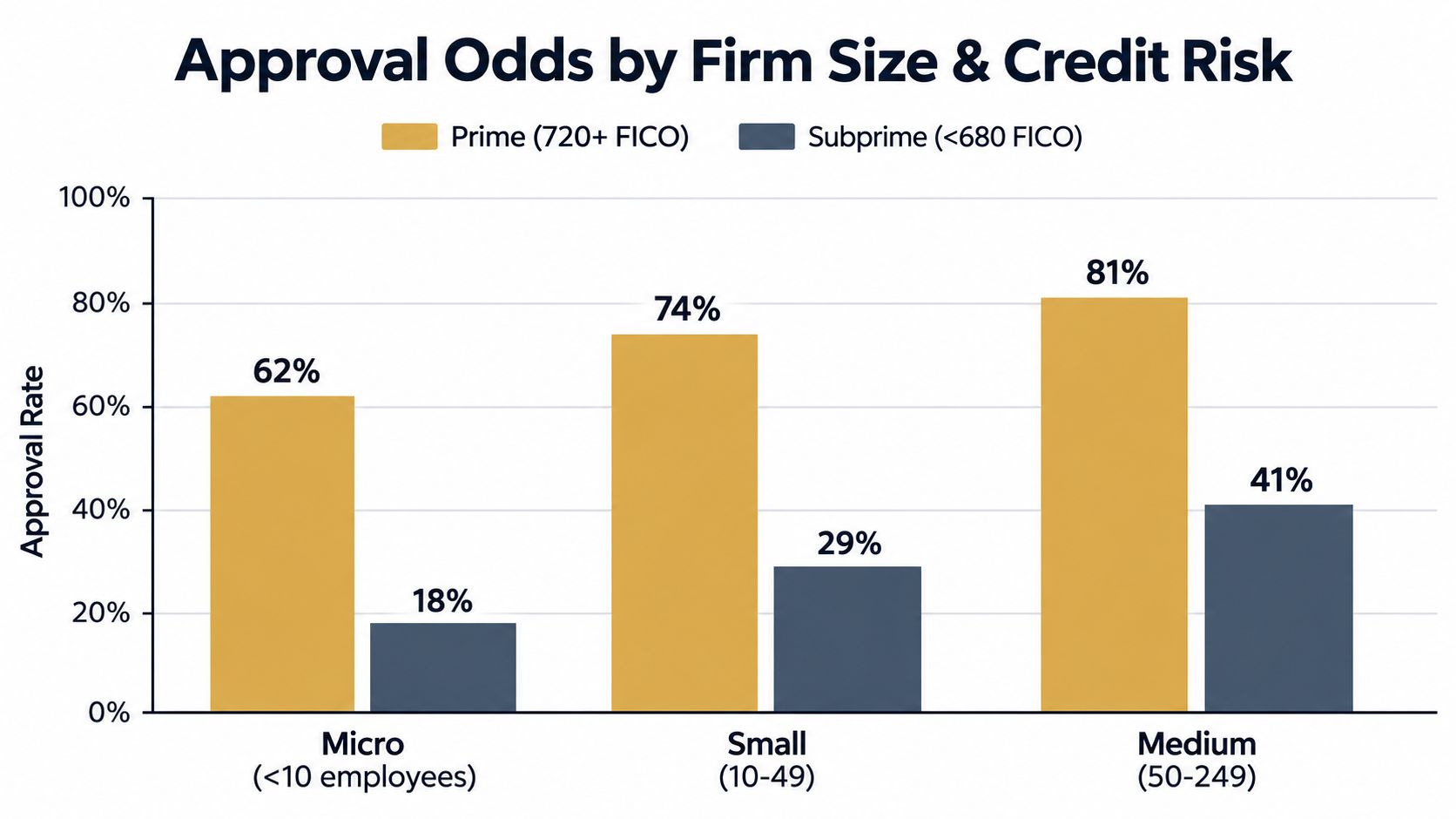
Lenders price and size a request against evidence, not the founder's ambition. They examine the company's scale, operating history, credit profile, reporting quality, and capacity to absorb repayment. Federal Reserve survey results show that full approval was more common among larger small businesses, rising from 47% for firms with 1 to 4 employees to 72% for firms with 50 to 499 employees, as summarized in the survey summary on small-business credit access. Size signals operating depth: more customers, formal reporting, management coverage, and reserves against a temporary setback.
Credit quality changes the conversation
Credit risk creates another clear dividing line. Approval was about 60% for low-credit-risk firms versus 30% for high-credit-risk firms. The same Federal Reserve findings also showed the size pattern, from about 47% for firms with 1 to 4 employees to 72% for firms with 50 to 499 employees, discussed in this analysis of small-business capital formation.
For an acquisition buyer, those gaps affect structure as much as eligibility. A profitable target can remain difficult to finance when its books are inconsistent, personal and business transactions are mixed, or the proposed debt assumes cash flow that historical statements cannot support. The lender evaluates the target and the buyer: transaction experience, available liquidity, guarantees, and the transition plan all influence the result.
Before contacting lenders, apply four tests:
- Can historical cash flow support the proposed payment? Use conservative assumptions and include normalized owner compensation, taxes, working capital, and transition costs.
- Does the request fit the company's scale? A facility that seems modest to a buyer can look aggressive against a short operating history or concentrated customer base.
- Can each material figure be reconciled? Income statements, tax returns, bank statements, seller disclosures, and the purchase agreement should present one consistent story.
- What happens after a partial approval? Decide whether seller financing, an equity partner, retained cash, or a smaller transaction will cover the gap.
A small business loan credit guide can clarify the credit factors lenders review. It cannot substitute for repair work. If the profile is weak, improve the records, reduce the requested amount, or stage the financing.
Underwriters don't fund the buyer's ambition. They fund the evidence that the business can repay.
For a first-time buyer, a smaller or partially approved facility may be more workable than one oversized application. Demonstrated repayment can support a later refinance or expansion after the company has built a stronger lending record.
Comparing Debt and Equity Pathways for SMB Acquisitions
Debt and equity are not interchangeable, and the viable choice depends on the target's size, credit profile, documentation, cash-flow reliability, collateral, and the seller's willingness to participate. Debt preserves ownership but creates mandatory payments. Equity reduces repayment pressure while giving an investor economic rights, influence, or both. A founder pursuing the wrong channel can waste weeks on a structure the business cannot support.
Government-backed lending remains a meaningful option for qualified buyers. In fiscal year 2025, the U.S. Small Business Administration guaranteed 84,400 small-business loans totaling $44.8 billion, described as the most capital delivered through that program, according to reported business-funding data. The figure does not make every acquisition eligible. It does show why buyers should investigate government-backed programs before concluding that only conventional bank debt is available.
Canada's 2024 Credit Conditions Survey illustrates how approval and terms vary by facility. Businesses requesting debt financing had an 89% approval rate, with an average authorized amount of C$191,918. Long-term debt carried a 6.9% average interest rate and a 78% collateral requirement, while short-term debt averaged 8.1% interest and 52% collateral, based on the survey findings. These terms are context, not a quote for a particular acquisition. Lenders still assess repayment capacity, guarantees, collateral, and the quality of the records supporting the request.
A practical comparison
| Funding Type | Approval Rate | Collateral Required | Typical Deal Size | Best For |
|---|---|---|---|---|
| Government-backed debt | Selective, dependent on eligibility and underwriting | Often required through the lending structure | Varies by program and lender | Buyers with documented cash flow and a financeable operating history |
| Conventional bank debt | Selective, with stronger results for larger and lower-risk firms | Commonly required | Varies by lender and repayment capacity | Established businesses with clean records |
| Private debt | Negotiated and risk-sensitive | May involve assets, guarantees, or pricing for risk | Varies by mandate | Time-sensitive purchases or borrowers outside bank criteria |
| Equity partnership | No conventional loan approval rate | Usually no traditional collateral requirement | Negotiated | Acquisitions where debt service would strain the business |
| Seller financing | Negotiated with the seller | Often tied to the seller's confidence and deal terms | Negotiated | Bridging valuation, financing, or diligence gaps |
The table is a screening tool, not a promise of availability. Test debt first when the target has stable cash generation and the purchase structure supports repayment. Equity becomes more practical when earnings are volatile, buyer liquidity is limited, or the business needs patient capital for operational improvement.
A blended structure often fits the transaction best. Senior debt can fund the financeable portion, seller financing can show alignment, and equity can cover the gap without loading the operating company with excessive fixed payments. Buyers can review equity and debt financing for acquisitions before negotiating a term sheet.
Building a Documentation Package That Passes Underwriter Filters
Underwriters do not approve a founder's story. They approve a file whose numbers, ownership, repayment plan, and transaction purpose withstand review. Applications stall when earnings do not reconcile, the requested amount has no connection to operating history, or the buyer's liquidity and guarantees remain unclear.
Build the evidence file before approaching lenders. Preparation should answer the predictable objections rather than merely collect paperwork.
Assemble the lender's evidence file
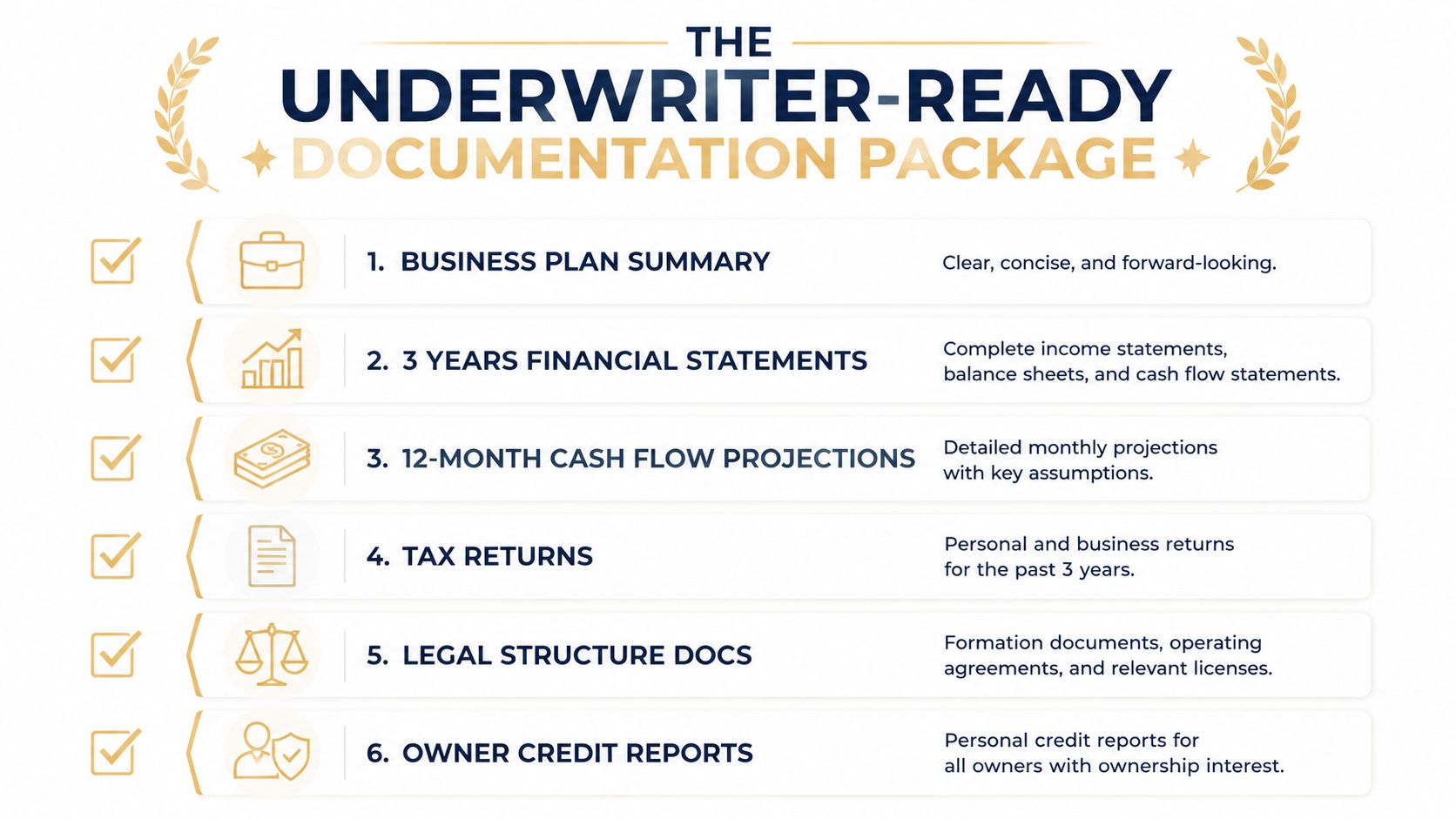
Start with records that establish what the business is, how it has performed, and how the requested capital will be used.
- Business plan summary: Explain the transaction, buyer background, purchase logic, management plan, and specific use of funds.
- Financial statements: Provide historical income statements, balance sheets, and cash-flow information in a consistent format.
- Cash-flow projections: Show expected post-close performance, repayment burden, working-capital needs, and a downside case.
- Tax returns: Reconcile taxable income with management accounts and explain legitimate add-backs clearly.
- Legal structure documents: Include formation records, ownership details, purchase agreements, leases, licenses, and material contracts.
- Owner credit information: Identify liabilities, guarantees, liquidity, and issues that could affect repayment capacity.
The checklist is only useful if the records agree. If seller-adjusted earnings differ from tax returns, quantify and explain each adjustment. If customer concentration threatens repayment, model the effect. If the buyer will replace the owner, document the transition timetable and the people responsible for daily operations.
Lenders also review the requested amount against the evidence. Tie each use of funds to a closing requirement, working-capital need, or clearly supported operating forecast. Unsupported cushion inflates the request and can weaken credibility.
Request capital in stages when the evidence is thin
Requesting the full amount for an ideal transaction can be premature when the business lacks a proven repayment record or the documentation has unresolved gaps. A smaller facility may be more practical. After the company demonstrates repayment performance and produces stronger operating evidence, the borrower can seek an expansion or refinance. That staged approach appears in small-business capital-formation guidance.
Keep the data room orderly, use consistent file names, and prepare written explanations for unusual transactions. A lender should not have to infer why a large transfer occurred or which entity owns a contract. For acquisition-specific records, review essential documents for business acquisitions.
A clean package cannot remove weak cash flow, but it can prevent avoidable uncertainty from deciding the outcome:
Alternative Capital Channels and What They Actually Fund
Crowdfunding is often presented as the easy answer for founders who can't secure bank debt. That advice confuses accessibility with capacity. A platform may make it easier to present an opportunity to investors, but the channel still has a typical investor base, regulatory structure, transaction cost, and check-size reality.
The SEC's 2025 staff report found that Regulation Crowdfunding offerings had a median of $114,000, and more than half of issuers were under three years old, according to coverage of the report on exempt offerings. That profile makes crowdfunding more naturally suited to seed-stage businesses, product launches, and community-backed concepts than to a conventional acquisition requiring a larger, coordinated funding package.

Match the channel to the check
At the $100,000 to $500,000 level, plausible structures can include a combination of buyer equity, seller financing, a smaller bank or government-backed facility, private investors, or a targeted private placement. The right mix depends on securities compliance, investor eligibility, repayment capacity, and the purchase agreement. Crowdfunding may contribute to the stack, but it shouldn't be treated as the default solution because the platform is digital.
For larger private-market raises, the SEC report indicates that most exempt capital moved through established channels such as Rule 506(b), Rule 506(c), Regulation S, and Rule 144A, rather than the small-business-focused exemptions commonly discussed in beginner content. It also reported that U.S. private companies raised 36% of all capital raised by U.S. companies. Those facts point to a more complex investor stack, often involving private funds, family offices, strategic investors, or structured partnerships.
UK lending data adds another segmentation lesson. In the second quarter of 2025, gross lending to businesses with turnover up to £2 million rose 28% year on year, while broader SME lending growth slowed to about 8% to 9%, according to UK Finance's Business Finance Review. The OECD's 2025 coverage also described restrictive conditions, including weakness in several non-bank sources such as factoring and leasing.
That means a founder shouldn't ask whether alternative capital is available in the abstract. Ask what the channel funds, who makes the decision, how quickly it can close, and whether its economics fit the acquisition. A detailed review of alternative financing methods for business purchases can help buyers compare those structures without assuming every platform scales to an acquisition.
Executing Your Capital Raise from First Approach to Close
Consider a buyer pursuing a profitable owner-operated service company. The buyer doesn't begin by contacting every bank, broker, and online platform. First, the buyer confirms the seller's financial records, normalizes earnings, identifies working-capital needs, and tests whether the proposed purchase price can support debt service under conservative assumptions.
The initial lender package contains the acquisition summary, historical financial statements, tax returns, bank records, ownership documents, a transition plan, and a clear sources-and-uses schedule. The buyer approaches a lender whose appetite fits the company's size and profile, then asks for feedback before treating preliminary interest as committed funding.
Sequence the conversations
The lender conversation comes first when debt appears supportable. That establishes the amount and terms the business may carry. The buyer then approaches an equity partner for the remaining gap, offering a structure that defines ownership, distributions, governance, reporting, and the conditions for a future buyout. If the lender counters with a smaller facility, the buyer doesn't hide the gap. The buyer revises the purchase price, adds seller financing, contributes more equity, or changes the transaction scope.
During diligence, every material claim must survive comparison with the underlying records. Customer concentration, owner duties, lease terms, payroll, tax obligations, and supplier dependencies can change the lender's view of risk. The buyer should maintain a live closing checklist, assign responsibility for each item, and document every term change in the purchase agreement and financing documents.
A partial approval is information, not failure. It tells you how the capital provider currently values the risk.
The final decision is whether the structure leaves enough resilience after closing. A transaction that closes only because every assumption works perfectly is poorly financed. When the buyer can't explain repayment capacity, ownership rights, or the source of each dollar, the raise isn't ready for closing.
Dealmaker Wealth Society offers acquisition training, capital-raising education, deal-structuring playbooks, mentorship, and peer support for buyers working through debt, equity, seller financing, and related acquisition decisions. Those resources can be useful when a live transaction needs practical feedback rather than another generic funding checklist.
Visit Dealmaker Wealth Society to access structured training, templates, mentorship, and a private peer community focused on sourcing, financing, negotiating, and closing small-business acquisitions. Use the resources to pressure-test your capital stack and prepare a lender- and investor-ready package before you approach the market.

From the Dealmaker Blog









A Creative Business Buying Fable