What Is a Quality of Earnings Report and Why It Matters
What Is a Quality of Earnings Report and Why It Matters
A quality of earnings report is an independent, third-party financial analysis that tests whether reported EBITDA is real, recurring, and sustainable before a deal closes. It rebuilds the seller's earnings into a normalized figure by separating durable operating cash earnings from one-time items, owner-related costs, and accounting noise.
You're reviewing a small business acquisition, and the numbers look convincing at first. The tax returns show $1.2 million in net income, while the confidential information memorandum presents $3 million of adjusted EBITDA. The seller's broker says the difference reflects owner perks, unusual expenses, and other legitimate add-backs.
Your job isn't to decide whether the spreadsheet looks polished. It's to determine which earnings a new owner can reasonably expect to keep.
That's the purpose of a quality of earnings report, commonly called a QoE. Major accounting and advisory references describe high-quality earnings as results that reflect current operating performance, help predict future performance, and support an assessment of firm value. The analysis therefore focuses on normalizing EBITDA and distinguishing recurring cash earnings from temporary or judgment-driven items. The accounting framework behind quality of earnings explains why sustainable profit matters more than a single reported income figure.
A QoE doesn't ask whether the accounting is technically recorded. It asks whether the earnings will transfer to you, support acquisition debt, and remain credible after the seller leaves. That distinction drives the negotiation over price, working capital, seller financing, earn-outs, escrow, and closing conditions.
Table of Contents
- What a Quality of Earnings Report Actually Does
- Why QoE Matters in M&A Transactions
- Key Components a QoE Report Examines
- Common QoE Adjustments and How They Get Tested
- The QoE Process, Timeline, and Who Performs It
- How Buyers and Sellers Use QoE Findings
- Common Misconceptions and Underrated Risks in QoE
- Practical Takeaways for Your First Acquisition Deal
What a Quality of Earnings Report Actually Does
A QoE report sits between ordinary tax preparation and a full financial audit. Tax returns primarily document historical results for compliance. An audit examines financial statements against an accounting framework and provides an opinion within its defined scope. A QoE is built for a transaction, so it concentrates on whether reported earnings are durable enough for a buyer, lender, and investor to underwrite.
The analyst starts with the company's historical financial statements, general ledger, bank activity, customer information, and accounting policies. Then the analyst reconstructs EBITDA by testing the adjustments management has presented and identifying additional items that affect sustainable earnings. A transaction-focused explanation of quality of earnings analysis describes this work as a way to test whether profits are tied to core operations rather than nonrecurring items.
Net income is not the acquisition earnings base
Net income includes interest, taxes, depreciation, amortization, unusual gains and losses, and expenses that may not transfer to a buyer. EBITDA removes some of those accounting effects, but management's “adjusted EBITDA” can still contain weak add-backs.
Consider the opening example. The seller may have added back personal travel, excess owner compensation, a legal settlement, and transaction fees. Some of those adjustments may be defensible. Others may represent costs the business will continue to incur, even if the accounting description makes them look exceptional.
The QoE provider creates a separate, underwritten earnings figure. That number gives the buyer a more useful starting point for valuation, debt capacity, and post-close planning than reported net income alone.
Practical rule: An add-back survives because the cost won't continue under a reasonable ownership structure, not because management labels it “one-time.”
The report is forward-looking in a practical sense
QoE analysis uses historical results, but its question is forward-looking: what earnings can the business sustain after closing? The provider reviews revenue recognition, expense classification, working capital, debt-like items, and unusual gains or losses to identify what could change the buyer's economics.
An independent overview of what buyers discover before a sale describes QoE as a third-party analysis that reconciles management's adjusted earnings to an underwritten number. That reconciliation is where optimistic presentation becomes a deal-ready earnings base.
Why QoE Matters in M&A Transactions
M&A pricing often applies a negotiated earnings multiple to EBITDA. If the seller's EBITDA is overstated, the buyer can overpay even when the multiple itself looks reasonable. A change of one times EBITDA on a business presented at $3 million of EBITDA changes headline value by $3 million, because the multiple is applied directly to the earnings base.
That's why the debate usually isn't “what multiple should we use?” It's “what EBITDA deserves the multiple?” A buyer may accept the seller's industry multiple while rejecting adjustments that don't represent transferable earnings.
Lenders use the same normalized earnings concept when evaluating acquisition debt. If the QoE provider reduces EBITDA, the lender may support less debt, require more buyer equity, increase pricing, add tighter covenants, or decline to fund the proposed structure. The buyer then has to decide whether to renegotiate price, add seller financing, defer consideration through an earn-out, or walk away.
One finding can affect several deal terms
QoE findings travel through the transaction documents. A working capital shortfall can reduce cash delivered at closing. A customer concentration concern can support an earn-out. A debt-like obligation can become a purchase price deduction or a seller responsibility under the purchase agreement.
| QoE Output | Deal Lever Affected |
|---|---|
| Normalized EBITDA | Purchase price and valuation multiple |
| Revenue durability findings | Earn-out design and representations |
| Working capital analysis | Closing working capital target and cash adjustment |
| Debt-like items | Purchase price deduction and indemnity protection |
| Cash flow conversion | Debt sizing and lender underwriting |
Buyers should also connect financial findings to operational diligence. A useful financial due diligence checklist for assessing operational factors helps link the earnings analysis to customer retention, staffing, systems, suppliers, and the processes that produce the reported results.
Buyer-side and sell-side QoE serve different purposes
A buyer usually commissions QoE after signing a letter of intent, when access to detailed records becomes available. The buyer wants an independent view before committing capital and finalizing financing.
A seller can commission a sell-side QoE before launching the process. That approach gives management time to document valid adjustments, correct accounting issues, explain unusual trends, and address working capital concerns before buyers start negotiating against them. In both cases, the report converts a persuasive earnings story into a number that other parties can test.
Key Components a QoE Report Examines
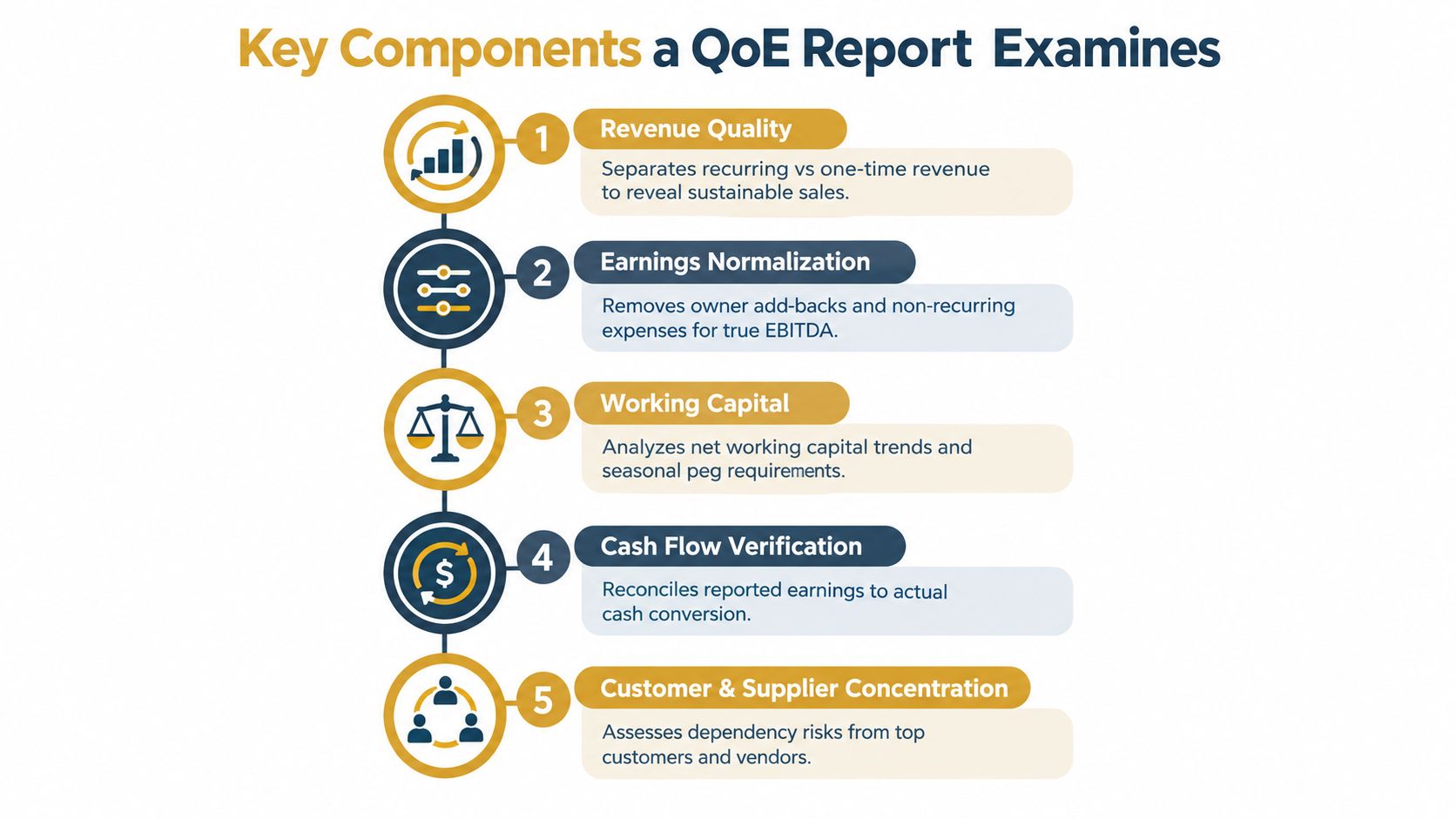
A strong report follows the money from revenue to reported earnings, from reported earnings to cash flow, and from cash flow to the balance sheet. The exact scope varies by business and engagement, but five workstreams appear repeatedly.
Revenue quality comes first
The provider separates recurring revenue from sales that won't repeat. A software company might report $600,000 in implementation fees, but the analyst will ask whether those fees arise from a continuing service model or from a limited project that has already ended. The review may also examine contract terms, deferred revenue, customer churn signals, pricing changes, credits, refunds, and concentration among major customers.
Revenue can be recorded correctly and still be a poor indicator of future performance. A large order from a customer that isn't expected to reorder has a different value from contracted or repeat revenue.
Expense classification reveals the cost of ownership
The analyst reviews owner compensation, related-party rent, personal travel, discretionary perks, unusual professional fees, and expenses that management says a buyer won't need. The key question is what a replacement owner or management team would incur.
If the owner's family member performs a necessary operating role, removing the compensation entirely may overstate earnings. If the owner receives compensation far above the market cost of that role, a partial normalization may be appropriate.
Working capital affects cash at close
Working capital analysis examines receivables, inventory, payables, accrued expenses, and seasonal patterns. A distributor with ballooning inventory may show acceptable EBITDA while consuming cash and carrying obsolete products. The buyer needs a normalized working capital target, often called a peg, so the business arrives at closing with the operating resources required to function normally.
Debt-like items sit outside the headline debt balance
Customer deposits, accrued bonuses, deferred revenue, contingent liabilities, and other obligations may require careful treatment. Some are ordinary operating liabilities. Others represent cash the buyer must spend after closing for a pre-closing obligation. The QoE report helps identify that distinction before the purchase agreement assigns responsibility.
Cash flow tests whether earnings reach the bank
The analyst reconciles accrual EBITDA to operating cash flow. Receivables that grow faster than sales, inventory accumulation, delayed vendor payments, or capitalized routine expenses can make earnings look stronger than cash generation. The financial assessment frameworks for acquisition diligence provide a useful companion perspective for connecting accounting results to the business's actual financial condition.
The following video can help first-time buyers visualize how these workstreams fit into a transaction review.
Common QoE Adjustments and How They Get Tested
The adjustment schedule is where most deal-room tension appears. Management wants credit for every expense it considers unusual. The buyer wants proof that each adjustment represents a durable improvement in post-close earnings.
A QoE provider generally tests three questions:
- Transferability: Would a reasonable third-party owner continue paying this cost?
- Evidence: Do invoices, contracts, payroll records, and bank statements support the adjustment?
- Repeatability: Will the claimed benefit remain in place after closing, rather than depending on a single event?
Adjustments that may survive
Owner compensation can be normalized when the current amount differs materially from the cost of employing a replacement executive. The provider may accept a difference rather than removing the entire expense. Personal expenses paid by the company can also qualify when documentation shows they're unrelated to operations and won't continue.
Transaction fees tied specifically to the sale are often treated differently from recurring professional fees. A legal settlement may be a valid add-back if it was unusual and fully resolved, but ordinary legal costs disguised as a settlement won't receive the same treatment.
Related-party rent requires a market comparison. If the seller's company pays rent above what the property would command under a normal lease, the excess may be normalized. The underlying occupancy cost remains because the buyer still needs a facility.
Adjustments that get challenged
Suppose a marketing agency presents $400,000 of excess owner compensation as an add-back. The QoE provider won't accept the label automatically. The analysis needs to establish the owner's actual responsibilities, the replacement role, the market-level compensation, and whether the business can operate without that work.
Now consider a manufacturer that recorded a $250,000 legal settlement. The buyer may accept it as nonrecurring, reduce it, or reject it if the settlement reveals an ongoing product, employment, or regulatory problem. The accounting event is only one part of the decision. The underlying risk determines whether the cost has truly disappeared.
For readers dealing with more complex disputes, cross-border investigations, or suspected misclassification, an explanation of how forensic accounting works in UAE offers useful context on tracing transactions and evaluating financial evidence.
| Adjustment Type | How QoE Tests It | Typical Outcome |
|---|---|---|
| Excess owner compensation | Compares actual duties and replacement cost | Partial add-back or normalization |
| Personal expenses | Reviews support and business purpose | Accepted only when clearly non-operating |
| Transaction-specific fees | Matches invoices to the sale process | Often accepted when fully documented |
| Legal settlement | Examines cause, resolution, and recurrence risk | Accepted, reduced, or rejected |
| Above-market related-party lease | Compares rent with a reasonable market cost | Excess may be removed, base rent remains |
| Inventory write-down | Tests whether the loss reflects an ongoing condition | Challenged when obsolete inventory remains |
| Deferred maintenance | Checks whether future spending is required | Often treated as a continuing cost |
The strongest add-backs are documented, isolated, and connected to a cost that a buyer won't incur. A claimed benefit that depends on an unfilled role, an untested cost cut, or a future management decision is much more vulnerable.
The QoE Process, Timeline, and Who Performs It
A QoE engagement begins with a scope request from the buyer's advisor, seller's broker, lender, or transaction team. The parties define the period under review, the requested deliverables, the EBITDA framework, and the working capital and debt-like items to be analyzed.
The provider then enters the data room. The requested materials commonly include monthly financial statements, general ledgers, trial balances, tax filings, bank records, customer revenue detail, payroll information, contracts, accounts receivable aging, inventory reports, accounts payable aging, and explanations for management adjustments.
Fieldwork turns documents into questions
The provider tests the records, performs trend analysis, reconciles accounts, and interviews management. Those interviews matter because unusual results often require operational context. A revenue spike may reflect a new contract, a billing change, a one-time project, or a timing issue that isn't obvious from the general ledger.
Management also responds to follow-up requests and supplies support for proposed add-backs. If bank statements don't reconcile, customer data is incomplete, or the company can't explain a material balance-sheet item, the provider may expand the work or qualify the conclusion.
For an SMB transaction, the work is often organized around a two-to-four-week timeline, as described in transaction guidance for quality of earnings engagements. The timetable can extend when records arrive late, management responses are incomplete, or the accounting system contains unreconciled balances. A practical guide to quality of earnings reports emphasizes that the analysis is designed to rebuild earnings into a normalized figure while testing revenue, working capital, and debt-like items.
Several parties rely on the final output
The QoE provider is usually a transaction advisory firm, accounting firm, or Big Four affiliate with diligence experience. The company's internal accounting team gathers records and explains the books. The seller's M&A advisor coordinates access and manages the presentation. Buy-side counsel uses findings in the purchase agreement, while lenders may require independent analysis before funding.
The final deliverable commonly includes a written report and supporting schedules. Buyers should expect to see adjusted EBITDA bridges, revenue analysis, working capital calculations, debt-like items, cash flow observations, and a clear list of accepted, reduced, and rejected adjustments.
How Buyers and Sellers Use QoE Findings
QoE output changes more than the headline purchase price. It changes the buyer's confidence in the earnings, the lender's view of repayment capacity, and the seller's ability to receive cash at closing.
Suppose the buyer's provider reduces the target's normalized EBITDA by $200,000, from the seller's presented $3 million. The buyer can apply the negotiated multiple to the lower base, seek a price reduction, or preserve part of the original economics through an earn-out tied to future performance. Seller financing can also bridge a valuation gap, especially when the seller believes the disputed earnings will materialize after closing.
The buyer shouldn't treat every adjustment as a reason to renegotiate aggressively. Some findings reveal a cost that disappears. Others expose a cost that the buyer will inherit. The distinction affects how much value the buyer can underwrite with certainty.
Financing follows the underwritten number
Lenders generally care about the EBITDA they believe will remain available for debt service. A downward QoE adjustment can reduce the debt package or increase the buyer's equity contribution. It can also lead to tighter reporting requirements, additional covenant protection, or conditions requiring the buyer to resolve specific risks before funding.
Working capital findings can create a closing adjustment. Debt-like items can reduce the purchase price or require a specific indemnity. Revenue concentration can support an earn-out, retention condition, or seller note rather than an all-cash payment.
A buyer evaluating these consequences should connect the report to the implications of due diligence findings, particularly when financial findings affect operations, financing, or post-close integration.
Sellers can control the narrative earlier
A seller-side QoE gives management time to assemble support for legitimate add-backs and correct weak reporting before a buyer sees the numbers. It can also expose problems that need operational attention, such as inconsistent revenue recognition, outdated inventory, undocumented related-party arrangements, or working capital that has been managed below a sustainable level.
The seller shouldn't use a pre-emptive report as a marketing document. Its value comes from making the earnings bridge defensible. When buyers receive clear support for adjustments, negotiations can focus on the remaining judgment calls instead of basic credibility questions.
The same discipline applies to claims about improving EBITDA. If a software company says it can increase adjusted EBITDA by 15% through pre-emptive add-back documentation, the buyer still needs to test the underlying costs, evidence, and transferability. Documentation can support a valid adjustment, but it can't turn a recurring expense into a nonrecurring one.
Common Misconceptions and Underrated Risks in QoE
A QoE isn't an audit, valuation, or appraisal. It doesn't issue a broad opinion that the company's internal controls work, and it doesn't independently determine fair market value. Instead, it gives transaction participants a structured analysis of the earnings that may support valuation and financing.
Another misconception is that an add-back is valid whenever the seller incurred the cost only once. The event may be isolated, but the risk behind it may continue. A legal settlement involving a recurring compliance weakness, for example, can signal future spending even if the original payment won't repeat.
Quiet distortions deserve attention
Supplier rebates can inflate a period when management pulls future benefits into current results. Related-party rent can exceed a reasonable market cost, while the buyer still needs to pay a normal lease after closing. Owner perks may be coded as discretionary even though they include insurance, travel, staffing, or services that a replacement executive will require.
Capitalized routine expenses create another trap. If ordinary repairs or maintenance are placed on the balance sheet, current EBITDA may look stronger while future cash needs remain understated. Inflation can also distort comparisons when costs rise faster than pricing, inventory values change, or historical margins no longer describe stand-alone performance. Guidance on quality of earnings in changing accounting and inflation environments highlights the importance of reviewing earnings, cash flow, and balance-sheet quality together.
A QoE is a defensive underwriting tool. It should make the buyer more certain about what transfers, not make the seller's story sound more impressive.
These issues can compress a valuation multiple, trigger indemnification demands, alter escrow protection, or cause a lender to revisit the proposed debt structure. A seller who commissions an analysis still benefits when the report identifies weaknesses early, because clean, supported adjustments create more trust than self-serving add-backs presented at the last minute.
Practical Takeaways for Your First Acquisition Deal
Start with timing. If you're selling, a pre-emptive QoE can help you resolve accounting issues and document adjustments before buyers arrive. For a planned sell-side mandate, commissioning the work 60 to 90 days before a planned close gives the transaction team time to respond to findings, as recommended in the deal planning framework for this process. If you're buying, buyer-side QoE typically begins after the letter of intent, when detailed records and management access become available.
Choose a provider with transaction experience in your industry and deal size. Your tax accountant may understand the books but may not have the independence, normalization judgment, or lender perspective required for M&A diligence. Ask how the provider tests owner compensation, related-party transactions, revenue recognition, working capital, debt-like items, and proof of cash.
Prepare the data room before fieldwork
Stage the materials the analyst will need:
- Financial records: Monthly income statements, balance sheets, general ledgers, trial balances, and tax filings.
- Revenue support: Customer-level sales, contracts, recurring revenue schedules, credits, refunds, and deferred revenue.
- Cost support: Payroll records, owner compensation, related-party invoices, leases, legal bills, and proposed add-backs.
- Balance-sheet detail: Receivables aging, inventory reports, payables aging, customer deposits, accrued liabilities, and debt schedules.
- Cash evidence: Bank statements and reconciliations that connect recorded earnings to actual cash movement.
Demand a standalone normalization schedule, not a paragraph that says “adjusted EBITDA reflects customary add-backs.” You should be able to trace every adjustment to evidence, understand whether it transfers to a new owner, and stress-test the earnings base against your purchase multiple.
Finally, make the risk visible in the documents. Use QoE findings to shape the working capital peg, price adjustment mechanics, seller note, earn-out, escrow, and indemnification package. Treat QoE as the deal's reality check, not a formality, because it's where headline price and closing price finally meet.

Dealmaker Wealth Society offers structured education, checklists, mentorship, and peer support for entrepreneurs evaluating acquisitions, including guidance on due diligence, valuation, financing, and deal structure. If you're preparing to review a QoE or negotiate around its findings, visit Dealmaker Wealth Society to explore the acquisition training and deal-support resources.

From the Dealmaker Blog









A Creative Business Buying Fable